DESTINATION

Bhutan

Land of the Thunder Dragon

The only carbon-negative country on Earth, and the only one that measures national progress by Gross National Happiness. A Buddhist monarchy of 770,000 people, 71% forest, and a capital with no traffic lights.

71%Forest cover
Only oneCarbon-negative
~770,000Population
3,120 mTiger's Nest altitude
Explore trips
Bhutan
Explore by region

1 distinct landscape

Tap a region to filter the trips below.

About Bhutan

The Last Himalayan Buddhist Kingdom

Bhutan is a Himalayan kingdom of about 770,000 people east of Nepal, and it stayed closed longer than almost anywhere. Foreigners were first admitted in 1974, and television arrived only in 1999. That late opening is why the culture reads as intact rather than preserved for visitors: the national dress is worn because people wear it, not for you.

Bhutan measures progress through Gross National Happiness instead of GDP. The fourth king introduced the idea in 1972 and it entered the constitution in 2008, resting on four pillars: sustainable development, environmental protection, cultural preservation and good governance. The most concrete result is environmental. Bhutan is carbon negative, because 71% forest cover absorbs more than its population emits, and the constitution sets a floor of 60% forest in perpetuity.

Bhutan makes visiting deliberately expensive, and that is the policy working. It charges a Sustainable Development Fee per person per night and requires every itinerary to run through a licensed Bhutanese operator. The rate has been revised more than once in recent years and moved substantially, so ask for the current figure rather than trusting a number you read somewhere. The policy is low volume and high value by design, and it is the reason Bhutan does not feel like Kathmandu. Most people fly into Paro, the only international airport, and start from Thimphu an hour away.

  • 01
    Tiger's Nest

    Taktsang, on a 900 m cliff above Paro. A 2 to 3 hour climb, and the building everyone pictures when they think of Bhutan.

  • 02
    Gross National Happiness

    A constitutional measure of progress, introduced 1972 and formalised in 2008. Policy is assessed against it.

  • 03
    Carbon negative

    The only country on Earth absorbing more carbon than it emits. The constitution mandates a 60% forest floor; actual cover is 71%.

  • 04
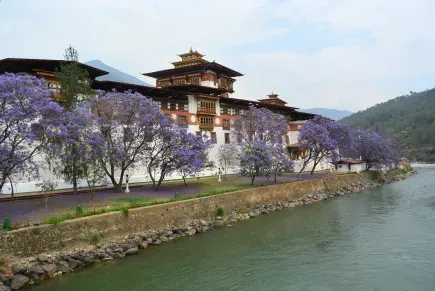
    Punakha Dzong

    Built in 1637 at the confluence of two rivers, and arguably the finest building in the country. Jacaranda in flower in May.

  • 05
    Sustainable Development Fee

    Charged per night, with a licensed Bhutanese operator required. Deliberately low-volume tourism; ask us for the current rate.

  • 06
    Druk Path Trek

    Six days at altitude between Paro and Thimphu, past lakes and old dzongs. The classic short Bhutanese trek.
Good to know

Bhutan questions, answered

How much does it cost to visit Bhutan?
Bhutan charges a Sustainable Development Fee per person per night on top of your travel and accommodation, and you must book through a licensed Bhutanese operator. The SDF has been revised more than once recently and the rate moved significantly in both directions, so any figure published online may well be stale. Ask us for the current number when you plan. The intent is unchanged: fewer visitors, paying more.
Why is Bhutan carbon negative?
Forest and hydropower. Bhutan has 71% forest cover, and its constitution requires at least 60% in perpetuity, so the forest absorbs more carbon than its 770,000 people emit. It also exports hydroelectricity to India, offsetting fossil generation there. It is the only country on Earth that is net negative, and it is a policy outcome rather than an accident of size.
Can I travel independently in Bhutan?
No. Every itinerary must be arranged through a licensed Bhutanese tour operator, and you travel with a guide. This is not a soft recommendation; it is how entry works. Indian, Bangladeshi and Maldivian nationals have different arrangements.
How hard is the Tiger's Nest climb?
Moderate. It is roughly 900 m of ascent over 2 to 3 hours on a good path, starting around 2,600 m. There is a cafeteria at the halfway point, and horses can be hired for the lower half though not the final staircase. Most reasonably fit people manage it comfortably. Start early to avoid the heat and the crowds.
When is the best time to visit Bhutan?
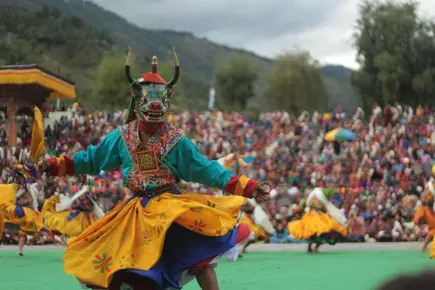
Spring, March to May, and autumn, September to November. If you can, time it to a tsechu: Paro Tsechu falls in spring, Thimphu Tsechu in autumn, and they are real religious festivals rather than performances. Hotel capacity around them is genuinely limited, so book well ahead. The monsoon is green and empty but hides the mountains.
How do you get to Bhutan?
Fly into Paro, the only international airport, usually via Kathmandu, Delhi or Bangkok. The approach into Paro is demanding enough that only a small number of pilots are certified for it, which is why flights are weather-sensitive and delays are common. Overland entry from India via Phuentsholing is possible and slower. Build in buffer days.
Can I combine Bhutan with Nepal?
Easily, and most people do. Kathmandu is the usual gateway and Paro is a short flight away, so a Nepal and Bhutan trip is straightforward. Adding Tibet makes it an 18 to 21 day three-country circuit. The paperwork differs for each country and we handle all of it together.