


Choosing a trip
Trip difficulty grades
Seven grades, set by how many days in a row you walk and how high you sleep. Find yours.
Swotah grades every trip on a seven-step scale, Easy through Extreme Severe, set by two things: how many days in a row you walk, and how high you sleep. Find the row where the daily hours and the altitude ceiling both look manageable, then read that grade's section. Between two grades, book the lower one.
How do the seven trekking grades compare?
Altitude figures describe where you sleep, not the high point you touch during the day, because sleeping altitude is what the body must adapt to. Hours are typical and each trip page carries the real plan. They do not climb neatly with the grade: a short itinerary packs the same ground into fewer days, which is why Moderate holds the longest single day here.
| Grade | Walking per day | Altitude band | Terrain | Fitness needed | Example trip |
|---|---|---|---|---|---|
| Easy | 3 to 5, up to 6 on the Shivapuri climb | Valley and lowland; no acclimatisation nights | Roads, paved paths, gentle village trail | Able to walk an afternoon | Shivapuri Day Hike |
| Moderate | 4 to 8, up to 10 on the Poon Hill day | 900 m to 3,000 m | Stone staircases, forest, terraced hillside | Occasional weekend hiker | Poon Hill Trek |
| Hard | 4 to 7, up to 8 | Up to about 4,000 m | Rough trail, steep ascent, long descent | Hiking regularly before you book | Annapurna Base Camp |
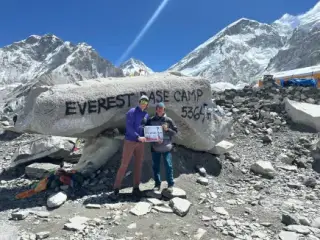
| Very Hard | 5 to 7, up to 9 | 3,500 m to 5,000 m | Moraine, glacier-side trail, high valleys | Prior multi-day trekking, plus altitude tolerance | Everest Base Camp |
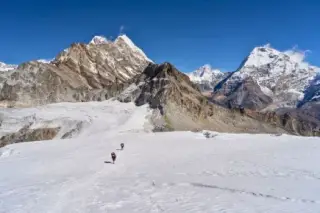
| Severe | 5 to 7, and 8 to 9 on pass days | Around 5,000 m, held for longer | More than one high pass, snow and scree | A Very Hard trek already completed | Everest Three High Passes |
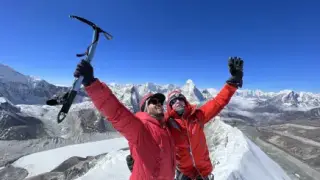
| Very Severe | 4 to 6, plus a 12 to 16 hour summit day | Above 6,000 m | Fixed rope, crampons, steep snow and ice | Technical instruction and peak training | Island Peak |
| Extreme Severe | 4 to 6 on rotations, 10 to 16 on summit day | Above 8,000 m | Full expedition mountaineering | Substantial prior high-altitude climbing | Everest Expedition |
Who is the Easy grade for?
Easy trips walk 3 to 5 hours a day and suit anyone who can manage an afternoon on foot without training for it, children included. The day is built around villages and lunch rather than distance, and you sleep too low for acclimatisation to matter. The continuous climb to Shivapuri Peak is the one stretch that surprises people, at 4 to 6 hours. Try the Shivapuri day hike, the Dhulikhel to Balthali hike or the Best of Nepal tour.
Who is the Moderate grade for?
Moderate trips move between 900 m and 3,000 m, where you feel the climb in your legs but not the thin air in your chest. An occasional weekend hiker copes, but read the day plan before assuming it is gentle: the Poon Hill Trek compresses the route into three walking days of 4 to 8 hours, and the sunrise day with the descent to Tikhedhunga runs 9 to 10. The 8-day Annapurna Poon Hill Trek spreads the same ground thinner, and the Lower Everest Trek gives Khumbu scenery without Khumbu altitude.
Who is the Hard grade for?
Hard trips top out near 4,000 m on rough, constantly undulating trail, and this is where an underprepared trekker stops enjoying themselves around day four. Days run 4 to 7 hours with a couple at 8, and the descents punish knees more than the climbs punish lungs, so be hiking regularly before you book. Annapurna Base Camp is the reference trip, with the Langtang Valley Trek alongside it.
Who is the Very Hard grade for?
Very Hard trips keep you sleeping between 3,500 m and 5,000 m for a week or more, and that sustained altitude, not the walking, defines the grade. Daytime high points sit above the sleeping band: Everest Base Camp stands at 5,364 m, Thorong La at roughly 5,416 m. Most days walk 5 to 7 hours, the longest closer to 9, and the acclimatisation days between them are not padding. Trips: Everest Base Camp, Gokyo Ri and Gokyo Valley, Annapurna Circuit, Upper Mustang.
Who is the Severe grade for?
Severe trips hold you near 5,000 m and link more than one high section, so the honest prerequisite is a Very Hard trek you finished comfortably rather than survived. Pass days run 8 to 9 hours against a 5 to 7 hour norm, and the plan slips when a pass fills with snow or a flight is grounded, so keep spare days before you fly home. Examples: Everest Three High Passes, Gokyo Valley with Everest Base Camp, Manaslu Circuit.
Who is the Very Severe grade for?
Very Severe covers climbing above 6,000 m: harness, crampons, fixed line, and a summit day unlike anything before it. Approach days walk 4 to 6 hours, but the Island Peak (6,189 m) summit is a 12 to 16 hour round trip from Chhukung. It and Mera Peak (6,476 m) are the usual first objectives, both assuming a completed Very Hard trek plus instruction on snow, with Lobuche East alongside. Trekking-rated travel insurance commonly stops at 6,000 m, so advisers suggest cover to 7,000 m here. Snow and weather decide summits, not the booking.
Who is the Extreme Severe grade for?
Extreme Severe is the 8,000 m expedition grade, open only to climbers with substantial prior high-altitude mountaineering experience. Nepal's Everest permit runs 55 days, which tells you the shape of it: a season of rotations of 4 to 6 hours apiece, closing with a 10 to 16 hour summit round trip from Camp 4. The risk is real and preparation does not remove it. Since September 2025 the Department of Tourism has required one guide per two climbers above 8,000 m, and the Everest spring royalty is USD 15,000. Trips: Everest, Manaslu, Annapurna I.
How do you know which grade fits you?
- What you have walked in the last six months, not what you managed ten years ago.
- The consecutive-days test: walk 6 hours, sleep, repeat the next morning and the one after. A single heroic day proves nothing.
- Load. Even with a porter carrying your duffel you walk with a 5 to 7 kg daypack.
- Downhill tolerance. Knees end more Nepal treks than lungs do.
- Age is not the deciding factor. Recent training and your altitude response are.
Take the lower one. A Moderate trek you finish strong sells you on Nepal; a Very Hard trek you abandon on day five does not. Give us your honest hiking history when you enquire and we will grade you rather than sell you up.
How do you train for a Nepal trek?
Eight to twelve weeks moves most people up one grade, and specificity beats volume: walking uphill under weight is what transfers to a Himalayan trail.
- Hill repeats with a loaded pack. One hill with 15 to 20 minutes of climb, walked three or four times carrying 6 to 8 kg, twice a week.
- Back-to-back days. Every second weekend, walk 4 to 6 hours on Saturday and again on Sunday. Sunday tells you the truth.
- Stairs downwards as well as up. Descending loaded conditions the quadriceps and knees, and everyone skips it.
- One long day a month. Nine hours if you are booking Moderate or above, in the boots and pack you will bring.
- Break the boots in. New boots cause blisters that end more trips than poor fitness.
Our Everest Base Camp trek training guide gives a week-by-week build, and the Annapurna Base Camp trek difficulty guide walks a Hard route day by day.
Why does altitude matter more than fitness?
Above roughly 2,500 m, acute mountain sickness (AMS), high-altitude cerebral edema (HACE) and high-altitude pulmonary edema (HAPE) become real risks, and none of them respect how strong you are. The CDC notes AMS symptoms, headache with nausea, appetite loss or dizziness, usually appear 2 to 12 hours after reaching a new altitude. Being fit lets you climb faster, and climbing faster is what triggers it.
Wilderness Medical Society guidance cited by the CDC caps sleeping-altitude gain at about 500 m per night above 3,000 m, plus an acclimatisation night per 1,000 m gained. That is why a Very Hard itinerary spends a day at Namche doing apparently nothing.
HACE shows as confusion, loss of coordination and vomiting. HAPE shows as breathlessness out of proportion to the effort, chest tightness and a cough. Descent is the only definitive treatment for either, and anyone whose symptoms worsen at rest goes down that day.
Insurance follows the same logic. Many standard policies exclude activity above 3,000 to 4,000 m, below the ceiling of any Very Hard trek. Confirm your altitude limit and evacuation clause in writing before you fly.
Can a beginner do the Everest Base Camp trek?
Yes, provided the beginner trains for it, because Everest Base Camp is graded Very Hard for altitude rather than technical difficulty. There is no climbing and no equipment to learn. A first-timer with three months of loaded hill walking usually copes better than an unprepared runner.
Do I need to be a runner to trek in Nepal?
No. Running builds the cardiovascular base but does not prepare knees, hips or shoulders for eight hours under a pack on uneven stone. Hill walking with weight is the training that transfers.
What happens if I cannot keep up with the group?
Nothing, because the group moves at the pace of its slowest member and each day ends at a fixed teahouse rather than a distance target. Arriving an hour behind changes only when you get your tea. Tell your guide early if you are struggling: altitude symptoms and ordinary tiredness look identical from the outside.
Is there an age limit for trekking in Nepal?
There is no upper age limit on Easy through Very Hard treks. Recent activity, heart and lung health, and your response to altitude decide the outcome. Anyone with a cardiac or respiratory condition needs a doctor's clearance for high altitude before booking.
Does a higher grade mean a more dangerous trip?
A higher grade means more sustained altitude, longer days and less margin, and margin is what safety is made of. The grade describes demand; it does not guarantee an outcome. Weather and physiology apply at every level, which is why itineraries carry contingency days and guides can turn a group back.
Altitude guidance follows the CDC Yellow Book chapter on high-altitude travel. Royalty and guide-ratio figures are current as of July 2026; confirm on the Department of Tourism fee page.
Between two grades?
Send us your recent hiking history and we will tell you honestly which grade to book, including when the answer is the easier one.