

Frequently asked questions
Search the whole library, or jump to a topic. Every answer has its own link you can share.
Demography
Nepal sits between India and China (Tibet), landlocked, roughly between 26°N and 30°N. It covers 147,516 km² — about the size of England and Scotland together, or Arkansas — and shares 1,690 km of border with India to the south, east and west and 1,236 km with Tibet to the north.
In that width the land rises from 60 m in the Terai to 8,848.86 m at the summit of Everest, which is why a country you can drive across in a day contains jungle, rice terraces and glaciers. More on Nepal at a glance.
Nepal's headline attraction is the Himalaya. Eight of the world's fourteen internationally recognised 8,000 m peaks stand in Nepal — Everest/Sagarmatha (8,848.86 m), Kanchenjunga (8,586 m), Lhotse (8,516 m), Makalu (8,463 m), Cho Oyu (8,201 m), Dhaulagiri I (8,167 m), Manaslu (8,163 m) and Annapurna I (8,091 m). Everest's height is the figure Nepal and China agreed jointly in December 2020; older pages still quoting 8,848 m are out of date.
Beyond the mountains: four UNESCO World Heritage properties (the Kathmandu Valley with its seven monument zones, Lumbini the birthplace of the Buddha, Chitwan National Park and Sagarmatha National Park), the Kali Gandaki gorge, Tilicho Lake in the Annapurna region, Newar art and architecture, 124 mother tongues recorded in the 2021 census, and wildlife found almost nowhere else — one-horned rhino, Bengal tiger, snow leopard and red panda.
Read more on Nepal at a glance or browse our trekking trips.
By air into Tribhuvan International Airport in Kathmandu, which is the only reliably served international gateway — common connections are Delhi, Doha, Dubai, Bangkok, Kuala Lumpur, Hong Kong and Istanbul.
Pokhara and Gautam Buddha (Bhairahawa) have international terminals but, as of mid-2026, no dependable scheduled international service; do not plan an itinerary around them without checking current schedules. Overland, you enter from India at Kakarbhitta, Birgunj, Bhairahawa/Sunauli, Nepalgunj or Mahendranagar. The Tibet border is open only to travellers on an organised tour with the required Chinese permits.
Every nationality except Indian citizens needs a visa. Indians travel visa-free under the 1950 Indo-Nepal treaty — carry a passport, or an original Election Commission voter ID at land borders.
Most other nationalities get the visa on arrival. Children under 10 are free, except US-citizen children who pay the adult fee, and SAARC nationals other than Afghans get a free 30-day visa on their first visit each year. Your passport must have at least six months' validity. Full detail on our Nepal visa page.
Yes — most nationalities can get a Nepal tourist visa on arrival. It is issued at Tribhuvan International Airport in Kathmandu, at Pokhara and Gautam Buddha (Bhairahawa) international airports, and at the main open land borders with India.
As of March 2026, thirteen nationalities are not eligible and must obtain a visa in advance from a Nepali diplomatic mission: Afghanistan, Cameroon, Ethiopia, Ghana, Iran, Iraq, Liberia, Nigeria, Palestine, Somalia, Swaziland (Eswatini), Syria and Zimbabwe. Holders of refugee travel documents are also excluded. Iran was added to this list in March 2026 — some travel sites still show the older twelve-country version.
Bring a passport valid for at least six months, one passport photo, and the visa fee in cash. Filling the pre-arrival form at nepaliport.immigration.gov.np before you fly speeds up the counter, but it is not an e-visa — the visa is still issued in person. Check the current ineligibility list on the Department of Immigration site before you book. See also Nepal visa information.
Three, running east–west in parallel bands. The Terai is the southern plain, 60–305 m, about 17% of the land area — jungle, farmland and Nepal's densest population. The Hill region rises through the Siwaliks and Mahabharat range to the midland valleys, including Kathmandu at about 1,400 m and Pokhara. The Himalaya begins above roughly 3,000 m, with the treeline near 4,000 m and permanent snow from 5,000–5,500 m.
Most trekking happens in the third band, but the walk in usually starts in the second.
Nepal's 2021 census recorded 29,164,578 people — 14,253,551 male and 14,911,027 female — growing at 0.92% a year, at a density of 198 people per km². That census, run by the National Statistics Office in November 2021, is the last official count.
UN mid-year projections put the figure at roughly 29.6 million for 2026; those are third-party estimates, not a census. Around 3.03 million people live in the Kathmandu Valley (Kathmandu, Lalitpur and Bhaktapur districts combined).
Nepal is a federal republic of 7 provinces, 77 districts and 753 local levels. The provinces are Koshi, Madhesh, Bagmati (which contains Kathmandu), Gandaki (Pokhara), Lumbini, Karnali and Sudurpashchim.
The 753 local levels break down as 6 metropolitan cities, 11 sub-metropolitan cities, 276 municipalities and 460 rural municipalities. That structure dates from the 2015 constitution and the 2017 federal restructuring — which is also why Nepal's official "urban" population share jumped to 66%: the boundaries were redrawn, not the towns.
According to myths, Kathmandu valley was a lake until the Tibetan saint, Manjushree, flew down to Kathmandu. Upon seeing the huge lake, he cut the Chobhar ridge in half with his mighty sword and drained the waters to allow civilization to flourish in the fertile sacred valley.
The Kathmandu Valley may have been inhabited as early as 300 BCE; the oldest known objects found in the valley date to a few centuries BCE, and the earliest known inscription is dated 185 CE.
Nepal has ten Ramsar-listed wetlands, designated between 1988 and 2008: Koshi Tappu, Bishazari Tal, Ghodaghodi Tal, Jagdishpur Reservoir, Mai Pokhari, the Gokyo lake complex, Gosaikunda, Phoksundo Lake, Rara Lake and the Lake Cluster of Pokhara Valley.
Four of them — Gokyo, Gosaikunda, Phoksundo and Rara — sit on trekking routes, so you can walk to a wetland of international importance without a detour.
Annapurna Conservation Area, established in 1986. At 7,629 km² it is also Nepal's largest protected area, and it is managed by the National Trust for Nature Conservation rather than the government directly — which is why your ACAP fee funds trail maintenance and village projects inside the region. Trips: Annapurna Base Camp, Annapurna Circuit.
Rara Lake, roughly 10.8 km², in Rara National Park in Nepal's remote far west. It sits at about 3,000 m, is a Ramsar-listed wetland, and sees a tiny fraction of the traffic the Annapurna and Everest regions get.
Pokhara is the second city travellers use — the Annapurna gateway, on Phewa Lake. After that: Lalitpur and Bhaktapur in the Kathmandu Valley itself, Biratnagar and Dharan in the east, Butwal and Siddharthanagar (Bhairahawa) in the south near Lumbini, Nepalgunj and Dhangadhi in the west. Chitwan is a district, not a city — the town you stay in for the national park is Sauraha.
Culture
The 2021 census recorded 124 languages spoken as mother tongues in Nepal. Nepali, the official language, is the mother tongue of 44.86% of the population.
The next largest are Maithili (11.05%), Bhojpuri (6.24%), Tharu (5.88%), Tamang (4.88%), Bajjika (3.89%), Awadhi (2.96%) and Nepal Bhasa/Newar (2.96%). English is widely spoken in Kathmandu, Pokhara and on the main trekking routes — every Swotah guide works in English.
There are 59 officially indigenous nationalities recognized by government of Nepal.
Dozens are performed regionally, but a handful travel across the country: Tamang Selo, Dhaan Nach and Chandi Nach of the eastern hills, Chutki, Jhyaure, the call-and-response Dohori, the Newar Lakhe dance of Kathmandu's Indra Jatra, and Maruni.
You will most likely see them at a festival rather than a stage show — Indra Jatra in Kathmandu and Dashain and Tihar in autumn are the best chances.
Some of the major thrilling adventure activities are; Bungee Jumping/Swing, White Water Rafting, Cannoning, Jungle Safari, Para Hawking/Paragliding, Mountain biking, zip flyer, Skiing, Rock Climbing, skydiving, Silver Triangle and so on.
Greet people with palms together and "Namaste" — a handshake is fine in business settings in Kathmandu but is not the default, and men should not offer a hand to a woman first.
Beyond that, five things matter in practice: take your shoes off before entering a home or temple; eat and pass things with your right hand; do not step over someone's legs or over food; walk clockwise around stupas and mani walls, keeping them on your right; and always ask before photographing people, monks and cremations at Pashupatinath included.
Dress modestly at religious sites — covered shoulders and knees. Leather is banned inside some Hindu temples. Public displays of affection are uncommon outside tourist areas.
Daura-Suruwal or Labeda-Suruwal is the traditional outfit of Nepalese men where as Gunyou-Cholo is for female. It is also worn by Nepalese Origin of Sikkim and Darjeeling people.
Nepal has four UNESCO World Heritage properties — two cultural, two natural:
- Kathmandu Valley (cultural, inscribed 1979) — one property covering seven monument zones: Kathmandu Durbar Square, Patan Durbar Square, Bhaktapur Durbar Square, Swayambhunath (the "Monkey Temple"), Boudhanath, Pashupatinath and Changu Narayan.
- Sagarmatha National Park (natural, 1979) — 124,400 hectares of the Everest massif and the Sherpa homeland.
- Chitwan National Park (natural, 1984) — Terai grassland and sal forest holding one-horned rhino and Bengal tiger.
- Lumbini, the Birthplace of the Lord Buddha (cultural, 1997) — the Maya Devi temple, Ashokan pillar and sacred pond in Rupandehi district.
Sources often say "ten UNESCO sites in Nepal" by counting the seven Kathmandu Valley monument zones separately. Nepal has fifteen further sites on UNESCO's tentative list; those are candidates, not inscribed sites.
There are four UNESCO world heritage listed sites
(Two Cultural, Two Natural) Kathmandu Valley (1979), Lumbini, the Birthplace of the Lord Buddha (1997)
Chitwan National Park (1984), Sagarmatha National Park (1979).
Myths
No — and the assumption gets tiring. Mountaineering is concentrated in a handful of high-altitude communities, above all the Sherpa of Solukhumbu, and even there it is a job rather than a birthright. Most Nepalis live in the hills and the Terai plains, farm or work in cities, and have never been on a glacier.
The related myth worth correcting: "Sherpa" is an ethnic group, not a job title. A Sherpa is not automatically a guide or porter, and a guide or porter is very often not a Sherpa.
Religion
Per the 2021 census: Hindu 81.19%, Buddhist 8.21%, Muslim 5.09%, Kirat 3.17%, Christian 1.76%, with the remaining ~0.6% covering Prakriti, Bon, Jain, Bahai, Sikh and unstated.
In practice the line between Hindu and Buddhist practice in Nepal is soft — the same family will visit Pashupatinath and Boudhanath in the same week, and many festivals are shared. Nepal is constitutionally secular.
The traditional phrase is "thirty-three koti" — often rendered in English as 330 million, though koti is just as often read as "kind" or "class", which would make it thirty-three categories of divinity rather than a headcount. Either way the point is the same: Hindu practice in Nepal is plural, and the god you meet depends on the valley you are standing in.
In Kathmandu you will see this directly — Pashupatinath, Boudhanath and Swayambhunath draw Hindu and Buddhist worshippers to the same courtyards, often on the same day.
Nepal is garden of four castes and thirty-six sub-castes.
The old answer — four castes and thirty-six sub-castes — comes from the Muluki Ain of 1854, a legal code that no longer applies. Caste-based discrimination has been illegal in Nepal since 1963 and is prohibited under the 2015 constitution.
What Nepal actually has today is a large number of caste and ethnic groups recorded separately in the census, alongside 59 indigenous nationalities formally recognised by the state and 124 mother tongues counted in 2021. As a traveller you will notice it as regional difference — Newar in the Kathmandu Valley, Gurung and Magar through the Annapurna hills, Sherpa and Tamang in the high east, Tharu across the Terai.
Developed from Vedic religion, Hinduism is a major religion of South Asia.
Founded by Siddhartha Gautama in the 6th century BC, Buddhism is a widespread Asian religion or philosophy.
Festivals
The saying is "366 festivals for 365 days" — more festivals than days in the year — and on any given week something is being celebrated somewhere.
The two that stop the country are Dashain and Tihar, both in autumn. In 2026 Dashain falls mid-to-late October, with Fulpati on Saturday 17 October and Maha Ashtami on Sunday 18 October; Tihar follows in November, with Laxmi Puja on Sunday 8 November and Bhai Tika on Wednesday 11 November. Both are lunar, so the dates shift each year.
Plan around them: shops close, buses and domestic flights fill weeks ahead, and Kathmandu empties as people travel home. Trekking itself carries on — the trails in October are the best of the year.
Climate
Autumn — late September to November — is the best trekking window in Nepal. The monsoon has washed the haze out of the air, skies are the clearest of the year, and temperatures are stable. It is also the busiest season, so book flights and lodges early.
Spring, March to May, is the second window: warmer, rhododendron forests in flower through Annapurna and Langtang in late March and April, and the only season for Everest expeditions. Views are good but hazier than autumn.
Winter, December to February, works well for lower routes such as Poon Hill and lower Annapurna and Langtang — clear, cold, empty trails — but high passes and base camps are seriously cold and can close with snow.
The monsoon, June to early or mid-September, brings around 80% of Nepal's annual rain. Leeches, cloud, landslides and damaged trails make it the weakest season for standard trekking — with one exception: Upper Mustang and Dolpo sit in the rain shadow of the Annapurna and Dhaulagiri massifs and stay dry and walkable right through it.
Route-specific timing: best time for the Everest Base Camp trek.
Politics
Nepal is a federal democratic republic and is open and broadly safe for tourism as of mid-2026. Nationwide protests in September 2025 had ended by early 2026, and the US State Department moved Nepal back to Level 2, "Exercise Increased Caution", in March 2026, down from Level 3.
What that means on the ground: trekking regions are unaffected, but occasional local demonstrations and short strikes can happen in Kathmandu and other cities with little notice. Avoid crowds and political gatherings, keep a day of slack around international flights, and check your own government's advice before you fly — US State Department or UK FCDO. Advisory as checked July 2026.
Accommodation
In cities: standard, superior or deluxe rooms depending on the trip grade. On trek: teahouses and lodges on the established routes, homestays where the route runs through villages, and tents with full camp kit where neither exists.
Teahouse standards drop as you gain altitude — a twin room with a shared bathroom at 4,000 m is normal, and hot water and charging are usually paid extras. Nepal's hotels run from two- to five-star; if you want to upgrade either end of a trek, say so and we will price it.
On trek, all three meals are included, ordered from the teahouse menu, with soup at dinner and hot drinks. In cities, breakfast only — Kathmandu and Pokhara have restaurants worth eating in, and we would rather you used them.
Vegetarian, vegan, halal and gluten-free all work on trek with notice; tell us when you book so guides can brief teahouses ahead of you. Dal bhat is the meal that will actually get you up the hill, and refills are traditionally free.
You need a policy that explicitly covers trekking at the maximum altitude of your itinerary and emergency helicopter evacuation plus repatriation. Those two lines are what claims are refused on.
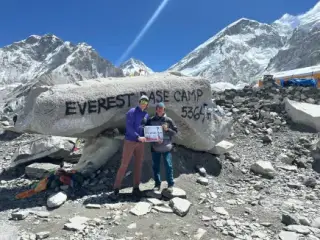
Most mainstream travel policies exclude "mountaineering" or cap useful cover at 3,000–4,000 m — below Everest Base Camp (5,364 m), Kala Patthar (5,545 m) and the Thorong La (5,416 m). Advisers commonly recommend a policy rated to at least 6,000 m for Everest Base Camp and Annapurna itineraries, and at least 7,000 m if you are climbing a trekking peak such as Island Peak (6,189 m) or Mera Peak (6,476 m).
The costs you are insuring against are real: a helicopter lift from Lobuche, Dingboche or Gorak Shep to Kathmandu is typically USD 3,000–6,000 and can exceed USD 10,000 in bad weather, with another USD 1,000–3,000 for hospital treatment in Kathmandu.
Read the altitude clause yourself, in writing, before you buy — an "adventure sports" add-on often tops out at 2,000–3,000 m. More detail on our travel insurance page.
None, for most treks. If you can walk 5–7 hours a day on uneven ground for several days in a row, you can do the standard teahouse routes.
What matters more than experience is honest cardiovascular fitness and time: build hill-walking into the two or three months before you fly, and pick an itinerary with proper acclimatisation days rather than the shortest one available. Peak climbing is different — Island Peak and Mera need previous high-altitude trekking and, for some routes, rope skills. Check the grading on our difficulty level page.
Not the way it used to work. Since April 2023 foreign trekkers have been required to walk with a licensed guide inside Nepal's national parks and conservation areas — that covers Everest, Annapurna, Langtang and Manaslu. Operators report the rule as still being enforced through 2026, with Langtang tightening it further from February 2025. Confirm the current position with the Nepal Tourism Board or with us before you plan an unguided itinerary.
Restricted areas moved the opposite way. In March 2026 the Department of Immigration reportedly dropped the long-standing minimum-two-trekkers rule, so a single trekker can now be permitted for Manaslu, Upper Mustang, Nar Phu and similar zones — but a licensed guide from a registered agency is still mandatory and the permit still has to be issued through that agency. You cannot apply yourself.
You can absolutely trek as a party of one. You just do it with a guide. See our trekking trips or ask us to build a private itinerary.
Easy – In this level, the walking duration may be anywhere in between 2 hours to 5 hours in a day. This level is flexible and easy so anyone can be part of these trips. These trips can include lots of breaks and resting time as per your comfort and need.
Moderate- in this level we climb towards the altitude between 900m to 3,000m, good health and fitness condition is a must.
Hard- Paths are going to be difficult. Rough roads, tiring up and downs are a given in this grade. You need to make sure that you are in good health condition for these trips as we will be scaling up to 4,000 meters here.
Very hard- The strenuous level takes you to an altitude of 3,500 to 5,000m. These treks are going to be of longer duration and some trekking experience before is suggested and is beneficial. Your fitness game has to be very strong.
Severe- You will have to be fully equipped and should be ready to carry bag packs and other essential items if needed. These treks could last longer than your fixed duration. We hope you will be doing some physical fitness exercise alongside your trekking experience from before.
Very Severe- Since it includes crossing an altitude of 6,000m, you need to be exceptionally fit and willing to take the challenges across the way. This grade includes all the mountain climbing and peak expedition treks.
Extreme Severe- This grade demands extreme fitness and mountaineering experience. It includes climbing the high mountain that stands at an altitude of 8,000 m and known as killer mountains.
Every trip on this site carries one of these grades — see trip difficulty levels for the full scale and what each one demands.
Destination, group size, trip length and season. The same itinerary costs more in spring and autumn than in summer or winter, because permits, flights and lodges all price to demand.
The larger levers are the internal flights an itinerary needs (Lukla is the obvious one), whether it is a private departure or a joining group, and the hotel grade in Kathmandu. We will show you the breakdown rather than a single number — ask for a quote.
The most popular are Thangka Paintings, Singing Bowls, Pashmina, Rice Paper Items, Khukuri, Handicrafts, Statues and Masks, Jewellery and Arts, Tea and Spices.
A government-licensed Nepali trekking guide, hired directly by us, who has walked your route before. Guides are licensed by the Nepal Academy of Tourism and Hotel Management and carry that licence on trek — ask to see it, on any trip with any company.
Your guide handles permits and checkpoints, teahouse bookings, the daily pace, and the altitude call — including the decision to turn you around, which is theirs to make and yours to accept. On peaks above 8,000 m Nepal now requires one guide for every two climbers; on lower mountains, one per fifteen.
Guides work in English. If you need another language, tell us when you enquire and we will tell you honestly whether we can staff it. Meet the office team on our team page.
Five permit families cover almost everything a visitor does:
- TIMS card — NPR 2,000 for an individual foreign trekker, NPR 1,000 in an organised group; NPR 600/300 for SAARC nationals. Issued jointly by the Nepal Tourism Board and TAAN.
- National park entry — for example Sagarmatha (Everest) and Langtang, NPR 3,000 per foreign visitor, NPR 1,500 for SAARC nationals.
- Conservation area permit — ACAP for Annapurna, MCAP for Manaslu, NPR 3,000 per foreign visitor; children under 10 exempt on ACAP.
- Restricted-area permit — Manaslu, Upper Mustang, Upper Dolpo, Nar Phu, Tsum, Kanchenjunga. Priced per person per day or per week and always issued through a registered agency.
- Climbing permits — Nepal Mountaineering Association royalties for the 27 designated trekking peaks; Department of Tourism royalties for expedition peaks including Everest.
Some regions add a local municipality fee on top — Khumbu Pasang Lhamu Rural Municipality charges NPR 3,000 in the Everest region. Fees as checked July 2026; confirm current rates on the Nepal Tourism Board site or ask us. We arrange every permit on our trips. Background reading: trekking permits in Nepal.
Nepal's restricted zones sit along the Tibetan border and each needs a special permit issued through a registered trekking agency. The ones travellers actually ask about are Manaslu and Tsum Valley, Upper Mustang, Upper Dolpo, Nar Phu and Kanchenjunga.
The rule that mattered most changed in March 2026: the Department of Immigration is reported to have scrapped the long-standing minimum-of-two-trekkers requirement, so a solo trekker can now be permitted for these areas. A licensed guide from a registered agency remains mandatory and you still cannot apply for the permit yourself. Verify with the Department of Immigration before committing to a solo restricted-area plan.
Permit costs vary by area and season and are charged per person per week or per day, on top of the relevant conservation area permit. Trips: Manaslu Circuit, Upper Mustang.
Most Everest Base Camp itineraries run USD 1,000–3,000 per person for 12–17 days, including trekking accommodation, the Kathmandu–Lukla flights, guide and porter. Where you land in that band depends on group size, season and how much comfort you want in Kathmandu at either end.
Permits are a small share of it: Sagarmatha National Park entry is NPR 3,000 per foreign trekker and the Khumbu Pasang Lhamu Rural Municipality fee is NPR 3,000, which with the local trekking permit comes to roughly USD 62 in total for 2026. The two costs that actually move the number are the Lukla flight and the season — spring and autumn price higher than summer or winter.
See the full itinerary and current departure prices on our Everest Base Camp Trek page, or read how much the Everest Base Camp trek costs. Fees as checked July 2026.
Porters carry a capped load, and the cap is enforced at the start of each stage rather than negotiated at altitude. Every guide and porter on our trips is insured for accident, medical treatment and helicopter evacuation on the same terms we ask you to insure yourself for.
They are equipped for the altitude they are being asked to walk to — jacket, boots, gloves, eye protection and sleeping arrangements are our responsibility, not something a porter funds out of a daily wage. Guides carry a first-aid kit and are trained to recognise altitude sickness and act on it.
If a porter is unwell, they descend. That is not a favour and it does not come out of their pay. More on how we work: our responsible travel policy.
Roughly 5–15 km a day, or 5–7 hours of walking, depending on terrain and altitude. Distance is the wrong measure high up — 8 km at 4,500 m is harder than 20 km at 1,500 m.
The figure that governs the itinerary is sleeping altitude. Above 3,000 m the standard guidance is to raise your sleeping altitude by no more than 300–500 m a night, with an extra acclimatisation night for every 1,000 m gained. That is why a well-built Everest Base Camp itinerary takes 12–14 days and a compressed one gets people evacuated.
There are hotels from 2 to 5 stars category, some also like home stay or camping, it’s up to the guest to decide.
Everest Base Camp, Gokyo Lakes, the classic Everest trek, Everest Panorama, the long classic route and the Gokyo–Kala Patthar combination.
Everest Base Camp is the one most people mean: see the itinerary. If you want the mountain without the crowd on the main trail, Gokyo with Everest Base Camp is the better trip.
Annapurna Circuit, Annapurna Base Camp, Jomsom–Muktinath, Ghorepani Poon Hill, Ghandruk, Upper Mustang, Tilicho Lake, the Royal Trek and Panchase.
For a first Himalayan trek, Poon Hill is short and low; Annapurna Base Camp puts you inside the sanctuary; the Circuit crosses the Thorong La at 5,416 m and needs proper acclimatisation.
Langtang Valley trek, Gosaikunda, Helambu, the combined Langtang–Helambu circuit, the Ganja La pass, Ganesh Himal and Shivapuri.
Langtang is the closest serious trekking region to Kathmandu — the trailhead is a drive away, not a flight — which makes it the practical choice on a short trip. The valley was devastated by the 2015 earthquake and has been rebuilt by the people who live there; trekking money goes directly into that. See the Langtang Valley Trek.
Yes, in almost every region worth trekking. Since April 2023 foreign trekkers have been required to walk with a licensed guide inside Nepal's national parks and conservation areas — Everest, Annapurna, Langtang, Manaslu. Operators report the rule still being enforced through 2026, and Langtang tightened it further from February 2025.
Restricted areas — Manaslu, Upper Mustang, Upper Dolpo, Nar Phu, Tsum, Kanchenjunga — have always required a guide and a registered agency, and still do. What changed there in March 2026 is that the minimum-two-trekkers rule was reportedly scrapped, so one person can now be permitted.
Enforcement is at checkpoints, where the permit and the guide's licence are both checked. Because this rule has moved more than once, confirm the current position with the Nepal Tourism Board or with us before planning anything unguided. Every Swotah trek includes a licensed guide as standard.
Two, plus a local card. Sagarmatha National Park entry is NPR 3,000 per foreign trekker (NPR 1,500 for SAARC nationals) and the Khumbu Pasang Lhamu Rural Municipality permit is NPR 3,000, bought at Lukla or Monjo. Together with the local trekking permit that comes to roughly USD 62 per person for 2026.
The TIMS card that used to apply across Nepal has largely been replaced in the Khumbu by these two permits — it is still required for Langtang, Manaslu and the far west. We buy and carry all of it on our trips, so there is nothing for you to queue for.
Fees as checked July 2026 and they do change; confirm with the Nepal Tourism Board. Trip page: Everest Base Camp Trek.
Dhaulagiri, Upper Mustang, Upper Dolpo, Kanchenjunga, Manaslu, Makalu Base Camp, Ganesh Himal, Rara Lake, Simikot, Sikles and Rolwaling.
These routes have little or no teahouse infrastructure, so you carry tents, kitchen and crew. Several — Manaslu, Upper Mustang, Upper Dolpo, Kanchenjunga — are restricted areas needing a special permit issued through a registered agency and a licensed guide. Budget more time and more money than a teahouse trek of the same length, and expect to see almost nobody. Talk to us about dates.
Driving
Yes, but think twice. Traffic drives on the left, hill roads are narrow and unfenced, and local driving conventions are not the ones you learned. Monsoon landslides close highways at short notice.
Carry an International Driving Permit alongside your home licence and confirm current requirements with Nepal's Department of Transport Management before you rent anything. For most visitors a car with a driver costs little more than self-drive and removes the whole problem.
On the left, as in India and the UK. Overtaking on mountain roads, horn use and right-of-way all work differently from what you are used to — if you have not driven in South Asia before, a car with a driver costs little and is the sane choice.
Assume delays and build slack into your itinerary. Nepal's terrain, road condition and weather mean few overland journeys run to schedule, and monsoon landslides can close a highway for a day.
What you will actually use: tourist coaches on the Kathmandu–Pokhara and Kathmandu–Chitwan routes, which are comfortable and worth the small premium over local buses; domestic flights, which are quick but weather-dependent (the Lukla flight in particular cancels for cloud); and taxis or ride-hailing apps inside Kathmandu, where agreeing the fare before you get in saves an argument.
Leave a spare day in Kathmandu before an international flight, especially if you are connecting from a mountain airstrip. We build that buffer into our itineraries for the same reason.
Safety
Yes, with normal precautions. Nepal is a comfortable country for women to travel in and solo female trekkers are common on the main routes. The US State Department rates Nepal Level 2, "Exercise Increased Caution", as of March 2026 — its second-lowest tier.
Practical points that come up: dress modestly outside tourist districts and at religious sites; avoid walking alone in unlit areas of Kathmandu late at night; and be firm rather than polite if someone is persistent, which is understood and not considered rude.
On trek you will in any case be walking with a licensed guide, which is now the rule inside Nepal's national parks and conservation areas. If you would prefer a female guide, ask when you enquire — tell us and we will say honestly whether we can staff it for your dates.
Higher than you think. Most standard travel policies exclude "mountaineering" or stop covering you above 3,000–4,000 m — which is below almost every Himalayan trek people book.
As a working rule: for Everest Base Camp (5,364 m) or Kala Patthar (5,545 m), buy a policy rated to at least 6,000 m, roughly 500–1,000 m above your highest point, because cover typically stops dead at the stated ceiling. For a trekking peak such as Island Peak (6,189 m) or Mera Peak (6,476 m), you want 7,000 m and explicit peak-climbing cover.
The policy must also name emergency helicopter evacuation and repatriation, not just medical expenses. An evacuation from the Khumbu to Kathmandu commonly runs USD 3,000–6,000 and can pass USD 10,000, with hospital care on top.
One more thing worth knowing: Nepal's helicopter-rescue sector was the subject of a criminal fraud investigation, with charges filed in March 2026 over fabricated evacuations billed to foreign travellers' insurers. Insist that any evacuation goes through your insurer's assistance hotline for pre-authorisation unless life is at immediate risk, and keep your own record of what happened. Read our travel insurance guidance.
Altitude sickness starts above about 2,500 m and is a normal risk, not a failure. Acute mountain sickness usually shows 2–12 hours after you arrive at a new altitude: headache plus nausea, loss of appetite, dizziness or unusual fatigue. Tell your guide the first time you feel it, not on day three.
The prevention is pacing. Above 3,000 m, raise your sleeping altitude by no more than 300–500 m a night and take an extra acclimatisation night for every 1,000 m gained. Climb high, sleep low. Drink, skip the alcohol, and do not let a fixed flight date push you upward on a bad day.
Two conditions turn this serious. HACE shows as confusion, loss of coordination, staggering and vomiting. HAPE shows as breathlessness at rest, chest tightness, a persistent cough and a sudden collapse in your ability to walk. Either one means descend immediately, at night if necessary.
Descent is the only treatment that works. Anyone whose symptoms are getting worse at rest should go down before they get seriously ill. Our guides carry a first-aid kit, monitor the group daily and have the authority to turn anyone around — see how to avoid altitude sickness on the Everest Base Camp trek.
Mountaineering
We provide the group kit: sleeping bags, duffel bags, tents where the route needs them, and the technical gear for peak climbing.
You bring the things that have to fit you — broken-in trekking boots, a down jacket, base and insulating layers, gloves, sunglasses rated for glacier glare, a headtorch, a personal first-aid kit and any medication. We send a full kit list once you book; anything missing can be bought or hired in Thamel at short notice.
There are almost 92 unclimbed peaks in Nepal (2017).
There are 1913 peaks in Nepal which are above 5500m.
Payments
Cards and ATMs work fine in Kathmandu, Pokhara and larger towns — hotels, established restaurants and gear shops take cards, and ATMs dispensing Nepalese rupees are easy to find in tourist areas, subject to your bank's withdrawal fee and daily limit.
On trek, it is cash only. Above the roadheads there are no ATMs and no card readers in teahouses. Draw enough rupees in Kathmandu or Pokhara for the whole trek, in small denominations, and carry a reserve for tips and any emergency.
The rupee is pegged to the Indian rupee at INR 1 = NPR 1.60. Against the US dollar it floats — around NPR 152.7 buy / NPR 153.3 sell on 30 July 2026; check the day's rate at Nepal Rastra Bank.
With us you can pay online on this site, by card on a POS machine at our office, or in cash on arrival.
Full booking and cancellation terms are on our booking and cancellation policy page, and the general terms on terms and conditions.
If your dates are uncertain, tell us before you pay a deposit rather than after — get in touch and we will tell you honestly what is and is not recoverable at each stage.
Adventure Activities
Bungee jumping and the canyon swing at Kushma and the Bhote Koshi, white-water rafting and kayaking on the Trishuli, Bhote Koshi and Karnali, canyoning near Pokhara and Sundarijal, paragliding and para-hawking over Phewa Lake, jungle safari in Chitwan and Bardia, mountain biking, zip-lining, rock climbing and skydiving over the Khumbu.
Most of these bolt onto a trek without adding days. See adventure sports and mountain biking.
Elephant Polo is international sport only held in Nepal.
General
No. Cannabis has been illegal in Nepal since 1976, despite how openly it grows and how often it is offered around Thamel and on trekking trails. Penalties are real and being a tourist is not a defence.
Cow is the national animal of Nepal and is worshiped as Goddess Laxmi
Danphe/Himalayan Monal (Lophophorus impejanus) is the national bird of Nepal.
There are 27 endangered species found in Nepal.
Tourists carrying more than 5,000.00 US dollar or equivalent foreign currency are requested to declare in the Custom Declaration Form at the time of arrival in Nepal.
Kalinchowk trek, Sailung Trek, Singla Pass (Jemrung Trekking) and Trisuli –Gorkha trek are the non-touristy areas in Nepal.
The General Post Office (Ph.: 4227499, 4470020) is located near Dharahara Tower and is open from 10 am to 5 pm from Monday to Thursday. On Fridays it remains open until 3 pm. Stamps, aerograms and postcards may be purchased from 7 am to 7 pm at the counters.
Bio Diversity
There are 208 mammal species reported including 28 species outside the limits of the protected areas but excluding four known extinct species.
More than 870 bird species have been recorded in Nepal — close to 8% of the world's total, in a country the size of Bangladesh. Counts differ between checklists because new records are added most years.
Chitwan and Koshi Tappu are the classic birding destinations; the Danphe (Himalayan monal), Nepal's national bird, is a high-altitude species you have a genuine chance of seeing on the Everest and Annapurna trails.
There are 13 national parks in Nepal.
Over 876 species of birds are known to exist in Nepal
Shey Phoksundo National Park is largest national park with area covering 3555km2 (1,373 sq. mi).
Shivapuri Nagarjun National Park, 159 km² (61 sq mi), on Kathmandu's northern rim — close enough to day-hike from the city.
Ten sites, designated between 1988 and 2008: Koshi Tappu (17,500 ha), the Lake Cluster of Pokhara Valley (17,850 ha), the Gokyo lake complex (7,770 ha), Bishazari Tal (3,200 ha), Ghodaghodi Tal (2,563 ha), Rara Lake (1,583 ha), Phoksundo Lake (494 ha), Jagdishpur Reservoir (225 ha), Mai Pokhari (90 ha) and Gosaikunda (13.8 ha).
Gokyo, Gosaikunda, Phoksundo and Rara all sit on trekking routes.
Nepal has six conservation areas: Annapurna (7,629 km²), Gaurishankar (2,179 km²), Kanchenjunga (2,035 km²), Api Nampa (1,903 km²), Manaslu (1,663 km²) and Blackbuck (15.95 km²).
Conservation areas differ from national parks in that people live and farm inside them, and permit revenue is shared with those communities. Annapurna is the one most trekkers pay into.
Some of the endangeredanimals of Nepal are Snow Leopard, Bengal Tiger, Swamp Deer, Black Buck, Red Panda, One Horned Rhino, Asiatic Elephant, Striped Hyena etc.
Beyond the Border
You cannot apply yourself. Every foreign visitor to Bhutan must book through a licensed Bhutanese tour operator, who applies for the visa or entry permit on your behalf and confirms it before you fly — there is no visa on arrival.
The cost that surprises people is the Sustainable Development Fee. As of mid-2026 operators report it at USD 100 per person per night for most international visitors, with that rate stated as fixed until 31 August 2027; children aged 6–12 pay half and under-6s are exempt. Indian, Bangladeshi and Maldivian nationals pay a lower regional rate, reported at INR 1,200 per person per night for Indian nationals, and Indians need an entry permit rather than a visa. Confirm the current SDF directly with Bhutan's Department of Tourism before you budget — this fee has changed more than once.
We arrange the operator, permit and SDF as one package. See our Bhutan trips.
Metal statues, sacred paintings, masks and similar religious objects need certification from the Department of Archaeology before they can leave the country. Reputable handicraft dealers and travel agents will arrange this for you at the point of sale.
Anything more than 100 years old — images, paintings, manuscripts — cannot legally be exported. Do not buy it in the first place: it belongs in Nepal, and you will lose it at the airport.
Passengers departing from the Tribhuvan International Airport are required to pay an airport tax of Rs. 900 if going to SAARC countries (Bangladesh, Bhutan, India, Maldives, Pakistan and Sri Lanka) and Rs. 1130.00 to all other international destinations. Domestic airport tax is Rs. 170.
Visa & Immigration
Yes — a 48-hour transit visa is issued at airport immigration on presentation of an onward airline ticket. It is for transiting only; if you intend to leave the airport area and travel, take the standard tourist visa instead. Confirm current terms with the Department of Immigration.
This visa is for those people who want to permanently live in Nepal.
A residential visa is for people intending to live in Nepal long term, not for visitors. It is a multiple-entry visa, historically charged at USD 200 for the first year and USD 100 for each renewal.
Fees and eligibility for long-stay categories change and are decided case by case — confirm directly with the Department of Immigration. For a holiday or a trek, this is not the visa you want.
On top of your used personal belongings you can bring in, duty free, 200 cigarettes or 50 cigars and one 1.15-litre bottle of spirits.
Equipment you are obviously travelling with — laptop, phone, camera, drone, binoculars, portable speakers — comes in duty free on the understanding that it leaves with you. Declare high-value gear on arrival so there is no argument on the way out. Anyone carrying more than the equivalent of USD 5,000 in cash should declare it on the customs form.
Rules change; confirm anything unusual (drones, satellite phones, professional film gear) with the Department of Immigration or Nepal Customs before you fly. As checked July 2026.
USD 30 for 15 days, USD 50 for 30 days, USD 125 for 90 days — all multiple-entry, all payable on arrival.
Pay in cash. US dollars or another convertible currency in clean, recent notes is the reliable method; the card machines at Tribhuvan exist but are unreliable, and land borders rarely have working ones at all. Children under 10 are free, except US-citizen children, who pay the adult rate.
Extending costs USD 45 for the first block of up to 15 days plus USD 3 for each additional day, paid in rupees at the Department of Immigration in Kathmandu (Kalikasthan) or the Pokhara office. Your total stay is capped at 150 days per visa year. Overstaying is charged at roughly USD 5 a day in penalty on top of the extension fee and must be settled before you can leave.
Fees as of July 2026 — confirm on the Nepal Tourism Board or Department of Immigration site before you fly. See also Nepal visa information.
Still stuck?
Ask the Kathmandu office. Permit rules, altitude, dates, payments — a person who runs these trips answers, not a bot.