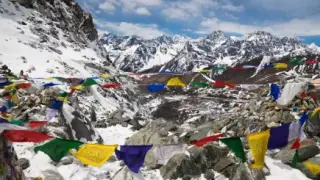
A 31-day Alpine D expedition to Himlung Himal (7,126 m) via the restricted Nar Phu Valley, with a four-camp program on mixed rock, ice and snow.
Duration
31 Days
Max Altitude
7,126 m / 23,379 ft
Difficulty
Severe
Group Size
Max 14 trekkers
Region
Annapurna Trekking Packages, Nepal
Best Season
Spring · Autumn
Accommodation
Hotels KTM; teahouses & expedition tents
Meals
All meals on trek & at expedition camp
Transport
Private vehicle KTM-Besi Sahar-Koto
Dates & Prices
Choose your date
All dates are guaranteed departures — we never cancel for low numbers. Book online or send a quick enquiry.
YearMonth
2 departures · 2026
Oct
11
Oct 11, 2026 — Nov 10, 2026
Guaranteed departure — from 2 trekkers
Available
USD9,980
per person
Oct
25
Oct 25, 2026 — Nov 24, 2026
Guaranteed departure — from 2 trekkers
Available
USD9,980
per person
Can’t find a suitable date? We run private departures on any date with as few as 2 trekkers.
Trip Overview
About the Himlung Himal Expedition
Himlung Himal (7,126 m) is a technical mountaineering objective in the restricted Nar Phu Valley of Manang district, on the border ridge between Nepal and Tibet. The Japanese Alpine Club made the first ascent in 1992 via the north face, and the mountain was opened to commercial expeditions in 2001. The 31-day itinerary combines a remote valley approach through the Annapurna Conservation Area with a full high-altitude climbing program on mixed rock, ice and snow to 7,126 m.
The approach follows the Nar Phu Valley from Koto (2,600 m) through the cliff-guarded gorge to Phu Gaun (4,080 m), a Tibetan-style village with yak pastures and medieval-looking stone houses. The route is restricted; a Nar Phu Restricted Area Permit is mandatory alongside the Nepal mountaineering royalty fee (approximately USD 1,800) and the Annapurna Conservation Area Permit. The climbing program establishes four high camps to approximately 6,800 m, with summit day pushing the final 326 vertical metres to the top.
Himlung is graded Alpine D (Difficult) and is considered one of the more approachable 7,000 m peaks in Nepal, though approachable does not mean easy. Crevasse navigation, fixed-line technique, crampon and ice-axe arrest, and high-altitude acclimatisation are all required. Supplemental oxygen is optional but commonly used above 6,500 m. The sections below cover permits, the climbing period, altitude acclimatisation, seasons, food, and what to pack.
Last updated June 2026
Trip Highlights
Highlights
1
Summit Himlung Himal at 7,126 m via the technical north-face route
2
Trek the restricted Nar Phu Valley, one of the least-visited corridors in Nepal
3
Four-camp expedition program on mixed rock, ice and snow above 5,600 m
4
First-ascent route by the 1992 Japanese Alpine Club team on the Nepal-Tibet border ridge
5
Nar Phu Restricted Area Permit and Nepal mountaineering royalty in a single itinerary
6
Views north into Tibet and south across the full Annapurna range from 7,126 m
Day by Day
Himlung Himal Expedition Itinerary: 17 Days
Tap any day to expand — altitudes, walking times, meals, and overnight details for every stage of the journey.
A Swotah representative meets you at Tribhuvan International Airport and transfers you to your hotel in Kathmandu (1,400 m). Your expedition leader briefs you on the program, checks your gear list and begins the climbing permit paperwork. Overnight in Kathmandu.
Sleep at 1,400 mDinner
Tonight’s stay
Hotel
A guided half-day visits the UNESCO World Heritage Sites of the Kathmandu Valley. The afternoon is for final gear checks, permit collection, team briefing and a welcome dinner with the expedition guide. Any missing equipment can be hired or purchased in Thamel. Overnight in Kathmandu.
Sleep at 1,400 mBreakfast
Tonight’s stay
Hotel
A private vehicle heads west on the Prithvi Highway to Besi Sahar (760 m), the entry town for the Annapurna Conservation Area, approximately 5 to 6 hours. Overnight in Besi Sahar.
Sleep at 760 mBreakfastLunchDinner
Tonight’s stay
Lodge
The road continues up the Marsyangdi Valley to Koto (2,600 m), the checkpoint where Nar Phu Restricted Area Permits are verified. This section of road is rough and the drive takes 4 to 5 hours. Koto sits at the mouth of the Nar Phu gorge. Overnight in Koto.
Sleep at 2,600 mBreakfastLunchDinner
Tonight’s stay
Lodge
The first trekking day enters the restricted Nar Phu Valley, climbing through a cliff-guarded gorge with juniper forest and the Phu Khola roaring below to the first campsite at 2,980 m. The trail is remote immediately after the checkpoint; no other commercial route passes through here. About 5 to 6 hours. Overnight at Nar Phu Campsite.
Sleep at 2,980 mBreakfastLunchDinner
Tonight’s stay
Camping
The gorge opens to wider country as the trail climbs to Meta (3,560 m), a small seasonal settlement with stone houses and yak pastures. The Kang Guru massif (6,981 m) appears to the south. About 5 to 6 hours. Overnight at Meta.
Sleep at 3,560 mBreakfastLunchDinner
Tonight’s stay
Camping
A steady climb through high-altitude scrub and past mani walls reaches Kyang (3,820 m), a collection of flat-roofed Tibetan-style stone houses at the edge of the high plateau. Nights here are cold year-round. About 4 to 5 hours. Overnight at Kyang.
Sleep at 3,820 mBreakfastLunchDinner
Tonight’s stay
Camping
Phu Gaun (4,080 m) is the largest settlement in the upper Nar Phu Valley, a walled Tibetan-style village with a gompa, prayer flags and yak pastures extending toward the head of the valley where Himlung and Nemjung (7,140 m) dominate the skyline. About 3 to 4 hours. Overnight in Phu Gaun. Last supply resupply point before base camp.
Sleep at 4,080 mBreakfastLunchDinner
Tonight’s stay
Camping
A rest day at 4,080 m for acclimatisation. Options include a short walk to the Phu Gaun gompa, an acclimatisation hike above the village to 4,400 to 4,500 m, or time to sort expedition equipment. The cook team prepares a full camp meal. Overnight in Phu Gaun.
Sleep at 4,080 mBreakfastLunchDinner
Tonight’s stay
Camping
The final approach day climbs from Phu Gaun through moraine and boulder field to Himlung Base Camp at 4,900 m, below the northern glacier. The cook and porter team arrives with the full camp equipment to establish the dining and sleeping tents. About 3 to 4 hours. This is the expedition's operational base for the next 15 days. Overnight at Himlung Base Camp.
Sleep at 4,900 mBreakfastLunchDinner
Tonight’s stay
Camping
The 15-day climbing period operates from Himlung Base Camp (4,900 m). The program follows a structured rotation schedule: the lead guides fix ropes and establish Camp 1 (approximately 5,600 m), Camp 2 (6,100 m), Camp 3 (6,500 m) and Camp 4 (approximately 6,800 m) during the first rotation, while clients do load carries for acclimatisation. Rotations progress BC-C1-C2-BC and BC-C2-C3-BC before a rest day at base camp and the summit rotation.
Summit rotation: BC to C3, rest, C3 to C4 (6,800 m), summit push to 7,126 m on the north-face route, descent to C3, then BC, then valley. The route on the upper mountain involves 40 to 50 degree ice and mixed sections. Supplemental oxygen is optional but available and commonly used from C3 upward. The 15-day window allows for a second weather-window attempt if the first is blocked. Swotah uses a commercial meteorological service for summit-day forecasting. Overnight alternates between base camp and high camps as per rotation schedule.
Sleep at 7,126 mBreakfastLunchDinner
Tonight’s stay
Camping
After the summit rotation and a rest night at base camp, the expedition breaks camp and descends to Phu Gaun (4,080 m) with the porter team. The cook team prepares the last base camp meal. About 3 to 4 hours walking. Overnight in Phu Gaun.
Sleep at 4,080 mBreakfastLunchDinner
Tonight’s stay
Camping
The valley exit begins, retracing the approach trail down through Kyang to Meta (3,560 m). The lower altitude after 15 days above 4,900 m is immediately noticeable, and most climbers sleep deeply. About 5 to 6 hours. Overnight at Meta.
Sleep at 3,560 mBreakfastLunchDinner
Tonight’s stay
Camping
The final trekking day descends through the Nar Phu gorge back to Koto (2,600 m) at the valley mouth, where restricted-area permits are checked out. About 5 to 6 hours. Overnight in Koto.
Sleep at 2,600 mBreakfastLunchDinner
Tonight’s stay
Camping
A private vehicle covers the rough road from Koto down the Marsyangdi to Besi Sahar (760 m), approximately 4 to 5 hours. Overnight in Besi Sahar.
Sleep at 760 mBreakfastLunchDinner
Tonight’s stay
Lodge
The return drive on the Prithvi Highway reaches Kathmandu in approximately 5 to 6 hours. The evening is a team farewell dinner with tip ceremony for the guides, Sherpas and support staff. Overnight in Kathmandu.
Sleep at 1,400 mBreakfastLunchDinner
Tonight’s stay
Hotel
The expedition ends today. A Swotah representative transfers you to Tribhuvan International Airport for your onward flight. If you would like to extend your stay, arrange a post-expedition trek or book another trip, the team is available to help.
Breakfast
What’s included
What's included
Every cost on the trail is broken out below — no hidden fees, no surprises at the trailhead.
Included
20 items
Transfer services to and from the Airport on arrival and departure
Assistance at the International Airport by the Swotah representative while arriving and departing
Standard/Deluxe room in Kathmandu on a BB basis
One day sightseeing in Kathmandu (Swayambhunath, Pashupatinath, Boudhnath and Durbar Square)
Local English-speaking Guide for sightseeing in Kathmandu
Necessary staff, including experienced guides and porters (3:1) during trekking and climbing
All trekking and camping equipment, like camp furniture, kitchenware, dining tents, guest tents, etc
3 meals a day (Breakfast, Lunch, and Dinner with tea or coffee) along with available accommodation at Hotel/Lodge/Guest House or tents for members and staff during trekking and climbing on twin sharing basis
Per person, 30 kg baggage allowance during the upward trek (carried by a porter) and 20 kg baggage allowance while returning from the Base Camp
Trekking Permit and Local Permit
Climbing permit for Himlung Himal Expedition
Experienced sherpa guide
Oxygen for the climber and the sherpa with a mask and a regulator
Experienced, Trained and Government Licensed Climbing Guide(s) during Climbing Period as per the group size as required
Wages, equipment, medical and accidental insurances for all involved staff
First aid medical kit for the Group and staff
Appropriate food for high altitude for all climbing crew at the base camp and above, as required
Fix and dynamic rope during the climbing period as required
All necessary paperwork, office service charge, and Government Taxes levied in Nepal
Complete pre-departure information, flight ticket reconfirmation, and visa extension procedure services (if necessary)
Not included
16 items
Lunch is not included for Kathmandu
Emergency rescue evacuation if required
Personal accident insurance or Helicopter rescue (it will be covered by the insurance company)
International flights
Nepal entry visa; you can obtain a visa easily upon your arrival at Tribhuvan International Airport in Kathmandu. (Tourist Visa with Multiple Entries for 30 days can be obtained by paying US $ 40 or equivalent foreign currency. Similarly, a Tourist Visa with Multiple Entries for 90 days can be obtained by paying US $ 100. Please bring 2 copies of passport-size photos.
Any kind of hot and cold drinks, a hot shower
Alcoholic beverages, Mineral water, laundry, phone calls, and internet
Personal climbing equipment;
All kinds of Personal Expenses;
Icefall fees and Garbage Deposit fees (Shared with other members) if applicable;
Wake talkies &Filming permit;
Any other expenses which are not mentioned in the Price Includes section;
Personal climbing guide if requested.
Optional trips and sightseeing if extended.
Tips for guides and porters;
Excess baggage charges (if you have more than 15 kg of luggage, a cargo charge is around $1.5 per kg);
How Hard Is the Himlung Himal Expedition?
Himlung Himal is graded Alpine D (Difficult). The route involves mixed rock, ice and snow to 7,126 m with fixed lines, four high camps and crevassed glacier terrain. Supplemental oxygen is optional but widely used above 6,500 m. Prior experience on glaciated peaks above 6,000 m is required.
▲Alpine D. Mixed rock, ice, snow to 7,126 m. Four high camps. Prior 6,000 m glaciated-peak experience required; O2 optional above 6,500 m.
Overall Rating
8
Severe
out of 10 · physical effort scale
Max altitude7,126 m
Trekking days28 days
Trip Details
Planning your Himlung Himal Expedition
Everything you need to plan the trek, topic by topic. Tap any one to open it.
Himlung Himal is graded Alpine D (Difficult), placing it among the more serious…
Himlung Himal is graded Alpine D (Difficult), placing it among the more serious 7,000 m objectives in Nepal. The summit at 7,126 m is reached via the normal north-face route, which involves glaciated approach terrain, crevasse navigation, fixed-line ascent on steep ice and mixed ground, and cramped high camps exposed to altitude above 6,500 m. Four high camps are established to approximately 6,800 m before the summit push.
Prior experience on glaciated peaks above 6,000 m, with crampon and ice-axe technique and fixed-line management, is the minimum requirement. Supplemental oxygen is optional but is commonly used by climbers above 6,500 m and by some from C3. Swotah's expedition team includes licensed high-altitude guides, and all clients receive a pre-expedition briefing covering acclimatisation protocol, weather-window assessment and emergency descent procedure. Anyone with a history of severe AMS, HACE or HAPE must discuss medical history with a doctor before joining.
Spring (April to May) and autumn (September to October) are the two viable seaso…
Spring (April to May) and autumn (September to October) are the two viable seasons for the Himlung Himal Expedition, because those windows sit between the summer monsoon and the severe winter cold when the upper mountain becomes dangerously unstable or wind-blasted. Spring offers warming temperatures and longer days as the season advances, though summit windows in April can be interrupted by residual cold fronts from the north. October is the most reliable month: post-monsoon skies are clear, winds are light and the upper snowpack is consolidated.
The monsoon (June to August) brings heavy precipitation that increases avalanche risk on the approach glacier and at all high camps, so it is not used for summit attempts. Winter (November to March) brings extreme cold and jet-stream winds above 6,000 m that close the mountain. The fixed departure dates Swotah offers are timed around the stable autumn and spring windows, and the 15-day climbing block has a built-in weather buffer for exactly this reason.
Himlung Himal sits in the Nar Phu restricted area and requires three separate pe…
Himlung Himal sits in the Nar Phu restricted area and requires three separate permits. The Nepal mountaineering royalty for Himlung is approximately USD 1,800 per climber, paid to the Department of Tourism (NTD/DoT) before the expedition starts. The Nar Phu Restricted Area Permit adds a further fee per person per week, issued only to groups led by a licensed Nepali agency. The Annapurna Conservation Area Permit (ACAP) covers the lower approach from Koto.
All three permits must be in order before the group leaves Kathmandu. Swotah handles the application process once you provide a passport copy and passport-size photographs; current royalty rates are confirmed at the time of booking because they are set by Government of Nepal gazette notification and can change between seasons. A liaison officer appointed by the Nepal Mountaineering Association accompanies the expedition, as is required by regulation for all peak permits above 7,000 m.
Kathmandu accommodation for the pre-expedition preparation days is a comfortable…
Kathmandu accommodation for the pre-expedition preparation days is a comfortable hotel with private rooms, included in the package. The Nar Phu Valley approach uses teahouses in villages like Meta, Kyang and Phu Gaun, which are simpler than those on the main Annapurna circuit but heated and hospitable, with basic but adequate food.
Base camp (4,900 m) uses a full tented camp: double-walled expedition tents for sleeping, a cook tent and a dining tent. High camps C1 through C4 use light mountain tents fixed to the slopes at approximately 5,600 m, 6,100 m, 6,500 m and 6,800 m respectively, sized for two climbers with insulated sleeping mats. A four-season sleeping bag rated to at least minus 30 C is essential for the high camps, and a base camp bag rated to minus 15 C is the minimum for base camp nights.
Base camp catering is a full cook service: a Swotah kitchen team prepares hot br…
Base camp catering is a full cook service: a Swotah kitchen team prepares hot breakfast, a packed lunch for climbing days and a hot cooked dinner every evening. The menu runs to dal bhat, pasta, rice dishes, soups, omelettes, porridge and hot drinks, with vegetables and protein supplied on the resupply runs from Phu Gaun. Caloric demands above 5,000 m are significant; the cook team is experienced with altitude appetite loss and prepares smaller, more frequent servings on summit-push days.
Water at base camp comes from snowmelt and nearby streams, always boiled or treated before use. At the high camps, snow is melted on a gas stove inside the tent. Carry a minimum of 3 litres per day above base camp, and drink before you feel thirsty; dehydration is the fastest route to impaired acclimatisation and AMS. Sports drinks and electrolyte tablets are useful supplements during the summit rotation days.
The expedition begins with a private vehicle drive from Kathmandu to Besi Sahar…
The expedition begins with a private vehicle drive from Kathmandu to Besi Sahar (760 m) on the Annapurna Highway, approximately 5 to 6 hours. A second drive the same day or next morning continues from Besi Sahar to Koto (2,600 m), which is the road head for the Nar Phu Valley and where trekking permits are checked. The Nar Phu Valley is accessed only from Koto; there is no alternative entry point.
Return transport reverses the same road: Koto to Besi Sahar, then Besi Sahar to Kathmandu by private vehicle, allowing the team to reach Kathmandu within one day from the road head. Swotah uses private jeeps for these road legs because the Koto road is rough and a standard bus cannot reliably cover the full distance in a single day. All road transfers are included in the expedition package.
The 15-day climbing period (days 11 to 25) operates from Himlung Base Camp at 4,…
The 15-day climbing period (days 11 to 25) operates from Himlung Base Camp at 4,900 m and follows a structured rotation-and-acclimatisation program before the summit attempt. Camp 1 is established at approximately 5,600 m, Camp 2 at 6,100 m, Camp 3 at 6,500 m and Camp 4 at approximately 6,800 m; all four camps are fixed-line sections, with ropes installed by the Swotah lead guides on the first rotation.
The standard program is two or three load-carry and acclimatisation rotations (BC-C1-C2-BC and BC-C2-C3-BC) before a rest day at base camp and the final summit rotation (BC-C3-C4-summit-C3-BC-valley). Summit day from C4 gains the final 326 vertical metres on mixed ground with sections of 40 to 50 degrees. The 15-day window builds in time to wait for a second weather window if the first is unusable. Swotah's lead guides make the weather-window call in consultation with a commercial weather forecast service.
Himlung Himal stands at 7,126 m in the Peri Himal subrange, on the boundary ridg…
Himlung Himal stands at 7,126 m in the Peri Himal subrange, on the boundary ridge between Nepal and the Tibet Autonomous Region of China. The Japanese Alpine Club made the first ascent in 1992 via the north face, which is the same route used by commercial expeditions today. The mountain's north face is almost entirely on the Nepal-Tibet border ridge, giving views north into Tibet and south across the Annapurna range and the Nar Phu corridor.
At 7,126 m, Himlung is not among the 14 eight-thousanders, but it sits above the physiological altitude threshold (roughly 7,000 m) where extreme altitude effects, including HACE risk and reduced supplement oxygen partial pressure, become acute for most climbers. The mountain was opened to commercial expeditions in 2001 by the Nepal Government. The name Himlung derives from Tibetan and refers to the ice cliff formations on the upper peak.
A licensed high-altitude guide is legally required for all Nepal mountaineering…
A licensed high-altitude guide is legally required for all Nepal mountaineering royalty peaks above 6,000 m, and Himlung Himal at 7,126 m is no exception. Swotah's expedition team is led by a Nepal Mountaineering Association-licensed guide with documented Himlung summit experience; the guide-to-client ratio is a maximum of 1:2 on high-camp rotations above C2. Each climber also has a dedicated high-altitude Sherpa (Climbing Sherpa) for the summit rotation.
A liaison officer appointed by the Nepal Ministry of Tourism accompanies the expedition from Kathmandu, as required by permit regulations. The base camp team includes a base camp manager, kitchen staff and a communications officer. Porter loads on the Nar Phu approach are capped at 25 kg per person, and all staff carry expedition insurance, a Swotah requirement that exceeds the legal minimum. Tip guidelines for the team are shared in the pre-expedition information pack.
Mobile coverage in the Nar Phu Valley is limited. Nepal Telecom (NTC) gives the…
Mobile coverage in the Nar Phu Valley is limited. Nepal Telecom (NTC) gives the strongest signal in Koto and Phu Gaun, with near-zero coverage in the gorge sections and at base camp. Swotah provides a satellite communicator at base camp for emergency contact and weather updates, and a tourist SIM for the Kathmandu and approach days. Do not rely on mobile data for navigation or weather above Phu Gaun.
Charging at teahouses is available for a fee (NPR 200 to 500 per device) at Meta, Kyang and Phu Gaun, dropping to solar-panel-only at base camp. A 20,000 mAh power bank is the minimum for the expedition days above Phu Gaun; cold temperatures at the high camps discharge lithium batteries significantly faster than at sea level, so keep the power bank inside your sleeping bag overnight. The expedition's satellite communicator is kept charged by the base camp manager.
Himlung Base Camp sits in the Annapurna Conservation Area, where all waste, incl…
Himlung Base Camp sits in the Annapurna Conservation Area, where all waste, including human waste, must be packed out or buried below the snow line at a minimum of 60 m from any water source, per Nepal mountaineering regulation. Swotah operates a leave-no-trace base camp: all food packaging, fuel canisters and non-biodegradable waste is bagged and carried out to Koto for proper disposal. Fixed ropes and surplus camp equipment left on the mountain must be removed at the end of the expedition season.
Tipping is customary and expected in Nepali mountaineering culture. A common guideline is USD 200 to 400 per guide or lead Sherpa per expedition, USD 100 to 200 per base camp staff member and USD 50 to 100 per approach porter, adjusted to your sense of their contribution. Tips are distributed by the expedition leader on the final Kathmandu evening and go directly to the seasonal workers, many of whom depend on expedition income for most of their annual earnings.
What to pack
What to pack
The full kit list. Anything we loan (sleeping bag, down jacket) is called out — bring everything else.
✓Expedition duffel (90-100L, carried by porter to BC)
✓Summit pack (35-40L daypack for climbing days)
✓Dry bags or compression sacks
✓Packing cubes
Frequently Asked
Questions & Answers
Everything trekkers ask before booking. Don't see yours? Tap Enquire — we usually reply within a few hours.
Yes, our representative will already be there to receive you at the airport and you will be directly transferred to the hotel.
For nights in cities, we use standard/superior standard/deluxe rooms whereas, during the trek, we use lodges/tea houses/camping/guesthouses/homestay for our clients or whatever is available and accessible. We also arrange sleeping bags for our clients, as per their request.
Only mountaineers who have adept mountaineering skills, adequate strength and previous experience in high mountains can climb this mountain.
September to October and April to May are best seasons to climb Himlung Himal.
Climbing is a hard and tiresome activity that requires a lot of physical movement so pack your active wears and trekking pants for at lower altitudes. Weather at high altitude is unpredictable, so carry a lightweight waterproof jacket along with thick down jacket, pant and thermal inner wear to escape the severe cold. Needless to say that, Good shoes are very important for climbing in rough and snowy terrain, so invest in good quality shoes or rent it from us at a minimum price. For mountaineering, you will require special clothes that can be bought or hired from us.
It will take almost 1 month to climb it and to return only a few days, so to complete this mountaineering you need at least 30-35 days in total, to finish this trip.
We believe in operating small intimate group to provide personal attention and services to our guests. Small groups can enjoy the trek hassle free and enjoy the customized trip according to their need and suitability. We do not incorporate more than 14 People in a group, unless we get special requests from our clients.
We use a private vehicle for sightseeing inside Kathmandu Valley and to drive to Besi Sahar we use car, van, Mini Bus etc. depending on the number of traveller.
In cases emergency, you can change the day trips but it’s better to not change it. Still, we customize the trip according to your preference, but if you need to change plan during the trek, consult the guide and company.
If you need extra day to complete the trekking, you'll need to inform the guide in advance and the guide will let the company know. Adding a day to trekking can result in many changes in other arrangements such as transportation, guides' schedule, flight details, hotel bookings and all, so we really don't recommend this to our clients unless there's an emergency cases. But it's true that those changes could be made but it will cost extra. The best way to do it is to inform the agent company about it.
To confirm your booking, a non-refundable deposit of minimum of 15% of total trip amount is required, which can be made by bank transfer. The due balance is payable on arrival in Kathmandu with cash or card.
No, you cannot use the credit card during the climbing. You have to exchange the money in Nepali Rupees before you start the trip. You can use credit card only in Kathmandu and Pokhara.
Yes, we will invite you for dinner in a cultural restaurant on the night of your arrival for briefing the itinerary and small orientation program will be held by the tour leader and guides before we embark on our adventure.
This is certainly one of the highest mountains in the world. In terms of technical difficulty, we'd rate 'Himlung Himal' as 6.
We make sure to take security measures during climbing to make your expedition successful. We hire experienced and authorized Guides/Sherpas to safeguard your life in the mountains. We strongly recommend that you follow the guide’s instruction with utmost care.
During Camping, our expert camping cooks prepare a wide range of delicious meals empowering you with enough strength for your strenuous climbing. All the cooking materials will be carried by our porters.
Yes, you will get purified, filtered water in many tea houses. You can also get a hot water during camping.
Yes, Our Sherpas/Guides are trekking experts and also authorized license holders from Nepal Government. The Sherpas know the climbing route like the back of their hand and use their expertise in ensuring your safety in the mountains.
Yes, you need climbing permit. It's not legal to climb without it.
Yes, for the first few days, it's possible to have telephonic communication. In some villages, you can make local and international calls from telephone provided by the guesthouse owner after paying the price directly. For higher altitude climbing, we usually have satellite phones with our Sherpas.
Before coming to Nepal, make sure that you are totally insured. In case of emergencies like altitude sickness, dehydration or any medical conditions, let your Guide know about your problem and subsequently. As soon as we are informed of a situation, we'll send an emergency helicopter rescue team. You will be transferred to the hospital for the treatment.
Before coming to Nepal, make sure you are covered for diphtheria & TB, hepatitis A, hepatitis B, malaria, typhoid, polio and tetanus. Make sure you are in best shape to complete the trekking without any complications.
Why Travel with Swotah
Why Book the Himlung Himal Expedition with Swotah
Most Nepal operators look the same from the outside. Here's what actually makes the difference.
Born in Nepal
100% locally owned since 2016. Trek profits stay with the mountain families and village schools along your route.
Guaranteed Departures
Every date on our calendar runs — no minimum group size. You never pay to be cancelled.
Certified Guides
Government-licensed, WFR-certified, English-speaking. Most were born within two valleys of the trail.
Small Groups
Small groups, never more than 8 trekkers. You get a real experience, not a convoy.
Gear Included
Sleeping bag and down jacket loaned at no extra charge — both rated to –20°C.
Flexible Payment
Deposit from 10% to confirm, balance before departure or in cash on arrival. Reschedule up to 30 days prior.
24/7 Support
Kathmandu office and dedicated WhatsApp emergency line. We answer at 2am if needed.
Hall of Fame
TripAdvisor Travelers' Choice 2023, 2024 and 2025. Hundreds of verified five-star reviews.
Get a free personalised travel brief for the Himlung Himal Expedition.
Tell us your travel dates and group size. Our team in Kathmandu will put together a tailored itinerary, honest costs, and practical tips — completely free, no commitment.