

Before you book
Travel insurance for Nepal
What your policy must cover to be worth anything above 3,000 m, and what a helicopter evacuation really costs.
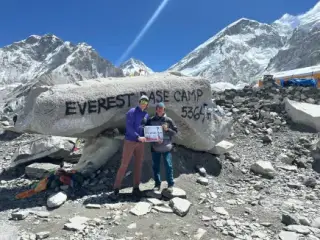
No Nepali law forces a foreign trekker to buy travel insurance, but Swotah requires it, for one narrow reason. A helicopter evacuation from the Khumbu to a Kathmandu hospital is commonly quoted at USD 3,000 to 6,000, while the ordinary policy sold alongside a flight stops working between 3,000 m and 4,000 m. Everest Base Camp sits at 5,364 m, which is where people discover they bought the wrong policy.
Is travel insurance mandatory to trek in Nepal?
Nepal has no blanket law requiring foreign visitors to hold travel insurance, which is why nobody asks for one at immigration in Kathmandu. The requirement comes from operators instead: registered trekking agencies generally will not confirm a booking without proof of a valid policy, Swotah included.
Every traveller on a Swotah trek or climb must hold insurance covering emergency helicopter evacuation and repatriation. A guide standing at 4,900 m with a sick client has two options: the insurer authorises a flight, or somebody pays cash. Rules on restricted-area routes also shift season to season, so ask us and read our summary of trekking permits in Nepal.
What altitude does your travel insurance actually cover?
Most mainstream policies carry an altitude exclusion or hazardous-activity clause that caps useful cover around 3,000 m to 4,000 m. Cover does not taper above that ceiling. It stops, and anything higher falls outside the policy.
Specialists commonly suggest a rating 500 m to 1,000 m above your itinerary's highest point, which puts an Everest Base Camp trek in the 6,000 m band, not the 5,500 m one. The margin covers the day you are rerouted over a higher pass or walk up Kala Patthar at 5,545 m.
| Trip | Highest point reached | Policy rating to look for |
|---|---|---|
| Everest Base Camp trek | 5,364 m base camp, 5,545 m Kala Patthar | 6,000 m trekking cover |
| Annapurna Circuit trek | 5,416 m at Thorong La | 6,000 m trekking cover |
| Island Peak (Imja Tse) | 6,189 m summit | 7,000 m plus mountaineering cover |
| Mera Peak | 6,476 m summit | 7,000 m plus mountaineering cover |
An "adventure sports" or "hiking" add-on is not an altitude rating. Several top out at 2,000 m to 3,000 m, which covers a day walk above Pokhara and nothing on the Everest trail. Read the altitude figure, not the name of the pack.
What does an emergency helicopter evacuation in Nepal cost?
Pickups from Lobuche, Dingboche or Gorak Shep to Kathmandu are typically quoted at USD 3,000 to 6,000 out of pocket, rising past USD 10,000 in bad weather or for complex high-altitude rescues, plus roughly USD 1,000 to 3,000 for hospital treatment. Those are aggregated operator and charter figures as of July 2026, not an official tariff.
Insurers have become far stricter about authorising those flights. A Central Investigation Bureau investigation, with charges filed in March 2026, examined 1,248 Mountain Rescue Service evacuations flown between 2022 and 2025 and found 171 fraudulent, worth claims of roughly USD 10.31 million, with 32 people charged under organised-crime law. The reported pattern was staged or exaggerated evacuations and inflated billing, aimed at foreign trekkers whose insurers could verify little on the ground. The Kathmandu Post published the detailed account.
Pre-authorisation is the consequence for you. Most policies already require the insurer or its assistance company to approve an evacuation first, a step often skipped in remote terrain, which is part of what let the fraud run. Expect hotline approval to be enforced tightly outside clear emergencies.
If you are conscious and stable, your insurer's 24-hour line gets called before the aircraft is booked. An unauthorised flight can leave you personally liable for the invoice.
The checklist a Nepal trekking policy must satisfy
High-altitude specialists name the same benefits repeatedly. Check each against the policy wording, not the marketing page.
- Emergency helicopter evacuation and onward repatriation, named as separate benefits.
- An altitude rating above your itinerary's highest point, stated in metres in the policy document.
- Mountaineering cover if you are attempting a trekking peak, on top of the altitude rating.
- Trip cancellation and interruption, which is what pays when a Lukla flight is grounded for three days.
- Medical and emergency expense cover for the hospital stay after an evacuation.
- A 24-hour assistance number that answers, in a language you speak, at Nepal time.
What does a "mountaineering" exclusion mean on a peak-climbing trip?
A mountaineering exclusion voids claims arising from climbing activity, and insurers apply it by activity type or altitude rather than by how technical you found the day. It catches trekkers who never thought of themselves as climbers.
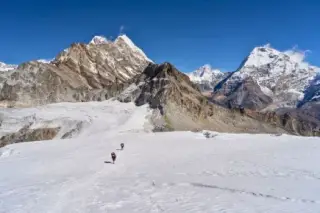
Island Peak, Mera Peak and Lobuche East are classified as "trekking peaks" by the Nepal Mountaineering Association, which issues their permits. That phrase is a permit category, not an insurance category. To an insurer, a roped ascent to 6,476 m on Mera Peak is mountaineering, and a trekking policy will decline it. Anyone on our peak climbing trips needs the climbing extension confirmed in writing before departure.
"Does this policy cover a guided ascent of an NMA trekking peak to 6,500 m, including helicopter evacuation from above base camp?" A written yes beats any number on a comparison site.
At what altitude does altitude sickness start, and what treats it?
Above roughly 2,500 m, travellers are at risk of acute mountain sickness (AMS), high-altitude cerebral edema (HACE) and high-altitude pulmonary edema (HAPE), according to the CDC Yellow Book. AMS symptoms usually appear 2 to 12 hours after arriving at a new altitude: headache plus nausea, vomiting, loss of appetite, dizziness or fatigue. HACE presents as confusion, ataxia (loss of coordination) and altered mental state. HAPE presents as breathlessness on exertion, chest tightness and cough.
Descent is the only definitive treatment. Oxygen and medication buy time, nothing substitutes for losing altitude. Anyone whose AMS symptoms worsen at rest goes down before becoming seriously ill; HACE signs mean descending immediately.
Prevention is ascent-rate control. Above 3,000 m, gain no more than about 500 m of sleeping altitude per night and add an acclimatisation night for every 1,000 m gained. Our Everest itineraries build those nights in, and the detail is in our guide to avoiding altitude sickness on the Everest Base Camp trek.
What do you do the moment something goes wrong on trek?
Five steps, in this order, protect the patient and the claim at once.
- Tell your guide immediately. Onset time is the most useful fact in an altitude case, and it gets recorded when it happens, not at the next tea stop.
- We contact our Kathmandu office. The team decides whether the answer is a rest day, descent on foot, or an evacuation.
- Call your insurer's 24-hour line for pre-authorisation. Have the policy number, patient name, location and symptoms ready, on paper, because a dead phone at 4,900 m should not cost you a claim.
- Take the evacuation the insurer authorised. A flight to Kathmandu or a walk down to a lower village, whichever they approved, beats a costlier option offered on the spot.
- Keep every piece of paper. Medical reports, hospital invoices, the charter receipt, prescriptions and the authorisation reference. Claims fail on missing documents more often than on disputed medicine.
Which insurers do high-altitude trekkers use?
Swotah does not sell or earn anything from travel insurance, and we recommend no specific insurer, because the right policy depends on your nationality, age, itinerary and existing cover. Names that recur among Nepal trekkers include World Nomads, True Traveller, the Austrian Alpine Club UK section, the British Mountaineering Council, and Global Rescue, a membership-based rescue service rather than an insurance policy. That list is informational, not exhaustive, not an endorsement, and nobody on it pays us anything. Altitude tiers change season to season, so confirm current terms in writing and see our notes on insurance for the Everest Base Camp trek.
Common questions about trekking insurance in Nepal
Is travel insurance compulsory in Nepal?
Not by national law, but effectively yes in practice, because registered agencies including Swotah will not confirm a booking without a valid policy. Restricted-area requirements change, so ask us about your route.
Will my standard annual travel policy cover Everest Base Camp?
Usually not, because most mainstream policies cap altitude cover between 3,000 m and 4,000 m and Everest Base Camp is at 5,364 m. Find the altitude figure in the wording before assuming anything.
What altitude rating do I need for Island Peak or Mera Peak?
Specialists commonly recommend at least 7,000 m, since Island Peak at 6,189 m and Mera Peak at 6,476 m sit above the 6,000 m ceiling of most trekking-only policies. The mountaineering extension is a separate item.
Does insurance cover a helicopter if I am simply exhausted?
No. Insurers pay for medically necessary evacuation their assistance line has authorised, and after the 2026 fraud prosecutions they are scrutinising Nepal claims closely.
Does Swotah sell travel insurance?
No. We require a policy covering emergency evacuation and repatriation, and take no commission from any insurer. Send us the altitude clause of a policy you are considering and we will tell you what it misses.
Costs and rescue-fraud figures as of July 2026; altitude illness guidance follows the CDC Yellow Book. Nothing here is insurance advice or a recommendation of any provider. Confirm cover with your insurer, and talk to our Kathmandu team about your trip's altitude profile.
Not sure your policy covers your trek?
Send us your itinerary and the altitude your policy covers. We will tell you plainly whether it matches the trip you have booked.