A 10-day restricted trek into the walled Kingdom of Lo, with 14th-century monasteries, ochre cliffs and Lo Manthang at 3,840 m, walkable even in the monsoon.
Duration
10 Days
Max Altitude
3,840 m / 12,598 ft
Difficulty
Moderate
Group Size
Max 14 trekkers
Region
Mustang Region Treks, Nepal
Best Season
Spring · Monsoon · Autumn
Accommodation
Teahouse lodges; basic high up. Hotels in Kathmandu/Pokhara.
Meals
3 meals/day on trek; dal bhat staple. Limited choice above.
Transport
Drive KTM-Pokhara; fly Pokhara-Jomsom (return); jeep to Kagbeni.
Dates & Prices
Choose your date
All dates are guaranteed departures — we never cancel for low numbers. Book online or send a quick enquiry.
YearMonth
3 departures · 2026
Oct
19
Oct 19, 2026 — Oct 28, 2026
Guaranteed departure — from 2 trekkers
Available
USD1,600
per person
Nov
1
Nov 1, 2026 — Nov 10, 2026
Guaranteed departure — from 2 trekkers
Available
USD1,600
per person
Nov
13
Nov 13, 2026 — Nov 22, 2026
Guaranteed departure — from 2 trekkers
Available
USD1,600
per person
Can’t find a suitable date? We run private departures on any date with as few as 2 trekkers.
Trip Overview
About the 10 Days Upper Mustang
The 10-Day Upper Mustang Trek is a restricted-area trek into the former Kingdom of Lo, a walled Tibetan Buddhist enclave in Nepal's Kali Gandaki valley, sheltered north of the Annapurna and Nilgiri Himalayas. Because the region sits in a rain shadow, the trail stays walkable through the monsoon, from May to October, making it one of the few Nepal treks that can fill a June or July trip. The maximum altitude is 3,840 m at Lo Manthang, the ancient walled capital where 14th and 15th-century monasteries rise from ochre cliffs above the Tibetan plateau.
Upper Mustang is the region above Kagbeni at 2,810 m that until 1992 was entirely closed to outsiders. The route drives from Kathmandu to Pokhara (a 6 to 7 hour scenic drive, with a 25-minute flight as an optional upgrade), then takes a short mountain flight to Jomsom at 2,720 m before driving to Kagbeni and walking north through the villages of Tselle, Geling at 3,510 m, and Charang at 3,560 m to reach Lo Manthang. A full day at the capital allows visits to Jampa Lhakhang, Thubchen Gompa and the old royal palace, and the Chhoser sky caves lie within reach of that day or the route back. The Tiji festival in Lo Manthang, held each May, brings three days of ceremonial masked dances to the main courtyard.
By law, Upper Mustang requires a Restricted Area Permit (RAP) — USD 50 per person per day inside the restricted zone, about USD 300 for this itinerary — plus the Annapurna Conservation Area Permit (NPR 3,000) and a licensed guide booked through a registered agency. Since March 2026 the old minimum-group-size rule has been removed, so solo travellers are welcome. Swotah arranges all permits once you provide a passport copy. The sections below cover permit costs, the best seasons, what the trek asks physically, and what to pack.
Last updated June 2026
Trip Highlights
Highlights
1
Explore walled Lo Manthang (3,840 m) with its 14th and 15th-century monasteries
2
Fly into Jomsom in the world's deepest gorge between Dhaulagiri and Annapurna
3
Trek the only Himalayan route that stays open and dry through the monsoon
4
Visit Jampa Lhakhang and Thubchen Gompa in the ancient walled capital
5
See the Chhoser sky caves and ochre cliff formations of the Tibetan rain shadow
6
Chance to witness the Tiji festival in Lo Manthang in May
Day by Day
10 Days Upper Mustang Itinerary: 10 Days
Tap any day to expand — altitudes, walking times, meals, and overnight details for every stage of the journey.
A Swotah representative meets you at Tribhuvan International Airport and transfers you to your hotel in Kathmandu at 1,400 m. Your guide runs a short orientation briefing covering the 10-day itinerary, the restricted-area permits, and what to expect on the trail. Overnight in Kathmandu.
Sleep at 1,400 m
Tonight’s stay
Hotel
Pokhara is 200 km west of Kathmandu, a 6 to 7-hour drive through the Prithvi Highway along the Trishuli and Marsyangdi river valleys, or about 25 minutes by domestic flight. The afternoon in Pokhara at 827 m allows a walk along Phewa Lake or rest before tomorrow's early mountain flight. Your guide confirms the Jomsom flight time and the permit paperwork for the restricted zone. Overnight in Pokhara.
Sleep at 827 mBreakfast
Tonight’s stay
Hotel
The Pokhara to Jomsom mountain flight takes about 20 minutes and passes close to Dhaulagiri (8,167 m) and Nilgiri; flights depart early before the Kali Gandaki valley wind builds. From Jomsom at 2,720 m, a jeep drive north of about 30 minutes reaches Kagbeni at 2,810 m, where the permit checkpoint marks the start of the restricted zone. The afternoon trek from Kagbeni follows the Kali Gandaki upstream through ochre-cliff terrain to Tselle at around 3,090 m. Overnight in Tselle.
Sleep at 3,090 mBreakfastLunchDinner
Tonight’s stay
Guesthouse
Geling at 3,510 m is the overnight stop after a 5 to 6-hour day through the barren, wind-sculpted landscape north of Tselle. The trail crosses open plateau with views of eroded red and ochre cliff faces before dropping into the Geling valley, where a small monastery sits above the village. The altitude here is enough to notice, so a steady pace and consistent hydration matter. Overnight in Geling.
Sleep at 3,510 mBreakfastLunchDinner
Tonight’s stay
Guesthouse
Charang at 3,560 m is a village with a small dzong and a whitewashed monastery visible from the trail. Today's stage from Geling takes about 4 to 5 hours across rolling plateau, with the Nilgiri massif visible to the south on clear days. Charang marks the last stop before Lo Manthang and gives a clear preview of the walled capital's style of architecture. Overnight in Charang.
Sleep at 3,560 mBreakfastLunchDinner
Tonight’s stay
Guesthouse
Lo Manthang at 3,840 m is the maximum altitude of the trek and the destination the permit exists to reach. The 3 to 4-hour walk from Charang crosses a low ridge before the walled city comes into view on the flat plateau, its mud-brick perimeter and the rooftop shrines of Jampa Lhakhang and Thubchen Gompa rising from the dry rangeland. On arrival, your guide arranges entry to the monasteries and the old royal palace. Overnight in Lo Manthang.
Sleep at 3,840 mBreakfastLunchDinner
Tonight’s stay
Guesthouse
A full day at Lo Manthang at 3,840 m allows unhurried visits to the main monasteries inside the wall. Jampa Lhakhang, built in the 15th century, houses a three-storey Maitreya Buddha statue, and Thubchen Gompa contains well-preserved Tibetan-style murals from the same period. The Chhoser sky caves, hand-cut into the cliff faces a short ride north, are reachable by jeep or on foot. The Tiji festival fills the palace courtyard for three days each May with ceremonial masked dances. Overnight in Lo Manthang.
Sleep at 3,840 mBreakfastLunchDinner
Tonight’s stay
Guesthouse
The return from Lo Manthang to Jomsom at 2,720 m is mostly by jeep, covering the distance in roughly 3 to 4 hours through the same ochre valley. A stop at Kagbeni allows a last look at the permit checkpoint village and its medieval tower before reaching Jomsom for the night. The evening in Jomsom is a chance to recharge devices, catch limited Wi-Fi and settle for an early flight the next morning. Overnight in Jomsom.
Sleep at 2,720 mBreakfastLunchDinner
Tonight’s stay
Hotel
The morning Jomsom to Pokhara flight departs early, before the valley wind makes the airstrip difficult, and takes about 20 minutes. From Pokhara, a connecting domestic flight or a 6-hour drive returns you to Kathmandu at 1,400 m. A Swotah representative meets you on arrival and transfers you to your hotel. The evening in Kathmandu is free for Thamel's bookshops and restaurants. Overnight in Kathmandu.
Sleep at 1,400 mBreakfast
Tonight’s stay
Hotel
A Swotah representative transfers you to Tribhuvan International Airport for your onward flight. If your flight is in the afternoon, a final morning in Kathmandu can take in Boudhanath stupa or Thamel's handicraft shops. Swotah can arrange extensions to Pokhara, the Annapurna Circuit, Everest Base Camp or any other Nepal trek if you would like more time.
Sleep at 1,400 mBreakfast
Tonight’s stay
-
What’s included
What's included
Every cost on the trail is broken out below — no hidden fees, no surprises at the trailhead.
Included
12 items
Airport transfers with an escort by private vehicle
Standard/deluxe rooms in Kathmandu on twin/double sharing with breakfast.
Guided sightseeing tour in Kathmandu, along with entrance fees and a professional guide
Accommodation during the trek (or camping in case of need)
All meals (Breakfast, lunch, dinner) during the trek
Authorized English-speaking guide along with Porters (3:1) for the trek
Equipment and clothing for porters, including their insurance
All applicable government taxes
All expenses for all staff's meals, accommodation, salary, equipment, insurance, and transportation
All necessary paperwork: Upper Mustang Restricted Area Permit (RAP) and Annapurna Conservation Area Permit (ACAP)
Two-way Pokhara to Jomsom airfare with domestic airport departure tax
Medical kit (carried by your trek leader)
Not included
7 items
International flights; Nepal visa fee
Excess baggage charge(s) for the domestic flight
Extra night accommodation in Kathmandu and Pokhara because of early arrival, late departure, early return from the mountain due to any reason other than the scheduled itinerary
Lunch and evening meals in Kathmandu
Travel and rescue insurance
Personal expenses (phone calls, laundry, bar bills, battery recharge, extra porters, bottle or boiled water, shower, etc.)
Tips for guide(s), porter(s) and driver(s)
How Hard Is the 10 Days Upper Mustang?
The Upper Mustang Trek is a moderate restricted-area trek. The maximum altitude is 3,840 m at Lo Manthang, days run 4 to 6 hours, and the gradient is gentler than the high passes of the Annapurna Circuit. Good general fitness is enough.
▲Moderate. 4-6 hr days, max altitude 3,840 m (Lo Manthang). No high passes; gentle terrain. Good fitness is enough; altitude awareness still advised.
Overall Rating
4
Moderate
out of 10 · physical effort scale
Max altitude3,840 m
Trekking days8 days
Trip Details
Planning your 10 Days Upper Mustang
Everything you need to plan the trek, topic by topic. Tap any one to open it.
The Upper Mustang Trek is graded moderate. The maximum altitude is 3,840 m at Lo…
The Upper Mustang Trek is graded moderate. The maximum altitude is 3,840 m at Lo Manthang, and most of the walking follows the Kali Gandaki valley and its tributaries without the long pass days that make the Annapurna Circuit and Everest Base Camp routes harder. Days run 4 to 6 hours on well-defined trail, so a good level of general fitness is the main requirement.
Altitude awareness still applies: you sleep at 3,510 m in Geling and 3,560 m in Charang before reaching Lo Manthang. Drink 3 to 4 litres of water a day, ascend steadily, and tell your guide early about any headache or dizziness. Swotah guides carry a first-aid kit and a pulse oximeter, and anyone with a heart or respiratory condition should have a health check before booking.
Upper Mustang sits in the rain shadow of the Annapurna and Nilgiri Himalayas, so…
Upper Mustang sits in the rain shadow of the Annapurna and Nilgiri Himalayas, so it receives very little monsoon rain and stays walkable from March to November. This is the defining advantage of the route: you can trek in June and July when most of Nepal's trails are muddy and leech-ridden. The Tiji festival in Lo Manthang, three days of ceremonial masked dances in the main courtyard, falls in May each year and is one of the best reasons to time a spring visit.
Autumn (late September to November) gives the clearest mountain views and is the most popular season overall. Spring (March to May) is warmer lower down and includes the festival. Winter (December to February) is cold and many lodges above Kagbeni shut, so it is not recommended unless you have winter camping gear and confirmed open accommodation.
Upper Mustang is a restricted area, so it needs two permits and, by law, a licen…
Upper Mustang is a restricted area, so it needs two permits and, by law, a licensed guide booked through a registered Nepal agency. Since 22 March 2026 the old minimum-group-size rule (two trekkers) has been removed, so solo trekkers can now obtain the permit individually — a licensed guide, however, remains mandatory and is checked at the Kagbeni post. The Restricted Area Permit (RAP) costs USD 50 per person per day inside the restricted zone (from Kagbeni north); for this itinerary that is about 6 days, roughly USD 300. The Annapurna Conservation Area Permit (ACAP) costs NPR 3,000 per person for non-SAARC nationals (about USD 25).
These permits are issued only through a registered agency; individual trekkers cannot obtain them at the border. Swotah arranges both permits on your behalf once you provide a passport copy and two passport photos, and confirms current rates before departure.
Accommodation on the Upper Mustang Trek is the teahouse lodge, simpler than on t…
Accommodation on the Upper Mustang Trek is the teahouse lodge, simpler than on the Annapurna Circuit because the region is restricted and the number of trekkers per year is capped. The lodges in Kagbeni and Jomsom are comfortable, with attached bathrooms and a good menu, while the stops at Tselle, Geling and Charang are smaller, with shared bathrooms and basic heating. Lo Manthang has a handful of well-run guesthouses by Mustang standards.
Hotels in Kathmandu and Pokhara at the start and end are comfortable. A warm sleeping bag is important, as nights above 3,000 m drop to low single figures even in summer, and colder than that in spring and autumn.
Food on the Upper Mustang Trek is teahouse cooking. Dal bhat (lentil soup, rice…
Food on the Upper Mustang Trek is teahouse cooking. Dal bhat (lentil soup, rice and vegetable curry) is the staple and is refilled for free, making it the practical choice on long days. Tibetan bread, noodles, tsampa porridge, momos and potatoes fill out the menu, and the choice narrows in the small villages above Geling. Swotah includes three meals a day on the trek.
For water, aim for 3 to 4 litres a day to support acclimatisation. Do not drink untreated stream or tap water: lodges sell boiled water, and purification tablets, a filter bottle or a UV pen all work. Carry a reusable bottle; the region enforces responsible trekking guidelines and single-use plastic is increasingly restricted.
The trek starts with a flight from Kathmandu to Pokhara (about 25 minutes), foll…
The trek starts with a flight from Kathmandu to Pokhara (about 25 minutes), followed by a short but spectacular mountain flight from Pokhara to Jomsom at 2,720 m in the Kali Gandaki valley. From Jomsom, a jeep drive north reaches Kagbeni at 2,810 m, the gateway to the restricted zone where the walking begins. The Jomsom airstrip is wind-sensitive, so flights operate early in the morning before the valley wind builds.
The return follows the same route: trek back to Jomsom, fly to Pokhara, then onward to Kathmandu. Swotah runs jeep transfers for the Jomsom to Kagbeni leg and books both mountain flights, and the itinerary builds in a contingency buffer for weather delays on the Jomsom route, which is one of the most prone to wind-related disruptions in Nepal.
Lo Manthang is the walled capital of the former Kingdom of Lo, standing at 3,840…
Lo Manthang is the walled capital of the former Kingdom of Lo, standing at 3,840 m on a flat plateau with the Trans-Himalayan rangeland of Tibet visible to the north. The town was founded in the 14th century and its perimeter wall, still largely intact, encloses whitewashed houses, the old royal palace and four major monasteries. Jampa Lhakhang, built in the 15th century, houses a three-storey clay statue of Maitreya Buddha, and Thubchen Gompa, from the same period, contains Tibetan-style murals of considerable age.
The Tiji festival, held each May in the palace courtyard, is a three-day ceremony of masked dances that re-enacts the expulsion of a demon from Mustang, and draws both local villagers and a growing number of visitors. The Chhoser sky caves, hand-cut into the cliff faces north of Lo Manthang, are some of the most accessible of the hundreds of ancient cave dwellings scattered across Upper Mustang.
The Kali Gandaki is one of the world's deepest gorges, cutting between Dhaulagir…
The Kali Gandaki is one of the world's deepest gorges, cutting between Dhaulagiri (8,167 m) and Annapurna I (8,091 m), and the Upper Mustang route follows its valley northward into the Tibetan plateau. Because the Annapurna massif blocks the monsoon from reaching this far north, Upper Mustang receives an average of only 200 to 300 mm of rain per year, similar to a semi-arid steppe, while the lower slopes of the Annapurna Circuit get 10 times that amount in a monsoon season.
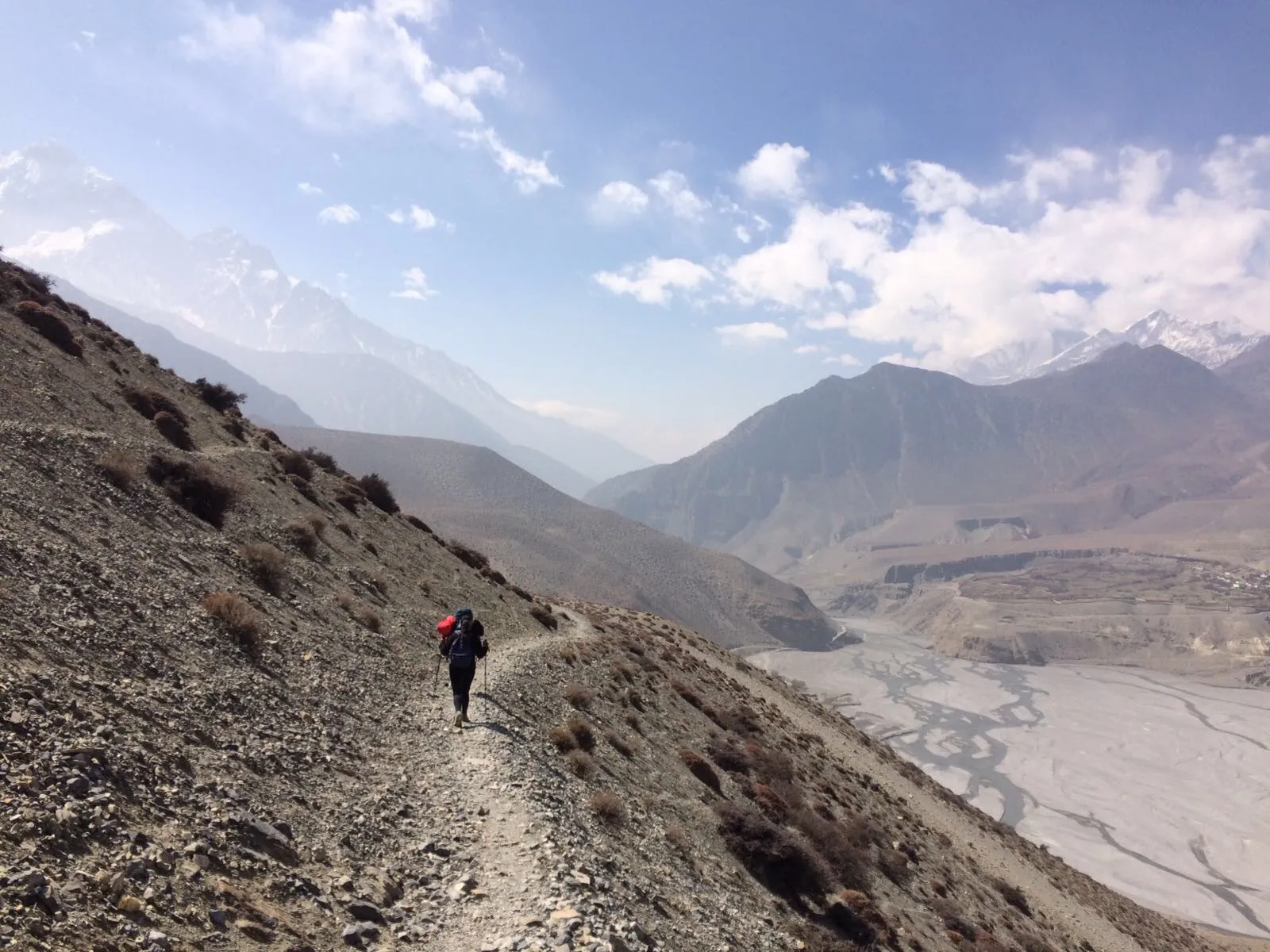
The ochre and red-banded cliffs that colour the landscape are eroded from ancient lake-bed sediment, and the flat-roofed mud-brick villages sit on alluvial terraces above the valley floor. This rain-shadow geology is directly why the trek remains walkable in the monsoon and why the scenery looks more like the Tibetan plateau than a Himalayan valley.
A licensed guide is mandatory on the Upper Mustang Trek: the restricted-area per…
A licensed guide is mandatory on the Upper Mustang Trek: the restricted-area permit is issued only through a registered agency and to trekkers accompanied by a licensed guide (the former two-trekker minimum was removed in March 2026, so solo trekkers are now welcome), and checking points along the route verify the permit and the guide's credentials. Swotah's guides hold Ministry of Tourism licences, have Nepal Mountaineering Association training, and know the gompa interiors and village protocols of Lo.
A porter is recommended for comfort: one porter carries up to 20 to 25 kg, and you walk with a light daypack. Swotah provides a free duffel for the porter load, caps weights at safe limits, and provides porter insurance. Tips for the guide and porter are customary; a common guideline is 10 to 15% of the trek cost, paid directly at the end.
Mobile coverage in Upper Mustang is patchy. Nepal Telecom (NTC) gives the best s…
Mobile coverage in Upper Mustang is patchy. Nepal Telecom (NTC) gives the best signal in Jomsom and Kagbeni, with weaker coverage in the villages above, and limited or no signal in Lo Manthang. Swotah can provide a tourist SIM with an NTC data package for the trip.
Wi-Fi is available at some lodges in Jomsom and Kagbeni for a fee, and rare or absent above. Charging costs a small fee per device at most lodges, rising with altitude. A power bank is important for the upper villages, where generator power is limited and socket access is not guaranteed, and cold nights drain batteries faster than at lower elevations.
Responsible trekking in Upper Mustang matters because the region is restricted,…
Responsible trekking in Upper Mustang matters because the region is restricted, the permit cap limits visitor numbers, and the communities depend on the trail economy. Carry a reusable bottle and treat your water, pack out all waste, ask before photographing people or gompa interiors, and walk clockwise around mani walls and chortens. The gompa custodians often ask for a small donation for entry and photography; this supports ongoing maintenance.
Tipping is customary but not mandatory. A standard guideline is 10 to 15% of the trip cost, shared between the guide, porter and driver, paid at the end of the trip. Booking with a registered agency like Swotah ensures that restricted-area permits are legal, staff insurance is in place, and porter loads meet government weight limits.
What to pack
What to pack
The full kit list. Anything we loan (sleeping bag, down jacket) is called out — bring everything else.
✓Duffel bag (carried by porter)
✓Daypack (25-30L)
✓Dry bag or rain cover
✓Packing cubes
Frequently Asked
Questions & Answers
Everything trekkers ask before booking. Don't see yours? Tap Enquire — we usually reply within a few hours.
Yes, our representative will be there to greet you at the airport. Upon arrival, you will be transferred to your hotel by a private car/jeep.
Yes, there is going to be a small orientation/briefing program before we embark on our adventure by the tour manager, leader/guide.
Upper Mustang is one of the most popular trekking routes in the world. Upper Mustang is a thrilling experience where you can explore ancient monasteries from the 14th century, Buddhist shrines, Tibetan culture, rustic villages and beautiful hospitable people of Mustang. It is little bit hard to do this trek so you will have to be physically and mentally fit and healthy to do this trek.
Spring (March to May) and autumn (September to November) are the best seasons, with stable weather and clear views. Uniquely for Nepal, Upper Mustang also works in the summer monsoon (June to August): it sits in the Himalayan rain shadow and stays dry, though flights to and from Jomsom can be delayed by weather in Pokhara. Winter (December to February) is very cold and many lodges close.
No vaccinations are required to enter Nepal, but the usual travel vaccinations are recommended: hepatitis A and B, typhoid, tetanus and diphtheria, and keeping routine vaccines such as polio and MMR up to date. Malaria is not a risk in the dry, high country of Upper Mustang; discuss prophylaxis with your doctor only if you also visit the lowland Terai. Check current advice with a travel clinic four to six weeks before you fly.
To confirm your booking we ask for a deposit based on how far ahead you book: 10% at 366+ days before departure, 15% at 151 to 365 days, 20% at 91 to 150 days, 30% at 31 to 90 days, 50% at 15 to 30 days, and full payment within 14 days of departure. The balance is due no later than 15 days before departure by bank transfer, or in cash (USD preferred) on arrival in Kathmandu. Credit card payments carry a 4% processing fee.
We believe in operating small intimate group to provide personal attention and services to our guests. Small groups can enjoy the trek hassle free and enjoy the customized trip according to their need and suitability. We do not incorporate more than 14 People in a group, unless we get special requests from our clients.
We customize the trip according to your preference but if you need to change plan during the trek, consult the guide.
If you need extra day to complete the trekking, you'll need to inform the guide in advance and the guide will let the company know. Adding a day to trekking can result in many changes in other arrangements such as transportation, guide’s schedule, flight details, hotel bookings and all, so we really don't recommend this to our clients unless there is an emergency case. But it is true that those changes could be made but it will cost extra. The best way to do it is to inform the agent company about it.
No, you cannot use the credit card during the trek. You have to withdraw the money before you start the trek. You can use credit card only in Kathmandu and Pokhara.
We contact the lodge/guesthouse owner for reservation of the room before trekking on a particular day. On other days, porters reach the destination on advance and book the rooms for you. But there are always going to be exceptions but even in those cases, we may have to be flexible about very basic sleeping arrangements. We always try to make sure that we have everything well arranged.
You carry only a daypack with water, snacks, a warm layer and your documents. A porter carries your main trek bag, so please keep it to about 12 kg. One porter carries up to 20 to 25 kg in total, and we cap loads at that weight because porters face the same trail and altitude as you do.
For nights in cities, we use standard/superior standard/deluxe rooms whereas, during the trek, we use lodges/tea houses/guesthouses/home stay for our clients, and whatever is available and accessible. We also arrange sleeping bags for our clients, on their request.
Upper Mustang is trekking region and mostly we spend our night at Guesthouse. In Guesthouse, you can get pasta, noodles, bread, soup etc. Dal Bhat (Rice, Lentils and Vegetables) are great way to gain energy for the strenuous trek. As you trek higher, it’s better to avoid meat because non-vegetarian is heavy meals which may cause food poisoning so we avoid it.
We use private transportation for sightseeing inside the Kathmandu Valley and to drive towards Pokhara too. We also drop and pick up from the starting and ending point of trek on private car or Jeep depending on the number of travellers.
Dress in layers for a wide temperature range: warm, sunny days on exposed trail and cold mornings, evenings and nights. Pack lightweight trekking trousers and base layers, a warm down jacket, a windproof shell (Mustang is famously windy by afternoon), a warm hat, gloves and sturdy trekking boots. Neutral colours and covered shoulders and knees are respectful in the monasteries and villages.
While trekking in higher lands, you need to pay for charging the electronics upon request to the guesthouse owner. The best idea is to bring your own power bank with you. It is easier and cheaper.
Mobile coverage reaches most of Upper Mustang, including the larger villages and Lo Manthang, though it weakens on the trails between them. Nepal Telecom tends to hold signal best, and Swotah provides a local SIM. Many teahouses also offer Wi-Fi for a small charge, and your guide carries a phone for emergencies.
Most days involve about 4 to 6 hours of walking on dry, rocky trails, with a couple of longer days near the higher villages. Upper Mustang has no high passes, so the days are steadier than the Annapurna Circuit. Your guide sets the pace and allows time for monasteries, photos and rest.
Yes, Nepal can proudly boast as one of the safest countries in South Asia for women, you will find people very friendly and respectful especially towards women. Locals are very respectful and welcoming toward women and tourist in general and our guides will make sure you are comfortable and safe while trekking in remote areas.
We make sure to take security measures during trek to make your trip delightful. We hire experienced and license holding guides to safeguard your life in mountains. We suggest you to follow the guide’s instruction carefully and take responsibility for personal belongings. Always keep your valued belongings near you and lock the door from inside during the night.
Always treat your drinking water on the trek; do not drink untreated tap or stream water. Boiled water is sold at every teahouse, and purification tablets, a filter or a UV pen all work well. Carry a reusable bottle and refill rather than buying plastic, which is a real waste problem in Upper Mustang. Aim for 3 to 4 litres a day in the dry high-desert air.
Make sure your travel insurance covers high-altitude trekking and helicopter evacuation, and bring the policy details with you. The trek tops out at 3,840 m in Lo Manthang, so serious altitude sickness is uncommon, but if anyone falls ill your guide contacts us at once and we arrange a helicopter to Pokhara, about 30 minutes away, for hospital care.
All our guides are trekking experts holding license from Nepal Tourism Board, Nepal Government. They are the most valuable assets of the company. Guides know the trekking route like the back of their hand and use their expertise in ensuring your safety in the mountains.
Why Travel with Swotah
Why Book the 10 Days Upper Mustang with Swotah
Most Nepal operators look the same from the outside. Here's what actually makes the difference.
Born in Nepal
100% locally owned since 2016. Trek profits stay with the mountain families and village schools along your route.
Guaranteed Departures
Every date on our calendar runs — no minimum group size. You never pay to be cancelled.
Certified Guides
Government-licensed, WFR-certified, English-speaking. Most were born within two valleys of the trail.
Small Groups
Small groups, never more than 8 trekkers. You get a real experience, not a convoy.
Gear Included
Sleeping bag and down jacket loaned at no extra charge — both rated to –20°C.
Flexible Payment
Deposit from 10% to confirm, balance before departure or in cash on arrival. Reschedule up to 30 days prior.
24/7 Support
Kathmandu office and dedicated WhatsApp emergency line. We answer at 2am if needed.
Hall of Fame
TripAdvisor Travelers' Choice 2023, 2024 and 2025. Hundreds of verified five-star reviews.
Get a free personalised travel brief for the 10 Days Upper Mustang.
Tell us your travel dates and group size. Our team in Kathmandu will put together a tailored itinerary, honest costs, and practical tips — completely free, no commitment.