

Pre-departure
Before you come to Nepal
The countdown, the kit, the money and the altitude — what to sort before you fly.
Six weeks is enough time to get ready for Nepal if you start with what depends on other people: a passport valid six months past your arrival date, insurance rated above your itinerary's high point, and a travel clinic appointment. Boots, cash, a SIM card and a water filter can wait until the last fortnight.
What do you need to sort out before you fly to Nepal?
- Eight weeks out. Nepal refuses a passport with under six months' validity from your arrival date, even at a land border. Book the travel clinic, because some vaccines run as a course. Buy insurance naming an altitude ceiling above your high point, with helicopter evacuation and repatriation; our travel insurance page has the rest.
- Four weeks out. Walk your boots in on real hills under a loaded pack. Restricted-area permits (Manaslu, Upper Mustang, Tsum, Nar Phu, Upper Dolpo, Kanchenjunga) are only issued through a registered agency, so send your passport scan and dates now. A licensed guide has been required in national parks and conservation areas since April 2023, still enforced in 2026 by operator reports.
- One week out. File the pre-arrival visa form at nepaliport.immigration.gov.np. It issues no visa; it pre-registers your details and prints a barcode that shortens the counter queue. Operators report the receipt lapsing about 15 days after submission, so check the window on the live form rather than filing early.
- 48 hours out. Power banks into cabin luggage per your airline's lithium rules, cards and cash split across two bags, insurer's 24-hour line screenshotted.
Cards get swallowed, blocked by fraud systems on a first Nepali transaction, or refused by an ATM out of notes. Carry two cards on different networks plus clean USD cash for the visa fee.
Which vaccinations do you need for Nepal?
The CDC lists Hepatitis A for almost all travellers to Nepal and Typhoid especially for smaller towns, rural areas or staying with local families. Hepatitis B applies to unvaccinated travellers under 60, and Japanese encephalitis to stays of a month or longer, or shorter stays with rural or extended outdoor exposure, mainly June to October in the Terai. Pre-exposure rabies vaccination may be considered given the stray-dog population, cholera for areas of active transmission. Stay current on MMR, DTaP or Tdap, varicella, polio and flu. Yellow fever is not required for Nepal itself, but proof can be demanded if you arrive from an endemic country. A travel clinic makes the final call, so take your dates and altitude profile to the appointment.
What should you pack for a Nepal trek?
Three layers do the work: a wicking base layer, an insulating mid layer you can add without stopping, and a windproof waterproof shell. Above 4,000 m, autumn and spring days run 5 to 15°C and nights fall well below freezing, so you dress for two climates inside 24 hours.
- Broken-in boots with ankle support, and the socks you tested in them.
- A sleeping bag rated comfortably below freezing. Rooms above 4,000 m are unheated.
- Waterproof shell jacket and trousers; sun hat, warm hat, liner and insulated gloves.
- Strong UV sunglasses, high-factor sunscreen and lip balm.
- Water treatment (filter, UV steriliser or tablets) plus two litres of bottle capacity.
- Headtorch, spare batteries, power bank, and an adapter for type C, D and M sockets.
- Two passport photos, a passport photocopy, blister plasters, prescriptions in original packaging.
Our published FAQ states that we provide sleeping bags, duffel bags and tents for trek and peak climbing, and that boots, flip-flops and personal gear are yours to bring. Check your own confirmation before buying anything expensive, because Thamel sells and hires most bulky items; our trekking gear list goes item by item.
Boots bought the week before departure end more treks than weather does. Blisters at 4,000 m do not heal while you keep walking, and there is no shop between Namche and Everest Base Camp.
How much cash should you bring, and how does money work in Nepal?
Nepal's currency is the Nepalese Rupee (NPR), issued by Nepal Rastra Bank and pegged to the Indian Rupee at a fixed INR 1 = NPR 1.60. The USD rate floats: on 30 July 2026 Nepal Rastra Bank published roughly USD 1 = NPR 152.74 buy and NPR 153.34 sell, so check the day's rate at nrb.org.np/forex. ATMs are common in Kathmandu, Pokhara and larger towns, usually capped at NPR 10,000 per withdrawal, and the major cards work at tourist-class hotels and airlines with a bank-set fee of roughly 4%.
Above the roadhead there are no ATMs and no card readers, so you carry the whole trek's spending in NPR from Kathmandu: drinks, charging, WiFi, snacks and the tip. Tipping comes at the end of a trek, in cash on the last night, either to guide and porters separately or as a pooled sum the group agrees. We publish no per-day figure because it turns on trip length, group size and crew numbers, so ask your trip coordinator what is normal for your departure.
ATMs dispense NPR 1,000 notes and no village teahouse can change one at seven in the morning. Convert a chunk into 100s and 500s in Kathmandu, and bring the exact USD for the visa desk in clean, recent-series notes.
How do you get a SIM card and stay connected on trek?
Ncell and Nepal Telecom (NTC) run tourist SIM counters inside Tribhuvan International Airport, activated in about 10 to 15 minutes on your passport, arrival visa and a photo. As of mid-2026, indicative pricing runs around NPR 880 for 10GB on NTC and NPR 599 for 7GB on Ncell; confirm on the Ncell tourist SIM page, because packs change often. Coverage thins as you climb: Ncell 4G is generally reported as stronger to around Namche Bazaar in the Everest region, to Manang in Annapurna and to Kyanjin Gompa in Langtang, while NTC is often reported as more consistent in remoter high sections such as Annapurna Base Camp. Higher up, and on Manaslu, Upper Mustang and Dolpo, expect little or no data; teahouses on the busy routes sell paid WiFi instead.
NTC and Ncell drop out in different places. A few hundred rupees on a second SIM turns one network's dead zone into the other's coverage.
Electricity, charging and power banks at altitude
Nepal runs 230V at 50Hz on plug types C, D and M, so bring an adapter covering all three; hotels often fit universal sockets, villages do not. Most modern electronics take 100 to 240V, so a converter is rarely needed, and our plugs and adapters guide covers the pin shapes. Cold flattens lithium batteries faster than use does, so sleep with batteries and power banks inside your sleeping bag. Assume teahouse charging is a paid extra, paid in cash, and not always available after two sunless days on a solar system.
Which water is safe to drink in Nepal?
Tap water in Nepal, Kathmandu included, is not safe to drink untreated because of contamination risk in pipes and storage tanks. Treat everything: a filter, a UV steriliser, chlorine dioxide tablets or a rolling boil all work, and teahouses on the main routes sell boiled water by the litre. Above Namche Bazaar, bottled water stops making sense, because every bottle was carried up by porter or pack animal and the empty is carried back down or burned inside a national park that has been a UNESCO World Heritage property since 1979. Most operators here now push refill-and-purify over single-use plastic for that reason.
Buying bottled water all the way to Base Camp costs more, weighs more and leaves waste that has to be walked or flown out of Sagarmatha National Park. Carry a treatment method and refill at the lodge.
How does the acclimatisation schedule work, and what should you tell your guide?
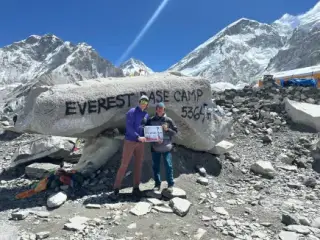
Above about 2,500 m you are exposed to acute mountain sickness (AMS) and, in its severe forms, high-altitude cerebral edema (HACE) and high-altitude pulmonary edema (HAPE). AMS is a headache plus nausea, vomiting, loss of appetite, dizziness or fatigue, typically appearing 2 to 12 hours after reaching a new altitude, which is why the headache you shrug off at 3pm matters by 9pm. The rule your itinerary is built on comes from the CDC: above 3,000 m, gain no more than about 500 m of sleeping altitude per night and add an acclimatisation night for every 1,000 m gained. That is why the acclimatisation days at Namche and Dingboche on an Everest Base Camp trek to 5,364 m are structural rather than padding.
Report every symptom on the day it happens: a headache declared at Dingboche is a rest day, while the same headache concealed until Lobuche is an evacuation. HACE shows as confusion, loss of coordination, altered mental state and vomiting; HAPE as breathlessness on exertion, chest tightness and cough. Descent is the only definitive treatment.
Skipping an acclimatisation day turns AMS that a rest night would have cleared into a descent and a helicopter bill of USD 3,000 to 6,000 out of the Khumbu. Nepal's rescue system was the subject of a fraud investigation reported in 2026, so call your insurer's assistance line for pre-authorisation before any evacuation that is not life-threatening.
What does the weather do month by month in Nepal?
Nepal has four travel seasons, and roughly 80% of the annual rainfall arrives in the monsoon as heavy afternoon and evening downpours.
| Season | Months | Kathmandu (approx. 1,400 m) | Above 4,000 m |
|---|---|---|---|
| Spring | March to May | 15 to 30°C by day | 5 to 15°C days, sub-zero nights |
| Monsoon | June to early or mid September | 20 to 28°C, humid | Cloud and rain |
| Autumn | Late September to November | 10 to 25°C by day | 5 to 15°C days, sub-zero nights |
| Winter | December to February | Roughly 2 to 19°C | Cold, passes sometimes snow-closed |
Autumn buys the clearest skies of the year and the busiest trails; spring buys warmth and rhododendron from late March; monsoon buys trail damage, leeches and hidden mountains. Two festivals should shape an autumn departure date, because both close businesses and disrupt transport: Dashain 2026 runs mid to late October, with Fulpati on Saturday 17 October, and Tihar follows with Bhai Tika on Wednesday 11 November. If your only free window is the monsoon, go to the rain shadow, where Upper Mustang and Dolpo stay trekkable into early September. Our difficulty grading shows whether a route matches your fitness in the season you can travel.
Which cultural etiquette actually matters in Nepal?
Nepal is 81.19% Hindu and 8.21% Buddhist by the 2021 census, and in the Kathmandu Valley the two traditions share the same courtyards. The greeting is Namaste or Namaskar, palms together at the chest. Feet carry the strongest taboo: do not point your soles at a person, a shrine or a cooking fire, do not step over someone sitting on the floor, and take your shoes off where your host does. Walk clockwise around stupas and mani walls, and cover shoulders and knees at temples; your guide will say which shrines non-Hindus may not enter and where leather comes off at the gate. Ask before photographing a person and accept a refusal, and at Pashupatinath keep the camera down on the cremation ghats. When you shop, our published guidance asks visitors not to buy sacred images, paintings or manuscripts, because they are Nepal's cultural heritage and belong here.
| English | Nepali |
|---|---|
| Hello | Namaste |
| How are you? | Tapaiilai kasto cha? |
| I am fine. | Malai thik cha. |
| Have you eaten? (an informal greeting) | Khana khannu bhayo? |
| Thank you | Dhanyabaad |
What happens on arrival day in Kathmandu?
Tribhuvan International Airport is Nepal's dominant international gateway, and the sequence is the same for everyone: arrival declaration, visa counter, baggage, then the wall of drivers at the exit. Hand over your passport, your online form receipt, a passport photo and the fee in cash, because card machines exist but are reported as unreliable. Visa on arrival costs USD 30 for 15 days, USD 50 for 30 days and USD 125 for 90 days, all multiple entry, and children under 10 are free except US citizen children, who pay the adult fee. Thirteen nationalities cannot use visa on arrival at all and must apply in advance at a Nepali mission; our Nepal visa information page carries the list.
Kathmandu sits at roughly 1,400 m, below the 2,500 m threshold where altitude illness starts, so night one is a jet-lag night rather than an altitude night. Nepal Standard Time is UTC+5:45, which catches people out setting an alarm for a dawn domestic flight. Before you leave the valley, get a face-to-face run-through of the itinerary with your trip coordinator: the altitude profile day by day, which permits are in hand, and what the porter carries against what stays in your daypack. Swotah Travel arranges your in-country travel to match your itinerary, so read your confirmation for what your departure includes and ask us to arrange anything it does not, an airport transfer included. Our Nepal at a glance page covers the country background.
Mountain flights and hill roads get cancelled for weather. A spare day in Kathmandu between the trek finishing and your international flight is the cheapest insurance you can buy.
How much cash should I carry for a Nepal trek?
Enough NPR for every day above the roadhead, drawn in Kathmandu, because there are no ATMs or card readers on the trail. Budget for drinks, charging, WiFi, snacks and the tip, against the usual NPR 10,000 ATM cap.
Do I need vaccinations to enter Nepal?
None is required for entry unless you arrive from a yellow-fever-endemic country, where proof can be demanded. The CDC recommends Hepatitis A and Typhoid for most travellers to Nepal, with Hepatitis B, Japanese encephalitis, rabies and cholera considered by itinerary.
Can I drink the tap water in Kathmandu?
No. Tap water anywhere in Nepal is unsafe untreated. Use a filter, a UV steriliser, chlorine dioxide tablets or boiled water, which on trek is cheaper than buying bottles carried up by porter.
Will my phone work on the Everest Base Camp trek?
Partly. Ncell 4G is generally reported as workable to around Namche Bazaar, after which coverage thins and teahouses sell paid WiFi instead. Buy a tourist SIM at Tribhuvan International Airport with your passport and arrival visa.
What is the best month to trek in Nepal?
October and November give the clearest post-monsoon skies and the steadiest weather, followed by March to May for warmth and rhododendron. June to early September is monsoon and is not recommended for standard routes.
How fast can I gain altitude on a Nepal trek?
Above 3,000 m, no more than about 500 m of sleeping-altitude gain per night, with an extra acclimatisation night for every 1,000 m gained, per CDC guidance. If symptoms worsen at rest, you descend.
What altitude must my travel insurance cover for Nepal?
Above your itinerary's high point, because most mainstream policies exclude altitude over 3,000 to 4,000 m, below Everest Base Camp. Insurers commonly recommend cover to at least 6,000 m for Base Camp and Kala Patthar (5,545 m), and 7,000 m for trekking peaks such as Island Peak (6,189 m). It must also cover helicopter evacuation and repatriation.
Visa fees, permit rules and exchange rates as of July 2026. Confirm with the Department of Immigration, rates with Nepal Rastra Bank, and health advice with the CDC Nepal travel health page and your own travel clinic.
Questions your packing list cannot answer?
Ask the team who runs these trips. We will tell you what your specific route needs in your specific month.