

A Swotah representative meets you on arrival at Tribhuvan International Airport (TIA) in Kathmandu and transfers you to your hotel by private vehicle. After check-in, there will be a briefing covering the full 21-day itinerary, entry requirements and permits for Bhutan and Tibet, what to expect in each country and any practical questions. If your Bhutan and Tibet arrangements have not yet been finalised, this briefing is also the point at which Swotah will confirm your documentation for both countries. The rest of the day is free to recover from travel and orient yourself. Kathmandu sits at 1,400 m / 4,593 ft; drink plenty of water. The Thamel area close to most hotels has a wide variety of restaurants for dinner at your own account. Overnight: 3-star hotel in Kathmandu.
21 days across three Himalayan nations — Nepal's heritage and jungles, Bhutan's Tiger's Nest and Dzongs, and Tibet's Potala Palace and high-altitude plateau.
Choose your date
All dates are guaranteed departures — we never cancel for low numbers. Book online or send a quick enquiry.
Can’t find a suitable date? We run private departures on any date with as few as 2 trekkers.
About the Best of Nepal, Bhutan and Tibet
Best of Nepal, Bhutan and Tibet is a 21-day guided tour that covers all three Himalayan nations in a single journey: Nepal's cities, jungles and lakeside valley; the Buddhist kingdom of Bhutan; and the vast, high-altitude Tibetan Plateau. The tour runs with fully licensed local guides in each country and includes private vehicles in Bhutan and Tibet, a mix of tourist and private road transport in Nepal, and two short international flights linking the countries.
In Nepal, the itinerary visits all four of Kathmandu Valley's UNESCO-listed monument zones—Pashupatinath, Boudhanath, Swayambhunath and Kathmandu Durbar Square—before continuing to Chitwan National Park for a two-night jungle safari (canoe, jeep and birdwatching), then Pokhara for a day of lake and mountain sightseeing. Bhutan is the second leg: four nights across Thimphu, Punakha and Paro with sightseeing at the Buddha Dordenma statue, Tashichho Dzong, Punakha Dzong, Chhimi Lhakhang (Temple of Fertility), and the National Museum in Paro. The signature day is the hike to Taktsang Monastery (Tiger's Nest) at 3,120 m / 10,240 ft, perched on a sheer 900-metre cliff face above the Paro valley.
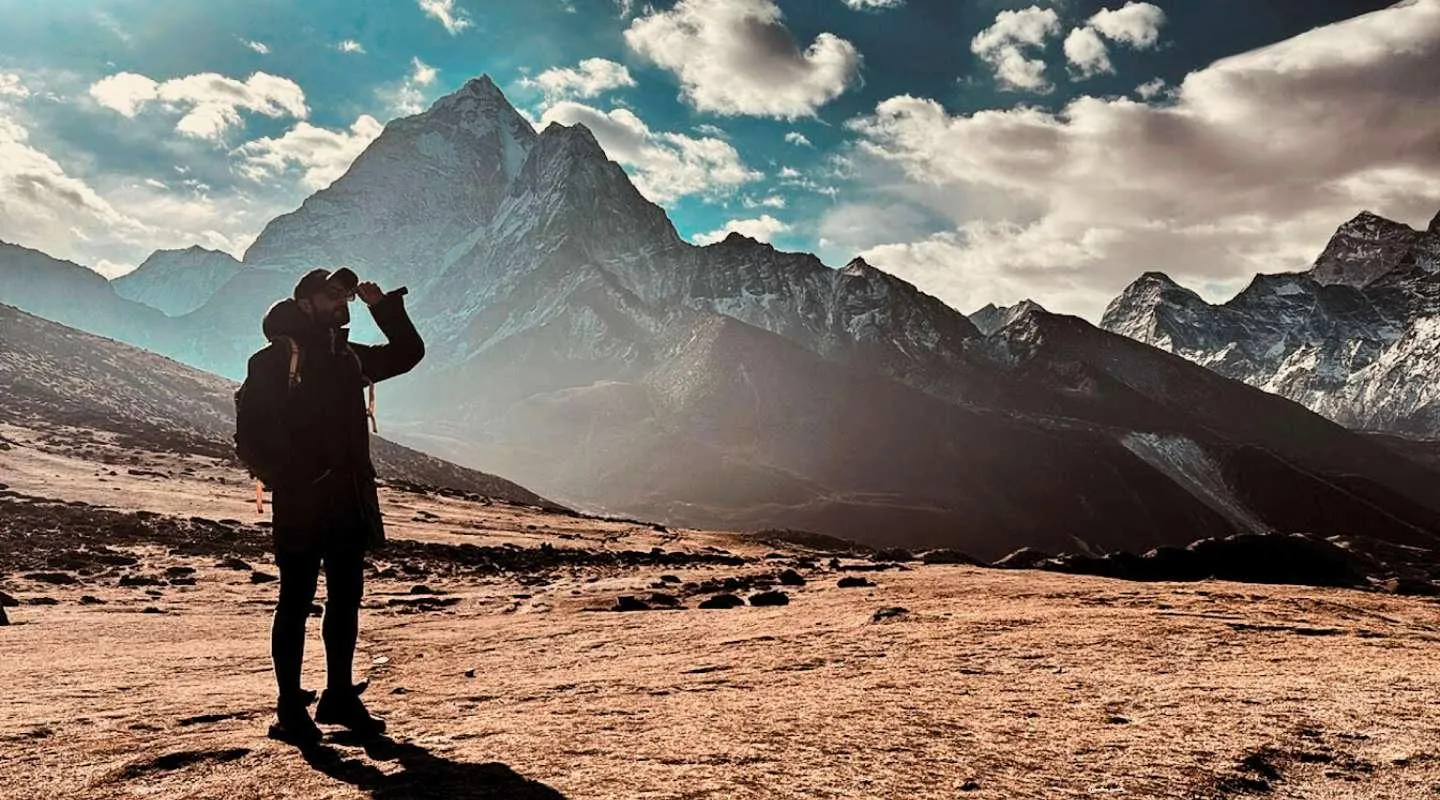
Tibet is the final leg, entered overland from Kathmandu via the Friendship Bridge and Kerung (Gyirong). Driving into Tibet by road—rather than flying directly to Lhasa at 3,650 m—gives the body two days to acclimatise gradually as altitude rises. The route crosses the Tibetan Plateau past views of Everest, Cho Oyu and Shishapangma from Tingri, crossing the Gyatso La Pass at 5,220 m / 17,126 ft — the highest point of the tour — before Lhatse, then continuing to Shigatse, where the Tashilhunpo Monastery is the home of the Panchen Lama. Two full days in Lhasa cover the Potala Palace and Jokhang Temple (both UNESCO World Heritage Sites), Barkhor Bazaar, and the great monasteries of Drepung and Sera. The return to Kathmandu follows the scenic route past Yamdrok Tso Lake and the Yarlung Tsangpo River, over the Karo La Pass at 5,010 m / 16,437 ft, before the final Kathmandu overnight and departure.
Last updated June 2026
Highlights
Hike to Taktsang Monastery (Tiger's Nest) at 3,120m — one of the world's most dramatic Buddhist sites
Explore the Potala Palace and Jokhang Temple in Lhasa — Tibet's greatest UNESCO World Heritage Sites
Canoe and jeep safari in Chitwan National Park — one-horned rhinos, crocodiles and over 400 bird species
Cross the Tibetan Plateau past Everest, Cho Oyu and Shishapangma over Gyatso La Pass at 5,220m
UNESCO World Heritage Sites in Kathmandu: Pashupatinath, Boudhanath, Swayambhunath and Durbar Square
Yamdrok Tso Lake and the Yarlung Tsangpo River on the scenic return journey from Lhasa
Best of Nepal, Bhutan and Tibet Itinerary: 21 Days
Tap any day to expand — altitudes, walking times, meals, and overnight details for every stage of the journey.
What's included
Every cost on the trail is broken out below — no hidden fees, no surprises at the trailhead.
Included
10 items
- Meals: Bed & Breakfast in Nepal, except in Chitwan (Full Board in Chitwan), Full Board in Bhutan, Bed & Breakfast in Tibet
- All accommodation nights (twin-sharing basis) in 3-star category hotels as listed in the itinerary
- All airport pickups and drops during the tour
- Tourist bus: Kathmandu to Chitwan, Chitwan to Pokhara, and Pokhara to Kathmandu (private car available as a paid upgrade)
- Shared jeep/van: Kathmandu - Kerung - Shigatse - Lhasa and back
- Private vehicle for all transfers and sightseeing in Bhutan
- The Sustainable Development Fee (SDF)
- All permits and taxes; travel permits for Tibet and Bhutan
- Sightseeing and monument entrance fees in Bhutan
- English-speaking local guide in each country and support staff
Not included
14 items
- Travel and medical insurance.
- Flights: Kathmandu to Paro and return flight: $525/pax approx. (subject to change due to season and availability)
- Lunch and dinner in Nepal and Tibet.
- Meals other than those mentioned in the itinerary.
- Expenses of a personal nature, such as bar bills, laundry, telephone calls, personal gratuities, etc.
- Nepal Visa fees: $50/pax (paid in cash on arrival at the airport)
- Visa to Bhutan:$40/pax (pre-arranged);
- Tibet Visa fees: $125.00 (extra $100 for USA)
- Sightseeing entrance fees in Nepal
- (Kathmandu - Paro - Kathmandu) flight (approximately USD 525 per person), Nepal and Tibet sightseeing entrance fees, lunch and dinner in Nepal (except Chitwan) and Tibet, travel insurance, tips, and personal expenses
- Any item not included in the inclusion section.
- Flight upgrade: (Lhasa-Kathmandu) (min 4 passengers required for the option).
- Flight upgrade: Kathmandu-Pokhara, Pokhara-Bharatpur, Chitwan-Kathmandu.
- Private car upgrade: (Kathmandu-Pokhara-Chitwan-Kathmandu).
How Hard Is the Best of Nepal, Bhutan and Tibet?
This tour is suitable for travellers of all ages and general fitness levels. The focus is sightseeing, road travel and short walks rather than multi-day trekking. The most physically demanding activity is the hike to Tiger's Nest in Bhutan: a return hike of approximately six hours with 900 m of elevation gain on a rough, rock-strewn path. If you feel you cannot complete it, there is a café about halfway that provides good views, and Swotah can arrange an alternative activity. The canoe and jeep safari in Chitwan are easy; the city sightseeing in Kathmandu, Thimphu, Paro and Lhasa involves walking at a moderate pace on flat ground for two to four hours a day. The main challenge on this tour is the altitude in Tibet — not from physical exertion, but from the elevation itself (up to 5,220 m over a mountain pass). Travelling by road into Tibet rather than flying allows your body to acclimatise gradually. Even so, most guests feel mild symptoms at some point in Tibet. Please read the Tibet altitude section below.
Planning your Best of Nepal, Bhutan and Tibet
Everything you need to plan the trek, topic by topic. Tap any one to open it.
Best of Nepal, Bhutan and Tibet is a sightseeing and road-travel tour — not a tr…
Best of Nepal, Bhutan and Tibet is a sightseeing and road-travel tour — not a trekking expedition. The daily pace is moderate: two to four hours of walking on guided sightseeing days, with longer road drives between destinations. The exception is the Tiger's Nest hike in Bhutan (day 6), which is a six-hour return walk with around 550 m of altitude gain on an uneven rocky path. This is manageable for most adults of reasonable fitness; a halfway café with views of the monastery is available for those who prefer not to summit.
The tour is suitable for travellers of any age with no significant mobility impairment. There is no minimum fitness requirement beyond the ability to walk on uneven surfaces for a few hours. Those over 80 who wish to enter Tibet may be required to provide additional medical documentation — a letter from your GP confirming you are fit to travel at high altitude is worth bringing regardless of age. Consult your doctor if you have cardiovascular, respiratory or circulatory conditions before booking this tour.
Spring (March to June) and autumn (September to November) are the recommended se…
Tibet is the highest region on Earth. The altitude you will sleep at reaches 4,3…
Nepal: 3-star hotels in Kathmandu and Pokhara with Wi-Fi, air conditioning, and…
One of the real pleasures of this tour is that each country has genuinely distin…
All three countries on this tour require travellers to be accompanied by a gover…
Bhutan is one of the most distinctive countries in the world. The kingdom strict…
Tibet sits at the heart of some of the most significant geopolitical tensions in…
Nepal is the only country in the world where Hinduism and Buddhism coexist at th…
Nepal: Visa on arrival at Tribhuvan International Airport. USD 30 for 15 days or…
This tour passes through sites of profound religious and cultural significance i…
Nepal: Nepali Rupees. Exchange USD, GBP or EUR at Tribhuvan Airport or Thamel mo…
Best of Nepal, Bhutan and Tibet Reviews from Swotah Travellers
Short clips from people who have done this trek. Tap any to play.
What to pack
The full kit list. Anything we loan (sleeping bag, down jacket) is called out — bring everything else.
- Main suitcase or rucksack (max 30 kg / 66 lbs for Bhutan flight; 30 kg for Nepal domestic flights)
- Day pack 20-25L for sightseeing days and the Tiger's Nest hike
- Waterproof pack cover
Our Guides for Best of Nepal, Bhutan and Tibet
Experienced local guides who know every trail, village, and viewpoint on this route.

Questions & Answers
Everything trekkers ask before booking. Don't see yours? Tap Enquire — we usually reply within a few hours.
- Spring (March to June) and autumn (September to November) are the best seasons for all three countries. Spring brings rhododendrons in bloom in Nepal and Bhutan and generally clear weather. Autumn offers the best post-monsoon mountain visibility — the sharpest views of the year across the route. Swotah recommends avoiding July and August (peak monsoon in Nepal and Bhutan) and December to February (below-freezing in Bhutan and Tibet, possible pass closures).
Why Book the Best of Nepal, Bhutan and Tibet with Swotah
Most Nepal operators look the same from the outside. Here's what actually makes the difference.
Born in Nepal
100% locally owned since 2016. Trek profits stay with the mountain families and village schools along your route.
Guaranteed Departures
Every date on our calendar runs — no minimum group size. You never pay to be cancelled.
Certified Guides
Government-licensed, WFR-certified, English-speaking. Most were born within two valleys of the trail.
Small Groups
Small groups, never more than 8 trekkers. You get a real experience, not a convoy.
Gear Included
Sleeping bag and down jacket loaned at no extra charge — both rated to –20°C.
Flexible Payment
Deposit from 10% to confirm, balance before departure or in cash on arrival. Reschedule up to 30 days prior.
24/7 Support
Kathmandu office and dedicated WhatsApp emergency line. We answer at 2am if needed.
Hall of Fame
TripAdvisor Travelers' Choice 2023, 2024 and 2025. Hundreds of verified five-star reviews.
.webp)