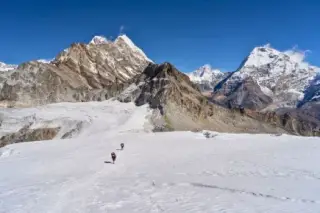
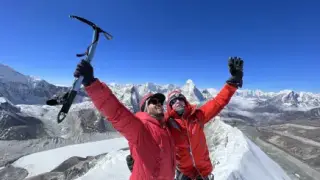
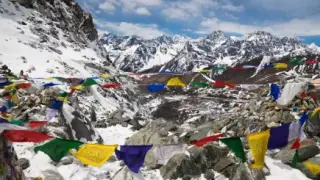
The Cho Oyu Expedition is a 44-day guided ascent of Cho Oyu (8,188 m), the world's sixth-highest mountain, on the Nepal-Tibet border in the Khumbu Himalaya. Cho Oyu means Turquoise Goddess in Tibetan, and the mountain stands just 26 km west of Everest, separated from the Khumbu by the ancient Nangpa La trade pass. Because its normal route on the north-west face holds no vertical rock barrier and gains altitude on moderate slopes relative to other 8,000 m peaks, Cho Oyu is widely regarded as the most technically accessible 8,000 m summit and is the most climbed of the 14 eight-thousanders.
The expedition approaches from the Tibet side, driving from Kathmandu through the Khasa/Zhangmu border crossing to Lhasa (3,650 m), then west across the Tibetan plateau through Shigatse and Xegar to Chinese Base Camp (approximately 4,800 m). From there yaks carry loads two days to Advanced Base Camp (5,700 m) at the foot of the north-west face. Three high camps at roughly 6,400 m, 7,100 m and 7,500 m are established and stocked during multiple rotation carries before summit day.
This is a serious high-altitude mountaineering expedition, not a trek. Climbers must be physically fit, experienced on crampons and jumar, and able to use supplemental oxygen. The Chinese Mountaineering Association permit, Tibet travel permit and Cho Oyu climbing royalty add up to significant paperwork and cost, all arranged by Swotah from Kathmandu. The sections below cover difficulty, permits, acclimatisation, gear and what to expect on the north-west face.