Mount Nuptse is a 7,861 m peak in the Khumbu Himal that forms the western wall of the Everest massif. It stands immediately southwest of Everest, connected to Lhotse by a high saddle at 7,556 m, and its main summit was first reached on 16 May 1961 by Dennis Davis and Sherpa Tashi Sherpa via the north ridge during a British expedition that also included Chris Bonington. Despite its proximity to the world's highest mountain, Nuptse sees far fewer attempts than its 8,000 m neighbours and remains a serious, seldom-climbed objective.
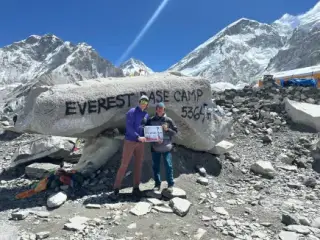
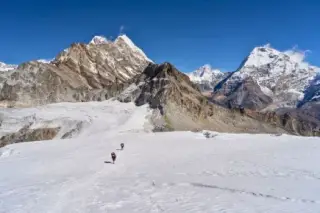
The south face rises 2,500 m and spans 5 km across, one of the most imposing walls in the Himalaya. The north ridge, the standard route, demands strong rock, ice and mixed climbing technique, with fixed ropes through steep sections and high camps typically established between 6,200 m and 7,000 m before the final summit push. The approach follows the classic Everest trail from Lukla through Namche Bazaar, Tengboche and Dingboche to Lobuche, then to base camp near the foot of the Nuptse wall at roughly 5,300 m.
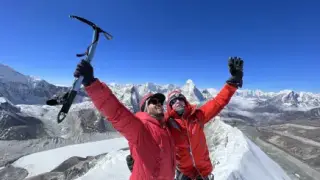
This is a 43-day expedition covering approach, acclimatisation, full climbing rotations and return. Climbers need expedition experience on peaks above 6,000 m, proficiency with crampons, ice axe, fixed rope and technical mixed terrain, and a clean bill of health before departure. Nepal's climbing royalty applies in the 7,501 m to 7,999 m band. The sections below cover the technical demands, permits, seasons, camps, food and what to pack for an expedition of this scale.