






Lukla Airport: A Passenger's Nightmare
Would you dare risk your life for an adventurous trip? Well, most of you wouldn't. While traveling to beautiful destinations can bring you joy, you don't care about the drawbacks of your package. So it would be best if you took an assessment and research before choosing your destiny and whether you would like to go there.
There are many beautiful places with challenging routes that can be life-threatening. And it would help if you were well-prepared for that. Whether you choose Death Valley in California or The Danakil Desert in Ethiopia, safety always comes first in your trailblazing trip. Here, we will discuss one of the same kinds of destinations: Lukla Airport.

Lukla is a place to kick off your Everest Base Camp trek. The only way to get to Lukla and start your Everest Base Camp trek is by going on a flight to Lukla Airport or in a bus or a rented vehicle to Jiri or Salleri, trekking from there. Reaching there could be more arduous than you think, but what really makes Lukla Airport so dangerous? Lukla Airport, also known as Tenzing Hillary Airport, is considered one of the most dangerous airports in the world, with serious accident and death rates throughout time.
Also, it's hard to access and is no destination for passive trekkers since you will lead through some challenging hills, passes, and rivers. The extremely sloping topography is a barrier for you to treasure your trip. Remember, Lukla is just a starting point of Everest Base Camp, you never know what is waiting for you behind Lukla. So always be prepared for the worst and make yourself strong to take risks in traveling.
Let's discuss some of the reasons behind Lukla Airport being one of the most dangerous airports.
Perils of Landing and Taking Off at Lukla Airport
Lukla Airport sits at an altitude of 2,846 meters from sea level, which is quite breathtaking. Whether it's land topography or dynamic weather, there are always some reasons behind the possible danger. Here are some of the factors to discuss:
Dynamic Weather
Lukla Airport features dynamic weather that can turn the day from sunny to cloudy and rainy to snowy within a short time. Similarly, the dawn and dusk of the area are always moist, which is a primary issue for air pilots to take flight.
If you know that airports at high-altitude are dangerous not just because of the weather but also due to the low air pressure. Low pressure directly impacts an airplane's handling, which can be life-threatening. Reduced Air Resistance makes it hard to slow down the aircraft. Reports show that around 50% of the flights in the afternoon get canceled just because of poor visibility. Lukla Airport has seen many vicious accidents throughout time, and seven of them killed more than 50 people, as per record.
High Altitude
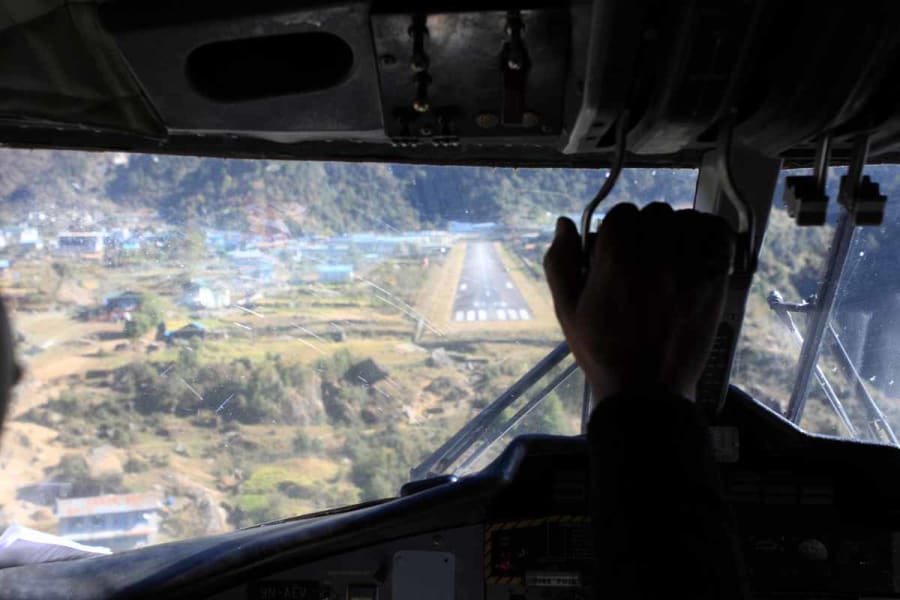
Lukla Airport is one of the highest airports in the world, located at 2,846 m. The airport is surrounded by steep hills causing problems for the pilot in properly landing the plane.
Being at a high altitude, weather issues, low air pressure, and density are common at Lukla Airport.
Short Runways
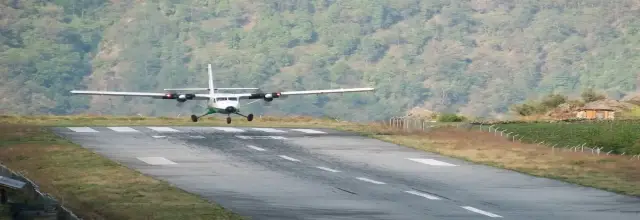
Lukla has one of the shortest runways of any commercial airport in the world: just 527 metres (1,729 feet) long, with a gradient of nearly 12%, a mountain wall at one end and a sheer drop into the valley at the other. Generally, most international airports have long runways extending up to 10,000 feet; however, Lukla only has a 1,729-foot runway, which is really scary.
It's the surrounding mountains and the direction of the airport that sits in between it, which makes piloting hard in the air, but when it comes to landing, short runways are the great thing to deal with because it can be the last moment of your life if you don't handle it properly.
Accidents At Lukla Airport
Accidents are not strange to see in Airports, and it is frequent when it comes to the scariest airports. Many accident records in Lukla Airport date back from 1973 to 2019.
Back in 1973, a crash of a De Havilland DHC-6 Twin Otter 300 in Lukla caused despair. The Airplane under Royal Nepal Airlines went down due to unknown circumstances when taking off from the airport.
All six passengers from the flight were left uninjured; however, the aircraft was damaged beyond repair.
The next mishap came on June 9, 1991, when De Havilland DHC-6 Twin Otter 300 in Lukla crashed due to unhealthy weather conditions. The pilot went around to follow the holding pattern due to bad weather. Later, when he tried to land, it struck the runway and bounced which caused all 17 passengers to be injured. The plane was never to be repaired since it fully deteriorated.
The following year on September 26, 1992, Harbin Yunsunji Y-12-II in Lukla crashed with no passengers injured. Similarly, the crash of Yeti Airlines' De Havilland DHC-6 Twin Otter on May 25, 2004, killed all three crew members on board the cargo flight. The plane hit the mountainside near Lamjura Pass due to poor visibility at an altitude of 11,600 feet.
The crash of Dornier DO228-201 in Lukla on June 30, 2005, left 12 passengers with injuries. Three years later, De Havilland DHC-6 Twin Otter crashed below the runway after it struck a rock and burst into flames. The mishap cost 18 lives: 12 Germans, 2 Australians, and 4 Nepalese citizens died, with the captain the sole survivor.
The collision of Dornier DO228 on August 25, 2010, took 14 lives. Similarly, another Dornier, DO228 of Sita Air P. Ltd, crashed, costing 19 lives, 16 passengers, and three crew.
The latest accidents in Lukla Airport are the ramming of Let L-410UVP-E20 in Lukla on May 27, 2017, and the runway excursion of another Let L-410 on April 14, 2019, which killed 2 and 3 people, respectively.
Preparations Needed to Fly in and Out of Lukla Airport
The first and foremost preparation to make for a safe ride in Lukla Airport is to check the health of airplanes so that there will not be any technical problems that can cause a mishap. It is apparent that Nepal has many poorly maintained aircraft that are still voyaging their flights, and it can take a lot of work to travel in those. Checking out every aspect of a plane's health would be a great kickstart.
The next important thing to keep in mind is the weather. Since Lukla is located at a high-altitude level, the weather is usually dynamic and frosty. It causes poor visibility for pilots to handle their flights. Scheduling flights only when the forecast is favourable is the better option. Note that in the busy spring and autumn seasons, most Lukla flights now operate from Manthali Airport in Ramechhap, about four hours by road from Kathmandu, to ease congestion at TIA. Read our guide to Lukla flight disruptions before planning tight connections.
Technical Support & Communication comes as the following vital elements to prepare. Every flight needs a qualified technical team to guide them about the radar, weather, and other aspects. Having proper communication with the team might help in flying in and out of Lukla Airport.
Repairs to the airport also can mitigate the rate of accidents that happen in Lukla Airport. Investigating the runways, stores, and quality of black-topped materials should be kept in mind from the start so that no plane will have to face any risks in landing.
What Is Being Done by Authorities to Improve Safety at Lukla Airport?
The primary thing to upgrade is the whole team responsible for taking flights and checking the plane's health and infrastructure. Every aspect from plane health to airport quality means a lot since low-quality work can cost dozens of lives in one mishap.
The authorities also have worked in coping with a new technology to align with safe flights at Lukla Airport. Nepal has now been using the latest technologies related to airplanes, case studies of the runways, and infrastructures to avoid any crashes in the future.
The Civil Aviation Authority of Nepal also has set some bars on pilots. Only pilots with 100 short-takeoff-and-landing flights are welcome at Lukla Airport. Similarly, they should have at least one year of such experience in Nepal with the completion of ten flights into Lukla under a certified instructor.
Moreover, case studies on the extension of the runway are in progress. Hope it will bring a positive result, making it more convenient for visitors to travel to Everest Base Camp through Lukla.