






Nepal’s red honey, or mad honey, is made by the Himalayan giant honey bee (Apis laboriosa) from the nectar of rhododendrons, which carries a group of natural toxins called grayanotoxins. Gurung and Magar honey hunters in Lamjung and Kaski, and Kulung Rai hunters in the Hongu valley, cut the combs from cliffs on rope ladders in spring and autumn. Small amounts cause warmth and light-headedness. Larger amounts cause vomiting, a slow heart rate and a sharp drop in blood pressure, and people regularly end up in hospital. No clinical trial shows that mad honey treats any illness, and no safe dose has been worked out, because toxin levels change from comb to comb.
- What it isHoney with grayanotoxins from rhododendron nectar
- Made byApis laboriosa, the world’s largest honey bee, up to about 3 cm long
- Who harvests itGurung and Magar hunters (Lamjung, Kaski), Kulung Rai hunters (Hongu valley)
- Harvest seasonsSpring (the strong "mad" honey) and autumn (usually milder)
- Poisoning signsNausea, dizziness, vomiting, slow heart rate, low blood pressure
- Legal statusLegal in Nepal and the US, restricted in countries such as South Korea and Australia
- SwotahWild Honey Hunting in Nepal, 9 days in Lamjung, from USD 1,350 (group departure)
Have you ever heard of red honey? Originating in the secluded valleys of Nepal, red honey is a type of honey produced by bees that feed on a particular type of Himalayan rhododendron flower. While this special honey has been enjoyed by locals for centuries, its mysterious and powerful effects have only recently become known to the outside world.
This blog post will explore the fascinating history and properties of red honey in Nepal and discuss why it has become known as "Mad Honey".
What is red honey?
Red honey is a unique type of honey produced in the Himalayan Mountains of Nepal.
It is produced by Apis laboriosa, the world’s largest honey bee, and is set apart from other honey by its reddish-amber tone. Hill families have taken small spoonfuls for generations as a folk remedy for pain, colds and upset stomachs. No clinical study has tested those uses.
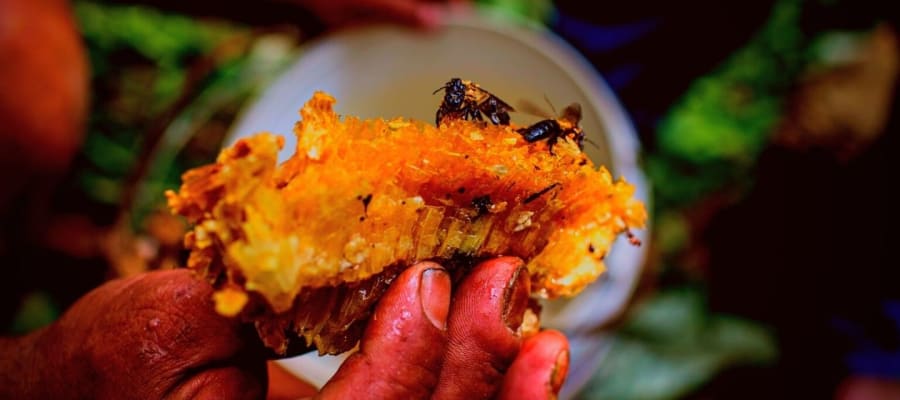
Photo: Red HoneyComb
Rhododendron flowers, which grow in abundance in the Himalayas, produce the nectar that is used to make the red honey. The nectar of several rhododendron species carries grayanotoxins, and ordinary honey has none. Too much can bring on nausea, dizziness, a slow heartbeat, fainting and dangerously low blood pressure. The claims that small amounts aid digestion, lift energy or cure stress and insomnia have never been tested in people.
Where does it come from?
Red honey, also known as Mad Honey, is a rare and exotic honey found in Nepal. It is produced by Apis laboriosa, the world’s largest honey bee. The colonies nest on cliffs between about 1,200 and 3,500 m and move down to warmer valleys in winter. The honey is sought after for its bitter, smoky taste and its kick. Nepal isn’t the only source: the Black Sea coast of Turkey has its own mad honey, and the Greek writer Xenophon described soldiers there falling sick after eating it around 400 BCE.
The honey is produced by the bees feeding on a particular type of Rhododendron flower that contains a compound called grayanotoxin. The toxin gives the honey its effects. The reddish colour comes from the nectar and pollen, so colour tells you nothing about how strong a jar is.

Photo: Wild Bee( Apis laboriosa)
The honey must be harvested carefully and with great caution as it can be toxic if ingested in large quantities. The process of gathering it can take days and is dangerous, because the combs hang from sheer rock faces far above the valley floor.
Red honey is fairly difficult to harvest and it takes time, expertise, and experience.
To get the honey out of the Apis laboriosa bees' colonies, hunters must traverse the Himalayan cliffs and endure harsh bee stings. After it is harvested, honey should be consumed within a year because its intoxicating effect and other qualities are said to decrease over time. The red honey is then prepared to be consumed or placed on the market.
The red honey has always been popular in the Nepalese market and it can be found in specialized stores throughout the country. Its odd flavour and reputation are making it popular well beyond Nepal. The most prized harvests come from the cliffs of Lamjung, Gorkha, and Kaski districts, where Gurung honey hunters descend rope ladders twice a year, in spring and late autumn, to cut combs hanging high above the valley floor. Mad honey is fully legal to buy in Nepal and legal to import into the United States, but several countries (South Korea and Australia among them) restrict it, so check your own rules before flying home with a jar.
Who Hunts Mad Honey in Nepal?
Honey hunting belongs to a few communities. In Lamjung and Kaski, Gurung and Magar villages such as Bhujung, Ghale Gaun and Pasagaun send teams to the cliffs twice a year. In the Hongu valley of eastern Nepal, Kulung Rai hunters keep a separate tradition. The method barely changes from place to place. The team lights a smoky fire of green leaves at the cliff base to drive the bees off the comb. One hunter climbs down a hand-woven bamboo or rope ladder, cuts the comb with a long pole and lowers it in a basket to the team below. Stings are part of the job.
The spring harvest, when the rhododendrons bloom, gives the strong red honey that the "mad" name refers to. Autumn honey comes mostly from other flowers and is usually milder.
The cliffs hold fewer bees than they used to. A survey of 148 cliff sites in Kaski district, published in the Journal of Apicultural Research in 2004, found fewer occupied cliffs and fewer nests on each cliff than in earlier decades. Researchers link the decline to pesticides, the loss of forest and flowers, road building and over-harvesting of whole combs. Honey hunters in Lamjung and Kaski told reporters in 2024 that their shares are shrinking as the hives disappear.
What Does Science Say About Red Honey's Benefits?
Most of what you read about mad honey’s benefits comes from folk use and sellers. Here is how each common claim stands up.
1. Traditional Nepalese treatment has been treating a variety of illnesses with red honey for ages.
2. Grayanotoxin, a naturally occurring neurotoxin from rhododendron nectar (not an enzyme), is what sets mad honey apart. In tiny doses users report warmth and mild euphoria, while larger doses are genuinely dangerous.
3. Laboratory studies have explored its antioxidant and antimicrobial properties, though no clinical evidence supports using it to treat any disease.
4. Like other dark honeys, it contains antioxidants. No study shows that it strengthens the immune system.
5. There is no evidence that it protects the heart or lowers stroke risk. Grayanotoxin slows the heart, and that is the main reason people end up in hospital.
6. The drop in blood pressure it causes is a sign of poisoning, not a treatment. No study shows it lowers cholesterol.
7. Some lab and animal studies suggest it might reduce inflammation and oxidative stress. Nobody has shown the same in people.
8. Claims of better focus and sleep have no evidence behind them. Drowsiness and light-headedness are early signs of too much grayanotoxin.
How People Use Red Honey in Nepal
In the hill villages, mad honey is taken by the spoonful, often with hot water, rather than cooked into everyday food. Treat it the same way if you buy a jar. Keep it out of shared dishes, dressings, drinks and baking, because the people eating them can’t tell what is in there or how much. Keep it away from children, and don’t take it with alcohol.
Made by the World’s Largest Honey Bee (Apis laboriosa)
The Himalayas and nearby mountains of India, Bhutan and China are home to Apis laboriosa, one of the biggest bees in the world. The worker bees reach about 3 cm (1.2 inches). Each colony builds a single open comb up to about a metre across under a cliff overhang. In summer the colonies nest as high as about 3,500 m among the rhododendrons, and in winter they move down to warmer valleys, some as low as about 850 m. A large comb is often said to hold tens of kilos of honey, though yields vary a lot.
What the Research on Mad Honey Shows
Mad honey, commonly referred to as red honey, has grown in popularity on the back of health claims. Grayanotoxin works by keeping sodium channels in nerve and heart cells open, which is why it slows the heart and drops blood pressure. Studies of mad honey are mostly hospital case reports of people who ate too much, plus a few lab tests.
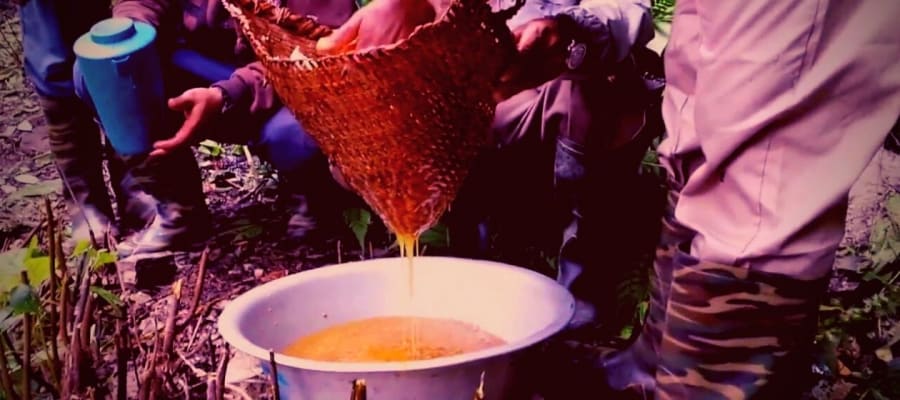
Photo: Honey Hunters Squeezing Honeycomb to extract red honey
Lab research shows that mad honey, like other dark honeys, has antioxidant compounds. No trial has tested whether eating it helps arthritis or any other inflammatory disease.
Sellers sometimes pitch it for stress, anxiety and depression. There is no research to back that, and the light-headed feeling people describe is the toxin at work.
Folk use includes stomach complaints, yet nausea and vomiting are the most common symptoms of mad honey poisoning in hospital reports.
Is Mad Honey Safe? Symptoms and When to Get Help
No safe dose of mad honey has been established. The toxin level changes with the season, the flowers and even the part of the comb, so a spoonful that did nothing last time can put you in hospital this time. We don’t give dosage advice for that reason.
Doctors in Nepal and Turkey see poisoning cases often enough to have written them up. In a 2024 case series of five patients from Nepal, most arrived with nausea, dizziness and vomiting, every one had low blood pressure and a slow heart rate, and three needed intensive care. In a Turkish series of 37 patients from the Black Sea coast, 18 had low blood pressure, 17 had a slow heart rhythm and 5 had complete heart block when they reached hospital. Most people recover within a day or two with fluids and atropine, and deaths are rare, but some patients have needed a temporary pacemaker.
| Finding on arrival (Turkish series, 37 patients) | Patients | |
|---|---|---|
| Low blood pressure | 18 of 37 | |
| Slow heart rhythm (sinus bradycardia) | 17 of 37 | |
| Complete heart block | 5 of 37 |
Symptoms usually start within a few hours of eating the honey. Get to a hospital if you feel faint, dizzy, sick or sweaty, or if your pulse feels slow, and tell the doctor you ate mad honey, because there is no quick lab test for it.
It’s also essential to remember that conventional medical treatments shouldn’t be substituted with mad honey. Before ingesting mad honey, it is best to consult with a doctor if you are dealing with any medical issues. People with heart conditions or low blood pressure, and anyone taking heart or blood pressure medicine, are at higher risk.
Pregnant and nursing women shouldn’t consume mad honey. Children and people with serious allergies should avoid it too.
Wild Honey Nepal Price
The price of wild honey in Nepal depends on the season, the village, the size of the harvest and how far it travels. We couldn’t find a reliable published rate, and prices abroad run much higher than in Nepal. Sellers charge more for spring honey sold as "potent", but a buyer has no way to test potency, so a higher price doesn’t mean a stronger or safer jar.

Photo: Honey hunter harvesting cliff honey
Real cliff honey is scarce, and plenty of jars sold as mad honey are ordinary honey or a blend. If you buy, choose a sealed, labelled jar from an established shop, or buy in the village where it was harvested, which also puts more of the money in the hunters’ hands. Check the rules at home before you fly. Mad honey is legal in Nepal and the US, but South Korea and Australia are among the countries that restrict it.
See the Honey Hunt with Swotah
Swotah’s Wild Honey Hunting in Nepal trip spends 9 days in Lamjung district, starting from Besisahar and following the Gurung hunters of villages such as Bhujung, Ghale Gaun and Pasagaun to the cliffs. The route stays below about 2,100 m, so altitude is not a worry. Departures run in the spring and autumn harvest windows, and the cheapest upcoming group departure is from USD 1,350. Groups are capped at 8 people.
All our guides are licensed, trained and first-aid certified, and Swotah tries to match you with a guide by experience, language, gender or age if you ask when you book. Swotah can arrange it as a private trip. Harvest dates depend on the bees and the weather, so the hunt itself can move by a few days.
Final Thoughts on Nepal’s Mad Honey
A final word of caution: mad honey is a tradition and a curiosity, not a medicine, and nothing here is medical advice.
Mad honey, produced by the world’s largest honey bee (Apis laboriosa) and cut from cliffs in Nepal’s middle hills, is a distinctive variety of honey. Lab tests have found antioxidant and antibacterial compounds in it, but it has no proven medical use and shouldn’t replace treatment for stress, digestive problems or anything else.
Depending on the source, the cost of wild honey in Nepal varies a lot. If you buy red honey, buy it from a source you trust, keep it sealed and labelled, and keep it away from anyone who doesn’t know what it is.
The best way to understand mad honey is to watch it come off the cliff. A Gurung hunter swinging on a bamboo ladder in the smoke, with a whole village waiting below, tells you more about it than any jar.
Is mad honey legal in Nepal?
Yes. Mad honey is legal to buy and sell in Nepal. It is also legal to bring into the United States, but South Korea and Australia are among the countries that restrict it, so check your own country’s rules before you pack a jar.
Why is it called mad honey?
Because of grayanotoxins, natural toxins in rhododendron nectar. A little causes warmth and light-headedness. Too much causes vomiting, a slow heart rate and low blood pressure, which is where the "mad" name comes from.
Can mad honey kill you?
Deaths are rare in the medical reports, but poisoning can be serious. In a 2024 Nepal case series, three of five patients needed intensive care, and some patients in Turkish reports needed a temporary pacemaker. Anyone who feels faint or dizzy after eating it should go to hospital.
Does mad honey have health benefits?
No clinical trial shows that it treats any disease. It contains antioxidants like other dark honeys, and a few lab and animal studies look at inflammation, but the claims about the heart, blood pressure, sleep and mood have no evidence in people.
When can I watch honey hunting in Nepal?
The hunts happen in spring and autumn. Swotah’s Wild Honey Hunting in Nepal trip runs in those windows in Lamjung district, from USD 1,350 per person on a group departure, and Swotah can arrange it as a private trip.