


The Annapurna Base Camp trek climbs from Pokhara through Gurung villages and rhododendron forest to base camp at 4,130 m, inside a ring of peaks that includes Annapurna I (8,091 m) and Machhapuchhre (6,993 m). Most people take 7 to 10 days on the trail, or 12 to 14 days from Kathmandu. It is rated moderate: no technical sections, but thousands of stone steps and one big climb into base camp. You need an ACAP permit and a TIMS card (NPR 5,000 in total) and, since April 2023, a licensed guide. The best months are October to November and March to May.
- Highest pointAnnapurna Base Camp, 4,130 m
- Start and finishPokhara (822 m)
- Days on trail7 to 10
- DifficultyModerate
- PermitsACAP + TIMS, about USD 37
- GuideRequired since 1 April 2023
- Best monthsOct to Nov, Mar to May
Annapurna base camp trek falls under one of the most popular treks in Nepal. Gateway to the pristine mountain ranges from the north-central part of Nepal, this trek is shorter and easier compared to other high-altitude treks. Annapurna flaunts the 55-kilometer-long mountain ranges, protected by the largest conservation area in the country- Annapurna conservation area (7,629km2). The trek is also known as the Annapurna Sanctuary trek, because the base camp sits inside a ring of peaks at the head of the Modi Khola valley.
The trek itself is very diverse, with varying landscapes of lush green meadows and dense forests to close-up views of the Annapurna massif. Passing through Gurung villages, this trail is less strenuous and comparatively shorter. Most reasonably fit people, young or old, can complete it with some training and a sensible pace.
Altitude is less of a problem here than on the Everest treks, but it still matters. The trail tops out at 4,130 m, and the last climb is steep: itineraries that skip a night at Machhapuchhre Base Camp gain about 1,200 m in a day, so altitude sickness is possible. Walk slowly, drink well and tell your guide about any headache or nausea. Our Annapurna Base Camp elevation guide shows the climb day by day.
The Annapurna base camp trek is the complete blend of the relatively easy trail with beautiful landscapes leading to spectacular scenery. Within the few days of the trek, you will be able to view the marvelous range of Himalayan vista, including Annapurna III (7,555 m), Machhapuchhre (6,993 m), Gangapurna (7,454 m), Annapurna South (7,219 m), Singu Chuli (6,501 m), Annapurna I (8,091 m), Hiunchuli (6,441 m), Baraha Shikhar (7,647 m), Nilgiri South (6,839 m), Tukuche (6,920 m), Dhaulagiri (8,167 m) and other surrounding peaks. Dhaulagiri, Tukuche and, on very clear mornings, Manaslu are seen from Poon Hill on the way in, while the Annapurna peaks and Machhapuchhre ring the sanctuary itself.
Location
Annapurna base camp is located in the Annapurna conservation area, which is very close to Pokhara. The sanctuary lies east of the popular Poon hill Ghorepani trek in maps, while it lies to the west of the Mardi Himal trek route.
Annapurna base camp trek, also known as the Annapurna sanctuary trek, starts from Pokhara (822 m). Tourist buses from Kathmandu are scheduled at 6 to 7 hours but often take 8 to 10 with roadworks and traffic, and the flight takes about 25 minutes. See how to get from Kathmandu to Pokhara. Because you can reach the trailhead by road, there is no mountain flight to be cancelled, which makes the trek easier to plan than Everest. Most lodges have phone signal and Wi-Fi for part of the way.
Map
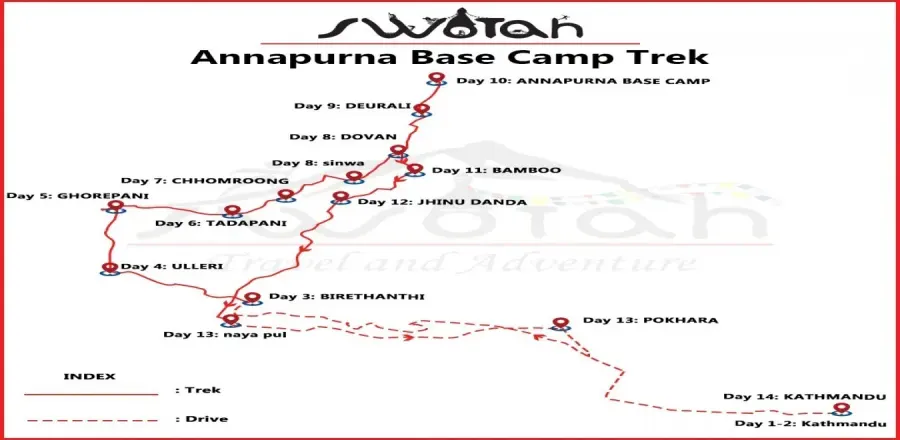
While the main Annapurna base camp trek route remains the same, there are different variations according to the side trails, weather conditions, natural calamities and time of the year.
ABC Route Options at a Glance
All three routes end at the same base camp. The difference is how you get into the Modi Khola valley and how many days you give yourself to adjust to the height.
| Route | Swotah trip | Way in | Best for |
|---|---|---|---|
| Via Ghorepani and Poon Hill | 14 days from Kathmandu, from USD 1,000 | Ulleri, Ghorepani, Poon Hill sunrise, Tadapani, Chhomrong | First-timers who want the Poon Hill view and a gentler build-up |
| Direct via Ghandruk | 12 days from Kathmandu, from USD 1,045 | Nayapul, Ghandruk, Chhomrong, Dovan, Deurali | Trekkers short on time who still want an easy pace |
| 7-day ABC from Pokhara | 7 days from Pokhara, from USD 565 | Ghandruk, Chhomrong, Himalaya, then straight up to base camp | Fit trekkers who are already in Nepal and comfortable with long days |
Annapurna Base Camp Weather
Annapurna Base Camp sits at 4,130 m, so the weather on the upper trail can change within hours. Weather at high altitudes in Himalayan regions is always subject to drastic change. If you are looking to trek offseason to the Annapurna region, be well prepared and well informed.
Best Time to Travel to ABC
Nepal has six seasons, each lasting two months. The traditional calendar names Spring (Basanta Ritu), Summer (Grishma Ritu), Monsoon (Barsha Ritu), Autumn (Sharad Ritu), Pre-winter (Hemanta Ritu) and Winter (Shishir Ritu). For trekking, it is simpler to think in four seasons:
- Spring : (March to May)
- Summer/Monsoon: (June to August)
- Autumn: (September to November)
- Winter: (December to February)
Autumn is the best season for trekking in the Annapurna region. It is dry, with clear skies and moderate temperatures, which makes October and November the most reliable months for mountain views.
The next best season to head for the trek in the Annapurna region is spring (March-May). The weather is warm, and the trail is blooming with beautiful rhododendrons.
The trail is busy in spring too. Mornings are usually clear, with cloud building some afternoons before the monsoon. In the lower villages days reach around 20°C, but base camp is far colder: daytime is roughly 7 to 17°C, and nights still drop to about -4 or -5°C even in April. Pack warm layers whatever the month.
If you prefer a quieter trail, winter is also an option, but nights at base camp fall well below freezing. From January to March, heavy snow can also bring avalanche risk between Deurali and Machhapuchhre Base Camp, so guides sometimes hold groups lower until it settles.
Permits Required
Like most of the protected areas of Nepal, the Annapurna conservation area also requires a permit to trek through the region. Foreigners must obtain an entry permit from the Annapurna Conservation Area Project (ACAP) as well as a TIMS card (Tourism Information Management System) to trek in the Annapurna region.
To trek to Annapurna base camp, you require two permits:
Annapurna Conservation Area Project (ACAP)
- For SAARC nationals: NPR 1,000 (about USD 7)
- For other foreigners: NPR 3,000 (about USD 20). Bought at a trail checkpoint instead, it costs double.
TIMS card
- Since April 2023 the TIMS card costs NPR 2,000 (about USD 13) for foreign trekkers, NPR 1,000 for SAARC nationals, and is issued only through registered trekking agencies. The old green and blue independent-trekker cards no longer exist. Every current fee is in our complete trekking permits guide.
The Annapurna Conservation Area Project (ACAP) and TIMS Card (Tourism Information Management System) permits are basically available at travel agents. Your agency arranges both before you start, through the Nepal Tourism Board offices in Kathmandu or Pokhara.
Since 1 April 2023, foreign trekkers in the Annapurna Conservation Area must walk with a licensed guide, so independent trekking there has ended. In total the two permits cost NPR 5,000, about USD 32. For the full rules read Trekking Permits in Nepal and our TIMS card guide.
Level of Difficulty
The Annapurna Sanctuary trek is rated moderate. The trails are well made, but there are thousands of stone steps. It passes stone-built Gurung villages, terraced farms and rhododendron forest before the valley opens into the sanctuary.
The first few days take you through an uphill route which then flattens out and you can cover more distance. There are plenty of steps to cover but also plenty of rest stops. Acclimatisation still matters on the last climb: from Himalaya or Deurali you gain more than 1,000 m to base camp, so many itineraries sleep at Machhapuchhre Base Camp (about 3,700 m) first. The Annapurna Base Camp trek's main destinations include both Machhapuchhre Base Camp and Annapurna Base Camp.
For a full breakdown of the stairs, daily hours and who finds it hard, read how difficult the Annapurna Base Camp trek is, and see our ABC training plan to get ready.
Essential Gear
Depending on the time of year, you'll need to make adjustments to clothing and equipment. The following equipment list for the trek will help:
1. A pair of thin hiking boots: Some people walk it in trail shoes in the dry season, but light hiking boots are safer because the upper trail can be icy or snowy. But make sure your footwear is comfy, light, and well-fitting.
2. A pair of comfortable slippers.
3. 4 pairs of liner socks: Two pairs of liner socks for warm climates and two pairs for cold climates totaling four pairs. Although trekking/liner socks are preferable, having merely regular socks is OK.
4. A few sets of underwear: You may get hiking underwear at your local store. They are also useful for other outdoor activities. In Nepal, you may purchase everyday underwear.
5. A high-quality best ultralight packable down jacket and down pant: You can rent a down jacket and down trousers in Kathmandu or Pokhara for about USD 1 to 2 a day.
6. T-shirts and pants: Keep in mind that you'll be traveling in both chilly and warm climates.
7. Thermals: Alternately, you could layer up.
8. A compact sleeping bag: you can buy, hire, or carry with you from your own country.
9. A trekking pole: This trek is straightforward, but there are a lot of ups and downs, so a trekking pole can help. Otherwise, you can use a strong stick you find along the way to support yourself.
10. Two sets of gloves, one for cold weather and the other for warm weather.
11. A wool cap
12. sunglasses
13. A headlamp or a torchlight
14. A first-aid kit with oral rehydration salts (ORS), plus Diamox only if your doctor prescribes it
15. Toiletries: Toilet paper, hand sanitizer, water purifiers, sunscreen, moisturizer, toothpaste, and toothbrush.
16. A waterproof map of Annapurna Base Camp
17. Snacks you like and entertainment such as books, cards, an iPad, etc.
Sample Itinerary: Direct Route via Ghandruk
A typical 10-day route from Pokhara, sleeping at Machhapuchhre Base Camp before base camp itself. Times are walking hours.
| Day | Route (time) | Overnight altitude |
|---|---|---|
| 1. | Pokhara to Nayapul by road, trek to Ghandruk (5 to 6 h) | 1,940 m |
| 2. | Ghandruk to Chhomrong (4 to 5 h) | 2,170 m |
| 3. | Chhomrong to Bamboo (4 to 5 h) | 2,310 m |
| 4. | Bamboo to Deurali (5 to 6 h) | 3,230 m |
| 5. | Deurali to Machhapuchhre Base Camp (about 2 h) | 3,700 m |
| 6. | Machhapuchhre Base Camp to Annapurna Base Camp (about 2 h) | 4,130 m |
| 7. | Annapurna Base Camp to Bamboo (6 to 7 h) | 2,310 m |
| 8. | Bamboo to Jhinu Danda, hot springs (about 5 h) | 1,780 m |
| 9. | Jhinu Danda to Pothana via Landruk (5 to 7 h) | about 1,890 m |
| 10. | Pothana down to Phedi (3 to 4 h), drive to Pokhara (about 40 min) | 822 m (Pokhara) |
Where You Sleep Each Night on the 14-Day Trip
Trekking days 3 to 11 of our 14-day Annapurna Base Camp trek, which goes in via Poon Hill. Bars are scaled to base camp at 4,130 m.
| Day | Overnight | Altitude | Metres |
|---|---|---|---|
| Day 3 | Ulleri | 2,050 m | |
| Day 4 | Ghorepani | 2,860 m | |
| Day 5 | Tadapani (Poon Hill 3,210 m at dawn) | 2,630 m | |
| Day 6 | Chhomrong | 2,170 m | |
| Day 7 | Himalaya | 2,920 m | |
| Day 8 | Annapurna Base Camp | 4,130 m | |
| Day 9 | Bamboo | 2,310 m | |
| Day 10 | Jhinu Danda | 1,780 m | |
| Day 11 | Pokhara | 822 m |
The jump from Himalaya to base camp on day 8 is the hardest part, about 1,200 m in one day. If you feel unwell, stopping at Deurali or Machhapuchhre Base Camp for the night is the safe call.
How Much Does the Annapurna Base Camp Trek Cost?
Permits come to NPR 5,000 (about USD 32): ACAP at NPR 3,000 and the TIMS card at NPR 2,000. A licensed guide usually costs USD 25 to 40 a day and a porter USD 20 to 25, and lodge rooms run about USD 5 to 10 a night, with food costing more the higher you go. Swotah's guided trips start from USD 565 for the 7-day trek from Pokhara and from USD 1,000 per person for the 14-day trip from Kathmandu. Each trip page lists exactly what is included. Our Annapurna permits guide covers the checkpoints and side-trip fees.
You can check the detailed itinerary: Annapurna Base Camp trek.
Ready to walk it? See our 12-day Annapurna Base Camp trek or the faster 7-day ABC itinerary, and read when the offseason works in the Annapurna region.
Annapurna Base Camp Trek: FAQs
How many days do you need for Annapurna Base Camp?
Seven days from Pokhara is the fastest sensible itinerary. Ten days on the trail, or 12 to 14 days from Kathmandu, gives a gentler pace and room for Poon Hill or a spare day.
Can I trek to Annapurna Base Camp without a guide?
No. Since 1 April 2023 foreign trekkers in the Annapurna Conservation Area must walk with a licensed guide, and the TIMS card is issued only through registered agencies.
Is altitude sickness a risk at Annapurna Base Camp?
Yes, though less than on the Everest treks. Base camp is 4,130 m, and itineraries that go straight up from Himalaya or Deurali gain 900 to 1,200 m in a day, so climb slowly and descend if symptoms get worse.
Is the trail safe in winter?
It is walkable, but nights are very cold and the stretch between Deurali and Machhapuchhre Base Camp is exposed to avalanches after heavy snow, mostly from January to March. In January 2020 an avalanche there killed four South Korean trekkers and three Nepali guides.
Annapurna Base Camp or Everest Base Camp?
Annapurna is lower, shorter and starts by road, so it suits a first Himalayan trek. Everest goes higher and needs a flight to Lukla. Our ABC vs EBC comparison sets them side by side.