


Yes, you can trek in Nepal with young children if you pick a low route and slow the pace down. The Millennium Homestay Trek (high point 1,709 m), the Royal Trek (about 1,760 m) and the Ghorepani Poon Hill Trek (3,210 m) all suit families. Under-fives often ride in a porter's doko basket. The UIAA advises keeping preschool children's sleeping altitude below about 2,500 m where possible and avoiding nights above 3,000 to 4,000 m, because small children can't tell you when altitude is making them ill.
- Youngest age that worksAbout 4, with a porter and doko basket
- Best family treksMillennium Homestay, Royal Trek, Poon Hill
- Altitude for under-fivesSleep below about 2,500 m where possible (UIAA)
- Over 3,000 mWe suggest age 12 and up
- PermitsUnder-10s are exempt from TIMS and generally from park fees
- Best monthsOct to Nov, Mar to Apr, and Dec to Feb on low routes
Nepal is famous for big treks and climbing trips, but are there family tours in Nepal that suit kids? If your kids are young adults (14 and up), they probably can do pretty much everything you can. But is it possible to trek in Nepal with younger kids?
There are a lot of great treks and hikes which are suitable for kids from even as young as four and up to the early teen years. A good trekking company knows that kids as young as four will need a bit of help in the form of a doko basket where they can comfortably sit while being carried by a porter. They also know these early teenage years can be tricky to keep them entertained and motivated. A good trekking company will be able to encourage, teach and entertain your children and book your trip.
Please note: some trekking agencies set a minimum age for longer or higher treks, often 10 to 12, so ask before you book. Every agency will expect parents to stay responsible for their children's well-being and safety on the trail.
This guide is about the practical side of trekking with young children: altitude, health, carriers, packing and keeping small legs moving. For route choice and logistics when your family spans toddlers to teenagers, see our family trekking in Nepal guide.

Is Altitude Safe for Young Children?
Children get altitude sickness about as often as adults do. The US CDC says children "are as susceptible as adults", and the UIAA Medical Commission says they need a similar time to acclimatise. The difference is reporting. A four-year-old won't say "I have a headache and feel sick". The UIAA puts it plainly: a small child with altitude illness would probably just go very quiet and still.
That is why the UIAA advises that preschool children should avoid sleeping above 3,000 to 4,000 m, and that a sleeping altitude below about 2,500 m is preferable. It also notes there are no conclusive data for young children, so treat these as cautious guidance. Above 3,000 m, the CDC rule for everyone is to raise your sleeping altitude by no more than 500 m a day and add an extra night for every 1,000 m gained. Our own suggestion: keep children under about 12 below 3,000 m, and go slower than the adult minimum when you do go higher.
If a child seems unwell at altitude, assume it is the altitude until proven otherwise. Stop going up. If they don't improve, or get worse, go down. Acetazolamide (Diamox) can be used in children, but the dose is by body weight, so it is a decision for your doctor before you travel, not something to work out on the trail.
| What you might notice | What it can mean | What to do |
|---|---|---|
| Fussiness, crying more than usual, off their food | Early altitude sickness in a child too young to describe it (CDC lists loss of appetite, irritability and pallor) | Rest, no higher today, watch closely |
| Unusually quiet, still, wanting to be carried | Possible altitude illness (UIAA) | Don't go higher until they're back to normal |
| Vomiting, poor sleep, headache in older kids | Acute mountain sickness | Stop the ascent. Descend if it doesn't settle |
| Hard to wake, confused, stumbling, breathless at rest | Possible HACE or HAPE, an emergency | Descend at once and call for evacuation |
Trekking with Kids: An Age-by-Age Guide
| Age | What works | Altitude | Good fits |
|---|---|---|---|
| Under 3 | Short day walks from a comfortable base, carried in a child carrier | Stay low. Sleep below about 2,500 m (UIAA) | Day hikes around Pokhara and the Kathmandu Valley |
| 3 to 7 | 2 to 4 hours of walking a day, with a porter and doko for the rest | Below about 2,500 m for nights. Kids this age can't describe symptoms well | Royal Trek, Millennium Homestay, Chisapani to Nagarkot |
| 8 to 11 | 4 to 5 hours a day, carrying a small daypack | Usually show altitude illness the way adults do (UIAA). Short visits near 3,000 m with care | Poon Hill, Royal Trek, Millennium Homestay |
| 12 and up | Most adult itineraries, at a steady pace | Same acclimatisation rules as adults | Annapurna Base Camp, Everest Base Camp for keen, fit teens |
So, where are the best places to go with kids?
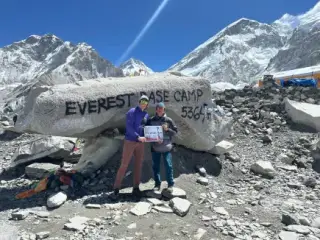
Further afield, treks to Everest Base Camp (5,364 m) and Annapurna Base Camp (4,130 m) are great for older kids. We suggest that over 3,000 m children should ideally be over 12 years old for any trek. Preferably even a bit older.
But the Annapurna foothills also have good options for young kids. For example, Swotah Travel and Adventure have a great Millennium Homestay Trek or the Royal Trek or even flying or driving into Jomsom (2,720 m, the district headquarters of Mustang) and exploring the valley around it. Jomsom is already high for a toddler, so keep the stay short and avoid going on up to Muktinath (about 3,710 m) with very young children.
There are short hikes around the Kathmandu Valley and Pokhara and some great small group tours of Nepal.
-
Shivapuri National Park to Nagarkot
-
The Millennium Homestay Trek – about 7 days on the trail
-
The Ghorepani Poon Hill Trek – 3 days on the trail, 4 from Pokhara
-
The Royal Trek – 3 days on the trail
-
Hiking Around Pokhara
A Short Trek out of Kathmandu through Shivapuri National Park to Nagarkot
A drive of under an hour gets you to Sundarijal, on the edge of Shivapuri Nagarjun National Park. After paying your entrance fee, it's a 4 to 5-hour hike through the forest (take a packed lunch!) to Chisapani, at about 2,200 m. This is your first overnight stay. Accommodation is not excellent, but the best is yet to come! Hike the following day to Nagarkot (about 2,175 m). This is a long 6 to 7-hour hike (this is where the porter with the doko comes in!) again through forest land. Take it easy and make it fun for the kids, with stops for games and snacks along the way. Nagarkot has beautiful accommodations and a couple of friendly hotels with a swimming pool! Here you can relax with a drink overlooking the panoramic view of the mountains. Don't forget to be on the terrace for sunset and sunrise! If it were me, I would stay the next day in Nagarkot to explore the village, staring at the mountains, swim, get a massage, and let the kids run off any excess energy they might still have.
Then you can drive to Bhaktapur the next day and explore the UNESCO-listed, largely car-free ancient town. With its temples, artisans, and astounding architecture, this is a fabulous reminder of days gone by. Again, if you have time, I suggest you stay overnight! And drive about an hour back to Kathmandu the following day. But I recommend 4 or 5 hours to explore Bhaktapur. Let the kids go on a potter's wheel (with permission, of course), learn the history of the temples, watch the fish in one of the ponds around the square or eat juju dhau, the local "king of curd". Many Nepalis say it's the best yogurt in the country.
Other Great Treks for Kids
I can recommend three great treks to do with kids.
The Poon Hill Trek, the Royal Trek, and the Millennium Homestay Trek.

The Millennium Homestay Trek – about 7 days on the trail
The trek takes its name from the year it was set up, 2000. It runs through the hill villages of Tanahun and Syangja districts near Pokhara, between about 420 m and 1,709 m, so there are no worries about altitude-related problems! Our version is 13 days including Kathmandu and Pokhara, with about 7 days on the trail. But of course, aside from the beautiful landscape and mountain views, the best part of this trek is living in real homes with real families!
The trek starts in Pokhara, and the best season to visit Nepal is also the best season to do this trek. That is spring and autumn. But if that doesn't suit your holiday plans, because this is such a low-altitude trek, you can also visit during the winter. With the mountains clear and the sun not beating down too much, winter is a great time to come. No snow, however. Avoid the monsoon (roughly June to mid-September), when the trails are wet and slippery and the leeches come out. Wet feet make for unhappy little hikers!
As the name implies, you will be staying in family homes! And there will be lots of children around to keep yours occupied. Be aware it is not a luxury trek. Accommodation is basic. Two beds to a room and an outside toilet/ shower. You can certainly turn this into an educational tour about culture. Food will be prepared in the family kitchen and will be the staple food of Nepal – dal bhat. That is lentil soup, curry, and rice. Bring snacks for the kids, as they will want something more familiar as time goes on.
Things to know: Although considered an easy trek, there are ups and downs. In the mornings, paths can be slippery. There is the Millennium Cave to discover as well as monasteries and temples. The route passes through more than 30 hill villages (not all at once!), home to Gurung, Magar, Brahmin and Chhetri families. People will want to teach you their culture, dances, songs, cooking, etc. Best be prepared to sing a song from your country too. A small gift for the homeowner will be much appreciated. And, as on any trek, people will be particularly fascinated by fair-haired children. Best warn them to expect extra attention, including cheek-pinching and requests for photos.
This trek gives back. Swotah Travel puts part of the trip cost toward a school lunch programme in a remote Syangja village on this route.

The Ghorepani Poon Hill Trek – 3 days on the trail, extendable
This is also a relatively low-altitude trek, the highest point being 3,210m (where you will only spend a couple of hours), and it takes you into the Himalayan foothills. There are shady rhododendron forests, stone steps to climb, Magar settlements to hike through, and the big reward, Poon Hill itself. It looks out over the Annapurna and Dhaulagiri ranges and Machhapuchhre (known as Fishtail). Sunrise is the classic time to hike up to the viewpoint. Ghorepani, where you sleep, is at about 2,860 m, so watch younger children for signs of altitude sickness there.
This trek starts from Pokhara, a very relaxed and laid-back town built around a lake.
From Pokhara, you drive past Nayapul to the trailhead at Tikhedhunga or Ulleri, depending on the road. Our 4-day Poon Hill Trek (from USD 300) has two long days of 7 to 8 hours, so with small children plan an extra night or two and shorter stages.
Now I should warn you about the trail up to Ulleri. Stone steps, about 3,000 of them between Tikhedhunga and Ulleri. This is where a porter to carry small children comes in. And yes, there is a limit on that doko. See the carriers section below. Bring walking poles, which help on that staircase. Expect to be exhausted and expect sore legs. Just imagine how easy the gym or that Spin or Step class will be from now on!
One village worth adding on a longer loop is Ghandruk. Here there is a museum about the Gurung people. And you and your kids can get dressed in Gurung style and get your photos taken.
And do try very hard to drag your kids out of bed before sunrise to climb to the top of Poon Hill to watch nature's spectacular sunrise over the mountains.
The sunrise from Poon Hill is so good that we built a yoga trek around it. Ask Swotah about the Poon Hill Sun Salutation Yoga Trek. While unsuitable for young children, teenagers who are already interested in yoga will enjoy this special treat!
Things to know: This trek can be walked most of the year, though the monsoon months bring rain and leeches and winter brings cold nights at Ghorepani. It can also be added to longer treks in the Annapurna region, so it gets busy in October and April. Because it is popular and well established, the food and lodges are good. Being close to Pokhara means relaxing and enjoying sightseeing before or after your trek. And there are plenty of things for kids to do in Pokhara.

The Royal Trek – 3 days on the trail
This trek got its name in 1980, when Prince Charles (now King Charles III) walked here with a large party. The route was named after his visit. Again this is a low-elevation trek, with about 1,760 m being the highest you will go. It's an easy trek suitable for children and adults of all ages, but a certain fitness level should be there. It's a great trek for those with little time or who don't want to be on the trail for too long. The scenery is the Annapurna range, snow peaks against blue skies, as you hike through the foothills. Again the villages and people you will meet on the trail are mainly of the Gurung ethnic group. Because this is a very short trek, it is often overlooked. Which means it is not very busy at all! Which makes it even better for your family.
Things to Know: The route starts at Bijayapur, a short drive from Pokhara, and finishes past Rupa Lake and Begnas Lake. Begnas is the quieter sister of Phewa Lake in Pokhara. The kids will love a boat ride there and may spot a few unusual birds. Ask us about adding a night by the lake.

Hiking Around Pokhara
All three treks above start and end at or near Pokhara. Whether you are trekking out of Pokhara or going there just to relax and enjoy the mountain scenery without actually hiking up and down, there are several short walks around Pokhara.
Peace Stupa: You can boat across the lake and hike up to the Peace Stupa. Or drive there and hike and boat back (arrange the boat ahead of time to be sure). From the stupa, there are lovely views of Phewa Lake and Pokhara.
Sarangkot: You can hike up to Sarangkot (about 1,600 m), which takes around 3 hours from Lakeside. Many people do this hike while it is dark to watch the sunrise over the Himalayas. In my opinion, far better to drive up and then walk back down. With children, walking by torchlight might not be the best idea. An even better idea is to stay overnight in one of the many hotels in Sarangkot.

Health, Food and Water for Kids on the Trail
See a travel clinic six to eight weeks before you go. For Nepal, the CDC recommends hepatitis A for unvaccinated travellers aged one and over, typhoid for most travellers, and up-to-date measles (MMR) for everyone, with an early dose for babies of 6 to 11 months. Rabies is worth a separate conversation. The CDC notes that dogs with rabies are common in Nepal and that rabies vaccine may only be available in larger city hospitals, which matters when you're days from a road. Teach kids not to touch dogs, cats or monkeys, and if they are bitten or scratched, wash the wound with soap and water for several minutes and get medical help the same day.
On the trail, every drink should be treated or bottled. Filter or purification tablets for refillable bottles beat buying plastic bottles, and lodges sell boiled water. Hand-washing before every meal does more than anything else to keep tummy bugs away, so carry hand gel for when there's no tap. Dal bhat is freshly cooked and usually safe. Be careful with salads, cut fruit and anything that has been sitting out. Sun at altitude burns fast, even on cold days, so use high-factor sunscreen, a wide-brimmed hat and good sunglasses on children as well as adults.
Porters, Doko Baskets and Child Carriers
The doko is the cone-shaped basket Nepali porters carry with a strap across the forehead. A small child can sit in one with padding and a blanket, and many love it. It isn't the only option. A framed hiking child carrier from home is often more comfortable for both child and porter, and your porter will happily carry that instead.
Porter loads have limits. Under the IPPG porter guidelines a porter should carry no more than 30 kg, and at Swotah we keep loads to about 20 kg. A child plus a carrier quickly reaches that, so plan on one porter for each small child who will be carried, separate from the porter carrying your bags. Build in short stages. Two to four hours of walking a day is plenty for most under-sevens, with the rest of the day for play.
Permits, Guides and Insurance for Children
Children need permits too, but under-10s are exempt from the TIMS card and generally from national park and conservation area entry fees. Our trekking permits guide has the full table. Since 1 April 2023 a licensed guide has been required for foreign trekkers on most trails in Nepal's protected areas. With children a guide is worth having anyway, because they know which lodges have warm rooms and where the next toilet is. Make sure your travel insurance covers every family member for trekking to your highest point and for helicopter evacuation. Our trekking insurance guide explains what to look for.
What to Pack for Kids
- LayersThermal base layers, a fleece, a warm down or synthetic jacket, a rain shell
- FeetBroken-in hiking shoes, spare socks, light camp shoes
- Head and handsSun hat, warm hat, gloves, buff
- SunHigh-factor sunscreen, lip balm, child-size sunglasses
- SleepChild-size sleeping bag rated for nights near freezing on higher routes
- HealthChildren's paracetamol and ibuprofen, oral rehydration salts, plasters, any medicine your doctor prescribes
- WaterOwn bottles, filter or purification tablets, hand gel
- FoodFamiliar snacks from home for fussy days
- FunCards, a small toy, a notebook and pencils, a head torch of their own
Keeping Kids Engaged on the Trail
Give them a job. A child who carries the snack bag, reads the trail signs or keeps the photo list stays interested far longer than one who is just told to keep walking. Spotting games work well: the first yak, the first prayer wheel, the first snow peak. Let them spin the prayer wheels (clockwise) and count chortens. Teach them a few words of Nepali, starting with namaste and dhanyabad (thank you), and they'll make friends in every village. Stop early, so there's time to play with local kids before dark. On homestay treks that is half the fun.
Aside from Trekking, What to Do with Kids in Nepal?
You now know it is possible to trek in Nepal with small kids. And I've given some of the best trekking destinations in Nepal for kids. But what other top activities to do in Nepal with a family?
Check out my earlier blog, Is Nepal a Family Destination?, to find out lots of fun things to do with kids in Nepal. Such as rafting, boating, wildlife spotting, bird watching, and discovering Nepal's rich heritage. Your family trip to Nepal can be as adventurous, educational, or laid-back as you want it to be! And if you like more comfort, there are luxury tours in Nepal, including breakfast at the Hotel Everest View (about 3,880 m) and other Nepal heli tours. A helicopter climbs far faster than anyone should acclimatise, so with young children keep that stop short and ask your doctor first. The choice is yours!

Planning the family logistics end-to-end? Pair this with is Nepal a family destination and our family trekking routes guide, which covers route choice and logistics for families with children of different ages.
Trekking in Nepal with Children: FAQs
What is the minimum age for trekking in Nepal?
There is no legal minimum age. Children of four and up manage short, low treks with a porter to carry them when they tire, and younger children can come on day walks in a carrier. Some agencies set their own minimums for longer or higher trips, so ask before you book.
Can a 5-year-old trek to Everest Base Camp?
We don't recommend it. Base camp is at 5,364 m and the nights at Lobuche and Gorak Shep are close to 5,000 m. The UIAA advises keeping preschool children's sleeping altitude below about 2,500 m where possible and avoiding nights above 3,000 to 4,000 m, mainly because young children can't report the early signs of altitude sickness.
Is Poon Hill good for kids?
Yes, for children of about eight and older who are happy to walk. Younger ones can come with a porter, but Ghorepani (about 2,860 m), where you sleep, is above the 2,500 m the UIAA prefers for preschoolers' nights, so watch them closely. The top is 3,210 m. Add an extra night or two to the standard 4-day trip so the stone-step days are shorter.
Do children need a TIMS card or park permit?
Children under 10 are exempt from the TIMS card and generally from national park and conservation area entry fees. Older children pay the same as adults. Your agency sorts this out with the rest of the permits.
When is the best time to trek in Nepal with children?
October and November bring clear skies and comfortable days. March and April are warm with rhododendrons in flower. On low routes such as the Millennium Homestay and Royal Trek, December to February also works well, with chilly nights. Avoid the June to September monsoon, when trails are muddy and leeches come out.