


Hillary Step on Mount Everest: Where It Is and Why It Matters
If you are a mountaineer or someone keen on mountaineering history, you will know what we mean when we talk about the Hillary Step. For others, let us explain.
The Hillary Step sits at 8,790 m / 28,839 ft, just below the summit of Mount Everest in Nepal. Its 12 m / 40 ft vertical rock face was the last obstacle climbers had to (literally) overcome before reaching the summit of the world’s highest mountain. But is it the same today as it was when it was discovered? Let’s answer that question after a brief background of the step and how it got its name.
Giving a Name to An Obstacle
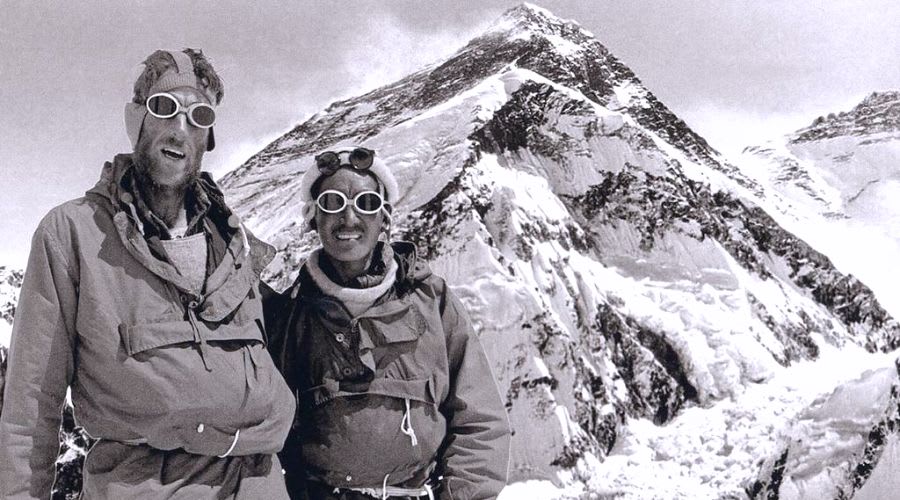
It doesn’t take a genius to work out that the Hillary Step got its name from one of the first two men to successfully climb Everest – Edmund Hillary. But why was this particular place given this name?
Lying between the South Summit and the true summit of Everest, about 60 m / 197 ft from the top, this vertical wall was first seen in 1953, when Hillary and Tenzing Norgay made the first successful ascent. By the time they reached this daunting obstacle, they were exhausted but oh-so-near to the top. This last push up the vertical rock became a symbol of achievement for them, and those who followed, in reaching the summit of the world. It was named the Hillary Step to mark this milestone achievement and became a byword in the mountaineering fraternity for courage and success.
Being a mix of rock, snow, and a very narrow ridge with exposed drops on either side, it was also very technical to climb the Hillary Step. Because of its challenges, it became famous among mountaineers…if you could make it up the Hillary Step, you were almost there… you had achieved your goal! It became a legend in its own lifetime as they say.
Why the Hillary Step Was So Dangerous
The danger of the Hillary Step was never just its 12 m of near-vertical rock. It sits at 8,790 m, deep inside the so-called death zone, where the air holds roughly a third of the oxygen available at sea level and the human body is actively deteriorating. Climbing even a short technical pitch at that altitude, in heavy boots and mittens, after ten or more hours of climbing, pushes most people to their limit.
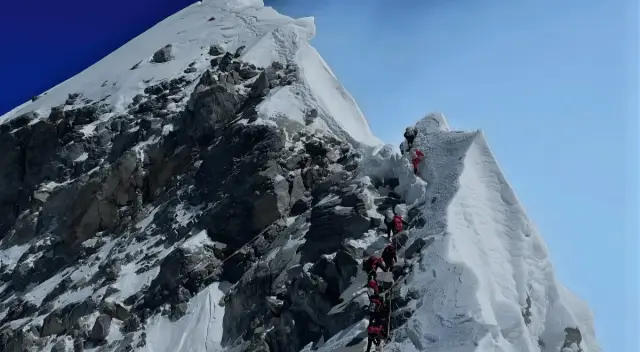
Worse, the Step only allowed one climber at a time on the fixed ropes. On busy summit days, that single-file constraint turned it into the most notorious bottleneck on the mountain. Climbers queued for an hour or more in temperatures far below freezing, burning through bottled oxygen they would need for the descent. The famous 2019 photograph of a long line of climbers snaking along the summit ridge captured exactly this problem. On either side of the narrow ridge, the drops are enormous: roughly 3,000 m down the Kangshung Face into Tibet on one side and over 2,400 m down the Southwest Face into Nepal on the other.
2015 Earthquake
On April 25, 2015, Nepal suffered from a huge earthquake that killed around 9,000 people and left many more thousands homeless. In the Everest Region, the earthquake caused massive avalanches. With nearly 1,000 climbers on the mountains, it could be said that we were lucky there were not more deaths. As it was, there were 19 bodies recovered from base camp as a result of an avalanche powering down Mt Pumori, sweeping the Everest Base Camp across the Khumbu Glacier.
There were dozens of climbers stranded on the mountains who needed rescuing, as their secure routes down were gone. Eventually, bodies were recovered, and people were rescued. According to the Nepal Mountaineering Association, there were 19 deaths, 10 being Nepali Sherpas. Google executive Dan Fredinburg, part of a four-person team mapping the area for a Google Earth project, was among those killed.

Did the Earthquake Affect the Hillary Step?
There is mixed information – even all these years later. It was reported that the step collapsed or was altered considerably. A newer route is now in place, but it also presents an equal challenge. With more snow (it is thought the main rock wall-face has collapsed) it may not be as technical now to cross the Hillary Step, but it is equally as challenging and dangerous both physically and psychologically.
Regardless of how the 2015 earthquake impacted Hillary Step, we know that today climate changes are taking place globally, and there has been less snow on the Himalayas for the last couple of years. This will also take its toll on this part of the mountain.
What Climbers Face Today
The clearest assessment came in May 2017, when British expedition leader Tim Mosedale reported from the summit that the Hillary Step, as a rock feature, was gone. Most guides now agree that the upper section of the rock wall collapsed, most likely in the 2015 earthquake, leaving a snowy ramp where the vertical pitch used to be.
In good snow years, the ramp is technically easier than the old rock climb: climbers ascend a steep snow slope on fixed lines rather than hauling themselves over a boulder at 8,790 m. But easier does not mean safe. In lean snow years, the loose, broken rock left behind by the collapse is exposed, and the route becomes awkward and unstable. The ridge remains as narrow and exposed as ever, the queues still form on busy days, and a slip in either direction is unforgiving. Whatever its shape, the final 60 m of Everest still demands full concentration from climbers who have very little left to give.
The Future
People are not going to stop climbing Everest or the other mountains in the Himalayas. As the landscape changes, people will adapt, and new challenges will be overcome. The Hillary Step will remain standing as an important landmark for climbers and will offer the same sense of achievement as it always has. To learn more about Everest’s darker history, read about the 1996 Everest disaster and the sobering story of Green Boots.