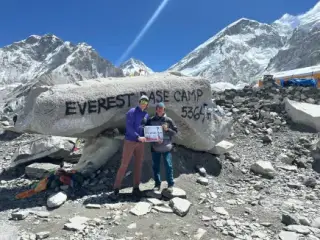
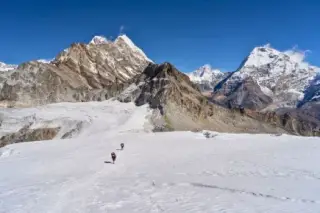
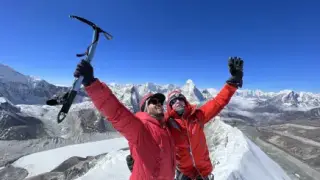
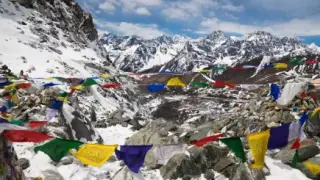
The Mount Everest Expedition is the attempt on Mount Everest, the world's highest mountain at 8,849 m (29,032 ft), known in Nepali as Sagarmatha and in Tibetan as Chomolungma. The standard route from Nepal is the South Col route, first climbed on 29 May 1953 by Edmund Hillary and Tenzing Norgay, and it remains the most-attempted line on the mountain. The expedition spans approximately 60 days in-country, including the approach trek through the Khumbu, multiple acclimatisation rotations through the Khumbu Icefall, and the summit push from Camp 4 on the South Col.
The route climbs from Everest Base Camp (5,364 m) through the Khumbu Icefall to Camp 1 at around 6,000 m, then into the Western Cwm to Camp 2 at approximately 6,400 m, up the Lhotse Face to Camp 3 at around 7,200 m, and finally to Camp 4 on the South Col at roughly 7,900 m. The summit day continues past the South Summit and the Hillary Step to the top at 8,849 m. Above 8,000 m you are in the death zone, where the body deteriorates faster than it can recover, and supplemental oxygen is essential on this route.
This is one of the most demanding undertakings in mountaineering. The Nepal government climbing royalty is approximately USD 11,000 per person for the spring season. Candidates need strong prior high-altitude experience, typically including a summit above 7,000 m, and excellent physical fitness. Swotah's Expedition team, including certified high-altitude Sherpa guides, manages the logistics, fixed-rope installation and camp support. The sections below cover permits, the climbing route, seasons, acclimatisation and what to prepare.