


The 1996 Mount Everest Disaster
The storm of May 10-11, 1996, made that year the deadliest season Everest had seen up to that point, a grim record that has since been surpassed twice. One was in April 2015, when the Nepal earthquake killed around 19 people in an avalanche at Everest Base Camp, as well as over 9,000 throughout the country. The other was in 2014, when an avalanche in the Khumbu Icefall killed 16 Nepali mountain workers.
In 1996, 12 people died on Everest, with eight of them being caught in a blizzard while descending from the summit. What made this so shocking was the fact it was the highest number of deaths in one season so far, and the fact it was widely publicized. With some of the most prestigious climbers dying, including Rob Hall and Scott Fischer, and journalist Jon Krakauer being there to recall, record, and question events, it became a global issue drawing attention to the challenges of climbing the world’s highest mountain.
Many of the survivors of that day wrote about their experiences, particularly Jon Krakauer, whose writings are available in his book Into Thin Air, which has also been made into a film.
Over Commercialisation?
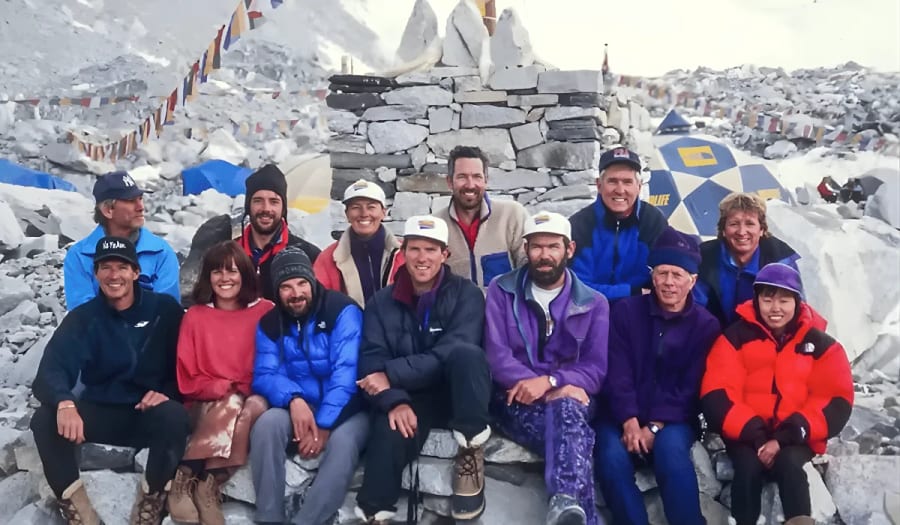
More than 30 climbers from three expeditions pushed for the summit that day, which Krakauer says led to dangerous overcrowding at the fixed-rope sections. It is also recorded that many of the climbers were inexperienced.
Interestingly, in those days a few hundred climbers on the mountain in a season was considered too many, yet today we see even more climbers attempting to scale Everest in a single season. For example, in spring 2025 the Government of Nepal issued 468 Everest permits to foreign climbers, and with Sherpa guides included, well over 700 people reached the summit.
There is still today the question of why so many non-climbers or inexperienced climbers are allowed to climb. It would seem, if you have the will and the money, your team leader will get you up the mountain at any cost. Well, actually it is the Sherpa guides who will get you up there. We see that in 1996, one of the Taiwanese climbers died at Camp 2 due to a lack of basic knowledge about the environment. This is not a unique situation.
In Krakauer’s account, he mentions the fact that one of the Sherpa there to fix ropes was so unrealistically burdened with a client’s gear that he was unable to do so. Therefore, rope fixing was late in being done, adding to the many problems that arose that day.
It took until 2025 for the authority that issues permits to climb Everest, to propose, in the draft Integrated Tourism Bill, that climbers must first have summited at least one 7,000-metre peak in Nepal before receiving an Everest permit. In this way, inexperienced and non-climbers would not be able to tackle Everest, where they are, potentially, putting others, particularly the Sherpa guides, in danger.
Respecting the Goddess Mother of the World
The Sherpa and Tibetan communities call Everest Chomolungma, meaning Goddess Mother of the World. The mountain holds spiritual significance for them and before every climb they undertake a ritual puja to worship the mountain and ask for safe passage on her. Should the correct respect and worship not be done properly, the Sherpas believe it brings bad luck to any expedition.
So What Did Happen During that Expedition?
Any climber will be able to tell you that it takes coordination, determination and understanding to climb any mountain in a team. Climbers of high altitude mountains will also tell you that when you experience lack of oxygen you are unable to think as clearly as you normally can, leading to confusion and sometimes over-confidence.
In 1996 it has been concluded that the disaster happened for a number of reasons, not just because of the blizzard that caught the climbers on their descent.
There were two expeditions that were climbing together on the mountain that day, after it was determined by their team leaders that this would be the best way to go. However, there was great rivalry between the two leaders – Rob Hall, who died near the summit, and Scott Fischer who died on the Southeast ridge balcony, 350 m / 1,150 ft below the South Summit. Both were experienced climbers, but both were determined to get their clients to the summit with the thought of positive advertising for future clients, despite having had a forecast about bad weather coming in.
It had been decided there would be a turnaround time of 2 pm – that is the time when climbers should start coming down the mountain, regardless of whether they had summited or not. This time was eventually ignored, and climbers continued to summit until after 3 pm. Obviously, as a client, if you have paid a lot of money, perhaps have had an unsuccessful climb previously, or are just determined to make it, you will not wish to turn around a few metres from the top. It is up to the team leaders to enforce this safety rule – they did not.
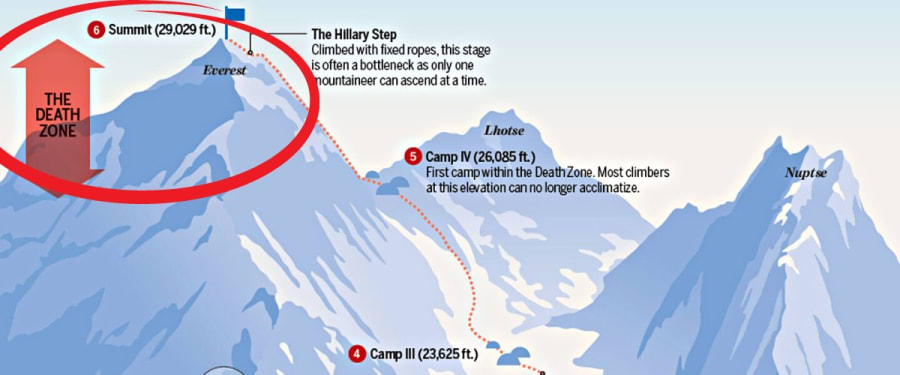
It was mentioned that there were bottlenecks at the Balcony and Hillary Step caused by the delay in securing the fixed ropes. This caused a 1.5-hour delay in summiting, which in turn caused a general lack of oxygen among the climbers. Added to this, there was an insufficient stock of oxygen at the point where it was stored for climbers coming down. This also led to the rescue teams being required to carry bottles up to the climbers who were stranded and in storm conditions, thus slowing the rescuers down.
In Conclusion
It appears there were several things that went wrong that day, particularly ignoring the warnings of an incoming storm and the fact that inexperience was seen across both teams who lost climbers. Or was the Goddess Mother of the World displeased?
In the words of Jon Krakauer ‘In the end it is Everest who decides who climbs and who does not.’