
Arrive in Kathmandu and meet the trek team at the airport. After the transfer to your hotel, a trip briefing covers the route, the camping arrangements beyond Gumba, and the days ahead in Bajura.
Sleep at 1,400 m
Tonight’s stay
Hotel



A 16-day camping trek along a historic Himalayan salt route into Nepal's Far West, crossing Bajura district's Bichya-Yuna-Gumba trail to a glacial lake below the east face of Mount Saipal (7,031 m).
The East Saipal Trek follows a remote section of the old Himalayan salt route into Bajura district, one of Nepal's least-visited corners. The trail was once used by local traders carrying salt between the high mountain settlements and the lower hills; while that trade has faded, the same footpaths still connect isolated villages across Far Western Nepal, and this trek walks them from the roadhead at Dulachaur to a glacial lake on the eastern flank of Mount Saipal.
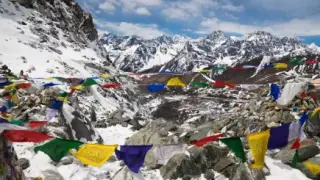
The journey begins with a flight to Surkhet and a road transfer through Rakam to Dulachaur in Bajura, the trek's starting point. From there the trail climbs through the villages of Bichya and Yuna to Gumba, the last permanent settlement on the route, where trekkers overnight in a local homestay. Beyond Gumba, camping is the only way to continue: the trail crosses Lampata and Chiya Chaur into open alpine grazing land at Rani Kharka, known locally as Ranisain, a high pasture with a clear view of Saipal's east face.
From camp at Rani Kharka, a day is spent exploring the glacial lake and basin below the peak, at around 3,900 m — one of the lowest-altitude high-mountain destinations in the Nepal Himalaya, reachable without crossing a technical pass. The return retraces the route back through Gumba to Maitarna, where a jeep meets the trail for the drive back to Dulachaur along the road toward Humla, before the journey continues via Surkhet to Kathmandu.
Very few trekkers visit this part of Bajura in any given year. The East Saipal Trek suits travellers who want a genuine wilderness experience away from Nepal's established trekking circuits: forested river valleys, terraced hillside villages, a homestay night in Gumba, and several days of fully supported camping in alpine country that sees almost no foreign visitors.
Last updated July 2026
Tap any day to expand — altitudes, walking times, meals, and overnight details for every stage of the journey.
Every cost on the trail is broken out below — no hidden fees, no surprises at the trailhead.
Included
12 items
Not included
7 items
The East Saipal Trek is graded Hard. Most walking days run 5-8 hours on uneven mountain trails, with a few long stages, notably the day exploring the glacial lake and returning to Gumba, and the descent from Gumba to Maitarna, extending to 8-10 hours. The maximum altitude is approximately 3,900 m at the glacial lake basin, which is moderate by Himalayan standards; the difficulty comes mainly from the terrain and the remoteness rather than extreme elevation. There are seven trekking days, four of them fully supported by camping with no villages or phone signal along the way. No technical climbing is involved, but a good level of fitness, prior multi-day trekking experience and a positive attitude toward basic camping conditions are all recommended.
Planning your East Saipal Trek
Everything you need to plan the trek, topic by topic. Tap any one to open it.
The East Saipal Trek is graded Hard, but not because of extreme altitude: the hi…
The East Saipal Trek is graded Hard, but not because of extreme altitude: the high point is approximately 3,900 m at the glacial lake basin below Saipal's east face, moderate by Himalayan standards. The difficulty comes from the terrain and the remoteness. Most walking days run 5-8 hours on uneven trails with real ascents and descents; the day exploring the glacial lake and returning to Gumba, and the descent from Gumba to Maitarna, both extend to 8-10 hours.
There are seven trekking days in total, four of them fully supported by camping with no villages, lodges or phone signal along the way. No technical climbing skill is required, but previous multi-day trekking experience, solid fitness, and comfort with basic camping conditions in a remote setting all matter more here than on Nepal's established trekking routes.
Autumn, September to November, is the recommended season. The weather is general…
The East Saipal Trek stays entirely within Bajura district throughout, which is…
Accommodation changes with the terrain. Kathmandu has a proper hotel on a bed-an…
A trek cook runs the kitchen from the first camp to the last, and all meals are…
Surkhet, the gateway to this trek, is a short domestic flight from Kathmandu. Fr…
The East Saipal Trek follows a remote section of the old Karnali salt route, onc…
Dulachaur, Bichya and Yuna are working hillside villages along the lower trail,…
Rani Kharka, known locally as Ranisain (from the Nepali for a queen's high pastu…
A licensed Swotah trekking guide leads every departure, supported by a cook and…
The full kit list. Anything we loan (sleeping bag, down jacket) is called out — bring everything else.
Everything trekkers ask before booking. Don't see yours? Tap Enquire — we usually reply within a few hours.
The trek starts and ends in Kathmandu. We fly you to Surkhet, then transfer by jeep through Rakam to Dulachaur in Bajura, the trailhead. All flights and road transfers are included in the package.
Most Nepal operators look the same from the outside. Here's what actually makes the difference.
100% locally owned since 2016. Trek profits stay with the mountain families and village schools along your route.
Every date on our calendar runs — no minimum group size. You never pay to be cancelled.
Government-licensed, WFR-certified, English-speaking. Most were born within two valleys of the trail.
Small groups, never more than 8 trekkers. You get a real experience, not a convoy.
Sleeping bag and down jacket loaned at no extra charge — both rated to –20°C.
Deposit from 10% to confirm, balance before departure or in cash on arrival. Reschedule up to 30 days prior.
Kathmandu office and dedicated WhatsApp emergency line. We answer at 2am if needed.
TripAdvisor Travelers' Choice 2023, 2024 and 2025. Hundreds of verified five-star reviews.
Tell us your travel dates and group size. Our team in Kathmandu will put together a tailored itinerary, honest costs, and practical tips — completely free, no commitment.