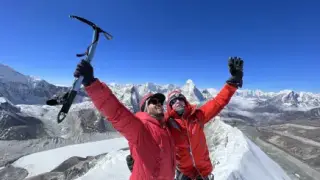
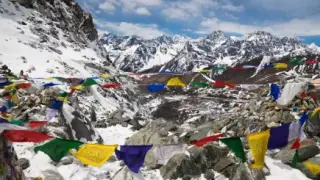
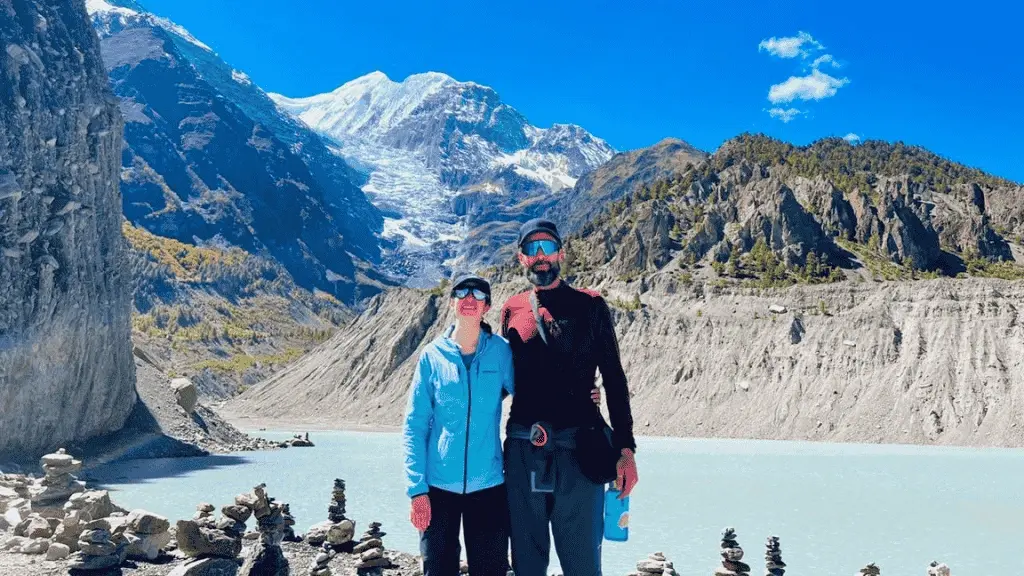
A 16-day climb of Mera Peak (6,476 m), Nepal's highest trekking peak, via the remote Hinku valley with five 8,000 m peaks in view from the summit.
Duration
16 Days
Max Altitude
6,476 m / 21,247 ft
Difficulty
Severe
Group Size
Max 7 trekkers
Region
Everest Tour Packages, Nepal
Best Season
Spring · Autumn
Accommodation
Tea houses & tents
Meals
All meals included
Transport
Flights Kathmandu-Lukla
Dates & Prices
Choose your date
All dates are guaranteed departures — we never cancel for low numbers. Book online or send a quick enquiry.
YearMonth
2 departures · 2026
Oct
10
Oct 10, 2026 — Oct 25, 2026
Fully booked
Sold out
USD2,195
per person
Nov
9
Nov 9, 2026 — Nov 24, 2026
Guaranteed departure — from 2 trekkers
Available
USD2,195
per person
Can’t find a suitable date? We run private departures on any date with as few as 2 trekkers.
Trip Overview
About the Mera Peak Climbing
Mera Peak, at 6,476 m, is the highest trekking peak in Nepal and the most-climbed peak above 6,000 m in the Himalaya. It stands in the Hinku valley southeast of Everest, inside the Makalu Barun National Park, and the summit ridge gives a 360-degree view that includes five of the world's fourteen 8,000 m mountains: Everest, Lhotse, Makalu, Cho Oyu and Kanchenjunga.
The standard route from Lukla crosses the Zatrwa La (approximately 4,600 m) and descends into the remote Hinku valley, passing through Thuli Kharka and Kothe before reaching Khare, the last settlement below the peak. From Khare the route climbs across a broad glacier to Mera Base Camp and High Camp at around 5,800 m, then follows a long snow ridge to the summit. The grade is Alpine F to PD: no fixed ropes or vertical ice, but crampons, an ice axe and a climbing harness are essential throughout the upper mountain.
This 16-day expedition suits fit trekkers with no prior high-altitude climbing, and Swotah pairs each climber with an experienced high-altitude guide for the glacier and summit push. The sections below cover difficulty, permits, the best season, gear and everything else you need to plan the climb.
Last updated June 2026
Trip Highlights
Highlights
1
Summit Mera Peak (6,476 m), Nepal's highest trekking peak
2
360-degree view of five 8,000 m peaks: Everest, Lhotse, Makalu, Cho Oyu and Kanchenjunga
3
Glacier approach via the remote Hinku valley with no crowds
4
Cross the Zatrwa La (approx. 4,600 m) on the way into the Hinku valley
5
Walk through the wild Makalu Barun National Park wilderness
6
First 6,000 m summit with crampons, ice axe and a rope team
Day by Day
Mera Peak Climbing Itinerary: 16 Days
Tap any day to expand — altitudes, walking times, meals, and overnight details for every stage of the journey.
A Swotah representative meets you at Tribhuvan International Airport and transfers you to your hotel in Thamel. Your climbing guide joins you in the evening for a full briefing: the itinerary, permit paperwork, a gear check and what to expect on the upper mountain. Overnight in Kathmandu (1,350 m).
Sleep at 1,350 mDinner
Tonight’s stay
Hotel
A guided morning around the Kathmandu Valley's UNESCO heritage sites, including Pashupatinath and Boudhanath, helps orient you before the climb. The afternoon is for any last gear purchases in Thamel, finalising the NMA peak permit and Makalu Barun National Park entry paperwork, and repacking your duffel for the porter. Overnight in Kathmandu (1,350 m).
Sleep at 1,350 mBreakfast
Tonight’s stay
Hotel
An early morning flight from Kathmandu lands at Tenzing-Hillary Airport in Lukla (2,840 m) after a 35-minute scenic approach over the foothills and the Dudh Kosi gorge. From Lukla the trail climbs immediately, passing through Surke and gaining the ridge toward the Zatrwa La before stopping at Chutanga (3,050 m), a small herder camp in rhododendron and juniper forest. The climb gains around 210 m and takes 2 to 3 hours. Overnight in Chutanga.
Sleep at 3,050 mBreakfastLunchDinner
Tonight’s stay
Teahouse
Today crosses the Zatrwa La (approximately 4,600 m), the pass that separates the Dudh Kosi drainage from the Hinku valley. The climb from Chutanga gains over 1,500 m on a steady trail through thinning vegetation to the broad, wind-scoured col, where the first views of Mera's long plateau summit appear. The descent drops sharply to the high meadow of Thuli Kharka (4,320 m), where yaks graze in summer and a basic teahouse serves hot food. About 5 to 6 hours. Overnight in Thuli Kharka.
Sleep at 4,320 mBreakfastLunchDinner
Tonight’s stay
Teahouse
The trail leaves the exposed meadow at Thuli Kharka and drops steadily into the Hinku valley, following a ridgeline and then a forested descent to the Hinku Khola river. Rhododendron and pine replace the high grassland as altitude drops 720 m. Kothe (3,600 m) sits on the valley floor above the river and is the main settlement in this section of the valley. About 4 to 5 hours. Overnight in Kothe.
Sleep at 3,600 mBreakfastLunchDinner
Tonight’s stay
Teahouse
From Kothe the trail turns south up the Hinku valley, climbing steadily along the river through pasture and boulder fields as the valley narrows and Mera's glacier begins to come into view above. Thangnang (4,320 m), also spelled Thaknak, is a high-altitude herding settlement at the foot of the moraine, with clear sightlines to Mera's broad upper plateau and the surrounding peaks of Kusum Kangru and Chamlang. About 4 to 5 hours. Overnight in Thangnang.
Sleep at 4,320 mBreakfastLunchDinner
Tonight’s stay
Teahouse
A full rest day at 4,320 m is a deliberate acclimatisation step before moving higher. The standard acclimatisation protocol is to take a 2 to 3 hour walk to around 4,700 m on the moraine above camp, then return to sleep at the same altitude. This pressures the body to produce more red blood cells without the fatigue of a full day's carry. The guide checks oxygen saturation with a pulse oximeter morning and evening. The afternoon is free for gear sorting, hydration and rest. Overnight in Thangnang.
Sleep at 4,320 mBreakfastLunchDinner
Tonight’s stay
Teahouse
Khare (5,000 m) is the last teahouse settlement and the staging point for the glacier, reached in 3 to 4 hours from Thangnang on a trail that climbs moraine ridges above the valley. The altitude gain of 680 m places most trekkers at the threshold where acute mountain sickness becomes a serious risk, so the day is deliberately short. The afternoon is for rest, hydration and a gear check: crampons, ice axe, harness and mountaineering boots are all needed from tomorrow. Overnight in Khare.
Sleep at 5,000 mBreakfastLunchDinner
Tonight’s stay
Teahouse
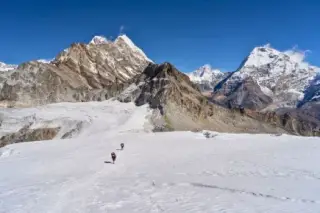
From Khare the route crosses the glacier approach, climbing rocky moraine then stepping onto the lower glacier to reach Mera Base Camp at around 5,300 m. The glacier here is relatively flat and crevasse-free, but crampons are worn from the glacier edge and the rope team is assembled. The climb of 300 m takes 3 to 4 hours. Base Camp is a collection of expedition tents on a relatively sheltered snow platform, with Mera's summit plateau visible directly above. The guide delivers a technical briefing on crampon technique, self-arrest with the ice axe and rope-team protocol. Overnight at Mera Base Camp.
Sleep at 5,300 mBreakfastLunchDinner
Tonight’s stay
Base camp
High Camp at around 5,800 m is a 500 m carry from Base Camp, following the glacier and then a steeper snow face to a ridge platform exposed to the wind but with clear views of the Hinku valley below and the summit above. The carry takes 3 to 4 hours. Tents are pitched on snow, and the evening is for an early meal, a final gear check and as much sleep as altitude allows. The summit attempt begins between 2 and 4 am depending on weather and conditions. Overnight at Mera High Camp.
Sleep at 5,800 mBreakfastLunchDinner
Tonight’s stay
Teahouse
Summit day begins in darkness. The team leaves High Camp at 2 to 4 am by headlamp, climbing the broad snow ridge above camp on a gradient that is sustained but never vertical. The false summit at around 6,350 m is reached first, then a short flat section leads to the true summit cairn at 6,476 m. The view from the top spans five 8,000 m peaks in a single panorama: Everest (8,849 m) to the northwest, Lhotse (8,516 m), Makalu (8,485 m), Cho Oyu (8,188 m) to the west and Kanchenjunga (8,586 m) to the east. The round trip from High Camp takes 5 to 7 hours. After the summit the team descends to High Camp or continues to Khare depending on conditions and energy. Overnight at High Camp or Khare.
Sleep at 5,000 mBreakfastLunchDinner
Tonight’s stay
Teahouse
The descent from the glacier to the valley is rapid: from High Camp or Khare the trail retraces the moraine path to Thangnang, then continues down the Hinku valley to Kothe (3,600 m). The drop of around 1,400 to 2,200 m from overnight camp to Kothe takes 5 to 7 hours. Returning below 4,000 m relieves any residual altitude effects and is one of the best feelings of any climb. Overnight in Kothe.
Sleep at 3,600 mBreakfastLunchDinner
Tonight’s stay
Teahouse
The return leg climbs back out of the Hinku valley toward the Zatrwa La. The trail from Kothe retraces north and then climbs steeply to the high meadow of Thuli Kharka (4,320 m), regaining around 720 m in 4 to 5 hours. After days on the glacier the green meadow and lower altitude feel like a different world. This is the last high camp before crossing back over the pass to Lukla. Overnight in Thuli Kharka.
Sleep at 4,320 mBreakfastLunchDinner
Tonight’s stay
Teahouse
The final trail day crosses back over the Zatrwa La (approximately 4,600 m) and descends all the way to Lukla (2,840 m). The climb to the pass from Thuli Kharka takes 2 hours, then a long descent through forest and past waterfalls drops back into the Dudh Kosi drainage. Lukla's stone-paved streets and teahouses feel surprisingly lively after the remote Hinku valley. About 6 to 7 hours total. Overnight in Lukla.
Sleep at 2,840 mBreakfastLunchDinner
Tonight’s stay
Hotel
Morning flights from Lukla to Kathmandu operate weather permitting; the Lukla runway closes in cloud or strong crosswind, so build flexibility into international connections. The flight is 35 minutes. Back in Kathmandu the afternoon is free for shopping in Thamel, a hot shower and a celebratory dinner. Overnight in Kathmandu (1,350 m).
Sleep at 1,350 mBreakfast
Tonight’s stay
Hotel
Your Mera Peak expedition ends today. A Swotah representative transfers you to Tribhuvan International Airport for your onward flight. If you would like to extend your stay, add a post-climb trek to Everest Base Camp or explore the Kathmandu Valley further, we are glad to arrange it.
Breakfast
What’s included
What's included
Every cost on the trail is broken out below — no hidden fees, no surprises at the trailhead.
Included
18 items
All airport transfers;
Climbing permit for Mera Peak;
First aid medical kits for the group and the staff;
Standard/Deluxe rooms in Kathmandu on a B/B basis;
Required fixed and dynamic rope during the climbing period.
Local English-speaking guide for sightseeing in Kathmandu;
All wages, equipment, medical and accidental insurance for all involved staff;
Flight tickets for the Ramechaap/Kathmandu-Lukla-Ramechaap/Kathmandu sector to all climbing members and staff;
All necessary paperwork, office service charges, and government taxes levied in Nepal;
Necessary staff, including experienced guides and porters, during the trekking and climbing.
Required experienced, trained and government-licensed climbing guide(s) during the climbing period as per the size of the group;
Full-day sightseeing in Kathmandu;
Per person, 20kg baggage allowance by porters (3:1) or Yak during trekking up and 20 kg baggage allowance while returning from Base Camp after climbing the peak;
Trekking Permit (National Park entry fee) and TIMS card (Trekking Information Management System);
All trekking and camping equipment like camp furniture, kitchenware, dining tents, guest tents, etc.;
Appropriate food for high altitude and all climbing crew at base camp and above as required;
Complete pre-departure information, flight ticket reconfirmation, and visa extension procedure services (if necessary);
3 meals a day (breakfast, lunch and dinner with tea or coffee) along with available accommodation or tents for members and staff during trekking and climbing on a twin-sharing basis.
Not included
12 items
Lunch and dinner in Kathmandu;
Travel and rescue insurance;
International flights, Nepalese visa fee;
Entrance fees during sightseeing;
Personal climbing equipment;
All kinds of personal expenses;
Icefall fees, Garbage Deposit (sharing with another member) if applicable;
Wake talkies & filming permit;
Personal climbing guide (if requested);
Optional trips and sightseeing if extended.
Tips for guides and porters (it’s encouraged to tip);
Excess baggage charges (if you have more than 15 kg of luggage, a cargo charge is around $1.5 per kg).
How Hard Is the Mera Peak Climbing?
Mera Peak is graded Alpine F to PD. The upper mountain is a long glacier walk on snow with crampons, ice axe and a harness; there is no vertical ice or fixed-rope climbing. The height of 6,476 m is the main challenge, not the technical grade.
▲Alpine grade F/PD. Max 6,476 m. Long glacier walk on snow; crampons and ice axe required. High altitude is the main challenge. Good fitness and altitude acclimatisation essential.
Overall Rating
8
Severe
out of 10 · physical effort scale
Max altitude6,476 m
Trekking days13 days
Trip Details
Planning your Mera Peak Climbing
Everything you need to plan the trek, topic by topic. Tap any one to open it.
Mera Peak at 6,476 m is graded Alpine F (facile) to PD (peu difficile) by mounta…
Mera Peak at 6,476 m is graded Alpine F (facile) to PD (peu difficile) by mountaineering standards. The summit push follows a long, broad snow ridge from High Camp at around 5,800 m, with no sustained vertical sections, fixed ropes or ice walls. Crampons, an ice axe and a climbing harness are essential from the glacier up, and all climbers clip into a rope team with a guide.
3 nights above 5,000 m, including summit day, place real physiological demands on the body. Acute mountain sickness (AMS) is the primary risk, and altitude is the real challenge rather than any technical difficulty. The route builds in deliberate acclimatisation, including a rest day at Thangnang and a slow approach through Khare. Swotah guides carry pulse oximeters, supplemental oxygen for emergency use and a comprehensive first-aid kit. Anyone with a history of cardiac or respiratory illness should have a pre-trip health check.
Autumn, from late September to November, is the prime season for Mera Peak. Post…
Autumn, from late September to November, is the prime season for Mera Peak. Post-monsoon skies are clear, winds on the summit ridge are moderate and the glacier is in good condition, with stable freeze-thaw cycles. October and early November give the highest success rates and the clearest summit views.
Spring (March to May) is the secondary window: warmer at altitude, often with deep pre-monsoon snow on the upper glacier that can slow progress, but perfectly feasible and less crowded than autumn. Winter (December to February) brings very cold temperatures and occasional high-altitude wind, and is recommended only for experienced parties. The summer monsoon (June to August) brings heavy rain low down and unconsolidated snow on the glacier, so the peak is rarely attempted in those months.
Mera Peak requires a Nepal Mountaineering Association (NMA) climbing permit, iss…
Mera Peak requires a Nepal Mountaineering Association (NMA) climbing permit, issued through a registered agency in the name of your licensed climbing guide. The NMA raised peak royalties in 2025, and at 6,476 m Mera sits in the same under-6,500 m band as Island Peak, so the permit is now around USD 350 per person in spring (March to May) and about USD 175 in autumn (September to November), winter and summer, up from the previous USD 250 and USD 125. Rates can still change, so Swotah confirms the exact figure before departure. Mera is approached through the Hinku valley, so you also need the Makalu Barun National Park entry permit and the Khumbu Pasang Lhamu Rural Municipality permit for the Lukla area; no TIMS card is required on this route. A qualified high-altitude guide is mandatory under NMA rules and the permit is issued in the guide's name. Swotah arranges every permit once you send a passport copy and two passport photos, and the park and municipality fees are included in the package price.
Accommodation on the Mera approach is a mix of teahouse lodges and tented high c…
Accommodation on the Mera approach is a mix of teahouse lodges and tented high camps. From Lukla through Chutanga, Thuli Kharka, Kothe, Thangnang and Khare you stay in teahouse lodges; those at Kothe and Khare are comfortable by remote-Himalayan standards, with private or twin rooms and a shared dining hall heated in the evening. The Hinku valley is far quieter than the Everest main trail, so lodges are simpler and fewer. Above Khare there are no lodges: Mera Base Camp (about 5,300 m) and High Camp (about 5,800 m) are expedition tent camps that the Swotah team supplies and sets up, with dining and toilet tents. An expedition-weight sleeping bag rated to at least minus 20 degrees Celsius is essential for the high camps, where night temperatures fall well below freezing; Swotah includes a four-season bag and an insulated mat in the gear list. Two nights in a Kathmandu hotel bookend the trip.
Dal bhat (rice, lentil soup and vegetable curry) is the staple throughout the te…
Dal bhat (rice, lentil soup and vegetable curry) is the staple throughout the teahouse section, available with free refills at most lodges, and the cook team prepares high-calorie hot meals at the mountain camps. Swotah includes all meals from the first trek day through the last; budget separately for Kathmandu dinners.
Water must be treated above Lukla: use purification tablets, a filter straw or boil at camp, and aim to drink 3 to 4 litres per day at altitude to reduce AMS risk. Bottled water is available in lower villages but not above Khare, so a reusable bottle and treatment method are essential. Camp cooking uses melted glacier snow above the snowline.
The expedition starts with a 35-minute mountain flight from Kathmandu (Tribhuvan…
The expedition starts with a 35-minute mountain flight from Kathmandu (Tribhuvan International, 1,350 m) to Lukla (Tenzing-Hillary Airport, 2,840 m). Lukla flights operate morning-only and are subject to weather delays; build at least one buffer day into international connections. Swotah includes Kathmandu-Lukla-Kathmandu flights in the package.
On the return, the trek walks back to Lukla for the flight to Kathmandu. Road travel from Kathmandu to the Lukla road head is not a standard option for this route because the Hinku valley approach is via the Zatrwa La from Lukla. International arrivals use Tribhuvan International Airport; Swotah provides airport pickup and departure transfer.
From Khare upward, the Mera Peak route becomes a mountaineering ascent. Mountain…
From Khare upward, the Mera Peak route becomes a mountaineering ascent. Mountaineering boots (double-layered, rated to -40°C) are mandatory; standard trekking boots are not suitable above Khare because crampons must be fixed correctly and the cold at High Camp is severe. Crampons, an ice axe, a climbing harness, locking carabiners and a chest ascender (jumar) are the core gear items.
The summit day follows the glacier, then a snow ridge to the false summit at around 6,350 m and the true summit at 6,476 m. The team ropes up from Base Camp. Fixed ropes are occasionally placed by earlier parties on the steeper section below the summit, but you should not assume they are in place. Swotah provides technical rope, snow stakes and group hardware; climbers bring personal items from the packing list.
Mera is a high-altitude glacier walk-up rather than a technical climb, so acclim…
Mera is a high-altitude glacier walk-up rather than a technical climb, so acclimatisation is the key to a safe summit. The Zatrwa La crossing on day 3 pushes to about 4,600 m before dropping to Thuli Kharka, an early high touch that aids adaptation. The rest day at Thangnang (4,320 m) and the steady approach through Khare (5,000 m) let the body adjust before the high camps; do not skip the Khare night or rush the ascent. From Mera Base Camp (5,300 m) the team moves up to High Camp at about 5,800 m, set on a rock shelf above the glacier. Summit day starts from High Camp around 2 to 3 am to reach the top in the calm, clear morning window and return before afternoon cloud and wind build. The round trip from High Camp to the 6,476 m summit and back takes roughly 5 to 7 hours on a long, broad snow slope, with a short steep final section to the true summit where a fixed rope is usually set. The summit panorama spans five 8,000 m peaks: Everest (8,849 m), Lhotse (8,516 m), Makalu (8,485 m), Cho Oyu (8,188 m) and Kanchenjunga (8,586 m). The team descends the same day to High Camp or down to Khare.
An NMA-licensed high-altitude guide leads every rope team on Mera Peak; solo cli…
An NMA-licensed high-altitude guide leads every rope team on Mera Peak; solo climbing without a licensed guide is not permitted under the peak permit rules. Swotah's climbing guides hold NMA high-altitude guide licences and have personal summit experience on Mera and other trekking peaks; your guide will have climbed this peak before.
A standard team includes the climbing guide, a cook for the high camps and enough high-altitude porters to carry tent and food loads. One porter carries 20 to 25 kg and faces the same altitude exposure as the climbing team, so Swotah caps loads at that weight and provides porter insurance. You carry only a light daypack from Khare to the summit.
Mera Peak sits inside Makalu Barun National Park, one of Nepal's least-disturbed…
Mera Peak sits inside Makalu Barun National Park, one of Nepal's least-disturbed protected areas. Carry all non-biodegradable waste off the mountain, use established camp sites, avoid open fires above the treeline and buy water at lodges rather than taking it from streams near settlements.
A common tipping guideline is 10 to 15 percent of the trek cost, split among the climbing guide, cook and porters. The summit climbing guide typically receives a larger share. Tips go directly to a seasonal workforce with few other income sources in the Hinku valley. Booking with a registered operator like Swotah ensures NMA permits, porter insurance and fair pay are handled correctly.
What to pack
What to pack
The full kit list. Anything we loan (sleeping bag, down jacket) is called out — bring everything else.
✓Expedition duffel bag (carried by porter)
✓Summit pack / daypack (30-35 L)
✓Dry bags or waterproof liners
✓Packing cubes
Frequently Asked
Questions & Answers
Everything trekkers ask before booking. Don't see yours? Tap Enquire — we usually reply within a few hours.
Mera peak is not a technically difficult peak to climb, but you need good stamina and energy to climb it. Even though Mera peak can be climbed without any previous climbing experience, you need to know how to use the climbing equipment and gears. At Base Camp, our guide also helps you to how to use that equipment so you don’t need to worry about that.
March to June and September to November are the best months to climb Mera Peak.
Weather in the mountains is difficult to predict. It usually snows heavy during the months of January, February and December.
Yes, our climbing guides are well trained and have got the license from the Nepal Mountaineering Association. They are experienced with many mountains above 6000 m to 7000 m and also some of them have experienced the 8000 m peaks.
Usually, we rent a sleeping bag which is good for -10 degree Celsius or -20 degree Celsius. In case the sleeping bag is not warm enough for you, we'll also provide you the extra blanket.
During trek please use comfortable and flexible dress. While trekking during the day at lower altitudes, lightweight trekking trousers and T-shirts are recommended. It's always a good idea to carry a waterproof jacket and some warmer clothing with you though as mountain weather is notoriously unpredictable. For the cold nights, thermal underwear, a warm fleece jacket and even a down jacket will help to keep you warm. Good shoes are of great importance. They must be comfortable. For higher altitude treks where you may have to tread snow for long hours, good boots are available for rent in Kathmandu. For mountaineering, you will require special clothes that can be bought or hired from us.
Yes, you shouldn’t worry about this. As you arrive, our representative will be standing outside the airport terminal. You'll be directly transferred to the hotel.
To confirm your booking, a deposit of 15% of total trip amount is required if you are booking at least a year in advance before trip departure date. If booking is made between 100-364 days before the trip departure, you'll need to pay 20% to confirm the trip. If payment is made between 99-60 days, 25% of the total trip amount will need to be paid and if booked between 59-30 days, 50% of the total trip amount needs to be paid and finally, if you are booking 29 days prior to trip departure, then 100% payment should be made. The payments can be easily made by the bank transfer. The due balance is payable on arrival in Kathmandu with cash (preferably USD/EURO) or card on POS/credit card machine. Please note that non refundable fee is 10% or $200 whichever is greater.
You have to pay the remaining balance after arriving in Kathmandu either by cash or through credit card, before we start our adventure.
It's always a good idea to book on your own. But we can also help you booking your flight in case of request.
There are no hidden costs in our itineraries. Therefore you don't need to carry much, but everything that's not mentioned on itinerary for example extra cup of tea, coffee, charging electrical appliances, can cost you extra. Therefore, we recommmend you to keep at least $20-$50 per day for your personal expenses.
Yes, you can add the extra days as per your wish, but for the extra day you have to pay the additional cost to cover guides, porters, accommodation and food.
The hotel in Kathmandu does provide the free storage services. So you can leave the clothes which are not necessary for the trekking. The best way is to save it in our office store room which is equally safe.
You have to carry your personal bags with water bottle and medicines. Remaining bags will be carried out by the porters.
For nights in cities, we use standard/superior standard/deluxe rooms whereas, during the trek we use lodges/tea houses/guesthouses/home stay for our clients, whatever is available and accessible. We also arrange sleeping bags for our clients, on their request. For this expedition, accommodation will be tented camp.
During the trek, you will get clean and hygienic food. Our cooks and helpers will cook the special meals.
There are plenty of water stations on each stop on the route. You can easily fill up the bottle from the open taps. We recommend that you bring water purifier tablets with you or at least get it from Kathmandu before you depart for trekking. You can also buy mineral waters but we usually recommend tap water which is pure and it helps us not promoting plastic bottled water.
We mostly use the comfortable and efficient vehicle so that you may not get a problem during the ride. We used private or tourist vehicle for the sightseeing in the Kathmandu. Depending on the nature or group sized also we used cars, minibus, vans or jeep for the travelling along the narrow and bumpy roads of Nepal. Mostly we used AC vehicles for your comfort.For domestic flight from Kathmandu to Lukla to Kathmandu we use Tara air, Yeti air, and Goma air which are the popular domestic airlines in Nepal.
Usually, we have to walk about 7-9 hours a day. But it shouldn't be taken as certain thing. Because number of hours of walk really depend on clients' speed. So it's really relative.
In some villages, it's really possible to charge, but it costs extra to charge the camera and other electronic devices. It usually costs between $ 3-$ 6 per hour. So it's expensive. The best idea is to bring a power bank.
Yes, for the first few days, it's possible to have telephonic communication. In some villages, you can make local and international calls from telephone provided by the guesthouse owner after paying the price directly to them. in higher altitude regions, we usually have satellite phones with our Sherpas or guides.
You can use a credit card only at the Kathmandu as outside the Kathmandu valley you have to use the cash so change your currency into the Nepali currency before the trekking.
Definitely we will provide you porter, or yak as per the condition. Besides your personal bag and the water bottle which will be frequently need for you they must be carried by you and remaining will be carried by our porter or yak.
Yes of course you can change the lodge if you don’t feel comfortable at one place, but it really depends on the availability of the lodges. During the peak season, the possibilities of changing the lodges are low.
We will send our potters to reserve the lodges before we reach there.
We make sure to take security measures during climbing to make your expedition successful. We hire experienced and authorized guides/Sherpas to safeguard your life in the mountains. We strongly recommend that you follow the guide’s instruction with utmost care.
No, there will not be any problem as mostly at the high altitude, we prefer vegetarian food to avoid the food poisoning.
Yes, the trekking guides working in our company are the certified license holders and they also have received high altitude first aid training from KEEP (Kathmandu Environmental Education Project).
Our guides are well trained; they carry the first aid box for emergency. You also take some medicine box for your personal use.
No vaccinations are compulsory in the Himalaya, but we do recommend you are covered for diphtheria & TB, hepatitis A, hepatitis B, *malaria, typhoid, polio and tetanus.
We also recommend:
•A dental check-up prior to traveling.
•That you know your blood group in case of emergency.
If you have any pre-existing medical conditions which might affect you on tour, you make these known to your tour leader and Swotah travellers at the time of your booking.
Why Travel with Swotah
Why Book the Mera Peak Climbing with Swotah
Most Nepal operators look the same from the outside. Here's what actually makes the difference.
Born in Nepal
100% locally owned since 2016. Trek profits stay with the mountain families and village schools along your route.
Guaranteed Departures
Every date on our calendar runs — no minimum group size. You never pay to be cancelled.
Certified Guides
Government-licensed, WFR-certified, English-speaking. Most were born within two valleys of the trail.
Small Groups
Small groups, never more than 8 trekkers. You get a real experience, not a convoy.
Gear Included
Sleeping bag and down jacket loaned at no extra charge — both rated to –20°C.
Flexible Payment
Deposit from 10% to confirm, balance before departure or in cash on arrival. Reschedule up to 30 days prior.
24/7 Support
Kathmandu office and dedicated WhatsApp emergency line. We answer at 2am if needed.
Hall of Fame
TripAdvisor Travelers' Choice 2023, 2024 and 2025. Hundreds of verified five-star reviews.
Get a free personalised travel brief for the Mera Peak Climbing.
Tell us your travel dates and group size. Our team in Kathmandu will put together a tailored itinerary, honest costs, and practical tips — completely free, no commitment.