


The best family treks in Nepal are short, low routes near Pokhara: the Royal Trek (stays below about 1,760 m), Ghorepani Poon Hill (4 days, sleeping at 2,860 m with a dawn climb to 3,210 m) and the 8-day Ghorepani and Ghandruk loop. Teenagers and fit grandparents can step up to Mardi Himal, Jomsom and Muktinath or Upper Mustang, which all sleep above 3,000 m and need slower days. For pre-school children the UIAA medical commission prefers a sleeping altitude below 2,500 m. A licensed guide has been required on most trails since 1 April 2023, and a porter makes a family trek far easier.
- Easiest family trekRoyal Trek, about 4 days on foot, under 1,800 m
- Classic first trekPoon Hill, 4 days from Pokhara, from USD 300
- Little ones (pre-school)Sleep below about 2,500 m where you can (UIAA)
- Teens and active grandparentsMardi Himal, Jomsom-Muktinath, Upper Mustang
- GuideLicensed guide required on most trails since 1 Apr 2023
- Best monthsOct to Nov, Mar to Apr (Dec to Feb for low routes)
Nepal is widely famous among adventurers as an adventure hub with a wide variety of activities to choose from, but don’t let that hold you down. Nepal is a versatile trekking destination offering various options to choose from per your requirements, considering the difficulty level, destination, and attractions.
Nepal is an emerging family trekking destination in Asia. Due to the wide scope and variability in trekking trails, it suits beginners and travelers with children.
Trekking must not be all about endurance and pushing your limits. While it can be quite an experience to conquer the most challenging trips in Nepal, nothing compares to the joy of sharing a trek with your family.
Traveling with the family is a unique experience in itself. Family Trekking in Nepal is one of the best ways to introduce your family, including children, to a completely new cross-cultural exchange, providing a wonderful opportunity to explore different cultures, languages, and lifestyles.
Of course, trekking in Nepal with children certainly requires some special planning. Getting around is easier than it was. Jeep roads now reach close to most trailheads in the Annapurna foothills, and mobile coverage reaches most lodges on the popular routes. That makes it simpler to cut a day short or get help in an emergency.
So, if you are thinking about family trekking, Nepal is a great place to start. One gets to experience the best of nature, culture and family time within Nepal.
Here, we introduce you to the best family-friendly destinations while trekking in Nepal.
This guide is about planning the trip as a family: which route fits your mix of ages, how long to walk each day, and what guides, porters and permits cost. For young children's health and altitude safety in more detail, read our guide to trekking in Nepal with children.
Family Treks in Nepal at a Glance
The highest place you sleep matters more than the highest point you visit, so the table sorts the routes by sleeping altitude. The age column is our suggestion for a first family trip, not a rule. Every child is different.
| Route | Walking days | Highest night | Walking per day | Road access | Our suggestion | |
|---|---|---|---|---|---|---|
| Silver Triangle tour | None (sightseeing) | Under about 2,200 m | Short walks | Everywhere | All ages | |
| Royal Trek | About 4 | Under about 1,800 m | 3 to 5 h | Roads close to the trail | All ages, toddlers carried | |
| Poon Hill (4 days) | 4 | Ghorepani, 2,860 m | 4 to 6 h | Jeep road at both ends | About 6 and up | |
| Ghorepani and Ghandruk loop | About 6 | Ghorepani, 2,860 m | 4 to 6 h | Roads reach Ghandruk | About 7 and up | |
| Jomsom and Muktinath | Varies | Muktinath, about 3,710 m | 4 to 6 h | Jeep road along the valley | Older children and teens | |
| Mardi Himal | 5 to 9 | High Camp, about 3,580 m | 5 to 7 h | Only at the start and end | Fit teens | |
| Upper Mustang | 10 or more | Lo Manthang, about 3,840 m | 5 to 7 h | Jeep road most of the way | Teens |
The Poon Hill Trek (4 Days)

One of Nepal's most famous trekking routes is the Poon Hill climb. A four-day trek with big mountain vistas across the Annapurna range is a wonderful way for young adventurers who can't stay still to have their first taste of the great outdoors. This trek route has a maximum height of 3,210 m at the Poon Hill viewpoint, and you sleep at Ghorepani (2,860 m). The altitude risk is low but not zero, so watch children for headaches, poor appetite or unusual tiredness on the climb to Ghorepani.
Jeep roads reach the trail at both ends, so Pokhara, one of the largest cities in Nepal, is a few hours away by road in case of an emergency. You and your children will be fascinated and challenged by the high steps, about 3,000 of them between Tikhedhunga and Ulleri. A magnificent rhododendron woodland and local communities are passed through on this nice hike. On the road, there are simple yet welcoming lodges. There are several options for meals, so you don't have to worry about what your child will eat.
The Royal Trek
Since Prince Charles (now King Charles III) walked this route in 1980, it has been dubbed the "royal trek." This path tops out at about 1,760 m, low enough that altitude sickness is not a concern. As you walk the road with your child, the sight of Mt. Annapurna, covered in regal white snow, awaits you not too far away. The hike concludes in Pokhara's serene and alluring Begnas Lake.
The Royal Trek is one of the shortest treks along the foothills of Annapurna, north of the Pokhara valley. It is a less crowded trail than the other route in the Annapurna region, so this trek is suitable for people who love being around mountains but do not have time for long and strenuous hikes. This four-day trek starts at Bijayapur on the eastern edge of the Pokhara valley and passes through several Gurung villages. This trek provides opportunities for meaningful cultural experiences with a diverse mix of people and cultures that inhabit this region. Throughout the trek, one can enjoy views of the neatly built hillside rice terraces, the magnificent Annapurna range, Machapuchhre [fishtail], and, on clear days, Lamjung Himal and Manaslu to the east. The Royal trekking trip is ideal for a family traveling within a limited time frame.
The Ghorepani Poon Hill Classic (8 Days)

Ghorepani Poon Hill is another best trekking destination for family travelers. This trek traversing through traditional Nepali village offers spectacular views of Annapurna ranges.
This 8-day trek is a short and fairly easy route ascending and descending through the picturesque village of Ulleri, Ghorepani, and Ghandruk offering us some of the best views of the Annapurna Himalayas. One of the major highlights of this trip is a climb to PoonHill (3,210m), viewpoint to possibly the most spectacular mountain landscapes on Earth flaunting impressive panoramic view of the Himalayan giants (Dhaulagiri (8,167m), Fishtail/Macchapuchre (6,993m), Annapurna (8,091m), Annapurna II and many more.
This trek offers you an amazing view of mountains, icy waterfalls, and sub-tropical valleys. The trail will lead you through a dense forest of orchids, Rhododendron and Magnolia. Your children will also get an impressive view of different species of birds and animals.
Altitude is less of a problem on this trek. The highest night is at Ghorepani (2,860 m), where mild symptoms are possible, so take the climb from Ulleri slowly. This venture is also less strenuous and short in duration. Thus, anyone physically fit irrespective of age, with limited time, can be a part of it.
Mardi Himal Trek
Mardi Himal Family Trekking is a good holiday choice for families with teenagers. It is a trek to an ‘off the beaten path’ in the quieter parts of the Annapurna region of Nepal with Mardi Himal trek, this 11-day trek guides you through the amazing villages to the foot of Mardi Himal (5,587 m), one of the less visited trekking peaks in Nepal. A shorter 6-day version from Pokhara suits families with less time.
The Mardi Himal trek starts near Kande and Phedi, west of Pokhara, and climbs through forest to High Camp (about 3,580 m), with a dawn day hike up to the base camp viewpoint at about 4,500 m. Appreciate the beautiful trails complete with dense forests, interesting villages, valleys, terraced farms, dazzling rivers and the splendid views of the Annapurna, Machhapuchre (Fishtail) and Hiunchuli Mountains while trudging through the less crowded trail.
Another benefit about this trekking route is the trail makes a small circuit up to the base camp of Mardi Himal which means we don’t have to retrace our way back through the same terrain.
This trek in the Annapurna region of Nepal needs no climbing skills, but it is steeper and higher than Poon Hill. You sleep at about 3,580 m and the base camp hike reaches about 4,500 m, so it suits fit teenagers and active adults better than young children. The upper ridge can be icy and windy, and families can stop at the High Camp viewpoint instead of going to base camp.
Experience staying in teahouses (lodges), local food, the excellent hill and mountain landscape, the panoramic views of the massive Himalayan mountains, including Annapurna, Machhapuchre, Hiunchuli and Mardi Himal within a short duration of time with Mardi Himal trek!
Jomsom Muktinath Trek

Jomsom Muktinath trek is one of the most interesting treks for family adventures. It lets you experience the off-the-beaten Jomsom-Muktinath trek which lies in the heart of the lower Mustang district.
This trek takes you from the Pokhara up the Kali Gandaki River, which rises near the Tibetan border, to the famous pilgrimage site for Buddhists and Hindus- Muktinath.
In the upper reaches of Kaligandaki, one can look for the fossilized ammonites which are also known as Shaligram.
If you happen to visit in late August or September, chances are you will get to enjoy Yartung, the festival with horse races around Muktinath, and explore the fascinating villages around Jomsom. Because the valley sits in the rain shadow, the Jomsom Muktinath trek is one of the few that also works in the summer monsoon, though flights and the road from Pokhara can be disrupted by rain lower down (see our monsoon trekking guide).
This trek to a beautiful windy valley lying in the rain shadow of Dhaulagiri and the Annapurnas is gentle underfoot, and a jeep road follows the valley if anyone tires. The altitude is the catch. Jomsom sits at 2,720 m and Muktinath at about 3,710 m, so give the family a night or two to adjust before going up. The afternoon wind is strong, so walk early. Physically fit older children can enjoy this astounding experience in the Mustang region.
Also Read: Trekking in Nepal with Children
Upper Mustang Trek

One of the most visited locations in Nepal is Mustang. The walled town of Lo Manthang, the end point of the Upper Mustang trek, sits at about 3,840 m. One benefit of the Mustang Trek is the availability of horse rentals, which helps when younger legs get tired. You can stop in Lower Mustang around Jomsom and Kagbeni, or carry on into Upper Mustang, which takes at least 10 days and is strenuous. Upper Mustang is a restricted area, with a permit of USD 50 per person per day plus the ACAP fee (see our Upper Mustang permit guide), so it suits families with teenagers and a bigger budget.
The peaks inside Upper Mustang are lower than in other regions of the nation, mostly between 6,000 and 7,000 meters, but Dhaulagiri and Nilgiri tower over the lower valley. The red cliffs, cave dwellings and monasteries are what children remember. Yak and horse sightings will be fun for kids.
The Silver Triangle Tour (No Trekking Needed)
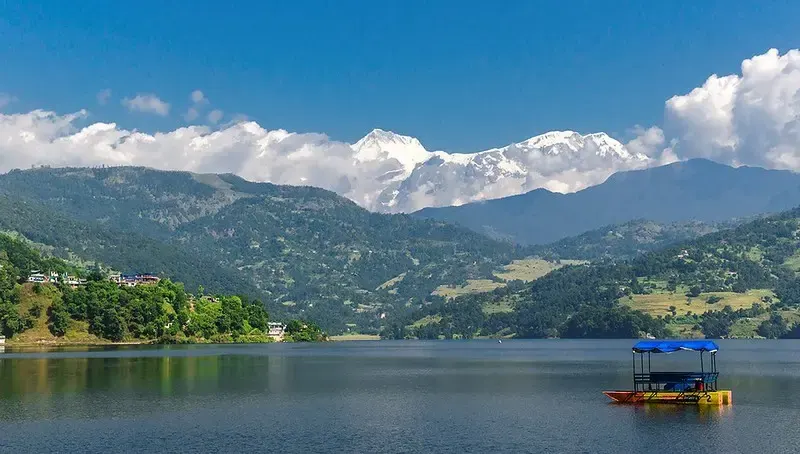
Experience touring around the most popular cities in Nepal with your family. Silver Triangle guides you to the three most important and famous cities: Pokhara, Chitwan, and Kathmandu. Tour starts with the city of lakes, Pokhara, goes through the oldest national park in Nepal- Chitwan, and finally, steps to the ancient city- of Kathmandu.
Children will definitely enjoy a short hike to the world peace stupa, amazing Davis falls, Mahendra cave and others. While in there, nightlife around the lakeside is also set to be an astounding experience.
Next, the jungle safari tour around the UNESCO-enlisted national park - Chitwan National Park is sure to keep your kids interested and excited as they look for rhinos, deer and birds on a jeep safari, canoe trip or guided walk. Elephant-back rides are being phased down after a December 2025 Supreme Court order called for alternatives, so check what is running when you book.
The final destination - Capital, Kathmandu is an ancient city sheltering hundreds of monuments, temples, and stupas. Kathmandu tour begins with sightseeing to the popular UNESCO enlisted attractions like Swayambhunath, Pashupatinath, Boudhanath, and others. Traveling to three different cities in Nepal offers spectacular scenery, a wide range of adventure activities, and many memories.
Anyone can be a part of a tour without having to think twice about physical or age restrictions. Apart from short walks during sightseeing, no strenuous walks are involved.
So, if you are eager to visit the three most popular destinations in one setting without having to compromise with safety and comfort then this trip is definitely for you. Silver triangle Nepal binds adventure activities, and jungle safaris with spirituality and relaxation.
Age-by-Age Tips for Family Trekking
- ✔️ Babies under 1 are easiest in a child carrier on short day walks from one base, such as a Pokhara lakeside hotel or a village lodge. In this manner, when you return at the end of the day, everything will be prepared for you.
- ✔️ With pre-school children, the UIAA medical commission advises against sleeping higher than 3,000 to 4,000 m and prefers a sleeping altitude below 2,500 m. Young children can't reliably tell you they feel unwell, so treat unexplained crankiness, poor appetite or vomiting on the way up as altitude-related until proven otherwise.
- ✔️ The most difficult age to take children walking is probably from 5 to 7 years, as they are too old to be carried and too young to walk long distances. In this case, it depends upon the child and the parents as they know them best to decide what kind of holiday to book.
- ✔️ Older children of 7 years or more who are active and acclimatize well can make great trekking partners, but don’t get too upset when you realize they are faster than you.
- ✔️ Teenagers and fit grandparents can usually manage the higher routes, as long as the itinerary gains height slowly and has a spare day.
- ✔️ Remember to trek only in favorable weather. October, November, March and April are the most reliable months.
- ✔️ A licensed guide is required on most trails, and hiring a porter as well lets parents carry only a daypack and keep a hand free for the kids.
- ✔️ When traveling with family, it is always smart to carry extra food and water supplies. Extra items like medicines or sun protection are also preferred.
Planning a Family Trek: Guides, Porters, Permits and Costs
Since 1 April 2023, foreign trekkers have needed a licensed guide on most trails in Nepal's national parks and conservation areas, including the whole Annapurna region. Families book through an agency, which also handles the TIMS card (NPR 2,000) and the ACAP permit (NPR 3,000). Children under 10 don't need a TIMS card and are generally exempt from park and conservation-area fees too.
Guides cost about USD 25 to 40 a day and porters about USD 20 to 25. A porter-guide, who carries a load and knows the trail, sits between them at USD 25 to 35. Most families of four take one guide and one or two porters, and porters carry up to about 20 kg each with us. Tip about 10 percent of wages at the end.
Teahouse rooms run about USD 5 to 10 a night, and most have twin beds, so a family of four usually takes two rooms. Lodges on the Poon Hill and Ghandruk trails are used to children and will cook plain rice, eggs, noodles and pancakes on request. Book a spare day into any trek above 3,000 m.
Check that your travel insurance covers every family member for trekking up to your highest point, including helicopter evacuation. For costs on the trail in more detail, see our complete guide to trekking in Nepal.
Ready for your big family vacation? Contact us for a detailed itinerary.
Tips for Trekking in Nepal With Children
A few rules of thumb make family treks work. With younger children, keep the sleeping altitude low, since young kids cannot reliably report altitude-sickness symptoms. The Royal Trek and both Poon Hill routes stay at or below 2,860 m at night. Mardi Himal, Jomsom and Muktinath and Upper Mustang go higher and suit older children who acclimatise well. Plan walking days around 4 to 5 hours with long lunch stops, and build in a buffer day, because children set the pace, not the itinerary. A porter is non-negotiable with kids: at USD 20 to 25 a day they carry the family bags, and on steep sections a child can ride in a doko basket, a memory in itself. Pack familiar snacks, a deck of cards, and motion-sickness tablets for the mountain roads, and make sure your travel insurance covers every family member at your maximum altitude. Teahouses welcome children warmly. Dal bhat refills are free, and Nepali hosts will spoil yours rotten.
Family Trekking in Nepal: FAQs
What is the best family trek in Nepal?
For most families it is Ghorepani Poon Hill: 4 days from Pokhara, nights no higher than 2,860 m and a sunrise view of Dhaulagiri and the Annapurnas from 3,210 m. With toddlers or grandparents who want an easier walk, the Royal Trek stays below about 1,760 m.
What age can children trek in Nepal?
There is no legal minimum age. Babies can come along in a carrier on low day walks, and many 6 to 7 year olds manage Poon Hill at a slow pace. For pre-school children the UIAA medical commission prefers a sleeping altitude below 2,500 m. Our guide to trekking with children covers ages and altitude in more detail.
Do families need a guide in Nepal?
Yes, on most trails. A licensed guide has been mandatory for foreign trekkers in Nepal's national parks and conservation areas since 1 April 2023. With children, a guide and a porter also free the parents to look after the kids.
Is altitude sickness a risk for children?
Yes. The US CDC treats children as just as susceptible as adults, and the UIAA says they need about the same time to acclimatise, but young ones can't always say how they feel. Choose routes with low nights, and above 3,000 m raise the sleeping altitude by no more than about 500 m a day. Go down if symptoms get worse, and ask a doctor before giving a child any altitude medicine.
When is the best time for a family trek in Nepal?
October and November bring clear skies and dry trails. March and April are warmer, with rhododendrons in bloom. The low routes such as the Royal Trek also work from December to February. School summer holidays fall in the monsoon, when the rain-shadow valleys of Mustang are the best bet.