


The best family trips in Nepal stay low and keep travel days short. Kathmandu’s temples and stupas, Pokhara’s lake, the jungle safaris of Chitwan and Bardiya, Lumbini, and easy village walks such as the Millennium Homestay Trek all sit below 2,000 m, so altitude is not an issue. For a first taste of trekking, the Poon Hill loop near Pokhara tops out at a 3,210 m viewpoint and sleeps no higher than Ghorepani at 2,860 m. Leave higher treks such as Langtang for teenagers, because the UIAA medical commission advises keeping preschool children’s sleeping altitude below about 2,500 m.
- Best seasonsOctober to November, and March to April
- Lowest-altitude optionsChitwan, Bardiya and Lumbini, all below about 200 m
- Easy first trekPoon Hill, 4 days, highest night Ghorepani 2,860 m
- Village homestay walkMillennium Homestay Trek, highest point 1,709 m
- Altitude rule for small childrenSleep below about 2,500 m where possible (UIAA)
- WildlifeChitwan: 694 rhinos (2021) and 145 tigers (2026)
- SwotahChitwan Jungle Safari from USD 800, Poon Hill Trek from USD 300 (group departures)
In a nation where guests are honoured as gods, Nepal is a perfect family holiday destination. Nepal is synonymous with the mighty Himalaya, warm and friendly people, strong family values, rich greenery, and unique culture and tradition. Since the Maoist conflict ended with the 2006 peace agreement and democracy returned, Nepal has become a safe and welcoming place to travel. You can visit every corner of the country expecting the same hospitality and people eager to go out of their way to make visitors feel at home.
Nepal is an ideal destination for family adventures. It offers moderate, safe and varied holiday choices: trekking, climbing, boating, kayaking, sightseeing, cultural visits, bird watching, mountain biking, wildlife safaris, heli sightseeing and mountain flights, and most of them can be tailored to a family’s pace.
A family trip offers countless chances to participate, enjoy, and spend quality time with one another. Family holidays here are designed with children's interests at heart, without compromising their enjoyment or safety, and with the family comfortably settled in good lodging, relaxation, great meals, and hospitality. You can choose from one-day outings to multi-day guided tours.
Best Places for a Family Trip in Nepal
A wide range of fun, engaging activities suits children: cycling through the fields, nature walks, paddling, a jeep safari in Chitwan National Park, jungle walks in Bardiya National Park, village life on the Millennium Homestay Trek, rowing boats on Phewa Lake in Pokhara, rafting on easier rivers such as the Seti, bird watching on Phulchowki hill, short treks, and a learning day at the Godavari botanical garden. Kathmandu, Pokhara, Chitwan and Lumbini are the best-known destinations. Lately the Terai lowlands, the Annapurna foothills and the Tanahun hills have joined the list too.
Kathmandu
Kathmandu, the capital of Nepal, is a good place to introduce children and adults to Nepal’s long history, city life and cultural heritage. From big hotels to small guest houses, Kathmandu has plenty of child-friendly places to stay, and family rooms are easy to find.
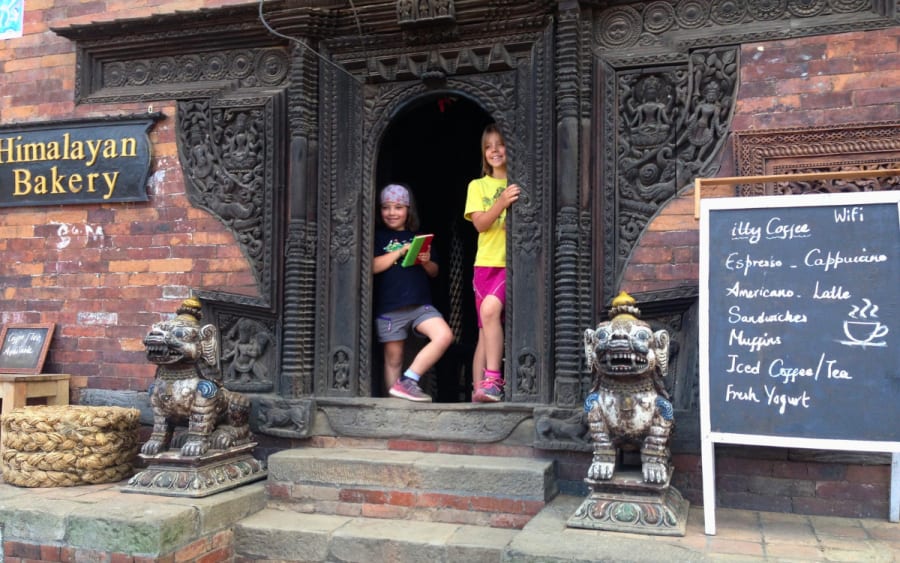
Photo: A temple in Kathmandu, part of the Kathmandu Valley UNESCO World Heritage Site.
Sightseeing tours around Kathmandu can be eye-opening for both parents and kids. Kathmandu Durbar Square at Basantapur, Pashupatinath Temple, Boudhanath and Swayambhunath stupas, Patan and Bhaktapur are all part of the Kathmandu Valley World Heritage Site, listed by UNESCO in 1979, and give a close look at Nepal's art, craftsmanship and customs. Children will especially enjoy the mischievous monkeys at Pashupatinath and Swayambhunath. Keep snacks out of sight and don't let children feed or touch them. The monkeys grab, and a bite means a course of rabies shots.
Nagarkot
Nagarkot is a hill station about 30 km east of Kathmandu, at roughly 2,100 m. It is best known for its sunrise and sunset views and its quiet hotels, which makes it an easy overnight trip for a family. On a clear morning you get a panoramic view of the entire Kathmandu Valley, terraced fields, stunning landscape, and distant snow peaks from Langtang and Manaslu to a small, faraway Everest, with the Indrawati River below.
Historically, due to its altitude and temperature, Nagarkot has been a place of escape for the royals of Nepal in the summer. Today it is best known for short treks around the Kathmandu Valley rim.
The walk from Nagarkot down to Dhulikhel takes most of a day, about 5 to 6 hours, along a well-marked trail that mixes village paths, Newar houses, forest and mountain views. Older children manage it fine, and a car can meet you at the bottom.
Families get the chance to interact with local people and experience age-old traditional hospitality, which can be deeply educational and enriching for both children and parents as they encounter new cultures and perspectives.

Pokhara
So inviting is the air of Pokhara that both parents and children will quickly feel at home amid the surrounding Himalayan panorama. With regards to trekking, the simplest and safest way to start a trek from Pokhara is to head to Phedi and follow the trail on foot to Dhampus (1,650 m), Landruk (1,565 m), Ghandruk (about 1,940 m), Ghorepani (2,860 m), Birethanti (1,025 m) and Nayapul. Ghorepani is the highest night, still below 3,000 m.
On the way, trekkers will experience the friendly, helpful Gurung villagers. The trek also takes you up to Poon Hill (3,210 m), the popular dawn viewpoint above Ghorepani, for the Annapurnas, Dhaulagiri, Tukuche Peak and other big Himalayan peaks. It is about an hour’s climb in the dark, so pack head torches and warm layers for the children.
In addition to this, Pokhara, a city of lakes, presents an array of inclusive options to visitors. From earth to sky to water, the possibilities are countless. Enjoy boating on Phewa Lake and kayaking on Begnas Tal, cycling around Phewa, and tandem paragliding from Sarangkot. Teenagers chasing a thrill can try the 80 m tower bungee near Pokhara, which takes jumpers from 12 with a parent present, or the 228 m jump at Kushma, about two hours away and billed as the world’s second-highest. Both set age and weight limits, so check them before you promise anyone a jump. Pokhara truly has everything for everyone, irrespective of age.
Chitwan National Park
A visit to Chitwan National Park works well straight from Kathmandu or as an add-on to a trek or rafting trip. The park lies in the subtropical Terai near the Indian border, about 160 km and 5 to 7 hours by road from Kathmandu, and it could hardly be more different from the snowy Himalaya. Chitwan covers 952.63 km² and has been a UNESCO World Heritage Site since 1984. It is home to rare animals such as the one-horned rhinoceros (694 in the park at the 2021 count), the royal Bengal tiger (145 in the 2026 survey), leopard, sloth bear, gaur, wild boar and several kinds of deer, and children love trying to spot them. Foreign visitors pay NPR 2,000 per day to enter the park.
A visit to the elephant breeding centre is another favourite outing for children, as is a dugout canoe ride on the Rapti or Narayani River, home to gharial and mugger crocodiles. Gangetic dolphins are now very rare here, and you have a far better chance of seeing them on the Karnali near Bardiya. Swotah’s Chitwan safari doesn’t include elephant rides. Read why many families now skip them. A jungle safari day wraps up beautifully with a cultural program performed by nearby Tharu villages, followed by a hearty dinner. It gives the family a fun, hands-on feel for life in Chitwan.
Lumbini
Approximately 300 km away from Kathmandu lies Lumbini. The story of Buddhism originated here under a full moon more than 2600 years ago. This place is the most consecrated for Buddhists, for it is viewed as a spiritual pilgrimage site. Lumbini has been a UNESCO World Heritage Site since 1997, and the nearby archaeological sites of Kapilvastu, Devdaha and Kudan add more of the story. Entry to the Sacred Garden costs NPR 1,000 for visitors from outside South Asia since May 2026. See our guide to Buddhist sites in Nepal for more. Go in the cooler months, because the Terai gets very hot from April to June.
A visit to the monasteries and temples of Lumbini fascinates both kids and adults. This fun experience brings out a feeling of investigation and revelation. Touring around Lumbini gives parents the opportunity to bring their kids closer to spirituality and yoga practice and improve their parenting skills by instilling the value of peace, mindfulness, and overall well-being.
Godavari and Phulchowki
Godavari is a popular day trip destination in the southeast corner of Kathmandu. Located at the base of Mount Phulchowki Hill, it is ideal for both locals and tourists to relax and unwind.
The National Botanical Garden at Godavari covers 82 hectares and mixes nature, short walks and a few sacred sites. It is a good destination for those seeking environmental beauty, rejuvenation, short hikes, and cultural immersion.
At an elevation of 1500m, Godavari is a tranquil place enveloped in a lush green canopy, diverse biodiversity, a dramatic natural mountain backdrop of Mount Phulchowki, and a cooler temperature. Botanists, naturalists and school groups come for its living collection of around 1,000 plant species. The garden includes a special garden with a water fountain, seasonal flowers, orchid house, cactus house, rhododendron garden, medicinal plants, rare, endangered and endemic plants, Botanical information and exhibition centre, Ethnobotanical garden, rock garden, coronation pond, taxonomic family garden, lily garden and Japanese style garden.
At the relatively short distance is a Panch Dhara(five water taps) and Godavari Kunda(pond), carrying cultural and spiritual significance amongst Hindus. Every 12 years the Godavari Mela draws huge crowds here, and pilgrims believe that bathing in the springs during the festival washes away sins and purifies the soul.
The garden has mostly level paths that suit small children and pushchairs (check access ahead if you use a wheelchair). It is just 18 kilometres (11 miles) away, takes 45 minutes to one hour from Kathmandu, has no concern about getting altitude sickness, and has ample resources for your child. This excursion can be adventurous and educational as it helps both children and parents comprehend the different floras and understand the local culture, traditions and lifestyle of Nepali people.
Mount Phulchowki, loosely translated to "hill of flowers," is the highest hill in the Kathmandu Valley. This hill station is just 20 kilometres from the capital and can be hiked through Godavari.
The trail mostly passes through small farms and villages. It progresses through dense vegetation and wildflowers until it reaches the summit of Mount Phulchowki, with a small temple, Phulchowki Mai, on top. It offers a bird' s-eye view of Kathmandu Valley and nearby villages and, of course, the stunning snow-capped Ganesh Himal, Langtang, and Gaurishankar Himal. Phulchowki, being a migratory path, is famous for its birdwatching. Several rare and endangered birds can be witnessed on the trail and on top. For instance, the Spiny Babbler (Nepal’s only endemic bird), Rufous-gorgeted Flycatcher, Yellow-throated Minivet, Tibetan Siskin, Chestnut-headed Tesia and several species of butterflies and animals.
This is a soft adventure holiday that is entertaining, educational, and memorable for children as well as their parents.
Bardiya National Park
Nepal, famous for its majestic Himalayan range and highlands, often sees its lowlands, the Terai region, which are overlooked by tourists. In fact, the Terai region offers ample family-friendly options, with something for everyone. Bardiya National Park is located in the far western part of the Terai region, Nepal, and covers around 968 square kilometres, the largest national park in the Terai. An isolated and remote area in the wilderness of Terai, untouched, largely unexplored and mostly unfiltered. Bardiya National Park is not a commercialised area, is not overrun by tourists, and provides authenticity and an immersive experience to visitors.
The Karnali River borders Bardiya National Park to the west, while the Babai River flows through it. The Babai River maintains an undisturbed environment that preserves the park's diverse wildlife and ecosystem. The park is home to 112 royal Bengal tigers (2026 national survey) and 38 one-horned rhinos (2021 count). Other animals include wild elephants, swamp deer and reptiles such as the gharial and the marsh mugger crocodile, and the Karnali holds freshwater Gangetic dolphins. Blackbuck live just outside the park in the Khairapur conservation area. More than 400 species of birds have been recorded, among them the Bengal florican, lesser florican and sarus crane. You can join a jeep safari, a guided jungle walk or a gentle boat ride, and rafting on the Karnali is a separate, more serious river trip for older children.
Aside from this, the Tharu, an Indigenous ethnic group, predominantly inhabits this region. Explore small Tharu villages and Tharu museums and learn about their unique culture, traditions, and lifestyle, which are vastly different from other ethnic groups. Bird watching in Bardiya National Park over the Giruwa River, in the early morning or late afternoon before the sunset is an unforgettable memory that gets ingrained in your mind forever. The Elephant Breeding Center and Crocodile Breeding Center can also be explored here.
This family-friendly tour is interactive and engaging, perfect for children of all ages. At some points, it might feel like a field excursion, with your guide explaining many fun and educational facts. Rest assured, this tour is anything but boring.
Millennium Homestay Trek
The Millennium Trek is a village-to-village trail in western Nepal, named after the year 2000. It links more than 30 Gurung, Magar, Brahmin and Chhetri villages in the Tanahun and Syangja districts and is one of the lowest-altitude treks near the Annapurna region.
The Millennium Trek, also called the Mid-Hill Ridge Line Trek, starts at 420 m and climbs to 1,709 m at Pyarsing. It roughly lies between the southeast of Pokhara and the northeast of Waling Bazaar. This trek is considered child-friendly and suited to families primarily due to its moderate elevation and low risk of altitude sickness.
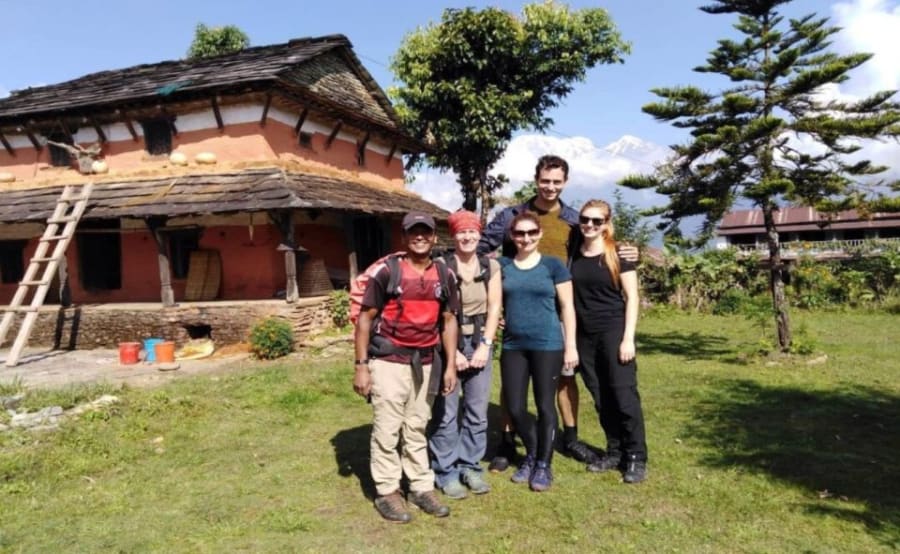
An opportunity to explore and enjoy nature's wonder on the lap of culturally rich traditional Nepalese villages, this ethnically diverse region, with Gurung, Brahmin, Chettri and Magar inhabitants. Traverse through different villages, each showcasing its unique hospitality and distinctive way of life.
Talking about the beautiful landscape and remarkable destinations, you'll stumble upon the panoramic view of several prominent ranges: Annapurna range, Machhapuchare, Ganesh Himal, and Dhaulagiri from different vantage points throughout the trail. Also, Millennium Cave is home to an underground river, a waterfall, and creatures like bats and insects.
Additionally, significant attractions like Dhorbarahi Temple, holding greater religious importance in the local community, Tanahun Durbar and Chandeshwori Temple also happened to lie here, as well as a few glimpses of 4x4 jeeps in the trail.
Along the way, you'll experience the unforgettable and utmost hospitality of Nepali people through locally grown organic meals. Most of it is grown in the village, and it tastes like it. Witness the traditional lifestyle, including farming and animal husbandry using conventional methods, techniques and equipment. Encounter blacksmiths who create tools and weapons, and enjoy extraordinary demonstrations of traditional handicrafts such as pottery and cloth weaving. This journey feels like travelling back in time to an era where humans and Mother nature were connected and technology had yet to take over the world.
History is preserved orally and conveyed to the younger generation and visitors through storytelling and traditional dance, such as Ghatu and Sorathi in the Gurung and Magar communities, Kauda in the Magar community, and Salaijo in the Tharu community. Other communal dances include Jhora,Thado Bhaka,Krishna Charitra, and more.
Learning about sustainability and simplicity, the importance of community and cultural heritage in the rural village where time seems to slow down, this trek can be a great medium to indulge your children in nature and teach them about the long-forgotten way of living.
Langtang Trek
The Langtang Valley Trek, leaving out the side climb to Kyanjin Ri, is one of the shorter and more accessible trekking routes in Nepal. Just 120 kilometres (about 75 miles) from Kathmandu, it's easy to reach and has good lodges. The valley reopened on 22 October 2026 after the August flood, with Thulo Syabru as the new trailhead.
The Langtang Village trail offers spectacular mountain views, wildlife, and beauty, and it whispers the tale of its reconstruction after the devastating earthquake in 2015. Walking up from the trailhead to Langtang Village, the transitions from forested to alpine terrain unveils local wildlife, langur monkeys, red pandas, lush forests of oak, rhododendron and bamboo.
Along the trail you look up at Langtang Lirung, Dorje Lakpa, Gangchenpo, Yala Peak, Naya Kanga and Langshisha Ri, and you pass Ghoda Tabela before reaching Kyanjin Gompa and its cheese factory.
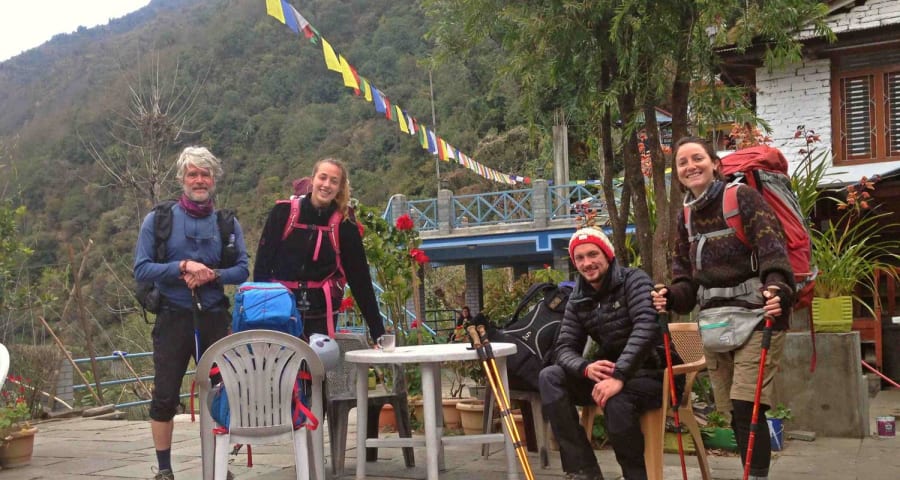
On the trek you'll also meet Tibetan Buddhism and the Tamang people, one of Nepal's Indigenous groups. A popular explanation says the name comes from the Tibetan “ta” (horse) and “mang” (warrior), so horse-riding warriors. You'll see it in their hospitality, food and customs.
Langtang is a trek for teenagers more than small children. Kyanjin Gompa, the usual top night, sits at about 3,870 m, well above the 3,000 m line, so the climb has to be slow and you need to watch everyone for signs of altitude sickness.
Trekking in the Annapurna Region
Families can encounter the magic of the Himalayas on a child-friendly, low-elevation trek, particularly the Poon Hill Trek in the Annapurna foothills. In the most relaxed way, families get to walk easy trails past high pastures, forests of oak and rhododendron, river valleys, stone staircases, rice paddies, and pretty villages. There are plenty of opportunities to interact with local people in the villages and learn about local culture and customs.
Also Read:
10 Easy Treks in Nepal for Beginners
7 Best Short Treks from Kathmandu
Family Trips in Nepal at a Glance
For children, the height you sleep at matters more than the height you visit. The table and chart sort the trips in this guide by their highest night.
| Trip | Highest night (approx.) | Days needed | Best for |
|---|---|---|---|
| Lumbini | about 100 m | 1 to 2 | All ages, history and monasteries |
| Chitwan National Park | about 150 m (Sauraha) | 2 to 4 | All ages, rhinos, canoe rides, Tharu culture |
| Bardiya National Park | about 150 m (Thakurdwara) | 3 to 5 | Older children keen on tigers and quiet jungle |
| Pokhara | 822 m | 2 to 4 | All ages, lake, boats, cycling |
| Kathmandu Valley | about 1,400 m | 2 to 4 | All ages, temples, stupas, Godavari |
| Millennium Homestay Trek | 1,709 m | 7 walking days | Children who like walking, village life |
| Nagarkot | about 2,100 m | 1 to 2 | All ages, sunrise views, short hikes |
| Poon Hill trek | 2,860 m (Ghorepani) | 4 to 8 | A first trek for school-age children |
| Langtang Valley | about 3,870 m (Kyanjin Gompa) | 7 to 10 | Fit teenagers |
Highest Sleeping Altitude by Trip
| Trip | Metres | Highest night (0 to 4,000 m) |
|---|---|---|
| Lumbini | about 100 | |
| Chitwan | about 150 | |
| Bardiya | about 150 | |
| Pokhara | 822 | |
| Kathmandu | about 1,400 | |
| Millennium Trek | 1,709 | |
| Nagarkot | about 2,100 | |
| Poon Hill (Ghorepani) | 2,860 | |
| Langtang (Kyanjin) | about 3,870 |
Gold bars are above the 2,500 m that the UIAA prefers for preschool children. Altitudes from Swotah itineraries, rounded.
Altitude and Children in Nepal
Children get altitude sickness as easily as adults. The US CDC says they are just as susceptible, and the UIAA medical commission says they need about the same time to acclimatise. The hard part is that small children can’t tell you. A toddler with altitude sickness may simply go quiet and still, or stop eating and sleeping well. For preschool children the UIAA advises against sleeping higher than 3,000 to 4,000 m and prefers a sleeping altitude below 2,500 m.
So the plan for most families is simple. Keep young children to the valleys, the Terai and Pokhara, try Poon Hill with school-age children, and save Langtang or Everest for teenagers. Above 3,000 m, the CDC rule for everyone is to raise your sleeping height by no more than 500 m a day and to add a rest day for every 1,000 m. Our guides to trekking in Nepal with children and family trekking in Nepal go into age-by-age detail.
Practical Tips for a Family Trip to Nepal
October and November are the clearest months, with March and April next for rhododendrons and warm days. The Terai, including Chitwan, Bardiya and Lumbini, gets very hot from late April, close to 40 °C in May, and the monsoon from June to September brings leeches, landslides and cloud. Winter is fine in the lowlands and Kathmandu but cold on any trek.
Give children only bottled, boiled or filtered water, and stick to freshly cooked food. Dal bhat is a safe, filling standby that most kids end up liking. Car seats are rare in Nepal, so bring a light travel seat for small children if you plan long drives. Roads between Kathmandu, Pokhara and Chitwan are slow, 5 to 8 hours each way, so short domestic flights can save a tired family a whole day. Children under 10 generally don’t need a TIMS card and are usually exempt from park and conservation-area fees, but check at the counter.
Final Thoughts on a Family Trip to Nepal
Holidaying in Nepal is a rare mix of safety, comfort, relaxation, adventure, discovery, excitement, challenge, and fun for both children and parents. Whether it is rafting an easier river or combining trekking, jungle safaris, nature walks, and cultural tours, Nepal gives families a special travel experience and a deeper understanding of its people, culture, and true essence.
Good starting points for a family are a homestay trek, a jungle safari and a few days of heritage sightseeing in the Kathmandu Valley. The trips below show what Swotah already runs.
As John Muir wrote in 1873, “The mountains are calling and I must go”. Nepal’s mountains are calling you too. It’s high time you embarked on an epic journey of exploring the mountain kingdom of Nepal. Ready to dive into this unforgettable once-in-a-lifetime opportunity with Swotah?
Why Swotah?
Like any other Nepali, we also live by the phrase that, “The Guest is God”. Swotah was started as an initiative to provide the best travel option on a budget with unparalleled hospitality, simultaneously boosting the livelihood of Nepalis and improving Nepal's tourism sector.
We offer a flexible, personal service, built around the number of days, how you want to travel and where you want to stay. Our commitment is to give back to nature and society. We promote local goods and communities, support eco-friendly campaigns and follow responsible travel practice. The goal is not only to make the journey one-time business transactions but to form a long-lasting mutual bond with clients.
Family-Friendly Trips with Swotah
Swotah doesn’t sell a fixed family package. These trips from our list fit families well, and the prices are the lowest current group departure per person.
| Trip | Days | Highest point | From (group departure) |
|---|---|---|---|
| Chitwan Jungle Safari | 7 | Terai lowlands | USD 800 |
| Bardiya National Park Safari | 7 | Terai lowlands | USD 1,100 |
| Best of Nepal Tour | 12 | 2,175 m | USD 1,010 |
| Millennium Homestay Trek | 13 | 1,709 m | USD 1,250 |
| Dhulikhel Balthali Hike | 5 | 1,730 m | USD 659 |
| Poon Hill Trek | 4 | 3,210 m viewpoint | USD 300 |
| 8 Days Annapurna Poon Hill Trek | 8 | 3,210 m viewpoint | USD 695 |
Swotah can arrange any of these as a private trip, with shorter walking days, family rooms and extra rest built around your children’s ages. Tell us how old everyone is when you enquire. If you ask, we try to match your guide to what you want, such as experience, language, gender or age. Prices change with the departure, so check the trip page for the current one.
Family Trips to Nepal: FAQs
Is Nepal safe for a family holiday?
Yes, for most families. Nepal has been peaceful since the 2006 peace agreement, and Nepalis are famously warm with children. The real risks are road travel, stomach bugs, monkeys at temples and altitude on treks, and all of them are manageable with a good plan and a guide.
What is the best age to take children trekking in Nepal?
Children of any age can enjoy low walks such as the Millennium Homestay Trek or the Dhulikhel hills. School-age children usually manage the 4-day Poon Hill trek. The UIAA advises keeping preschool children’s sleeping altitude below about 2,500 m, so leave treks that sleep above 3,000 m, such as Langtang, for teenagers.
Which national park is better for families, Chitwan or Bardiya?
Chitwan is easier, at 5 to 7 hours by road or a 25-minute flight from Kathmandu, with plenty of family hotels, canoe rides and rhinos. Bardiya is quieter and wilder and gives you a better chance of seeing a tiger, but it is a 1-hour flight to Nepalgunj plus a 2 to 3-hour drive, so it suits older children.
When is the best time for a family trip to Nepal?
October and November give clear skies and comfortable temperatures. March and April are also good, with rhododendrons in bloom. Avoid the Terai parks from May to September, when it is very hot and then wet.
Does Swotah offer family tours?
Swotah can arrange its safaris, sightseeing tours and easy treks as a private trip for your family, with the pace, hotels and walking days set around your children. There isn’t a separate fixed family package.