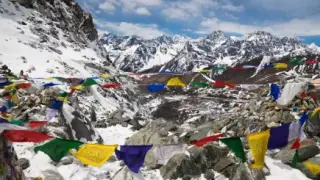
A 48-day high-altitude expedition to Annapurna I (8,091 m), the world's tenth-highest peak and the first 8,000 m mountain ever climbed, via the Annapurna Sanctuary approach.
Duration
48 Days
Max Altitude
8,091 m / 26,545 ft
Difficulty
Extreme
Group Size
Max 5 trekkers
Region
Annapurna Trekking Packages, Nepal
Best Season
Spring · Autumn
Accommodation
Expedition tents at high camps; hotel Kathmandu/Pokhara.
Meals
All meals included: Base Camp cook tent; high-camp rations.
Transport
Drive/fly Kathmandu-Pokhara; drive to Birethanthi trailhead.
Dates & Prices
Choose your date
All dates are guaranteed departures — we never cancel for low numbers. Book online or send a quick enquiry.
YearMonth
1 departure · 2027
Apr
18
Apr 18, 2027 — Jun 4, 2027
Guaranteed departure — from 2 trekkers
Available
USD18,000
per person
Can’t find a suitable date? We run private departures on any date with as few as 2 trekkers.
Trip Overview
About the Annapurna I Expedition
Annapurna I (8,091 m) is the world's tenth-highest mountain and the first 8,000 m peak ever climbed, summited on 3 June 1950 by a French team led by Maurice Herzog. It rises from the Annapurna massif in north-central Nepal, a 55 km wall of peaks bounded by the Kali Gandaki gorge to the west and the Marsyangdi River to the north and east. The expedition approaches from the south through the Annapurna Sanctuary, a high glacial basin enclosed by Annapurna I, Annapurna South, Hiunchuli and Machhapuchhre, reaching the south-side Base Camp at approximately 4,200 m.
Despite its first-ascent history, Annapurna I carries one of the highest fatality-to-summit ratios of all 8,000 m peaks, largely because of severe serac and avalanche hazard on the upper mountain. A series of high camps at approximately Camp I (5,500 m), Camp II (6,400 m), Camp III (7,200 m) and Camp IV (7,400 m) is established on fixed ropes before summit attempts in the summit window. Supplemental oxygen is used above Camp III. The mountain demands strong prior high-altitude experience, ideally one completed 8,000 m peak, plus a full fitness and technical check before departure.
The 48-day itinerary builds in realistic acclimatisation, rotation climbs to stock the high camps, a rest period at Base Camp, and contingency days for the summit window. Government expedition royalty applies. The sections below cover difficulty, permits, route, seasons and all practical details.
Last updated June 2026
Trip Highlights
Highlights
1
Summit Annapurna I (8,091 m), the first 8,000 m peak ever climbed, in 1950
2
Operate from Base Camp inside the enclosed Annapurna Sanctuary at 4,200 m
3
Structured acclimatisation with four high camps up to 7,400 m on fixed ropes
4
Supplemental oxygen and full Sherpa team for the summit push above 7,200 m
5
Dramatic serac and glacier terrain on one of the most technical Himalayan 8,000ers
6
Approach through the Annapurna Sanctuary via Ghorepani, Poon Hill and Chhomrong
Day by Day
Annapurna I Expedition Itinerary: 16 Days
Tap any day to expand — altitudes, walking times, meals, and overnight details for every stage of the journey.
A Swotah representative meets you at Tribhuvan International Airport and transfers you to your hotel in Kathmandu (1,400 m). The afternoon is free to rest after the flight. Your expedition leader holds a full briefing covering the 48-day schedule, the permit checklist, the high-camp system, supplemental oxygen protocols and emergency procedures. Equipment cross-checks begin this evening; submit passport copies and insurance documents if not sent in advance. Overnight in Kathmandu.
Sleep at 1,400 mDinner
Tonight’s stay
Hotel
A guided half-day around the Kathmandu Valley covers Pashupatinath temple, Boudhanath stupa and Swayambhunath, with permit paperwork at the Department of Tourism and Nepal Mountaineering Association in the afternoon. The expedition permit (mountaineering royalty), ACAP, Garbage Deposit and Liaison Officer documentation are finalised today. Final gear check in the evening: climbers confirm oxygen masks and regulators fit correctly and high-altitude suits are serviceable. Overnight in Kathmandu.
Sleep at 1,400 mBreakfast
Tonight’s stay
Hotel
An early morning drive heads west from Kathmandu on the Prithvi Highway through the Trisuli and Marsyangdi river valleys, then south via Pokhara if flying is not used, before turning toward Nayapul and the Modi Khola road head at Birethanthi (850 m). The drive takes approximately 6 hours from Kathmandu or 3 to 4 hours from Pokhara. Birethanthi sits at the junction of the Bhurungdi Khola and the Modi Khola; trekking permits are checked here by ACAP staff. Overnight in Birethanthi.
Sleep at 850 mBreakfastLunchDinner
Tonight’s stay
Guesthouse
The approach trek begins on stone-paved trail climbing the Modi Khola valley through the village of Hile and up a long, famous stone staircase to Ulleri (2,073 m), a Magar village at the top of the climb. Altitude gained: approximately 1,200 m over 5 to 6 hours of steady ascent. Rhododendron forest flanks the upper section. Ulleri provides the first views north toward the Annapurna massif. Overnight in Ulleri.
Sleep at 2,073 mBreakfastLunchDinner
Tonight’s stay
Teahouse
The trail continues through dense rhododendron and oak forest, passing Banthanti (2,250 m) and Nangethanti before climbing to Ghorepani (2,800 m) on a broad ridge. The gain of around 700 m over 4 to 5 hours is moderate. Ghorepani is a substantial village with good lodge options and serves as the staging point for the Poon Hill sunrise. The ridge gives the first expansive views of Dhaulagiri (8,167 m) to the west. Overnight in Ghorepani.
Sleep at 2,800 mBreakfastLunchDinner
Tonight’s stay
Teahouse
A 45-minute pre-dawn ascent reaches Poon Hill (3,210 m), the day's high point, where sunrise reveals Dhaulagiri (8,167 m), the Annapurna massif including Annapurna I (8,091 m), Annapurna South and Hiunchuli in full panorama. This is the clearest preview of the summit objective. Return to Ghorepani for breakfast, then descend east and climb through rhododendron forest to Tadapani (2,630 m), a 4 to 5-hour total walk. Overnight in Tadapani.
Sleep at 3,210 mBreakfastLunchDinner
Tonight’s stay
Teahouse
The trail descends through bamboo and rhododendron to the Modi Khola and climbs the opposite bank to Chhomrong (2,100 m), a large Gurung village spread across a sunny terrace. Chhomrong is the last significant resupply point before the Sanctuary and the last point with reliable mobile phone signal. Altitude is 2,100 m after the descent; the body adjusts for the climb ahead. The Annapurna South and Hiunchuli faces are directly visible from Chhomrong. Overnight in Chhomrong.
Sleep at 2,100 mBreakfastLunchDinner
Tonight’s stay
Teahouse
The trail drops steeply from Chhomrong into the Modi Khola gorge via Sinuwa (2,360 m), then follows the river through Bamboo (2,310 m) and dense rhododendron and bamboo forest to Dovan (2,400 m). The gorge narrows here, and the scale of the walls above begins to suggest the Sanctuary ahead. Walking time is 5 to 6 hours with moderate overall altitude gain. Overnight in Dovan.
Sleep at 2,400 mBreakfastLunchDinner
Tonight’s stay
Teahouse
The trail climbs from Dovan through Himalaya Hotel (2,920 m) and Hinku Cave (3,170 m) to Deurali (3,300 m), gaining approximately 900 m over 4 to 5 hours. Deurali is the gateway to the Annapurna Sanctuary proper; above here the trail enters the narrow gorge between Hiunchuli and Machhapuchhre. Snow can cover the trail from Hinku Cave upward in winter and early spring. A rest stop and fluid intake at Deurali are important before the altitude increases sharply above. Overnight at Deurali.
Sleep at 3,300 mBreakfastLunchDinner
Tonight’s stay
Teahouse
Above Deurali the gorge opens suddenly into the Annapurna Sanctuary, a high glacial bowl enclosed by nine peaks above 6,000 m including Annapurna I (8,091 m), Annapurna South (7,219 m), Hiunchuli (6,441 m) and Machhapuchhre (6,993 m). The trail passes Machhapuchhre Base Camp (3,700 m) before the final 500 m climb to Annapurna Base Camp (4,200 m). The north wall of Annapurna I fills the skyline from here; this is the expedition team's home for most of the next 34 days. Overnight at Base Camp.
Sleep at 4,200 mBreakfastLunchDinner
Tonight’s stay
Teahouse
Day 10 is the first full day at Annapurna Base Camp (4,200 m). The expedition team establishes the cook tent, mess tent and sleeping tents, sorts loads by camp, and completes the Liaison Officer's arrival check. Equipment inventories are taken: oxygen bottles counted, regulator-mask compatibility verified, and rope assignments distributed among the Sherpa team. A short acclimatisation walk above camp to 4,500 m in the afternoon helps initiate altitude adaptation. No carry to higher camps today. Overnight at Base Camp.
Sleep at 4,200 mBreakfastLunchDinner
Tonight’s stay
Camping
The team leaves Annapurna Base Camp (4,200 m) and descends the now-familiar Sanctuary trail through Machhapuchhre Base Camp (3,700 m), Deurali (3,300 m), Himalaya Hotel (2,920 m) and Dovan to Bamboo (2,310 m), a forest camp on the Modi Khola. The descent of nearly 2,000 m over 4 to 5 hours feels fast after weeks of expedition living, and the lower altitude brings a rapid recovery in breathing and energy. Overnight at Bamboo.
Sleep at 2,310 mBreakfastLunchDinner
Tonight’s stay
Teahouse
A final descent day follows the Modi Khola gorge from Bamboo (2,310 m) through Sinuwa and down to Jhinu Danda (1,600 m), a small village above Chhomrong with natural hot-spring pools beside the river, a welcome recovery treat after 35-plus days on the mountain. The walk takes 3 to 4 hours. The hot springs are a standard post-expedition reward for the Sherpa team and climbers. Overnight in Jhinu Danda.
Sleep at 1,600 mBreakfastLunchDinner
Tonight’s stay
Teahouse
A jeep picks up the team at Jhinu Danda or the nearest road point and drives approximately 3 to 4 hours to Pokhara (900 m) on the shores of Phewa Lake. Pokhara is the regional hub with good hotels and restaurants; the team typically takes the evening to celebrate the completed expedition at a lakeside restaurant. Overnight in Pokhara.
Sleep at 900 mBreakfastLunch
Tonight’s stay
Hotel
A 45-minute domestic flight from Pokhara airport returns the team to Kathmandu (1,400 m); a road drive is approximately 7 to 8 hours if the flight is unavailable. On arrival in Kathmandu, the expedition leader handles the Garbage Deposit refund process at the Ministry of Tourism and the NMA, and summit certificates are collected where issued. The afternoon is free for Thamel shopping, final meals and international flight preparation. Overnight in Kathmandu.
Sleep at 1,400 mBreakfast
Tonight’s stay
Hotel
The Annapurna I Expedition concludes. A Swotah representative transfers you to Tribhuvan International Airport for your onward flight. Summit certificates and expedition documentation are provided before departure. If you would like to extend your stay in Nepal, add another trek or expedition, or discuss the next 8,000 m objective, the Swotah team is ready to help plan your next trip.
Breakfast
What’s included
What's included
Every cost on the trail is broken out below — no hidden fees, no surprises at the trailhead.
Included
22 items
Standard/Deluxe rooms in Kathmandu on B/B twin sharing basis;
Airport transfers;
Guided city tour in Kathmandu by private vehicle with an authorized guide;
3 meals a day (breakfast, lunch and dinner with tea or coffee along) during the trek and climbing period;
Twin sharing tented accommodation and equipment during the camping trek (fully waterproof two-man tents, dining tents, kitchen gear, dining table, chairs, toilet tents, shower tent, etc.);
All camping equipment is in the base camp.
Surface transportation will be available as per the itinerary.
Trekking Permit (ACAP entry fee);
Local Permit;
Climbing permit for Mount Annapurna;
Necessary staff during the trekking and climbing period with an experienced guide and porters (2:1);
Necessary experienced government-licensed climbing guide during the climbing period, as per group size;
The facility of food, accommodation, salary, insurance, equipment, and medicine for all trekking staff;
Group medical supplies;
High altitude food and all the climbing crew above the base camp;
Necessary fixed and dynamic ropes;
The necessary kitchen crew in base camp.
All necessary paperwork, office service charge and government taxes;
Complete pre-departure information, flight ticket reconfirmation and extend visa service (if necessary);
Each client will have an individual tent available in the Annapurna advanced base camp.
Helicopter rescue insurance for all involved expedition staff;
Medical consultation services at the base camp with the HRA clinic.
Not included
14 items
Lunches and dinners in Kathmandu and Pokhara;
Entrance fees during sightseeing;
Travel and rescue insurance;
International flights;
Nepali visa fee
Personal climbing equipment;
All kinds of personal expenses;
Icefall fees garbage deposit (sharing with another member) if applicable;
Wake talkies & filming permit;
Personal climbing guide if requested.
Optional trips and sightseeing if extended.
Tips for guides and porters (it’s encouraged to tip);
Additional oxygen cost;
Excess baggage charges (if you have more than 15 kg of luggage, a cargo charge is around $1.5 per kg).
How Hard Is the Annapurna I Expedition?
Annapurna I is one of the most technically demanding and objectively dangerous 8,000 m peaks. Severe serac and avalanche hazard on the upper mountain, long fixed-rope sections above 6,000 m, and summit-day climbing to 8,091 m require candidates to have completed at least one prior 8,000 m peak and to be proficient in crampons, jumar and high-altitude travel. A 48-day schedule allows proper acclimatisation and rotation, but the mountain's rapid-weather windows mean summit attempts demand fast, disciplined movement at extreme altitude.
▲Extreme; 8,000 m expedition. Prior 8,000 m summit required. Severe serac/avalanche hazard, fixed ropes above 6,000 m, supplemental O2.
Overall Rating
10
Extreme
out of 10 · physical effort scale
Max altitude8,091 m
Trekking days45 days
Trip Details
Planning your Annapurna I Expedition
Everything you need to plan the trek, topic by topic. Tap any one to open it.
Annapurna I (8,091 m) is graded as an extreme-altitude 8,000 m expedition and ca…
Annapurna I (8,091 m) is graded as an extreme-altitude 8,000 m expedition and carries a historically high fatality ratio, primarily due to serac collapses and ice-avalanche release from the upper glacier and hanging ice bands between Camp III and the summit. Candidates must hold a prior 8,000 m summit and be fully competent on fixed ropes, crampons and jumar ascenders before applying.
The approach to Base Camp at approximately 4,200 m in the Annapurna Sanctuary gains altitude steadily over 9 days of walking. High camps at Camp I (around 5,500 m), Camp II (around 6,400 m), Camp III (around 7,200 m) and Camp IV (around 7,400 m) are established in sequence, with rotation carries stocking each camp before the summit push. Acclimatisation rotations include sleeping at Camp I and Camp II before the summit window. Supplemental oxygen is used from Camp III upward, and all team members carry a personal emergency oxygen supply. Swotah guides carry a pulse oximeter at Base Camp and all high camps.
The two summit windows for Annapurna I are pre-monsoon spring (late April to lat…
The two summit windows for Annapurna I are pre-monsoon spring (late April to late May) and post-monsoon autumn (early to mid-October). Spring is the main season for all commercial 8,000 m expeditions in Nepal, with the jet stream retreating northward from late April and providing stable periods suited to summit attempts. Most Annapurna I summit bids target early to mid-May.
Autumn is a shorter, more variable window. The monsoon lingers into late September and the jet stream returns in November, so the climbing window narrows to roughly two to three weeks in October. Heavy snowfall from the monsoon can still affect the approach and lower camps in early October. The season cards above show month-by-month conditions. Swotah builds the 48-day itinerary around the spring window, with the summit block scheduled for late April through late May.
Climbing Annapurna I requires a Government of Nepal expedition permit, officiall…
Climbing Annapurna I requires a Government of Nepal expedition permit, officially termed the Peak Climbing Permit or Mountaineering Royalty Fee. For the main (8,091 m) summit, the royalty is charged per person: approximately USD 700 per climber for a standard spring or autumn expedition in the pre-monsoon or post-monsoon season, payable to the Ministry of Tourism of Nepal. Exact fees are confirmed at the time of booking, as the government revises royalty schedules periodically.
Additional mandatory documentation includes a Garbage Deposit (refundable against clean camp verification), a Liaison Officer fee (a government LO joins the expedition at Base Camp), the Annapurna Conservation Area Permit (ACAP, NPR 3,000 for non-SAARC nationals), and a route-specific permit where applicable. Swotah handles all permit logistics, liaises with the Nepal Mountaineering Association and submits documents on behalf of the team. A valid passport copy, two passport-size photos and travel insurance documentation covering helicopter rescue above 6,000 m are required from each climber.
From Kathmandu and Pokhara, accommodation is in 3-star or higher hotels included…
From Kathmandu and Pokhara, accommodation is in 3-star or higher hotels included in the package. On the approach trek from Birethanthi to Annapurna Base Camp, nights are in teahouse lodges: comfortable lower down at Ghorepani and Chhomrong, more basic at Deurali and the Sanctuary. At Base Camp (approximately 4,200 m), the Swotah expedition team establishes a full camp with separate sleeping tents, a cook tent and a mess tent, all supplied by the expedition kit list.
High camps at Camp I, II, III and IV are dome tents with foam sleeping mats and high-altitude sleeping bags (rated to at least -40 C), rope-anchored and fitted with snow walls where the terrain allows. Camp IV at around 7,400 m is the highest sleeping camp. All high-camp tents and oxygen equipment are part of the expedition package; climbers supply their personal high-altitude sleeping bag, suit and climbing hardware per the kit list.
On the approach trek, Swotah includes three meals a day at the teahouse lodges:…
On the approach trek, Swotah includes three meals a day at the teahouse lodges: dal bhat, noodles, Tibetan bread and a varied local menu. At Base Camp, a dedicated cook prepares breakfast, lunch and dinner daily, including fresh vegetables, lentils, rice, pasta and expedition-adapted high-calorie meals. The mess tent is heated and serves as the team's social and planning space through the expedition.
High-camp rations are pre-packed expedition food: freeze-dried meals, energy bars, nuts, instant noodles and soups. Boiling point at 8,000 m is around 70 C, so cooking times are long and fuel management is critical. All water at Base Camp is sourced from snowmelt filtered through a standard expedition filter and treated with iodine tablets. At high camps, snow is melted on gas stoves. Climbers should drink a minimum of 4 litres per day at Base Camp and as much as practical at high camps to counter rapid dehydration at altitude.
The standard gateway to the Annapurna I expedition is Pokhara, reached from Kath…
The standard gateway to the Annapurna I expedition is Pokhara, reached from Kathmandu by either a 45-minute domestic flight (recommended) or a 7-8 hour road drive on the Prithvi Highway. The road head for the approach trek is Birethanthi (approximately 850 m) on the Modi Khola, reached by a 3-4 hour jeep drive from Pokhara via Nayapul. The walking route then goes via Ulleri, Ghorepani, Tadapani, Chhomrong, Dovan and Deurali into the Annapurna Sanctuary and Base Camp.
On the return, the team exits the Sanctuary to Chhomrong and down to Jhinu Danda, then drives to Pokhara, where the group typically spends one night before flying or driving back to Kathmandu for international departure. Swotah manages all road legs by private jeep and domestic flight bookings, including contingency re-booking if summit windows cause schedule shifts.
The upper mountain above Camp II on Annapurna I involves sustained high-angle ic…
The upper mountain above Camp II on Annapurna I involves sustained high-angle ice and mixed terrain on fixed ropes. Between Camp II and Camp III the route crosses the upper glacier with crevasse exposure and serac hazard. Above Camp III, the French Spur and summit ridge demand careful crampon and axe technique in winds that regularly exceed 50 km/h. All climbers use supplemental oxygen from Camp III onward; standard flow rates are 0.5 litres/minute during sleep and 1.5 to 2 litres/minute during summit-day climbing.
Essential technical gear includes a double-layered mountaineering boot (rated to -40 C), 12-point step-in crampons, two ice axes, a harness with minimum three locking carabiners, jumar ascenders (two recommended), a personal belay device, a chest harness and a high-altitude down suit (minimum 800-fill power). Swotah provides fixed ropes, snow stakes, deadman anchors and high-camp oxygen equipment; climbers supply personal hardware per the full kit list provided on booking.
The Annapurna I itinerary follows a structured acclimatisation profile: 9 days o…
The Annapurna I itinerary follows a structured acclimatisation profile: 9 days of progressive altitude gain on the approach trek, a rest and preparation phase at Base Camp (4,200 m), a first rotation to Camp I (5,500 m) with one sleep, a second rotation carrying loads to Camp II (6,400 m), and a final summit push: Base Camp to Camp I, Camp I to Camp II, Camp II to Camp III (7,200 m), Camp III to Camp IV (7,400 m), then summit (8,091 m) and return. The descent from Camp IV to Base Camp typically takes two days in good conditions.
Summit day from Camp IV begins between midnight and 2 a.m. to maximise the stable morning window. The round trip from Camp IV to the summit and back is 7 to 10 hours in average conditions. All team members carry personal emergency oxygen and a VHF radio. The Base Camp manager monitors weather forecasts from multiple sources (Meteogroup, Meteoblue and the Nepal DMI) and communicates go/no-go decisions to the high-camp team. Any climber showing severe acute mountain sickness, frostbite or cerebral/pulmonary oedema symptoms is descended immediately.
Swotah assigns a minimum of one experienced high-altitude Sherpa per two climber…
Swotah assigns a minimum of one experienced high-altitude Sherpa per two climbers on Annapurna I expeditions. All Sherpas hold Nepal Mountaineering Association (NMA) high-altitude guide licences and have completed a minimum of three 8,000 m summits, with Annapurna-specific rope-fixing experience preferred. The team is led by a certified expedition leader with Ministry of Tourism documentation.
At Base Camp, a dedicated cook, kitchen assistant and Base Camp manager are included in the package. The government Liaison Officer (LO) assigned by the Ministry of Tourism joins the team at Base Camp and is accommodated in a separate tent. Swotah covers LO accommodation and food as part of the permit process. Porters carry loads from the road head to Base Camp; above Base Camp, all carries are made by Sherpas and the climbing team.
Responsible expedition practice on Annapurna I means managing waste at every cam…
Responsible expedition practice on Annapurna I means managing waste at every camp. Nepal's Garbage Deposit system requires the team to submit a deposit before the expedition and recover it by carrying all non-biodegradable waste, human waste (blue bags supplied by the government), oxygen cylinders and spent equipment back to Base Camp and out of the Sanctuary. The Annapurna Conservation Area has strict leave-no-trace rules, and Swotah includes a camp clean-up day before the team departs Base Camp.
Tipping is a well-established norm on Nepalese expeditions. A broadly accepted guideline is USD 200 to 400 per team member for the Base Camp Sherpa team and cook, and USD 300 to 600 for high-altitude Sherpas, depending on summit success. Tips are distributed directly to the Sherpa team by the expedition leader. Porters on the approach trek receive tips separately; NPR 500 to 1,000 per day is a fair starting point. Booking through a registered operator like Swotah ensures correct permit handling, NMA-licensed guides, fair wage compliance and insured staff.
What to pack
What to pack
The full kit list. Anything we loan (sleeping bag, down jacket) is called out — bring everything else.
✓Expedition duffel bag (100 L, for porter carries)
✓Summit pack (30-35 L)
✓Daypack (20-25 L for approach trek)
✓Dry bags for electronics and documents
✓Packing cubes
Frequently Asked
Questions & Answers
Everything trekkers ask before booking. Don't see yours? Tap Enquire — we usually reply within a few hours.
Yes, our representative will be there to receive you at the airport and you will be directly transferred to your hotel.
Yes, we will invite you for dinner in a cultural restaurant on the night of your arrival for briefing the itinerary and small orientation program will be held by the tour leader and guides before we embark on our adventure.
August to November and March to May are two climbing seasons in Nepal.
It will take more than 4 week days to climb it and to return only a few days. So to complete this mountaineering, you need at least 30 to 35 days in total, to finish this trip.
Only mountaineers who have adept mountaineering skills, adequate strength and previous experience in high mountains can climb this mountain.
To confirm your booking, a non-refundable deposit of 20% of total trip cost is required, which can be made by bank transfer or Western Union Money transfer. The balance is payable on arrival in Kathmandu with cash or traveler cheque.
We believe in operating small intimate group to provide personal attention and services to our guests. Small groups can enjoy the trek hassle free and enjoy the customized trip according to their need and suitability. We do not incorporate more than 14 People in a group, unless we get special requests from our clients.
Most of the times, not. But in emergency cases, yes. Still, we customize the trip according to your preference, but if you need to change plan during the trek consult the guide and company.
If you need extra day to complete the trekking, you'll need to inform the guide in advance and the guide will let the company know. Adding a day to trekking can result in many changes in other arrangements such as transportation, guide’s schedule, flight details, hotel bookings and all, so we really don't recommend this to our clients unless there's an emergency cases. But it's true that those changes could be made but it will cost extra. The best way to do it is to inform the agent company about it.
No, you cannot use the credit card during the climbing. You have to exchange the money in Nepali Rupees before you start the trip. You can use credit card only in Kathmandu.
This is certainly one of the highest mountains in the world. In terms of technical difficulty, we'd rate 'Annapurna' as 9.
You will follow the popular trek to go there, but also you have to walk about 7-8 hrs. We also take a few days for acclimatizing to the higher altitude. Side trips are available on the days when you need to acclimatize.
During Camping, our expert Camping cooks prepare a wide range of delicious meals empowering you with enough strength for your strenuous climbing. All the cooking materials will be carried by our porters.
Yes, you will get purified, filtered water in many tea houses. You can also get a hot water during camping.
We use a private vehicle for sightseeing inside Kathmandu Valley. And you will be transferred to the Birethanthi by the deluxe Bus, Jeep or car with A/C depending on the size of the group.
Climbing is a hard and tiresome activity that requires a lot of physical movement so pack your active wears and trekking pants for at lower altitudes. Weather at high altitude is unpredictable, so carry a lightweight waterproof jacket along with thick down jacket, pant and thermal inner wear to escape the severe cold. Needless to say that, Good shoes are very important for climbing in rough and snowy terrain, so invest in good quality shoes or rent it from us at a minimum price. For mountaineering, you will require special clothes that can be bought or hired from us.
Yes, our Sherpas are trekking experts and also authorized license holders from Nepal Government. The Sherpas know the climbing route like the back of their hand and use their expertise in ensuring your safety in the mountains.
You have to carry your personal bags with water bottle and medicines remaining bags will be carried by porters to make you easy to climb.
For nights in cities, we use standard/superior standard/deluxe rooms whereas, during the trek we use lodges/tea houses/camping/guesthouses/home stay for our clients, and whatever is available and accessible. We also arrange sleeping bags for our clients, as per their request.
Yes, for the first few days, it is possible to have telephonic communication. In some villages, you can make local and international calls from telephone provided by the guesthouse owner after paying certain amount directly. For higher altitude climbing, we usually have satellite phones with our Sherpas.
We make sure to take security measures during climbing to make your expedition successful. We hire experienced and authorized guides/Sherpa’s to safeguard your life in the mountains. We strongly recommend that you follow the guide’s instruction with utmost care.
Before coming to Nepal, make sure that you are totally insured. In case of emergencies, like altitude sickness, dehydration or any medical conditions let your Guide know about your problem and subsequently, as soon as we are informed of a situation, we'll send an emergency helicopter rescue team. You will be transferred to the hospital for the treatment.
Yes, you need climbing permit. It is not legal to climb without it.
Before coming to Nepal, make sure you are covered for diphtheria & TB, hepatitis A, hepatitis B, malaria, typhoid, polio and tetanus. Make sure you are in best shape to complete the trekking without any complications.
Before coming to Nepal makes sure you are covered for diphtheria & TB, hepatitis A, hepatitis B, malaria, typhoid, polio and tetanus. Make sure you are in best shape to complete the trekking without any complication.
Why Travel with Swotah
Why Book the Annapurna I Expedition with Swotah
Most Nepal operators look the same from the outside. Here's what actually makes the difference.
Born in Nepal
100% locally owned since 2016. Trek profits stay with the mountain families and village schools along your route.
Guaranteed Departures
Every date on our calendar runs — no minimum group size. You never pay to be cancelled.
Certified Guides
Government-licensed, WFR-certified, English-speaking. Most were born within two valleys of the trail.
Small Groups
Small groups, never more than 8 trekkers. You get a real experience, not a convoy.
Gear Included
Sleeping bag and down jacket loaned at no extra charge — both rated to –20°C.
Flexible Payment
Deposit from 10% to confirm, balance before departure or in cash on arrival. Reschedule up to 30 days prior.
24/7 Support
Kathmandu office and dedicated WhatsApp emergency line. We answer at 2am if needed.
Hall of Fame
TripAdvisor Travelers' Choice 2023, 2024 and 2025. Hundreds of verified five-star reviews.
Get a free personalised travel brief for the Annapurna I Expedition.
Tell us your travel dates and group size. Our team in Kathmandu will put together a tailored itinerary, honest costs, and practical tips — completely free, no commitment.