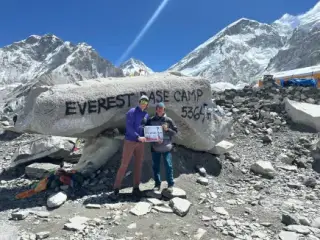
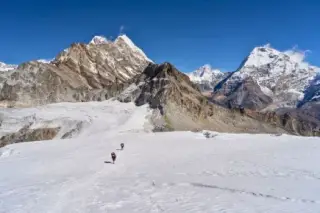
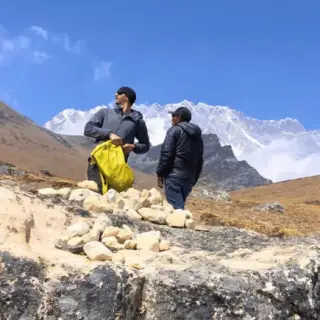
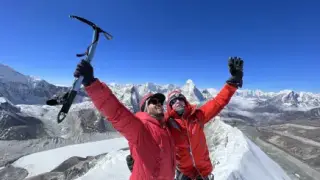
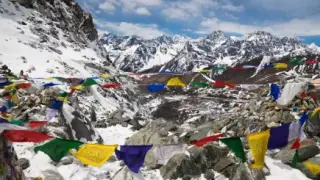
The Arun Valley to Everest Base Camp Trek is a 21-day route that reaches Everest Base Camp (5,364 m) and Kala Patthar (5,643 m) via the Salpa-Arun corridor, a seldom-walked eastern approach that starts at Tumlingtar (450 m) and threads through forests, rice terraces and Rai and Sherpa villages before joining the classic Khumbu trail above Phakding. The full altitude gain from the Arun valley floor to Kala Patthar is over 5,300 m, making this one of the longest continuous elevation gains in Himalayan trekking.
Days 2 through 8 follow the Salpa-Arun trail south of the main Everest highway. The route climbs from the subtropical Arun basin at 280 m, over the Salpa ridge at roughly 3,400 m, and drops to Bung before re-ascending toward the Pharak valley. These sections pass through settlements rarely seen by standard EBC groups: Gothey Bazar, Salpa Phedi, Sanam and Guranse at 2,880 m, Bung at 1,900 m, Gai Kharka and Puiyan. The ethnic mix along this corridor, Rai, Sherpa and Chhetri communities in adjacent villages, produces a cultural variety that the direct Lukla flight approach skips entirely.
From Phakding onward the trek joins the standard Khumbu route through Namche Bazar (3,445 m) with its acclimatisation day, then Tengboche (3,870 m), Dingboche (4,410 m), Lobuche (4,940 m) and Gorakshep (5,170 m) for the Base Camp visit. The final morning climbs Kala Patthar at 5,643 m for the closest eye-level view of Everest's south face available without a climbing permit. Permits required are the Sagarmatha National Park entry, Khumbu Pasang Lhamu Rural Municipality fee and TIMS; no restricted-area permit applies. The sections below cover difficulty, seasons, what to pack and how to prepare.