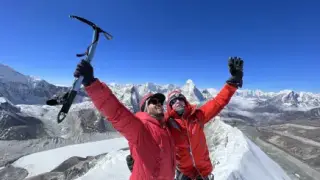
An 11-day package for the annual November Everest Skydive: exit a helicopter at 23,000 ft below Everest and land at Ama Dablam Base Camp (4,572 m) or Syangboche (3,780 m).
Duration
11 Days
Max Altitude
4,572 m / 15,000 ft
Difficulty
Easy
Group Size
Max 13 trekkers
Region
Everest Tour Packages, Nepal
Best Season
Autumn
Accommodation
Hotels in Kathmandu; teahouse lodges in Khumbu
Meals
Hotel breakfast in KTM; full board on trek
Transport
Domestic flight Kathmandu-Lukla; helicopter at drop zone
Dates & Prices
Choose your date
All dates are guaranteed departures — we never cancel for low numbers. Book online or send a quick enquiry.
Month
1 departure · 2026
Nov
1
Nov 1, 2026 — Nov 11, 2026
Guaranteed departure — from 2 trekkers
Available
USD25,000
per person
Can’t find a suitable date? We run private departures on any date with as few as 2 trekkers.
Trip Overview
About the Everest Skydive in Nepal
The Everest Skydive is a once-a-year aerial adventure in which skydivers exit an AS350 B3 helicopter at roughly 23,000 ft (about 7,010 m) below the summit of Mount Everest and land at one of two Himalayan drop zones: Syangboche airstrip at 3,780 m (12,402 ft) or Ama Dablam Base Camp at 4,572 m (15,000 ft). The 11-day package is built around the annual November event window, with optional rare special editions in May, and has operated since 2008 with around 400 jumpers total making it one of the smallest, most exclusive sporting events on the planet.
The itinerary works as a single, purposeful arc: arrival in Kathmandu, a sightseeing and briefing day, a flight to Lukla at 2,840 m and a three-day trek through Phakding and Namche Bazaar to Syangboche for altitude acclimatisation, followed by three days at the drop zone for the jump window, and then a one-day return to Kathmandu. Trekking in through the Khumbu means every jumper arrives at altitude with genuine acclimatisation, not a helicopter shortcut. The Sagarmatha National Park entry permit (NPR 3,000, about USD 23) and the Khumbu Pasang Lhamu Rural Municipality permit (NPR 2,000, about USD 15) are collected at Monjo and Lukla respectively; TIMS is no longer required inside the Khumbu.
Both solo and tandem options are available, with certified instructors managing oxygen-aware procedures above 5,000 m. The event is small by design: group size is limited, the cost is high, and the weather window can shift, which is why three jump-window days are scheduled. This is not a gap-year skydive; it is a precision event at an altitude where preparation and physical condition matter as much as nerve. The sections below cover the jump, the acclimatisation trek, permits, seasons and what to bring.
Last updated June 2026
Trip Highlights
Highlights
1
Freefall exit from a helicopter at 23,000 ft (about 7,010 m) below Everest
2
Land at Ama Dablam Base Camp (4,572 m / 15,000 ft), one of the world's highest drop zones
3
Annual November event running since 2008; around 400 jumpers total worldwide
4
Solo and tandem options with certified instructors and oxygen-aware high-altitude procedures
5
Acclimatisation trek via Lukla, Phakding, Namche Bazaar and Syangboche (3,780 m)
6
Views of Ama Dablam (6,812 m), Lhotse and the Everest massif from the drop zone
Day by Day
Everest Skydive in Nepal Itinerary: 11 Days
Tap any day to expand — altitudes, walking times, meals, and overnight details for every stage of the journey.
A Swotah representative meets you at Tribhuvan International Airport and transfers you to your hotel in central Kathmandu at 1,400 m. The evening is free for rest and adjustment after your international flight. Your guide will stop by to confirm the next day's briefing schedule and to review any outstanding medical paperwork or permit photographs you need to provide. Overnight in Kathmandu.
Sleep at 1,400 m
Tonight’s stay
Hotel
The morning covers Kathmandu at 1,400 m: Pashupatinath Temple on the Bagmati River, Boudhanath Stupa and, time permitting, Swayambhunath. After lunch the event's instructor team delivers the mandatory pre-jump ground school: the helicopter exit at 23,000 ft (about 7,010 m), oxygen use above 5,000 m, freefall body position, canopy phases, landing technique and the drop zone layouts at Syangboche (3,780 m) and Ama Dablam Base Camp (4,572 m). Weight checks and medical declarations are completed here. Overnight in Kathmandu.
Sleep at 1,400 mBreakfast
Tonight’s stay
Hotel
An early domestic flight from Kathmandu (or Manthali in peak season) lands at Tenzing-Hillary Airport, Lukla, at 2,840 m on the western wall of the Dudh Koshi valley. From Lukla the trail drops through mixed forest and crosses several suspension bridges to reach Phakding at 2,610 m, a walk of about 3 hours covering 8 km. Sleeping lower than Lukla on this first night is intentional: the gradual descent to Phakding gives the body a gentle introduction to Khumbu air pressure before the altitude gains begin tomorrow. Overnight in Phakding.
Sleep at 2,610 m
Tonight’s stay
TeaHouse
Namche Bazaar at 3,440 m is the main trading centre and administrative hub of the Khumbu, reached today via a 5-6 hour, 1,000 m climb from Phakding. The trail crosses the Dudh Koshi at the Sagarmatha National Park checkpoint at Monjo (2,835 m), where the park entry permit (NPR 3,000) is checked. A steep two-hour ascent through rhododendron forest above the park gate delivers the first views of Everest framed in the valley head. Namche's horseshoe of lodges, bakeries and gear shops sits at 3,440 m; this is the last comfortable resupply point before Syangboche. Overnight in Namche Bazaar.
Sleep at 3,440 m
Tonight’s stay
TeaHouse
A full rest day in Namche Bazaar at 3,440 m is a fixed part of the programme, not optional. The standard Khumbu protocol requires at least one night at this altitude before pushing higher, and your pulse oximeter readings this morning will inform whether the ascent to Syangboche tomorrow is on schedule. A short acclimatisation hike to the Everest View Hotel ridge at about 3,880 m and back improves the adaptation by spending time higher while returning to sleep lower. Namche's Saturday market is worth seeing if your timing falls on a weekend. Overnight in Namche Bazaar.
Sleep at 3,440 m
Tonight’s stay
TeaHouse
Syangboche at 3,780 m is the lower of the two Everest Skydive landing zones, situated on the small airstrip plateau above Namche. The trek from Namche takes about 1.5 hours on a clear trail with widening views of Ama Dablam (6,812 m) and the Lhotse-Nuptse wall. After settling in, the afternoon is a guided walk around the Syangboche drop zone: the landing area, wind-indicator positions and the sight lines to Ama Dablam Base Camp above. Your instructor reviews the jump-day briefing from Kathmandu and answers questions now that everyone is standing at altitude. A second pulse oximeter check confirms readiness. Overnight at Syangboche.
Sleep at 3,780 m
Tonight’s stay
TeaHouse
Jump day one. The helicopter departs Syangboche in the morning when conditions are assessed as clear: the AS350 B3 climbs to approximately 23,000 ft (about 7,010 m) below Everest, participants attach to oxygen, and the door opens above the greatest mountain wall on earth. Freefall lasts about 60 seconds before canopy deployment; the canopy ride of 5 to 7 minutes delivers you either to Syangboche (3,780 m) or, for those who chose the higher zone, to Ama Dablam Base Camp at 4,572 m, the ground high point of the entire package. A helicopter shuttle returns all participants to Syangboche after landing. Celebrations and debrief in the evening. Overnight at Syangboche.
Sleep at 4,572 m
Tonight’s stay
TeaHouse
Participants who did not jump on day 1 due to queue rotation, or who booked a second jump, complete their jump today on the same helicopter profile from 23,000 ft to the Syangboche or Ama Dablam Base Camp landing zones. A second jump is available to any participant who wishes to repeat the experience, subject to helicopter scheduling and weather. The afternoon is free at Syangboche for photography, resting or a short walk toward the Hotel Everest View at 3,880 m. Pulse oximeter checks continue each morning; anyone with persistently low readings is monitored by the guide. Overnight at Syangboche.
Sleep at 4,572 m
Tonight’s stay
TeaHouse
Day 8 is a scheduled weather buffer at Syangboche (3,780 m), held back deliberately to absorb any delay caused by cloud, upper-level wind or other conditions that grounded the helicopter on days 6 or 7. If all participants completed their jumps on schedule, this day becomes free time at Syangboche: an optional hike toward Khumjung village at 3,790 m, rest at the lodge, or a last look at Ama Dablam's silhouette from the drop zone. If jumps remain outstanding, the helicopter resumes operations this morning. Overnight at Syangboche.
Sleep at 3,780 m
Tonight’s stay
TeaHouse
The return from Syangboche follows the same Khumbu trail in reverse: a short descent to Namche Bazaar, then down through Monjo and Phakding to Lukla, arriving in time for the afternoon or early evening flight back to Kathmandu. The descent from 3,780 m to 2,840 m takes about 4-5 hours at a comfortable pace. Tribhuvan International Airport receives you at 1,400 m; a Swotah vehicle is waiting. Overnight in Kathmandu after a hot shower and a meal at sea-level oxygen pressure. Overnight in Kathmandu.
Sleep at 1,400 m
Tonight’s stay
Hotel
A Swotah representative transfers you to Tribhuvan International Airport for your onward flight. If your departure is in the afternoon, the Thamel area offers coffee shops, bookstores and a well-stocked outdoor market for any last-minute gear or souvenir purchases. Swotah can arrange extensions to Pokhara, the Annapurna region, Island Peak or the Everest Base Camp trek if you want to continue exploring the Khumbu before flying home.
Sleep at 1,400 m
Tonight’s stay
Hotel
What’s included
What's included
Every cost on the trail is broken out below — no hidden fees, no surprises at the trailhead.
Included
13 items
Airport Transfers: Pick-up and drop-off at the airport.
Accommodation in Kathmandu: Comfortable hotel stays with breakfast as outlined in the itinerary.
Kathmandu City Tour: Private vehicle city sightseeing and an expert tour guide.
Meals During Trek: Three daily meals and three tea/coffee breaks are provided during the trek.
Teahouse/Lodge Stays: Best available twin-sharing accommodations during the trek.
Guide and Porters: Highly experienced, English-speaking guides and porters, inclusive of all their expenses like salary, food, accommodation, transport, equipment, and insurance.
Trekking Essentials: Provided down jacket, sleeping bag, duffel bag, and trekking map.
Branded Souvenirs: T-shirt and a certificate upon trip completion.
Medical Kit: Access to a first aid medical kit, carried by your trekking leader.
Park Fees: Sagarmatha National Park Fee and Rural Municipality Entry Permit.
All Taxes and Charges: All applicable government taxes and service charges.
Not included
9 items
Nepalese Visa Fee: Cost of obtaining a Nepalese entry visa.
International Airfare: Tickets for international flights to and from Nepal are not included.
Excess Baggage Fees: Any charges for carrying baggage over the airline's weight limit.
Additional Accommodation: Extra nights in Kathmandu outside the scheduled itinerary due to early arrival, late departure, or early return from the trek.
Meals in Kathmandu: Lunch and dinner expenses in Kathmandu are not covered.
Travel and Rescue Insurance: Mandatory insurance for travel and rescue is not included and must be obtained by travellers.
Personal Expenses: Costs like phone calls, laundry service, bar bills, battery recharge, hiring additional porters, purchasing bottled or boiled water, taking showers, etc., are the traveller's responsibility.
Gratuities: Tips for guides, porters, and drivers are not included. A minimum of 10% of the total trip cost as tips for the guide and support staff is recommended.
Unspecified Costs: Any expenses not explicitly mentioned in the "includes" section of the package.
How Hard Is the Everest Skydive in Nepal?
The Everest Skydive package combines a moderate Khumbu acclimatisation trek (3-4 hr days up to 4,572 m) with an extreme aerial component: a freefall exit at 23,000 ft. Physical fitness, no heart or respiratory conditions, and passing the weight check (65-100 kg for tandem) are mandatory prerequisites.
▲Extreme aerial + moderate trek. Ground max 4,572 m; jump exit 23,000 ft. Trek: 3-5 hrs/day. Medical clearance, weight check and strong fitness required.
Overall Rating
2
Easy
out of 10 · physical effort scale
Max altitude4,572 m
Trekking days3 days
Trip Details
Planning your Everest Skydive in Nepal
Everything you need to plan the trek, topic by topic. Tap any one to open it.
The Everest Skydive uses an AS350 B3 helicopter as the jump aircraft, climbing t…
The Everest Skydive uses an AS350 B3 helicopter as the jump aircraft, climbing to the exit altitude of approximately 23,000 ft (about 7,010 m) below Everest for the freefall. This is the helicopter's cruise altitude for the jump, not a ground elevation; the actual terrain at this latitude sits far above normal skydiving airspace, which is why oxygen management and certified high-altitude procedures are built into every jump.
Two landing zones are used. Syangboche airstrip at 3,780 m (12,402 ft) is the lower and more forgiving option, adjacent to the Hotel Everest View. Ama Dablam Base Camp at 4,572 m (15,000 ft) is the higher of the two and the ground high point of the package; landing there puts you at the foot of Ama Dablam's south ridge with a direct view to the peak's iconic summit tower. Both zones sit well above the altitude ceiling of any mainstream civilian drop zone. The event has run since 2008 and around 400 jumpers have completed it, a figure that reflects the strict capacity limits rather than any lack of demand.
The Everest Skydive is a fixed annual event, not a year-round product. The prima…
The Everest Skydive is a fixed annual event, not a year-round product. The primary event window is November, when post-monsoon high-pressure systems produce the stable, clear conditions the jump requires. November also falls inside the main trekking season, so the acclimatisation approach through the Khumbu is straightforward.
Rare special editions have been held in May during the spring mountaineering season. Outside November (and the occasional May edition), the event does not run: the summer monsoon (June to September) brings cloud and precipitation that make high-altitude jumps unsafe, and winter jet-stream winds above 30,000 ft are severe enough to cancel operations for extended periods. If you see dates offered outside these two windows, verify directly with Swotah. Book the November event at least six months in advance; places sell out well before the event opens.
The Everest Skydive package passes through Sagarmatha National Park, which charg…
The Everest Skydive package passes through Sagarmatha National Park, which charges a park entry permit of NPR 3,000 (about USD 23) for foreign nationals. This permit is collected at the Monjo checkpoint on the trail between Phakding and Namche Bazaar.
The Khumbu Pasang Lhamu Rural Municipality permit costs NPR 2,000 (about USD 15) and is checked at Lukla. Both permits are required; Swotah includes them in the package cost and prepares the paperwork before you fly to Lukla. The old TIMS (Trekkers' Information Management System) card is no longer required inside the Khumbu, so those fees do not apply. Bring two passport-size photographs for permit processing.
Acclimatisation is built into the itinerary by design. The three-day approach fr…
Acclimatisation is built into the itinerary by design. The three-day approach from Lukla (2,840 m) through Phakding (2,610 m), Namche Bazaar (3,440 m) and Syangboche (3,780 m) follows the standard Khumbu altitude protocol: gain height slowly, sleep lower, allow a rest day at Namche. Arriving at the drop zone via a walking approach rather than a direct helicopter flight gives the body a genuine adjustment to 3,780 m before jump day.
Physical requirements for participation include: minimum age 18, weight between 65 kg and 100 kg for tandem jumps, and the absence of heart disease, respiratory conditions, epilepsy, recent fractures or any condition that would disqualify a participant from standard skydiving medicals. A fitness level sufficient to trek four days at Khumbu altitude is also required. Swotah sends a full medical questionnaire at booking; consult your doctor before paying a deposit if you have any doubts about eligibility.
Food on the trek portion follows the standard teahouse menu: dal bhat, noodle so…
Food on the trek portion follows the standard teahouse menu: dal bhat, noodle soup, Tibetan bread, eggs and local staples, with three meals a day included by Swotah. Namche Bazaar at 3,440 m has the widest selection, including bakeries and coffee shops that operate at high altitude. Above Namche, at Syangboche, the menu contracts and prices rise.
Water must be treated at all points above Lukla. Aim for 4 litres a day during the approach days because hydration is the cheapest tool against altitude sickness. Boiled water, purification tablets and filter bottles all work; lodge vendors also sell sealed water at a premium. On jump days, stay hydrated from the morning and avoid alcohol the evening before.
Lukla's Tenzing-Hillary Airport sits at 2,840 m and is the standard gateway for…
Lukla's Tenzing-Hillary Airport sits at 2,840 m and is the standard gateway for the Khumbu region. Flights operate from Kathmandu (Tribhuvan International Airport) and, during peak season when Lukla slots are limited, from Manthali Airport at Ramechhap (about 4-5 hours from Kathmandu by road). Swotah confirms the departure point before your trip based on seasonal availability.
The jump itself uses a dedicated AS350 B3 helicopter operated by the event crew, which handles the climb to 23,000 ft and the logistical coordination at both drop zones. No private helicopter charter is involved for individual participants. On the return day, the group flies or drives from Lukla back to Kathmandu. Swotah arranges all transfers and includes the Lukla flight in the package.
The Everest Skydive offers both solo and tandem jump formats, and the right choi…
The Everest Skydive offers both solo and tandem jump formats, and the right choice depends entirely on your skydiving licence level and currency. Solo jumps are available to holders of a valid USPA, BPA or equivalent national licence with a current free-fall qualification and documented jump currency; the event's instructors review your logbook before approving a solo slot, and oxygen-aware freefall procedure training is mandatory for everyone regardless of experience level.
Tandem jumps are open to first-time skydivers and those without a current solo licence. You are attached to a certified tandem instructor throughout the exit, freefall and canopy phases. The instructor manages all oxygen procedures and altitude-related decisions; your role is to follow the body-position briefing, maintain correct posture at exit, and relax during freefall. Most participants on the event choose tandem, which keeps the qualification bar lower without reducing the altitude or the view.
All participants attend a mandatory ground briefing in Kathmandu on day 1 of the…
All participants attend a mandatory ground briefing in Kathmandu on day 1 of the itinerary, covering the jump profile, oxygen use above 5,000 m, exit procedure, freefall body position, canopy phases and the landing zone. The briefing also reviews medical self-declaration, weight checks and kit fitting. No prior skydiving experience is required for tandem participants; the briefing gives you everything you need.
A second briefing takes place at Syangboche on the morning of your first jump window day, covering weather conditions, drop zone layout, wind direction and the specific flight path the helicopter will take. Instructors use this session to confirm that every participant's condition is stable after the acclimatisation trek. If any participant shows signs of acute mountain sickness (AMS), they are pulled from that jump cycle and reassessed the following day.
The Everest Skydive event is staffed by a combination of certified skydiving ins…
The Everest Skydive event is staffed by a combination of certified skydiving instructors, Nepali trekking guides and helicopter crew. Skydive instructors hold internationally recognised tandem and coach ratings and are trained in high-altitude oxygen procedures. On the trek approach, Swotah provides a licensed Nepali guide with Khumbu experience and a supporting porter team.
The event organisers manage helicopter scheduling, coordination with Civil Aviation Authority of Nepal, drop-zone safety and weather monitoring. Swotah acts as the Nepal-side booking and logistics partner, handling permits, accommodation, flights and pre-departure communication. Groups are deliberately small: limited places per event cycle keep the jump-day operation manageable and maintain safety margins at altitude.
Mobile coverage in the Khumbu is better than most remote Nepal regions. Nepal Te…
Mobile coverage in the Khumbu is better than most remote Nepal regions. Nepal Telecom (NTC) 4G covers Namche Bazaar and Syangboche, with signal generally available along the main trail. Phakding has intermittent coverage. Swotah provides a tourist SIM before the Lukla flight.
Wi-Fi is available at lodges in Namche and Phakding for a small fee; above Namche the connection is slower and less reliable. All lodges charge for device charging and costs increase with altitude, so a power bank (20,000 mAh or higher) is worth carrying. Camera batteries drain fast in the cold at 3,780 m and above; bring at least one spare battery per camera body and keep devices inside a sleeping bag at night when temperatures drop below freezing.
Responsible participation in the Everest Skydive means following the medical dec…
Responsible participation in the Everest Skydive means following the medical declaration honestly, reporting any AMS symptoms to your guide immediately, and not pressuring instructors to clear a jump when conditions or physical state are marginal. The event's small size and safety record depend on participants respecting these protocols.
Tipping is customary for the Nepali crew who support the trek portion. A common guideline is NPR 500 to NPR 1,000 per day for the guide and NPR 400 to NPR 600 per day for the porter, paid at the end of the trek. This goes directly to seasonal workers in one of Nepal's highest-cost-of-living communities. Carry small-denomination rupee notes for lodge payments and tips above Namche, where card machines are rare.
What to pack
What to pack
The full kit list. Anything we loan (sleeping bag, down jacket) is called out — bring everything else.
✓Duffel bag (for porter carry on trek)
✓Daypack (25-30L for trail and jump day kit)
✓Dry bag or rain cover
✓Small padlock
Frequently Asked
Questions & Answers
Everything trekkers ask before booking. Don't see yours? Tap Enquire — we usually reply within a few hours.
The Everest Skydive is a fixed annual event held in November, timed to coincide with the post-monsoon high-pressure window that brings stable, clear conditions at altitude. Rare special editions have also run in May during the spring mountaineering season, but these are not guaranteed each year. Outside November (and confirmed May editions), no jump dates are offered. The monsoon (June to September) and winter jet-stream period (December to March) both make the 23,000 ft helicopter exit unsafe, so the event does not operate in those months.
No. Tandem jumps are available to complete first-timers. You are attached by a certified tandem rig to an instructor who manages all oxygen procedures, the exit, freefall and canopy phases. You need to pass the pre-jump ground briefing, meet the weight requirements (65-100 kg) and complete the medical questionnaire. Solo jumps are reserved for holders of a valid USPA, BPA or equivalent national skydiving licence with current free-fall currency; the event instructors will review your logbook before approving a solo slot. Most participants choose tandem.
The 11-day package includes a four-day approach trek from Lukla (2,840 m) through Phakding (2,610 m), Namche Bazaar (3,440 m) and Syangboche (3,780 m), plus a full rest day at Namche. This follows the standard Khumbu altitude protocol: ascend gradually, include a rest day near 3,400 m, and allow the body to adjust before spending multiple nights at 3,780 m. Arriving at the drop zone on foot rather than by direct helicopter is a core design decision of the package; it significantly reduces AMS risk on jump days.
The highest ground point in the package is Ama Dablam Base Camp at 4,572 m (15,000 ft), which is the higher of the two landing zones. The jump exit altitude of 23,000 ft (about 7,010 m) is the helicopter's cruise altitude for the freefall, not a point you stand on the ground. The two figures measure different things: 15,000 ft is the altitude at which you land after the canopy ride; 23,000 ft is the altitude at which you exit the helicopter. Both are exceptional compared with any standard civilian drop zone.
The Everest Skydive deliberately limits group size each year. The exact number per event depends on helicopter scheduling, weather days available and instructor capacity, but the event has accumulated only around 400 total jumpers since 2008, which works out to an average of fewer than 25 participants per year. This is by design: small groups allow proper safety management at altitude, keep the logistics of the helicopter operation workable, and preserve the exclusivity of the experience. Waiting lists operate in peak years; book early.
Book at least six months before the November event. Places sell out well before the booking deadline, and the pre-trip medical clearance, weight confirmation and permit preparation all take time. For confirmed May special editions, lead times are shorter but still at least three months. Swotah requires a deposit to hold your place, and full payment is required no later than 60 days before departure. Contact Swotah as soon as you have confirmed your November travel window.
The 11-day package includes: airport transfers in Kathmandu, two nights hotel accommodation in Kathmandu, teahouse lodge accommodation on the trek (Phakding, two nights Namche, Syangboche), the tandem or solo jump with certified instructor and all equipment, Khumbu permits (Sagarmatha NP and Khumbu Pasang Lhamu), Lukla domestic flights, a licensed Nepali trekking guide and porter, and three meals a day on the trek. Not included: international flights, travel insurance, personal spending money, optional upgrades, and the medical check fee if your doctor charges for the clearance letter.
The Everest Skydive is among the most expensive single-activity adventure packages available. Prices vary by year and jump format (tandem costs more per head than solo due to instructor capacity). As a reference, the combined package including the jump, trek and accommodation has historically been priced upward of USD 25,000 per person, though Swotah confirms current pricing on enquiry. This figure reflects the helicopter operating cost at extreme altitude, instructor scarcity, permit and logistics fees in a remote region, and the strict capacity limits that keep the event rare.
Yes. Solo travellers are welcome and a single supplement applies for private room use in Kathmandu. On the trek, teahouse rooms are typically private or twin-share; Swotah will confirm arrangements at booking. For the jump itself, solo in the skydiving sense (jumping without a tandem instructor) requires a valid licence; solo in the travel sense (travelling without companions) is entirely fine and many participants book individually.
The AS350 B3 helicopter carries participants and instructors to approximately 23,000 ft (about 7,010 m) in the airspace below Everest. At this altitude the air contains roughly one-third of the oxygen available at sea level, so all participants and crew use supplemental oxygen from the moment the helicopter climbs above approximately 5,000 m. The door opens and you exit in tandem with your instructor (or solo if licensed), entering freefall at around 200 km/h. Freefall lasts approximately 60 seconds before canopy deployment, followed by a 5 to 7 minute canopy ride to the landing zone at Syangboche or Ama Dablam Base Camp.
All participants attend two briefings. The first is a full ground school in Kathmandu on day 1: jump profile, oxygen use, exit position, freefall body posture, canopy phases, landing technique and emergency procedures. The second briefing takes place at Syangboche on the morning of your jump window day, covering weather conditions, wind direction, drop-zone layout and the specific helicopter flight path. Tandem participants spend about one hour in briefing and practice; solo participants review additional freefall and oxygen management protocols. No physical training is required before arrival.
Tandem participants must weigh between 65 kg and 100 kg fully clothed and equipped. Participants below 65 kg may be considered case by case; above 100 kg tandem jumps are not possible due to certified rig load limits. Solo participants must meet their licence category's equipment limits. Medical disqualifiers include uncontrolled heart disease, coronary artery disease, uncontrolled hypertension, respiratory conditions including COPD or uncontrolled asthma, epilepsy, recent fractures (within 6 months), active psychiatric conditions and pregnancy. Swotah sends a medical questionnaire at booking; a doctor's clearance letter is required for any participant with a relevant medical history.
Three jump-window days (days 6, 7 and 8 in the itinerary) are built into the package specifically to absorb weather delays. The Khumbu's November high-pressure pattern is reliable, but high cloud, wind or turbulence at 23,000 ft can ground the helicopter. If you cannot jump on days 6 or 7, day 8 is the weather buffer. If all three days are grounded due to conditions outside the event's control, Swotah's booking terms cover the options available, which typically include a partial refund of the jump fee or a credit toward the next November event. The trek, accommodation and logistics costs are non-refundable once on the ground in the Khumbu.
Acute mountain sickness (AMS) is the main health risk on the trek approach. The itinerary addresses this with a gradual ascent profile: Lukla (2,840 m) on day 2, Namche (3,440 m) on day 3, a full rest day at Namche on day 4, and Syangboche (3,780 m) on day 5. No nights are spent above 3,780 m during the approach. Swotah's guide carries a pulse oximeter and checks oxygen saturation each morning; anyone below 80% at rest is assessed before further ascent. Acetazolamide (Diamox) is available as a prophylactic; consult your doctor before departure. Any participant showing moderate or severe AMS symptoms is not cleared for the jump that day.
Swotah requires comprehensive travel insurance before departure. The policy must explicitly cover: high-altitude skydiving (up to at least 25,000 ft), helicopter rescue and emergency medical evacuation from remote high-altitude terrain (minimum USD 200,000 coverage), trekking above 4,500 m, trip cancellation and curtailment, and personal baggage. Most standard travel policies exclude skydiving and high-altitude activities; check your policy wording carefully or use a specialist adventure sports insurer. Proof of insurance is required at the time of final booking confirmation. Do not arrive in Kathmandu without a confirmed policy that covers this specific activity.
Why Travel with Swotah
Why Book the Everest Skydive in Nepal with Swotah
Most Nepal operators look the same from the outside. Here's what actually makes the difference.
Born in Nepal
100% locally owned since 2016. Trek profits stay with the mountain families and village schools along your route.
Guaranteed Departures
Every date on our calendar runs — no minimum group size. You never pay to be cancelled.
Certified Guides
Government-licensed, WFR-certified, English-speaking. Most were born within two valleys of the trail.
Small Groups
Small groups, never more than 8 trekkers. You get a real experience, not a convoy.
Gear Included
Sleeping bag and down jacket loaned at no extra charge — both rated to –20°C.
Flexible Payment
Deposit from 10% to confirm, balance before departure or in cash on arrival. Reschedule up to 30 days prior.
24/7 Support
Kathmandu office and dedicated WhatsApp emergency line. We answer at 2am if needed.
Hall of Fame
TripAdvisor Travelers' Choice 2023, 2024 and 2025. Hundreds of verified five-star reviews.
Get a free personalised travel brief for the Everest Skydive in Nepal.
Tell us your travel dates and group size. Our team in Kathmandu will put together a tailored itinerary, honest costs, and practical tips — completely free, no commitment.