A 43-day commercial ascent of Lhotse (8,516 m), the world's fourth-highest mountain, via the Khumbu Icefall, Western Cwm and Lhotse Couloir.
Duration
43 Days
Max Altitude
8,516 m / 27,940 ft
Difficulty
Severe
Group Size
Max 7 trekkers
Region
Everest Tour Packages, Nepal
Best Season
Spring
Accommodation
Lodges KTM & Khumbu; tented camps BC to C4
Meals
Cook team at BC; energy foods & hot drinks in high camps
Transport
Flight KTM-Lukla; trek to BC; helicopter evac cover
Dates & Prices
Choose your date
All dates are guaranteed departures — we never cancel for low numbers. Book online or send a quick enquiry.
YearMonth
1 departure · 2027
Apr
12
Apr 12, 2027 — May 24, 2027
Guaranteed departure — from 2 trekkers
Available
USD19,690
per person
Can’t find a suitable date? We run private departures on any date with as few as 2 trekkers.
Trip Overview
About the Lhotse Expedition
The Lhotse Expedition is a full commercial ascent of Lhotse (8,516 m), the world's fourth-highest mountain, rising immediately south of Everest and separated from it only by the South Col. The climb follows the Everest South Col route from Kathmandu through Lukla, Namche Bazaar and Phakding to Base Camp at 5,364 m, then moves through the Khumbu Icefall and Western Cwm to the Lhotse Face, Camp 4 at approximately 7,800 m, and the steep Lhotse Couloir to the 8,516 m summit.
Lhotse was first summited on 18 May 1956 by Fritz Luchsinger and Ernst Reiss of a Swiss expedition, and the mountain's three main summits (Lhotse main, Lhotse Middle at 8,414 m, and Lhotse Shar at 8,383 m) make it one of the most complex massifs in the Himalayas. The South Face is one of the largest and steepest mountain walls in the world, rising around 3,200 m. The standard route is shared with Everest from Base Camp to Camp 3, diverging only at the Geneva Spur before the Lhotse Couloir.
This is a technical high-altitude expedition requiring prior 8,000 m experience or a strong record on 7,000 m peaks, physical conditioning over months, supplemental oxygen, Sherpa support and fixed-rope ascent. The climbing period runs through April and May, the only reliable weather window before the summer monsoon. Nepal climbing royalty for Lhotse is approximately USD 1,800 per person in the spring season. The guide sections below cover permits, the Lhotse Couloir, high-altitude camps, acclimatisation rotation, oxygen strategy and the full expedition logistics.
Last updated June 2026
Trip Highlights
Highlights
1
Summit Lhotse (8,516 m), the world's fourth-highest peak
2
Ascend through the Khumbu Icefall and Western Cwm on the Everest South Col approach
3
Climb the steep Lhotse Couloir (50-55 degrees) from Camp 4 at ~7,800 m
4
Share the iconic Base Camp (5,364 m) with Everest expeditions
5
Full Sherpa team, fixed ropes and supplemental oxygen supplied
6
Nepal royalty ~USD 1,800 per person; one of the more accessible 8,000 m fees
Day by Day
Lhotse Expedition Itinerary: 14 Days
Tap any day to expand — altitudes, walking times, meals, and overnight details for every stage of the journey.
A Swotah representative meets you at Tribhuvan International Airport and transfers you to your hotel in Thamel. The afternoon is free to rest, change currency and sort any last-minute gear. Your expedition leader calls by for an informal introduction and confirms the briefing schedule for the next morning. Overnight in Kathmandu (1,400 m).
Sleep at 1,400 mDinner
Tonight’s stay
Hotel
The full expedition briefing covers the Lhotse route, high-camp positions, the acclimatisation rotation plan and safety protocols. The Ministry of Tourism expedition permit, Sagarmatha National Park entry, and Khumbu Pasang Lhamu Rural Municipality fee paperwork are confirmed, and your passport details logged by the liaison officer. The afternoon is for a thorough equipment check: boots, crampons, harness, jumar, ice axe and oxygen mask fit are all tested before the team flies to Lukla. Overnight in Kathmandu (1,400 m).
Sleep at 1,400 mBreakfast
Tonight’s stay
Hotel
A 35-minute domestic flight from Kathmandu's domestic terminal lands at Lukla's Tenzing-Hillary Airport (2,860 m), one of the world's most dramatic runways at 527 m long and 12 degrees of slope. The flight is subject to weather; buffer days are built into the schedule. From Lukla, the trail descends through rhododendron forest and stone-flagged path alongside the Dudh Kosi river to Phakding (2,656 m), about 2 to 3 hours of easy walking to warm the legs. Overnight in Phakding (2,656 m).
Sleep at 2,656 mBreakfastLunchDinner
Tonight’s stay
Teahouse
From Phakding, the trail crosses the Dudh Kosi on a series of high suspension bridges and climbs steeply through the Sagarmatha National Park gate to Namche Bazaar (3,440 m), a 5 to 6 hour day gaining around 800 m. Namche is the main trading centre of the Khumbu: it has ATMs, bakeries, gear shops, reliable internet and the last resupply point for the expedition. The first views of Everest and Lhotse appear above the town on the ascent. Overnight in Namche Bazaar (3,440 m).
Sleep at 3,440 mBreakfastLunchDinner
Tonight’s stay
Guesthouse
A rest day at 3,440 m is mandatory for acclimatisation. The standard protocol is to climb higher in the morning and return: the walk to the Everest View Hotel ridge (3,880 m) takes about 90 minutes and gives a direct view of the Lhotse massif and Ama Dablam. The afternoon is for gear review, hydration and rest. The Sherpa Cultural Museum in Namche gives context on the Khumbu communities who make Himalayan expeditions possible. Overnight in Namche Bazaar (3,440 m).
Sleep at 3,440 mBreakfastLunchDinner
Tonight’s stay
Teahouse
The trail climbs from Namche, descends to cross the Dudh Kosi at Phunki Thanga, then makes a long, steep ascent through forest to Tengboche (3,870 m), around 5 to 6 hours. Tengboche Monastery, founded in 1923 and rebuilt after a 1989 fire, is the most important Buddhist institution in the Khumbu and offers an evening puja ceremony that many expedition teams attend for a blessing before moving higher. The campsite above the monastery has a direct view of Ama Dablam, Lhotse and the Everest massif. Overnight in Tengboche (3,870 m).
Sleep at 3,870 mBreakfastLunchDinner
Tonight’s stay
Teahouse
The route continues up the Imja Khola valley through Pangboche (3,930 m), with its ancient monastery and close-up views of Ama Dablam's south ridge, then climbs to Dingboche (4,410 m) in the upper Imja valley, about 4 to 5 hours. Dingboche is the standard acclimatisation hub for both the Everest and Island Peak routes and has comfortable teahouses and a well-stocked medical post. At 4,410 m, most climbers begin to notice a slight slowing in pace and an increase in respiratory rate. Overnight in Dingboche (4,410 m).
Sleep at 4,410 mBreakfastLunchDinner
Tonight’s stay
Teahouse
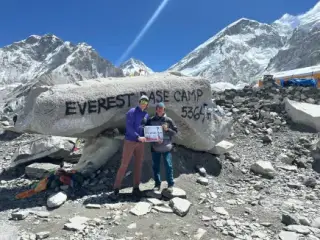
This block covers four days of progressive altitude gain. Day 8 is a rest day in Dingboche with an acclimatisation walk to Nangkartshang Peak (5,083 m), gaining 670 m above the village for wide views of the Lhotse massif, Makalu and the Island Peak ridgeline. Day 9 climbs to Lobuche (4,940 m) through the moraine of the Khumbu Glacier, past the Khumbu memorial chortens for climbers and Sherpas who have died on Everest. Day 10 continues to Gorak Shep (5,164 m), where the optional side trip to Kala Patthar (5,644 m) gives the classic full-face view of Everest and the Lhotse south face rising above the Western Cwm. Day 11 reaches Lhotse and Everest Base Camp at 5,364 m: a flat, rocky expanse on the glacial moraine, equipped with cook tents, dining tents, medical equipment, oxygen storage and the expedition communication setup. Base Camp is the home for the next four weeks. Overnight in Base Camp (5,364 m).
Sleep at 5,364 mBreakfastLunchDinner
Tonight’s stay
Teahouse
The 27-day climbing period is the core of the Lhotse Expedition and follows a climb-high, sleep-low acclimatisation structure with multiple rotations before the summit push.
Days 12-16 (First rotation): The team moves through the Khumbu Icefall (5,364 to ~6,100 m), the most objectively dangerous section of the route, crossing aluminium ladders over crevasses and moving between seracs in the early morning hours to avoid peak sun and serac fall. Camp 1 (~6,100 m) sits in the relatively safer flat area above the Icefall. From Camp 1 the route traverses the Western Cwm, a long, flat glacier bowl at 6,100 to 6,400 m between the walls of Everest, Nuptse and Lhotse, where midday temperatures can reach 40 C in direct sun despite the altitude. Camp 2 (~6,400 m) is the advance base camp in the Western Cwm. The first rotation typically reaches Camp 2 and returns to Base Camp for 2 to 3 rest days.
Days 19-25 (Second rotation): A second push climbs from Camp 2 up the Lhotse Face, a sustained 40-degree ice face carrying fixed ropes, to Camp 3 (~7,200 m). This altitude is above the acclimatisation threshold for most climbers, and supplemental oxygen is typically introduced from Camp 3 upward. The team sleeps at Camp 3 to maximise the acclimatisation benefit, then returns to Base Camp for a full rest block of 4 to 5 days. Weather forecasts from MeteoBlue and the expedition meteorologist are reviewed daily during this window.
Days 28-38 (Summit push): When a reliable 3 to 4 day stable weather window is confirmed, the summit push begins. Day 1 of the push: Base Camp to Camp 2. Day 2: Camp 2 to Camp 3. Day 3: Camp 3 to Camp 4 (~7,800 m) near the Geneva Spur, where the Everest and Lhotse routes diverge. Camp 4 is the launch pad, and the team rests, checks oxygen systems and sleeps as much as altitude permits. Summit day starts between midnight and 1 a.m.: from Camp 4 (~7,800 m) the route bears right from the Geneva Spur into the Lhotse Couloir, a steep, narrow gully of hard blue ice averaging 50 to 55 degrees with sections of 60 degrees. Fixed ropes are ascended using a jumar; frontpointing with 12-point crampons is required throughout. The upper couloir narrows as it approaches the summit pyramid, and the final ridge to the 8,516 m summit is exposed. Turnaround time is strictly enforced regardless of proximity to the summit. Descent returns through the couloir and the Lhotse Face to Camp 2 or Base Camp on the same day, weather permitting. Supplemental oxygen is used continuously from Camp 4. Overnight high varies by rotation (5,364 m to 8,516 m at summit).
Sleep at 8,516 mBreakfastLunchDinner
Tonight’s stay
Camping
After the summit push and descent to Base Camp, the team begins the return march down the Khumbu valley. The first day's walk descends from Base Camp (5,364 m) through Lobuche and down to Pangboche (3,930 m), around 4 to 5 hours of steady descent on well-worn trail. Pangboche is one of the oldest and highest permanent villages in the Khumbu; the lower monastery dates to around 1667. The altitude drop to below 4,000 m brings a significant improvement in breathing and energy. Overnight in Pangboche (3,930 m).
Sleep at 3,930 mBreakfastLunchDinner
Tonight’s stay
Guesthouse
The trail descends through Tengboche, crossing the suspension bridge below the monastery, and continues down through rhododendron and juniper forest to Namche Bazaar (3,440 m), around 4 to 5 hours. Namche is the celebration point: showers, bakeries and the chance to buy expedition souvenirs. The team reviews expedition photographs and the expedition leader completes the post-climb documentation required by the Nepal Mountaineering Association. Overnight in Namche Bazaar (3,440 m).
Sleep at 3,440 mBreakfastLunchDinner
Tonight’s stay
Teahouse
The final trekking day retraces the Dudh Kosi valley from Namche Bazaar, dropping through Phakding and the suspension bridges to Lukla (2,860 m), about 5 to 6 hours. Luggage is sorted and repacked for the morning flight; the expedition duffle bags go with the porter team. The evening in Lukla is for thanks to the Sherpa team and porter staff, and the distribution of tips. Overnight in Lukla (2,860 m).
Sleep at 2,860 mBreakfastLunchDinner
Tonight’s stay
Guesthouse
The 35-minute flight returns the team to Kathmandu's domestic terminal. Swotah transfers everyone to the hotel for a full rest day. The expedition leader arranges the summit certificate application at the Nepal Mountaineering Association office (required for official summit record) and collects any remaining permit documents. The evening is free for a celebratory dinner in Thamel. Overnight in Kathmandu (1,400 m).
Sleep at 1,400 mBreakfast
Tonight’s stay
Hotel
The Lhotse Expedition ends today. A Swotah representative transfers you to Tribhuvan International Airport for your onward flight. If you would like to add post-expedition sightseeing in the Kathmandu Valley, a rest extension in Pokhara, or information about other 8,000 m peaks for a future season, contact the Swotah team before or during the expedition.
Breakfast
What’s included
What's included
Every cost on the trail is broken out below — no hidden fees, no surprises at the trailhead.
Included
21 items
Standard/Deluxe rooms in Kathmandu on B/B basis;
Airport transfers;
Guided city tour in Kathmandu on a private vehicle;
3 meals a day (breakfast, lunch and dinner with tea or coffee) during the trek and climbing period;
Twin sharing tented accommodation and equipment during the camping (we will provide fully waterproof two-man tents, dining tents, kitchen gear, dining table, chairs, toilet tents, shower tent, etc.);
All camping equipment is in Base Camp.
30kg baggage allowance during trekking (with porters 2:1);
20kg baggage allowance returning from Base Camp;
Trekking Permit (National Park entry fee), local permit, and climbing permit for Mount Lhotse;
Oxygen bottles for the climber and the Sherpa with a mask and a regulator;
Experienced Sherpa guide;
Necessary staff during the trekking and climbing period with an experienced guide and porters;
Necessary experienced government-licensed climbing guide during the climbing period, as per group size;
The facility of food, accommodation, salary, insurance, equipment, and medicine for all trekking staff;
Group medical supplies a first aid medical kit, will be available.
High altitude food and all climbing crew will be available above base camp.
Necessary fixed and dynamic ropes will be available during the climbing period.
The necessary kitchen crew will be available in the base camp.
All necessary paperwork, office service charge and government taxes;
Complete pre-departure information, flight ticket reconfirmation and extend visa service (if necessary);
Farewell dinner in a typical Nepali Restaurant with a cultural dance show.
Not included
12 items
Lunches and dinners in Kathmandu;
Travel and rescue insurance;
International flights;
Nepalese entry visa fee
Personal climbing equipment;
All kinds of personal expenses;
Icefall fees garbage deposit (sharing with another member) if applicable;
Wake talkies & filming permit;
Personal climbing guide if requested.;
Optional trips and sightseeing if extended.
Tips for guides and porters;
Excess baggage charges (if you have more than 15 kg of luggage, a cargo charge is around $1.5 per kg).
How Hard Is the Lhotse Expedition?
The Lhotse Expedition is a high-altitude technical climb. It demands prior experience on 8,000 m peaks or at minimum strong 7,000 m ascents, months of physical conditioning, comfort with fixed ropes and jumar technique, and several weeks at altitude above 6,000 m. Supplemental oxygen is standard above Camp 3.
▲Technical, extreme altitude. Prior 8,000 m or strong 7,000 m experience required. Max altitude 8,516 m, weeks above 6,000 m, supplemental oxygen above ~7,000 m.
Overall Rating
8
Severe
out of 10 · physical effort scale
Max altitude8,516 m
Trekking days40 days
Trip Details
Planning your Lhotse Expedition
Everything you need to plan the trek, topic by topic. Tap any one to open it.
Lhotse (8,516 m) is graded extreme, the highest difficulty category in Himalayan…
Lhotse (8,516 m) is graded extreme, the highest difficulty category in Himalayan climbing. Climbers spend several weeks above Base Camp (5,364 m), with multiple rotation carries above 6,000 m and summit day starting from Camp 4 at approximately 7,800 m. The Lhotse Couloir above 8,000 m is the technical crux: a steep, icy gully averaging 50 to 55 degrees with sections of 60 degrees, where fixed ropes are essential and weather windows are narrow.
Prior experience on an 8,000 m peak is strongly recommended; at minimum, strong ascents on 7,000 m peaks with good high-altitude acclimatisation are required. Supplemental oxygen is standard from Camp 3 or Camp 4 upward. Acute mountain sickness, high-altitude pulmonary oedema and high-altitude cerebral oedema are all serious risks, and the expedition medic, pulse oximetry monitoring and a pre-arranged evacuation protocol are part of the Swotah safety framework.
Spring (April to May) is the only reliable season for a Lhotse summit attempt, d…
Spring (April to May) is the only reliable season for a Lhotse summit attempt, driven by the jet stream lifting off the summit for a narrow window, typically in mid-May, before the summer monsoon arrives in late May or early June. The expedition begins in late March or early April to allow a full acclimatisation rotation through April before the summit push in May.
Autumn (late September to October) sees some attempts but conditions are less stable than spring, the post-monsoon snowfall is heavier, and the route above 7,000 m is more dangerous. Winter and summer are not viable: winter temperatures at 8,516 m reach minus 40 C and below, and the monsoon brings heavy snowfall and avalanche risk. The spring season aligns with Everest permit season, sharing Base Camp infrastructure and fixed-line teams.
A Nepal climbing permit (royalty) for Lhotse is required from the Department of…
A Nepal climbing permit (royalty) for Lhotse is required from the Department of Immigration and the Ministry of Tourism. The royalty fee is approximately USD 1,800 per person in the spring season, one of the more accessible royalties among the 8,000 m peaks. The expedition agency submits the application with passport copies and expedition details; Swotah handles this on your behalf once documents are provided.
Additional permits include the Sagarmatha National Park entrance fee (approximately USD 30 per person), the Khumbu Pasang Lhamu Rural Municipality climbing fee (approximately NPR 2,000 per person), and the liaison officer fee required by Nepal for all 8,000 m expeditions. A Trekking Information Management System (TIMS) card is also needed for the approach. Swotah confirms all current fees before departure as government rates are subject to change.
Kathmandu nights are in a comfortable hotel. The Khumbu approach from Lukla to B…
Kathmandu nights are in a comfortable hotel. The Khumbu approach from Lukla to Base Camp uses standard teahouse lodges in Phakding, Namche Bazaar, Tengboche, and Dingboche, providing a progressive altitude gain with acclimatisation built in. Namche (3,440 m) is the last point with reliable internet and ATMs, and the acclimatisation day here is important.
Above Base Camp (5,364 m), accommodation is in tented high camps established and equipped by the expedition team. Camp 1 sits at approximately 6,100 m above the Khumbu Icefall, Camp 2 is in the Western Cwm at approximately 6,400 m, Camp 3 is on the Lhotse Face at approximately 7,200 m, and Camp 4 is at approximately 7,800 m near the Geneva Spur. Each camp is stocked with food, fuel and oxygen during rotation carries. A base camp cook team provides full meals and hot drinks.
At Base Camp, the Swotah cook team provides three full meals a day plus snacks a…
At Base Camp, the Swotah cook team provides three full meals a day plus snacks and unlimited hot drinks. Dal bhat, pasta, rice dishes and high-protein meals are the staples, with fresh vegetables sourced from Namche through the early expedition period. Acclimatisation days at Base Camp are rest and nutrition days, and caloric intake at this altitude is taken seriously.
Above Camp 2, food is pre-packed energy foods, bars, dehydrated meals, soup and hot drinks from a gas stove. Water at high camps comes from melted snow and ice. Dehydration accelerates altitude sickness, so drinking 4 to 5 litres per day is the target from Base Camp upward. Purification tablets or a filter cover any water sourced on the trek approach; above Base Camp, all water is boiled or from certified supplies.
The expedition begins in Kathmandu and flies to Lukla (2,860 m) on a 35-minute d…
The expedition begins in Kathmandu and flies to Lukla (2,860 m) on a 35-minute domestic flight operated by Tara Air or Summit Air. Lukla's Tenzing-Hillary Airport is at 2,860 m and subject to weather delays, so the schedule builds buffer days. From Lukla, the standard Khumbu trekking route leads through Phakding, Namche Bazaar, Tengboche and Dingboche to Base Camp over approximately 8 trekking days.
Kathmandu is served by international airlines from across Asia, Europe and the Middle East, with Tribhuvan International Airport (KTM) as the entry point. Most climbers arrive 1 to 2 days before the expedition briefing to allow for gear sorting, permit verification and the Kathmandu Mountaineering Association registration. Swotah arranges airport transfers, hotel, the Lukla flight booking and all ground logistics.
The Lhotse Couloir is the defining feature of the standard route above 8,000 m:…
The Lhotse Couloir is the defining feature of the standard route above 8,000 m: a steep, narrow gully of hard blue ice and snow averaging 50 to 55 degrees, with the summit pyramid rising to 8,516 m. Fixed ropes are placed by Sherpa teams in late April and maintained through the season; ascending without them is not attempted on a commercial expedition. The couloir begins at the top of the Lhotse Face above Camp 4 (~7,800 m) and requires frontpointing with crampons and controlled jumar technique.
The shared route with Everest follows the Khumbu Icefall from Base Camp (5,364 m) to Camp 1 at ~6,100 m: a broken glacier section with seracs, crevasses and ladders that is the most objectively dangerous part of the climb and is usually crossed in the early hours. The Western Cwm (6,100 to 6,400 m) is a high, flat glacier bowl between Everest, Nuptse and Lhotse. The Lhotse Face (6,400 to 7,800 m) is a sustained 40-degree ice face where the routes for Everest and Lhotse share the fixed lines until the Geneva Spur, where Lhotse climbers bear right into the couloir.
Acclimatisation on a Lhotse expedition runs on the classic climb-high, sleep-low…
Acclimatisation on a Lhotse expedition runs on the classic climb-high, sleep-low rotation. The first rotation typically reaches Camp 1 or Camp 2 and returns to Base Camp. The second rotation pushes to Camp 3 (7,200 m) and returns. Several rest days at Base Camp follow before the summit push, which is triggered when a reliable weather window appears, usually in the second or third week of May.
Summit day starts from Camp 4 (~7,800 m) at around midnight to 1 a.m. with headlamps and supplemental oxygen. The climb gains approximately 700 m of altitude over 5 to 7 hours to the summit at 8,516 m. The descent must be completed in daylight to safely navigate the Lhotse Couloir and the Lhotse Face. Oxygen flow rates are managed by the Sherpa team, and turnaround time is strictly enforced regardless of proximity to the summit. All climbers carry dexamethasone and nifedipine as emergency medications above 7,000 m.
The Swotah Lhotse Expedition includes a licensed expedition leader, high-altitud…
The Swotah Lhotse Expedition includes a licensed expedition leader, high-altitude Sherpa climbing guides certified by the Nepal Mountaineering Association, and a base camp cook team. Sherpa guides carry supplemental oxygen and emergency equipment on summit day and fix the high camps and ropes through the Khumbu Icefall and up the Lhotse Face through April.
A ratio of one Sherpa to one client is standard for the Lhotse Couloir section and summit push; Sherpa teams also carry loads between camps during the acclimatisation rotations, reducing client load-carry demands and preserving energy for altitude gain. A base camp manager handles logistics, weather forecasts (provided by MeteoBlue and other services), permit checking and liaison officer coordination. All Sherpa staff are insured under Nepal expedition insurance regulations.
Responsible expedition practice in the Khumbu includes strict waste management:…
Responsible expedition practice in the Khumbu includes strict waste management: all non-organic waste must be carried out from high camps, human waste at Base Camp is managed through the Khumbu Climbing Center's waste management system, and single-use plastics are minimised. The Sagarmatha Pollution Control Committee (SPCC) manages Base Camp waste regulations, and Swotah expeditions comply fully with their requirements.
Tipping is customary for expedition staff: a standard guideline is USD 500 per client for the lead Sherpa and USD 200 to 300 for supporting Sherpas, with smaller amounts for the cook team and assistants, but this varies and Swotah provides a suggested tipping table with your expedition briefing pack. Booking through a registered operator ensures Sherpa insurance, fair pay according to the Nepal Mountaineering Association rate card, and proper permit handling.
What to pack
What to pack
The full kit list. Anything we loan (sleeping bag, down jacket) is called out — bring everything else.
✓Large duffel bag (120L+) for porter loads to BC
✓Summit pack (35-40L) for high camps
✓Dry bag or waterproof liner
✓Packing cubes
Frequently Asked
Questions & Answers
Everything trekkers ask before booking. Don't see yours? Tap Enquire — we usually reply within a few hours.
Yes, our representative will be there to receive you at the airport and you will be directly transferred to your hotel.
Yes, we will invite you for dinner in a cultural restaurant on the night of your arrival for briefing the itinerary and small orientation program will be held by the tour leader and guides before we embark on our adventure.
The best seasons for Lhotse Expedition are August to November and March to May.
It will take around 3-4 weeks to climb it and to return only a few days. So to complete this mountaineering, you need at least 44 days in total, to finish this trip.
We believe in operating small intimate group to provide personal attention and services to our guests. Small groups can enjoy the trek hassle free and enjoy the customized trip according to their need and suitability. We do not incorporate more than 14 People in a group, unless we get special requests from our clients.
We use a private vehicle for sightseeing inside Kathmandu Valley. And we use domestic flight to transfer to Lukla and back.
Most of the time, it is not possible. But in emergency cases, you can. Still, we customize the trip according to your preference, but if you need to change plan during the trek, consult the guide and company
If you need extra day to complete the trekking, you'll need to inform the guide in advance and the guide will let the company know. Adding a day to trekking can result in many changes in other arrangements such as transportation, guide’s schedule, flight details, hotel bookings and all, so we really don't recommend this to our clients unless there's an emergency cases. But it's true that those changes could be made but it will cost extra. The best way to do it is to inform the agent company about it.
To confirm your booking, a non-refundable deposit of minimum of 15% of total trip amount is required, which can be made by bank transfer. The due balance is payable on arrival in Kathmandu with cash or card.
No, you cannot use the credit card during the climbing. You have to exchange the money in Nepali Rupees before you start the trip. You can use credit card only in Kathmandu.
For nights in cities, we use standard/superior standard/deluxe rooms whereas, during the trek, we use lodges/tea houses/guesthouses/home stay for our clients, and whatever is available and accessible. We also arrange sleeping bags for our clients, as per their request.
Only mountaineers who have adept mountaineering skills, adequate strength and previous experience in high mountains can climb this mountain.
During camping, our expert camping cooks prepare a wide range of delicious meals empowering you with enough strength for your strenuous climbing. All the cooking materials will be carried by our porters.
Yes, you will get purified, filtered water in many tea houses. You can also get a hot water during camping.
Climbing is a hard and tiresome activity that requires a lot of physical movement, so pack your active wears and trekking pants for at lower altitudes. Weather at high altitude is unpredictable, so carry a lightweight waterproof jacket along with thick down jacket, pant and thermal inner wear to escape the severe cold. Needless to say that, good shoes are very important for climbing in rough and snowy terrain, so invest in good quality shoes or rent it from us at a minimum price. For mountaineering, you will require special clothes that can be bought or hired from us.
Yes, our Sherpas are trekking experts and also authorized license holders from Nepal Government. The Sherpas know the climbing route like the back of their hand and use their expertise in ensuring your safety in the mountains.
Yes, you need climbing permit. It is not legal to climb without it.
Yes, for the first few days, it is possible to have telephonic communication. In some villages, you can make local and international calls from telephone provided by the guesthouse owner after paying certain amount directly. For higher altitude climbing, we usually have satellite phones with our Sherpas.
This is certainly one of the highest mountains in the world. In terms of technical difficulty, we'd rate “Lhotse” as 8.
We make sure to take security measures during climbing to make your expedition successful. We hire experienced and authorized Guides/Sherpas to safeguard your life in the mountains. We strongly recommend that you follow the Guide’s/Sherpa’s instruction with utmost care.
Before coming to Nepal, make sure that you are totally insured. In case of emergencies like altitude sickness, dehydration or any medical conditions, let your guide know about your problem and subsequently. As soon as we are informed of a situation, we will send emergency helicopter rescue team. You will be then transferred to the hospital for the treatment.
Before coming to Nepal, make sure you are covered for diphtheria & TB, hepatitis A, hepatitis B, malaria, typhoid, polio and tetanus. Make sure you are in best shape to complete the trekking without any complications.
Why Travel with Swotah
Why Book the Lhotse Expedition with Swotah
Most Nepal operators look the same from the outside. Here's what actually makes the difference.
Born in Nepal
100% locally owned since 2016. Trek profits stay with the mountain families and village schools along your route.
Guaranteed Departures
Every date on our calendar runs — no minimum group size. You never pay to be cancelled.
Certified Guides
Government-licensed, WFR-certified, English-speaking. Most were born within two valleys of the trail.
Small Groups
Small groups, never more than 8 trekkers. You get a real experience, not a convoy.
Gear Included
Sleeping bag and down jacket loaned at no extra charge — both rated to –20°C.
Flexible Payment
Deposit from 10% to confirm, balance before departure or in cash on arrival. Reschedule up to 30 days prior.
24/7 Support
Kathmandu office and dedicated WhatsApp emergency line. We answer at 2am if needed.
Hall of Fame
TripAdvisor Travelers' Choice 2023, 2024 and 2025. Hundreds of verified five-star reviews.
Get a free personalised travel brief for the Lhotse Expedition.
Tell us your travel dates and group size. Our team in Kathmandu will put together a tailored itinerary, honest costs, and practical tips — completely free, no commitment.