The Mount Putha Hiunchuli Expedition is a 38-day technical mountaineering programme on Dhaulagiri VI, the sixth summit of the Dhaulagiri massif, standing at 7,246 m in the remote Dolpa district of northwestern Nepal. It is not Dhaulagiri I (8,167 m) but a distinct peak of the same massif, first climbed by an Austrian team in 1954, and it holds a reputation as one of the more accessible 7,000 m summits in Nepal without being straightforward. The approach alone, through lower Dolpa from Juphal, covers 220 km of trail through a region few trekkers enter, making the full expedition a genuine wilderness undertaking.
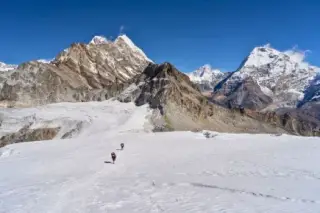
The route from Juphal follows the Bheri River and its tributaries through Dunai, Tarakot and a chain of small villages to German Base Camp at 4,500 m and then Putha Hiunchuli Base Camp at 4,915 m. A 21-day climbing period above base camp establishes camps to approximately 6,700 m on mixed rock, snow and ice, working the standard southwest ridge line. The technical grade is D (difficult), and the climbing demands prior 7,000 m or significant 6,000 m experience, sound crampon and fixed-rope technique, and comfort at altitude with limited rescue access.
Shey Phoksundo National Park forms the backdrop for the approach, and the district has strong Bon and Tibetan Buddhist cultural character. Nepal climbing royalty for Putha Hiunchuli is approximately USD 1,500 per person. The sections below cover the technical requirements, permits, seasons, logistics and what to bring for a high-altitude Dolpa expedition.