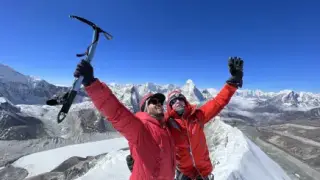
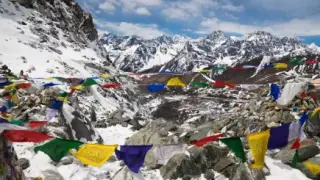
A 17-day Khumbu expedition combining the EBC approach and Kala Patthar with the technical (PD+) summit of Pokalde Peak (5,806 m) on mixed rock and snow.
Duration
17 Days
Max Altitude
5,806 m / 19,049 ft
Difficulty
Hard
Group Size
Max 14 trekkers
Region
Everest Tour Packages, Nepal
Best Season
Spring · Autumn
Accommodation
Teahouses & tented base camp
Meals
All meals on trek & at camp
Transport
Fly KTM-Lukla; private transfers
Dates & Prices
Choose your date
All dates are guaranteed departures — we never cancel for low numbers. Book online or send a quick enquiry.
YearMonth
3 departures · 2026
Oct
10
Oct 10, 2026 — Oct 26, 2026
Guaranteed departure — from 2 trekkers
Available
USD1,850
per person
Oct
12
Oct 12, 2026 — Oct 28, 2026
Guaranteed departure — from 2 trekkers
Available
USD1,850
per person
Nov
2
Nov 2, 2026 — Nov 18, 2026
Guaranteed departure — from 2 trekkers
Available
USD1,850
per person
Can’t find a suitable date? We run private departures on any date with as few as 2 trekkers.
Trip Overview
About the Pokalde Peak Climbing
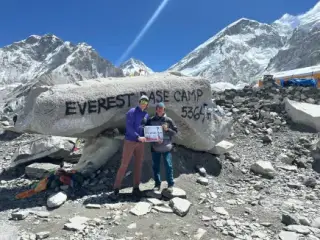
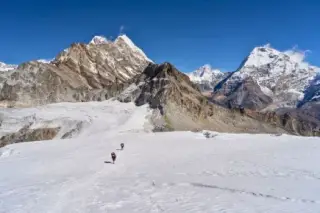
Pokalde Peak, also called Dolma Ri, is a 5,806 m trekking peak in the Khumbu region of Nepal, classified Grade PD+ by the Nepal Mountaineering Association under NMA Group B. It sits above the Dingboche valley east of Lobuche, with its summit ridge giving direct views of Everest (8,849 m), Lhotse (8,516 m), Makalu (8,485 m) and the Island Peak massif. The 17-day itinerary follows the classic Everest Base Camp approach to Lobuche, adds a Kala Patthar ascent to 5,545 m for acclimatisation, then swings to Pokalde Base Camp at 4,300 m before the summit push.
The technical section involves mixed rock and snow above base camp. Crampons, an ice axe and a fixed-rope handline on the steep upper couloir are standard. The approach covers well-maintained Sherpa teahouse trails via Lukla, Namche Bazaar, Tengboche, Dingboche and Lobuche, so route-finding is never in question and strong logistical infrastructure supports the trek all the way to high camp. Permits required are the Sagarmatha National Park entry permit, TIMS card and the NMA Group B peak-climbing permit.
This is the most accessible 5,800 m summit in Nepal for fit trekkers with no prior technical climbing experience, provided they handle altitude well and have basic cramponing instruction from the guide before the summit day. The sections below cover permits, difficulty, the technical summit section, seasons, gear and what to expect on the mountain.
Last updated June 2026
Trip Highlights
Highlights
1
Summit Pokalde (5,806 m) on mixed rock and snow, PD+
2
Kala Patthar (5,545 m): top Everest viewpoint, no permit
3
Full EBC approach: Namche, Tengboche, Dingboche, Lobuche
4
NMA Group B permit, Sagarmatha NP and TIMS by Swotah
5
Summit views: Everest, Lhotse, Makalu, Island Peak
6
NMA climbing guide, crampons and ice axe included
Day by Day
Pokalde Peak Climbing Itinerary: 17 Days
Tap any day to expand — altitudes, walking times, meals, and overnight details for every stage of the journey.
A Swotah representative meets you at Tribhuvan International Airport and drives you to your Kathmandu hotel. Your guide briefs you on the 17-day Pokalde Peak itinerary, reviews permits and checks technical gear including crampons and ice axe. Overnight in Kathmandu.
Sleep at 1,400 mDinner
Tonight’s stay
Hotel
A guided half-day around Kathmandu Valley UNESCO World Heritage Sites - Pashupatinath temple, Boudhanath stupa or Swayambhunath - with time in the afternoon to complete NMA permit paperwork and visit Thamel gear shops for any last equipment. Overnight in Kathmandu.
Sleep at 1,400 mBreakfast
Tonight’s stay
Hotel
A 35-minute STOL flight crosses the Himalayan foothills to Tenzing-Hillary Airport at Lukla (2,860 m), with the first Khumbu peaks already in sight. The trail descends through rhododendron and pine forest along the Dudh Koshi river to Phakding (2,656 m), crossing suspension bridges strung with prayer flags. About 3 to 4 hours of walking. Overnight in Phakding.
Sleep at 2,860 mBreakfastLunchDinner
Tonight’s stay
Teahouse
The trail climbs above the Dudh Koshi on long suspension bridges to Monjo, the entry checkpoint for Sagarmatha National Park where permits are verified, then makes the steep 600 m climb to Namche Bazaar (3,450 m), the main Sherpa trading town of the Khumbu. About 5 to 6 hours. Overnight in Namche.
Sleep at 3,450 mBreakfastLunchDinner
Tonight’s stay
Teahouse
A rest day with an acclimatisation hike up to the Everest View Hotel area (around 3,800 m), which gives the first unobstructed views of Everest (8,849 m) and Ama Dablam (6,812 m). The afternoon returns to Namche to sleep low. This climb-high-sleep-low approach is the standard acclimatisation protocol for the Khumbu. Overnight in Namche.
Sleep at 3,800 mBreakfastLunchDinner
Tonight’s stay
Teahouse
The trail contours the Namche hillside with ongoing views of Everest, Lhotse and Ama Dablam, then descends to the Imja Khola and climbs through rhododendron forest to Tengboche Monastery (3,870 m), the spiritual centre of the Khumbu and the largest monastery in the region. About 5 to 6 hours. Overnight in Tengboche.
Sleep at 3,870 mBreakfastLunchDinner
Tonight’s stay
Teahouse
The trail descends to Pangboche and forks up the Imja Khola valley to Dingboche (4,410 m), a wide flat-bottomed village on the plateau below Ama Dablam, Island Peak and the Lhotse face. About 5 to 6 hours. Overnight in Dingboche.
Sleep at 4,410 mBreakfastLunchDinner
Tonight’s stay
Teahouse
The route climbs past the Thukla memorials to Khumbu climbing victims and continues up the lateral moraine of the Khumbu Glacier to Lobuche (4,940 m), a cluster of teahouses with direct views of the Lobuche East and West summits. About 5 to 6 hours. Overnight in Lobuche.
Sleep at 4,940 mBreakfastLunchDinner
Tonight’s stay
Teahouse
An early start from Lobuche to Gorak Shep (5,164 m) and then the steep ascent of Kala Patthar (5,545 m), the black rocky spur on Pumori's south ridge and the highest non-permit viewpoint facing Everest's Khumbu face. The summit gives a direct view of the Khumbu Icefall, the Hillary Step ridge and the full south face of Nuptse. The descent returns to Lobuche (4,940 m) for the overnight, following climb-high-sleep-low acclimatisation protocol. About 7 to 8 hours total. Overnight in Lobuche.
Sleep at 5,545 mBreakfastLunchDinner
Tonight’s stay
Teahouse
The route retraces south down the moraine to Thukla and then to Dingboche (4,410 m), descending to sleep lower as the body continues to acclimatise ahead of the Pokalde summit push in two days. About 4 to 5 hours. Overnight in Dingboche.
Sleep at 4,410 mBreakfastLunchDinner
Tonight’s stay
Teahouse
A short approach leads south-east from Dingboche to Pokalde Base Camp (4,300 m), set below the lower rocky flanks of the peak. The afternoon is used for the guide's technical briefing on crampon technique, ice-axe self-arrest and the fixed-rope section on the upper couloir. Gear checks and an early dinner prepare the group for the 3 am summit start. About 2 to 3 hours. Overnight at Pokalde Base Camp.
Sleep at 4,300 mBreakfastLunchDinner
Tonight’s stay
Camping
Departure at approximately 3 am from base camp (4,300 m). The route crosses boulder and moraine terrain before reaching the snow approach, where crampons are fitted. The upper couloir, graded PD+, ascends at 45-50 degrees on mixed rock and snow, with a fixed-rope handline on the steepest section. The summit of Pokalde (5,806 m), also named Dolma Ri, is a narrow ridge with panoramic views of Everest (8,849 m), Lhotse (8,516 m), Makalu (8,485 m), Ama Dablam and Island Peak. The descent retraces the route to base camp. About 10 to 12 hours total. Overnight at Pokalde Base Camp.
Sleep at 5,806 mBreakfastLunchDinner
Tonight’s stay
Camping
A long descent from Pokalde Base Camp (4,300 m) retraces the approach via Dingboche and continues down through Pangboche to Tengboche (3,870 m). The altitude drop of 430 m from base camp to Dingboche, then a further 540 m to Tengboche, allows the body to recover quickly after the summit. About 6 to 7 hours. Overnight in Tengboche.
Sleep at 3,870 mBreakfastLunchDinner
Tonight’s stay
Teahouse
The trail descends the Imja Khola valley back through the rhododendron forest to Namche Bazaar (3,450 m), where hot showers, fresh bakeries and a celebration dinner mark the end of the technical section. About 4 to 5 hours. Overnight in Namche.
Sleep at 3,450 mBreakfastLunchDinner
Tonight’s stay
Teahouse
A final descent drops from Namche back through the suspension-bridge country along the Dudh Koshi to Phakding and then to Lukla (2,860 m), ending the walking section of the expedition. The evening allows a team dinner in Lukla. About 5 to 6 hours. Overnight in Lukla.
Sleep at 2,860 mBreakfastLunchDinner
Tonight’s stay
Teahouse
The morning STOL flight returns from Lukla to Kathmandu, weather permitting. A Swotah vehicle collects the group from the domestic terminal and transfers to the hotel. The afternoon and evening are free for rest, shopping in Thamel or a celebratory dinner. Overnight in Kathmandu.
Sleep at 1,400 mBreakfast
Tonight’s stay
Hotel
The Pokalde Peak expedition ends today. A Swotah representative transfers you to the international terminal at Tribhuvan Airport for your onward flight. If you would like to extend your stay in Nepal or add a further trek or peak, the team is glad to help arrange it.
BreakfastLunch
What’s included
What's included
Every cost on the trail is broken out below — no hidden fees, no surprises at the trailhead.
Included
12 items
Airport transfers by Private Vehicle.
Standard/Deluxe rooms in the standard hotel in Kathmandu on twin/double sharing with breakfast and dinner.
Guided sightseeing tour in Kathmandu, along with entrance fees and a professional guide.
Accommodation during trek (or camping in case of need).
All meals (Breakfast, lunch, dinner) during the trek.
Authorized English-speaking guide along with Porters (3:1) for the trek.
Two-way Kathmandu- Lukla airfare with domestic airport departure tax.
Equipment clothing for porter,s including their insurance.
All applicable governmentaxesax.
All expenses for all staff –meals, accommodation, salary, equipment, insurance, transportation.
All necessary paperwork, climbing permit, and local permit cost.
Medical kit (carried by your trek leader).
Not included
7 items
International flights; Nepalese visa fee.
Excess baggage charge(s) for the domestic flight.
Extra night accommodation in Kathmandu and Pokhara because of early arrival, late departure, early return from the mountain due to any reason other than the scheduled itinerary.
Lunch and evening meals in Kathmandu.
Travel and rescue insurance.
Personal expenses (phone calls, laundry, bar bills, battery recharge, extra porters, bottle or boiled water, shower, etc.).
Tips for guide(s), porter(s) and driver(s).
How Hard Is the Pokalde Peak Climbing?
Pokalde Peak is graded PD+ by the NMA. The approach follows standard EBC teahouse trails to Lobuche, and the technical section above base camp involves crampons, ice axe use and a fixed-rope handline on the steep upper couloir to 5,806 m.
▲PD+ grade. Mixed rock and snow above BC. Crampons, ice axe required. Max 5,806 m. Fit trekkers, no prior technical climbing needed.
Overall Rating
6
Hard
out of 10 · physical effort scale
Max altitude5,806 m
Trekking days13 days
Trip Details
Planning your Pokalde Peak Climbing
Everything you need to plan the trek, topic by topic. Tap any one to open it.
Pokalde Peak is graded PD+ (peu difficile plus) by the Nepal Mountaineering Asso…
Pokalde Peak is graded PD+ (peu difficile plus) by the Nepal Mountaineering Association, the second-lowest technical grade for Nepal trekking peaks. The approach to Lobuche follows the standard Everest Base Camp teahouse trail, and the difficulty is concentrated above Pokalde Base Camp at 4,300 m, where the route climbs mixed rock and snow to the summit ridge at 5,806 m. Crampons and an ice axe are required above the snowline, and a fixed-rope handline protects the steep upper couloir on summit day.
Daily walking on the approach runs 5 to 7 hours at altitudes between 2,656 m (Phakding) and 4,940 m (Lobuche). The Kala Patthar acclimatisation day reaches 5,545 m on day 8, giving the body time to adapt before the Pokalde summit push on day 11. Anyone with good cardiovascular fitness, no respiratory or heart conditions and a willingness to follow crampon instruction from the guide can attempt this peak. Swotah guides carry a pulse oximeter and first-aid kit, monitor oxygen saturation daily and have a clear descent protocol if altitude sickness develops.
Pokalde Peak has two reliable climbing windows: pre-monsoon spring (mid-March to…
Pokalde Peak has two reliable climbing windows: pre-monsoon spring (mid-March to late May) and post-monsoon autumn (late September to mid-November). Autumn is the most popular and stable season for the Khumbu, with clear skies after the monsoon, firm snow on the summit couloir and settled weather that keeps the flying window to Lukla open most days. October is the peak month, cold at high camps but with the best visibility.
Spring brings warmer temperatures lower down and spectacular rhododendron below Tengboche, though early-season fresh snow on the upper couloir can make the technical section more demanding in March. Winter (December to February) is possible but very cold above 4,000 m, and the Lukla flight schedule is less reliable. The monsoon season (June to August) is not recommended because cloud cover, wet rock on the summit section and flight disruptions all increase risk. The season cards above show monthly conditions.
Pokalde Peak requires three permits issued before departure from Kathmandu. The…
Pokalde Peak requires three permits issued before departure from Kathmandu. The Nepal Mountaineering Association (NMA) Group B peak-climbing permit is the key document; the current fee is USD 250 per person per expedition, and it covers the peak only during the permit season specified. Sagarmatha National Park entry adds NPR 3,000 per person for non-SAARC nationals, and the TIMS (Trekkers' Information Management System) card costs NPR 2,000 per person for agency-organised treks.
All three permits must be held before entering the Sagarmatha zone at Monjo. Swotah arranges every permit once you provide a passport copy and photographs, confirms current NMA fee rates before your trip (rates are reviewed periodically) and carries originals on the trail. You must also have valid travel insurance that includes high-altitude trekking and helicopter evacuation cover up to 6,000 m; the guide checks this before departure from Kathmandu.
Accommodation on the Pokalde Peak itinerary is teahouse lodges for all nights on…
Accommodation on the Pokalde Peak itinerary is teahouse lodges for all nights on the Everest Base Camp approach and descent, from Phakding (2,656 m) to Lobuche (4,940 m). Namche Bazaar has the widest choice, with hot showers, bakeries and reliable wi-fi. Above Namche, lodges at Tengboche, Dingboche and Lobuche are comfortable but simpler, with shared bathrooms and limited heating; temperatures drop sharply at night above 4,000 m.
At Pokalde Base Camp (4,300 m), accommodation is a tented or stone shelter arrangement because lodges do not exist at this approach point between Dingboche and the summit. Kathmandu offers a three-star hotel at the start and end. A four-season sleeping bag rated to -15 C is essential from Dingboche upward, and a liner adds useful warmth at Pokalde BC and on summit night.
Food on the Pokalde approach is teahouse cooking, with dal bhat as the main fuel…
Food on the Pokalde approach is teahouse cooking, with dal bhat as the main fuel: lentil soup, rice and vegetable curry, refillable at most lodges for free. The menu broadens in Namche, which has bakeries, pizza, apple pie and espresso. Above Namche at Tengboche, Dingboche and Lobuche the choice narrows to noodles, fried rice, Tibetan bread, eggs and soups. Summit day uses a packed lunch from the BC camp.
Swotah includes three meals per day on the trek and at base camp. For water, drink 3 to 4 litres a day from Namche upward to reduce altitude sickness risk. Bottled water is expensive above Namche; treat tap or stream water with iodine tablets, a filter straw or a UV pen, or buy boiled water at lodges. Carry a 1-litre reusable bottle and a thermos for the cold upper trail and summit morning.
The Pokalde itinerary begins with a 35-minute Twin Otter or Dash 8 flight from T…
The Pokalde itinerary begins with a 35-minute Twin Otter or Dash 8 flight from Tribhuvan International Airport in Kathmandu to Tenzing-Hillary Airport at Lukla (2,860 m), one of the most discussed short runways in aviation at 527 m. Swotah books STOL-carrier seats early in the season, because the morning flying window can be disrupted by cloud, and we schedule a contingency day in the itinerary for flight delays.
All Kathmandu road transfers run by private vehicle, covering the airport pickup on arrival, the city hotel to the domestic terminal on flight day and the return from the domestic terminal at the end. There are no road stages on the trek itself: every section between Lukla and Pokalde BC is on foot. Helicopter evacuation insurance is mandatory and must cover the full Khumbu altitude band to 6,000 m.
Day 8 of the itinerary makes a side trip from Lobuche to Kala Patthar (5,545 m),…
Day 8 of the itinerary makes a side trip from Lobuche to Kala Patthar (5,545 m), the black rocky spur above Gorak Shep on the south shoulder of Pumori. The ascent takes 3 to 4 hours from Gorak Shep at a steep but non-technical pace on a well-trodden trail, and the summit is the closest viewpoint to Everest (8,849 m) accessible without a climbing permit, with Nuptse, Lhotse and the Khumbu Icefall directly in view.
The practical purpose is acclimatisation: the body experiences 5,545 m before retreating to sleep at Lobuche (4,940 m), following the climb-high-sleep-low protocol that reduces acute mountain sickness risk on the Pokalde summit day three days later. Oxygen saturation readings at Lobuche the following morning typically show the body adapting. The guide carries a pulse oximeter and will delay the next stage if readings are not satisfactory.
Pokalde summit day begins at around 3 am from base camp at 4,300 m, climbing ini…
Pokalde summit day begins at around 3 am from base camp at 4,300 m, climbing initially over moraine and boulder terrain before reaching the snowline where crampons go on. The upper couloir is the technical crux, a 45-50 degree mixed snow and rock slope where the guide fixes a handline rope for the steep section. The summit ridge at 5,806 m is narrow, with Everest, Lhotse, Makalu and the Island Peak group directly visible on a clear day.
Total ascent time is 5 to 7 hours from base camp; the descent takes 3 to 4 hours. The guide gives a crampon and ice-axe arrest briefing the afternoon before summit day, and all technical gear including crampons, ice axe and harness is provided in the Swotah package. Route conditions vary by season: autumn typically offers firm snow and better crampon bite, while spring may have softer snow requiring earlier starts. The guide makes the final go or no-go call on summit morning based on conditions and the group's oxygen saturation.
A licensed climbing guide is mandatory for any NMA peak permit and is not option…
A licensed climbing guide is mandatory for any NMA peak permit and is not optional on Pokalde. Swotah's Pokalde guides hold Ministry of Tourism trekking licences and NMA climbing guide certification, have prior Pokalde summits, carry a first-aid kit and pulse oximeter, and are trained in fixed-rope rigging and high-altitude rescue protocol. Guide-to-climber ratios on Pokalde are typically 1:2 to 1:4 depending on group size.
A porter is strongly recommended for the teahouse stages: one porter carries up to 25 kg, so you carry only a daypack on the approach. Above base camp, the climbing guide and assistant Sherpa handle technical equipment. Swotah provides a free duffel bag for the porter, and all staff receive expedition insurance, fair wages and equipment in line with NMA and TAAN standards.
Mobile coverage in the Khumbu is reasonable on Nepal Telecom (NTC) and Ncell net…
Mobile coverage in the Khumbu is reasonable on Nepal Telecom (NTC) and Ncell networks as far as Gorak Shep, with strong signals at Namche and Dingboche and patchy coverage on the trail between lodges. Wi-Fi is available at most teahouses for a fee, typically NPR 300-500 per day, and speeds drop above Namche. Swotah provides a tourist SIM card with a data plan. Charging at lodges costs NPR 100-300 per device and is reliable up to Lobuche, but limited at Pokalde BC where there is no lodge power grid; a 20,000 mAh power bank covers several days off-grid.
Sagarmatha National Park bans single-use plastic bottles, so carry a reusable bottle and treat your own water. All non-biodegradable waste must be packed out from base camp; Swotah guides manage waste bags as standard. Drone flights are not permitted in the national park without a separate CAA Nepal permit. Tipping is customary at the end of the expedition: a common guideline is 10 to 15% of the total trip cost, divided among the climbing guide, assistant Sherpa, porter and driver, handed directly by the Swotah trip manager.
What to pack
What to pack
The full kit list. Anything we loan (sleeping bag, down jacket) is called out — bring everything else.
✓Duffel bag (carried by porter; 80-90 L)
✓Summit daypack (30-35 L)
✓Dry bag or pack rain cover
✓Packing cubes
Frequently Asked
Questions & Answers
Everything trekkers ask before booking. Don't see yours? Tap Enquire — we usually reply within a few hours.
Pokhalde Peak is not a technically difficult peak to climb, but you need good stamina and energy to climb it. Even though Pokhalde Peak can be climbed without any previous climbing experience, you need to know how to use the climbing equipment and gears. At Base Camp, our guide also helps you to how to use that equipment so you don’t need to worry about that.
Yes, you shouldn’t worry about this. As you arrive, our representative will be standing outside the airport terminal. You'll be directly transferred to the hotel.
For nights in cities, we use standard/superior standard/deluxe rooms whereas, during the trek we use lodges/tea houses/guesthouses/home stay for our clients, and whatever is available and accessible. We also arrange sleeping bags for our clients, on their request. For this expedition, accommodation will be tented camp.
The best season for Pokhalde Peak Climbing is during March to June and October to December.
Usually, we have to walk about 6-8 hours a day. But it shouldn't be taken as certain thing. Because the walking hour really depend on client's speed. So it's really relative.
It's always a good idea to book on your own. But we can also help you booking your flight in case of request.
There are no hidden costs in our itineraries. Therefore you don't need to carry much, but everything that's not mentioned on itinerary for example extra cup of tea, coffee, charging electrical appliances, can cost you extra. Therefore, we recommend you to keep at least $20-$50 per day for your personal expenses.
No, there will not be any problem as mostly at the high altitude, we prefer vegetarian food to avoid the food poisoning.
To confirm your booking, a deposit of $200 or 15% of total trip cost is required if you are booking at least a year in advance before trip departure date. If booking is made less than 100 days before the trip departure, you'll need to pay 20% to confirm the trip, if before two months, 25% of the total trip cost will need to be paid and if booked between 30-60 days, 50% of the total trip cost needs to be paid and finally, if you are booking 30 days prior to trip departure, then 100% payment should be made. The payments can be easily made by the bank transfer or Western Union Money transfer. The due balance is payable on arrival in Kathmandu with cash (preferably USD/EURO) or card on POS/credit card machine. Please note that non refundable fee is 10% or $200 whichever is greater.
You have to pay the remaining balance after arriving in Kathmandu either by cash or through credit card, before we start our adventure.
You can use a credit card only at Kathmandu. As outside the Kathmandu valley, you have to use the cash so change your currency into the Nepalese Rupees before the trekking.
Yes, you can add the extra days as per your wish, but for the extra day, you will have to pay the additional cost to cover guides, porters, accommodation and food.
Definitely we will provide you porter, or yak as per the condition. Besides your personal bag and the water bottle which will be frequently needed for you, they must be carried by you and remaining will be carried by our porter or yak.
The hotel in Kathmandu does provide the free storage services. So you can leave the clothes which are not necessary for the trekking. The best way is to save it in our office store room which is equally safe.
Yes, of course you can change the lodge if you don’t feel comfortable at one place, but it really depends on the availability of the lodges. During the peak season, the possibilities of changing the lodges are low.
We will send our potters to reserve the lodges before we reach there.
During the trek, you will get clean and hygienic food. Our cooks and helpers will cook the special meals.
There are plenty of water stations on each stop on the route. You can easily fill up the bottle from the open taps. We recommend that you bring water purifier tablets with you or at least get it from Kathmandu before you depart for trekking. You can also buy mineral waters but we usually recommend tap water which is pure and it helps us not promoting plastic bottled water.
We mostly use the comfortable and efficient vehicle so that you may not get a problem during the ride. We use private or tourist vehicle for sightseeing in the Kathmandu. Depending on the nature or group sized, we use cars, minibus, vans or jeep for travelling along the narrow and bumpy roads of Nepal. Mostly we use AC vehicles for your comfort. For domestic flight from Kathmandu to Lukla to Kathmandu, we use Tara air, Yeti air, and Goma air which are the popular domestic airlines in Nepal.
Yes, the trekking guides working in our company are the certified license holders and they also have received high altitude first aid training from KEEP (Kathmandu Environmental Education Project).
Yes, our climbing guides are well trained and have got the license from the Nepal Mountaineering Association. They are experienced with many mountains above 6000 m to 7000 m and also some of them have experienced the 8000 m peaks.
In some villages, it is possible to charge the devices, but it costs extra to charge the camera and other electronic equipments. It usually costs between $3-$6 per hour. So it's expensive. The best idea is to bring a power bank.
Yes, for the first few days, it's possible to have telephonic communication. In some villages, you can make local and international calls from telephone provided by the guesthouse owner after paying the price directly to them. In higher altitude regions, we usually have satellite phones with our Sherpas or Guides.
You will follow the popular trek to go there, but also you have to walk about 7-8 hrs. We also take a few days for acclimatizing to the higher altitude. Side trips are available on the days when you need to acclimatize.
During trek, please use comfortable and flexible dress. While trekking during the day at lower altitudes, lightweight trekking trousers and T-shirts are recommended. It's always a good idea to carry a waterproof jacket and some warmer clothing with you though as mountain weather is notoriously unpredictable. For the cold nights, thermal underwear, a warm fleece jacket and even a down jacket will help to keep you warm. Good shoes are of great importance. They must be comfortable. For higher altitude treks where you may have to tread snow for long hours, good boots are available for rent in Kathmandu. For mountaineering, you will require special clothes that can be bought or hired from us.
Our guides are well trained; they carry the first aid box for emergency. You also take some medicine box for your personal use.
No vaccinations are compulsory in the Himalaya, but we do recommend you are covered for Diphtheria & TB, Hepatitis A, Hepatitis B, Malaria, Typhoid, Polio and Tetanus. We also recommend: •A dental check-up prior to traveling that you know your blood group in case of emergency. If you have any pre-existing medical conditions which might affect you on tour, you make these known to your tour leader and Swotah travelers at the time of your booking.
We make sure to take security measures during climbing to make your expedition successful. We hire experienced and authorized Guides/Sherpas to safeguard your life in the mountains. We strongly recommend that you follow the guide’s instruction with utmost care.
Why Travel with Swotah
Why Book the Pokalde Peak Climbing with Swotah
Most Nepal operators look the same from the outside. Here's what actually makes the difference.
Born in Nepal
100% locally owned since 2016. Trek profits stay with the mountain families and village schools along your route.
Guaranteed Departures
Every date on our calendar runs — no minimum group size. You never pay to be cancelled.
Certified Guides
Government-licensed, WFR-certified, English-speaking. Most were born within two valleys of the trail.
Small Groups
Small groups, never more than 8 trekkers. You get a real experience, not a convoy.
Gear Included
Sleeping bag and down jacket loaned at no extra charge — both rated to –20°C.
Flexible Payment
Deposit from 10% to confirm, balance before departure or in cash on arrival. Reschedule up to 30 days prior.
24/7 Support
Kathmandu office and dedicated WhatsApp emergency line. We answer at 2am if needed.
Hall of Fame
TripAdvisor Travelers' Choice 2023, 2024 and 2025. Hundreds of verified five-star reviews.
Get a free personalised travel brief for the Pokalde Peak Climbing.
Tell us your travel dates and group size. Our team in Kathmandu will put together a tailored itinerary, honest costs, and practical tips — completely free, no commitment.