A 23-day restricted traverse through Nar Phu Valley, over the technical Teri La (5,595 m) and into Lo Manthang in Upper Mustang.
Duration
23 Days
Max Altitude
5,595 m / 18,356 ft
Difficulty
Moderate
Group Size
Max 7 trekkers
Region
Mustang Region Treks, Nepal
Best Season
Spring · Autumn
Accommodation
Camping Nar Phu; guesthouses Mustang
Meals
All meals by camp cook crew
Transport
Drive KTM-Besi Sahar-Koto; fly return
Dates & Prices
Choose your date
All dates are guaranteed departures — we never cancel for low numbers. Book online or send a quick enquiry.
YearMonth
4 departures · 2026
Oct
4
Oct 4, 2026 — Oct 26, 2026
Guaranteed departure — from 2 trekkers
Available
USD4,210
per person
Oct
5
Oct 5, 2026 — Oct 27, 2026
Guaranteed departure — from 2 trekkers
Available
USD4,120
per person
Nov
2
Nov 2, 2026 — Nov 24, 2026
Guaranteed departure — from 2 trekkers
Available
USD4,120
per person
Nov
7
Nov 7, 2026 — Nov 29, 2026
Guaranteed departure — from 2 trekkers
Available
USD4,210
per person
Can’t find a suitable date? We run private departures on any date with as few as 2 trekkers.
Trip Overview
About the Teri La Pass Trek
The Teri La Pass Trek is a 23-day high-alpine traverse that links two of Nepal's most restricted regions: the Nar Phu Valley, a narrow gorge-and-plateau system north of the Annapurna massif, and Upper Mustang, the walled Tibetan kingdom beyond the main Himalayan divide. The route crosses the Teri La at 5,595 m, the technical crux, before descending into the ochre-cliff canyon country of Lo, passing through Lo Manthang and finishing with a flight from Jomsom to Pokhara.
Nar Phu is a restricted valley accessible only from Koto on the Annapurna Circuit. It holds the villages of Meta (3,560 m) and Naar (4,100 m), chortens and gompas that predate the unification of Nepal, and the near-vertical walls of the Nar Phu Khola gorge, which filters out casual foot traffic. Upper Mustang, opened to trekkers in 1992, centres on Lo Manthang (3,810 m), a medieval walled city still governed by its king's palace. The Choser Cave complex, Luri Gompa, Thugchen Gompa and the eroded cliff dwellings of Dhakmar line the return route south.
The Teri La itself sits at 5,595 m and may require crampons and an ice axe on the steep approach from base camp at 5,100 m. The trek is camping throughout the Nar Phu section and the days between the pass and Lo Manthang; guesthouses appear only at Jomsom and on the Pokhara-Kathmandu legs. Four required permits, a camping logistics team and a licensed guide make this a trip that needs proper planning, and the sections below cover all of that.
Last updated June 2026
Trip Highlights
Highlights
1
Cross the Teri La at 5,595 m into Upper Mustang
2
Lo Manthang, walled capital of the kingdom of Lo
3
Restricted Nar Phu Valley from Koto to Naar
4
Teri La Base Camp night at 5,100 m below Damodar Himal
5
Choser Cave, Luri Gompa and Dhakmar cliff dwellings
6
Upper Mustang rain-shadow plateau south to Jomsom
Day by Day
Teri La Pass Trek Itinerary: 23 Days
Tap any day to expand — altitudes, walking times, meals, and overnight details for every stage of the journey.
A Swotah representative meets you at Tribhuvan International Airport and transfers you to your hotel. Your guide briefs you on the Teri La Pass Trek, runs through the restricted-area permit documents and checks your gear list. Overnight in Kathmandu (dinner included).
Sleep at 1,400 mDinner
Tonight’s stay
Hotel
A private vehicle covers the roughly 200 km Kathmandu to Pokhara run in 6 to 7 hours along the Prithvi Highway. Pokhara sits at 820 m on Phewa Lake and is the staging city for the Annapurna region. The evening is free. Overnight in Pokhara.
Sleep at 820 mBreakfast
Tonight’s stay
Hotel
A 4 to 5 hour drive east from Pokhara reaches Besi Sahar (760 m), the main road head for the Annapurna Circuit. The team assembles here and final packing is done. Overnight in Besi Sahar.
Sleep at 760 mBreakfastLunchDinner
Tonight’s stay
Camping
A jeep drives north along the Annapurna Circuit road for 7 to 8 hours to Koto (2,600 m), the last village before the Nar Phu Valley checkpoint. The restricted-area permit inspection happens at Koto; carry your originals. Overnight in Koto.
Sleep at 2,600 mBreakfastLunchDinner
Tonight’s stay
Camping
The trek begins at Koto, leaving the main Annapurna Circuit trail to enter the restricted Nar Phu Valley. The trail follows the Nar Phu Khola through a steep, narrow gorge cut into the Himalayan wall. About 3 to 4 hours of walking reaches the first campsite at 2,980 m. Camp dinner and overnight.
Sleep at 2,980 mBreakfastLunchDinner
Tonight’s stay
Camping
The gorge trail narrows at several points, carved into steep-sided walls above the river. The forest opens into a broader valley at Meta (3,560 m), also called Methang, with views of Pisang Peak and Kang Guru. About 4 hours. Camp overnight at Meta.
Sleep at 3,560 mBreakfastLunchDinner
Tonight’s stay
Camping
Naar (4,100 m) is the principal village of upper Nar Phu, with flat-roofed stone houses, prayer flags, a mani wall at the entrance and a gompa dated to the 11th century. The trail climbs steadily through barren, wind-polished terrain above the treeline. About 4 to 5 hours. Camp overnight at Naar.
Sleep at 4,100 mBreakfastLunchDinner
Tonight’s stay
Camping
Leaving Naar, the trail climbs above 4,000 m through Chhubche Kharka, where the valley narrows and the first glacial streams appear. The route passes waterfalls and pine stands before reaching the high camp at Dharmashala at approximately 4,450 m. About 6 to 7 hours. Camp overnight.
Sleep at 4,450 mBreakfastLunchDinner
Tonight’s stay
Camping
7 hours of steady climbing takes the route to the Tribeni confluence (also called Odhar) at roughly 4,850 m, where three stream systems join. The terrain here is fully above the treeline, with loose scree and glaciated slopes visible ahead toward the Teri La. Camp overnight at Tribeni.
Sleep at 4,850 mBreakfastLunchDinner
Tonight’s stay
Camping
Teri La Base Camp at 5,100 m is the last camp before the pass. The approach from Tribeni climbs steadily for 8 hours through high-alpine terrain with close views of the Damodar Himal and adjacent snowfields. An early camp and early sleep are essential for a pre-dawn start the next morning. Camp overnight at base camp.
Sleep at 5,100 mBreakfastLunchDinner
Tonight’s stay
Camping
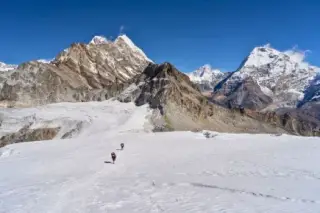
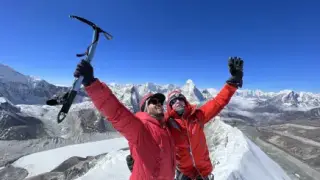
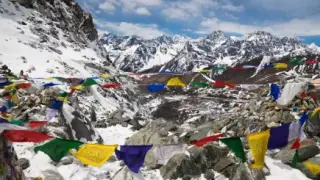
The Teri La at 5,595 m is the high point of the entire traverse and the divide between Nar Phu and Upper Mustang. A pre-dawn start (typically 3 a.m. to 4 a.m.) begins a 2-hour climb over steep snow and scree to the pass, where crampons and ice axe are standard equipment for the final 200 m of ascent. From the prayer-flag-strewn summit the descent runs 5 to 6 hours to Rijung Khola (approximately 3,800 m) on the Upper Mustang side. Total about 7 to 8 hours. Camp overnight at Rijung Khola.
Sleep at 5,595 mBreakfastLunchDinner
Tonight’s stay
Camping
Purano Kog (4,698 m) is an old settlement with traces of terraced cultivation at high altitude, a remnant of former farming activity along the Mustang border. The trail climbs back up from Rijung Khola for 6 to 7 hours. Camp overnight at Purano Kog.
Sleep at 4,698 mBreakfastLunchDinner
Tonight’s stay
Camping
The route crosses the Makar Pass (4,259 m) before descending to Tangee (3,340 m), a village with clusters of chortens and stone monuments. About 6 hours total, with the pass crossing in the first two hours. Camp overnight at Tangee.
Sleep at 3,340 mBreakfastLunchDinner
Tonight’s stay
Camping
The trail passes Lori Gompa, a cave monastery in the Upper Mustang cliff complex dated to the 15th century, before a further 2 hours brings the route to Yara (3,650 m). About 7 hours total with stops at the cave monastery. Camp overnight at Yara.
Sleep at 3,650 mBreakfastLunchDinner
Tonight’s stay
Camping
Lo Manthang (3,810 m) is the walled capital of the former kingdom of Lo and the centrepiece of Upper Mustang. The trail from Yara passes through Surkhang Gaun and crosses two passes, the Dhi La and Day La (both at approximately 3,950 m), before dropping to the white-walled city. About 6 to 7 hours. Camp or guesthouse overnight in Lo Manthang.
Sleep at 3,810 mBreakfastLunchDinner
Tonight’s stay
Camping
A full rest and exploration day in Lo Manthang covers the four main monasteries (Thugchen Gompa, Champa Lhakhang, Chyodi Gompa and Nyphu Gompa), the four-storey royal palace and the surrounding whitewashed lanes. The afternoon visit to Choser Cave, a Buddhist sky-cave complex about 5 km from Lo Manthang, can be done on foot or by horse. Camp or guesthouse overnight.
Sleep at 3,810 mBreakfastLunchDinner
Tonight’s stay
Camping
Dhakmar (3,820 m) sits below dramatic red-and-ochre cliffs on the return route south. The trail from Lo Manthang crosses the Chogo La and passes Lo Gyakar Ghar Gompa, founded by Guru Padmasambhava in the 8th century and one of the oldest in Upper Mustang, then continues over the Mui La Pass (4,170 m). About 8 hours. Camp overnight at Dhakmar.
Sleep at 3,820 mBreakfastLunchDinner
Tonight’s stay
Camping
Ghiling (3,775 m) is reached via Ghemi and a crossing of Ghemi La Pass (3,765 m) and Nyila Pass (4,010 m), with open views across the Mustang plateau to the Annapurna range, Nilgiri and the Kali Gandaki gorge below. About 7 hours. Camp overnight at Ghiling.
Sleep at 3,775 mBreakfastLunchDinner
Tonight’s stay
Camping
Chhusang (2,980 m) is a canyon village perched above the Kali Gandaki, with giant grey, red and orange cliffs pocked with old cave dwellings. The route crosses Syangboche La (3,850 m), Bhena La (3,830 m), Yamdala Pass (4,010 m) and Taklam La (3,640 m), passing Chungsi Cave and the village of Samar. About 8 hours of cumulative descent and crossing. Camp overnight at Chhusang.
Sleep at 2,980 mBreakfastLunchDinner
Tonight’s stay
Camping
A short morning walk reaches the holy confluence village of Kagbeni on the Kali Gandaki, the southern boundary of the Upper Mustang restricted zone. A private jeep then covers the remaining 18 km to Jomsom (2,700 m) along the river. Overnight in a guesthouse in Jomsom.
Sleep at 2,700 mBreakfastLunchDinner
Tonight’s stay
Guesthouse
A 20-minute domestic flight from Jomsom airport on Tara Air or Summit Air descends to Pokhara (820 m). Jomsom flights operate in the morning before the strong Kali Gandaki afternoon winds build; the schedule is weather-dependent and a buffer day may apply if visibility is low. Rest of the day free in Pokhara. Overnight in hotel.
Sleep at 820 mBreakfastLunchDinner
Tonight’s stay
Hotel
A morning domestic flight returns to Kathmandu (1,400 m), roughly 25 minutes. Your Swotah guide takes you around the main Kathmandu Valley UNESCO sites: Boudhanath stupa, Swayambhunath, Pashupatinath temple and one of the Durbar Squares. Farewell dinner in the evening. Overnight in Kathmandu.
Sleep at 1,400 mBreakfast
Tonight’s stay
Hotel
Your Teri La Pass Trek ends today. A Swotah representative transfers you to Tribhuvan International Airport for your onward flight. If you want to extend your stay, add another trek or arrange onward travel, the team is available to help.
Breakfast
What’s included
What's included
Every cost on the trail is broken out below — no hidden fees, no surprises at the trailhead.
Included
11 items
Airport transfers.
Standard/Deluxe rooms in Kathmandu on twin/double sharing with breakfast and dinner
Guided sightseeing tour in Kathmandu, along with entrance fees and a professional guide
Accommodation during the trek (or camping in case of need)
All meals (Breakfast, Lunch, Dinner) during the trek
Authorized English-speaking guide along with Porters for the trek
Equipment and clothing for porters (3:1), including their insurance
All applicable government tax
All expenses for staff –meals, accommodation, salary, equipment, insurance, transportation
All necessary paperwork and Trekking Permit, Trekkers' Information Management System fees (TIMS)
Medical kit (carried by your trek leader)
Not included
6 items
International flights; Nepalese visa fee
Extra night accommodation in Kathmandu because of early arrival or late departure due to any reason other than the scheduled itinerary
Lunch and evening meals in Kathmandu
Travel and rescue insurance
Personal expenses (phone calls, laundry, bar bills, battery recharge, extra porters, bottle or boiled water, shower, etc.)
Tips for guide(s), porter(s) and driver(s)
How Hard Is the Teri La Pass Trek?
The Teri La Pass Trek is a strenuous to technical remote camping trek. The Teri La at 5,595 m is the highest point crossed, crampons and ice axe may be needed on the steep approach, and the route spends eight consecutive nights above 3,500 m with no teahouse rescue net.
▲Strenuous-technical. 6-9 hr days, max altitude 5,595 m (Teri La). Camping throughout; crampons/ice axe likely. Strong fitness required.
Overall Rating
4
Moderate
out of 10 · physical effort scale
Max altitude5,595 m
Trekking days21 days
Trip Details
Planning your Teri La Pass Trek
Everything you need to plan the trek, topic by topic. Tap any one to open it.
The Teri La Pass Trek is graded strenuous to technical. The route crosses the Te…
The Teri La Pass Trek is graded strenuous to technical. The route crosses the Teri La at 5,595 m, which is not a walking pass: the final 500 m of ascent from base camp at 5,100 m involves a steep snow and scree slope where crampons and an ice axe are standard equipment, and where the exposure and gradient demand confidence on mixed terrain. Several nights above 4,000 m compound the altitude load, and acute mountain sickness (AMS) is a real risk from day 6 onward at Naar.
Daily walking runs 6 to 9 hours over remote trail with no teahouse safety net: there are no lodges between Koto and Jomsom, and the camping team is the only support on the route. Anyone with a respiratory or cardiac history should have a medical clearance before booking, keep to the scheduled acclimatisation days, drink 3 to 4 litres of water daily, and report any headache or nausea to the guide immediately. Swotah guides carry a first-aid kit, a pulse oximeter and supplemental oxygen for the pass section.
Spring (late March to mid-May) and autumn (October to early November) are the tw…
Spring (late March to mid-May) and autumn (October to early November) are the two viable windows for the Teri La Pass Trek. Both seasons bring stable high-pressure weather that keeps the pass clear of fresh snow during the crossing day; late autumn and late spring both carry risk of a storm resetting the conditions. Autumn is the drier and more stable of the two and is the most popular choice for the Upper Mustang section, where roads and the Jomsom flight schedule benefit from post-monsoon clarity.
Spring is colder at elevation and may hold more residual winter snow on the Teri La approach, but rhododendrons are in bloom on the lower approaches around Koto. The Upper Mustang rain-shadow effect means that even the monsoon months of July and August are drier than the lower hills, but the Nar Phu gorge is wet and the Teri La is snow-loaded, so monsoon trekking here is not recommended. Winter (December to February) closes the pass with deep snow and wind.
The Teri La Pass Trek requires four separate permits and, by law, a licensed gui…
The Teri La Pass Trek requires four separate permits and, by law, a licensed guide. The Upper Mustang Restricted Area Permit costs USD 500 per person for the first 10 days and USD 50 per extra day, making it one of the most expensive trekking permits in Nepal. The Nar Phu Valley Restricted Area Permit is an additional fee, currently requiring a registered agency booking; confirm the current rate with Swotah before departure as it is subject to revision. ACAP (Annapurna Conservation Area Permit) at NPR 3,000 for non-SAARC nationals and TIMS (Trekkers' Information Management System card) are also compulsory.
Solo trekking and unguided trekking in both restricted zones is not permitted under Nepal Tourism Board rules. Swotah handles all permit applications on receipt of a passport copy and photos and confirms current rates in the pre-trip documents. Carry originals throughout the trek: checkposts in both Nar Phu and Upper Mustang inspect documents on the trail.
Accommodation on the Teri La Pass Trek is camping from Koto all the way to Chhus…
Accommodation on the Teri La Pass Trek is camping from Koto all the way to Chhusang near the end of the Upper Mustang descent, a stretch of 16 consecutive nights. Swotah's camping team carries tents, cooking equipment and all food for that section; clients walk with a daypack only. The camp cook team sets up before the group arrives each evening. Some villages along the Upper Mustang section (Tangee, Yara, Lo Manthang) have guesthouses that can be used as an option, but the standard itinerary is full camping to keep permits and logistics clean.
Koto has basic guesthouses for the night before the restricted section begins. From Jomsom onward, the trek moves to hotel accommodation: simple guesthouses at Jomsom, then hotels in Pokhara and Kathmandu. A four-season sleeping bag rated to at least -10 C is required for the nights above 4,000 m, particularly the base camp night before the Teri La crossing.
All meals on the trek are prepared by the Swotah camping cook team from Koto to…
All meals on the trek are prepared by the Swotah camping cook team from Koto to Jomsom. Dal bhat (lentil soup with rice and vegetables) is the daily staple, supplemented with noodles, soup, eggs, pasta and pancakes where ingredients are available. Above 4,500 m the menu simplifies and portions that fuel a pass day need to be eaten even when appetite is suppressed by altitude: eating and drinking are the most reliable prevention for AMS.
Water above 3,500 m should be treated before drinking, either boiled at camp or purified with tablets, a filter or a UV pen. Aim for 3 to 4 litres a day from day 6 onward to aid acclimatisation. Carry a 2-litre reusable bottle, and plan that water above Naar is from glacial streams: the cook team boils all drinking water at high camp, but the guide can advise on treatment for between-camp fills. Plastic-bottled water is largely absent on this route.
The Teri La Pass Trek begins with two drive days from Kathmandu: first to Pokhar…
The Teri La Pass Trek begins with two drive days from Kathmandu: first to Pokhara (about 7 hours by private vehicle), then Pokhara to Besi Sahar, and on a rough off-road track to Koto (2,600 m) at the entrance to the Nar Phu Valley, typically splitting into two drive days. Koto sits on the Annapurna Circuit road just north of Chame; the Nar Phu restricted checkpoint is at Koto, not further along the main circuit.
The trek exits via the Mustang road to Jomsom and a domestic flight from Jomsom airport to Pokhara with Tara Air or Summit Air, then a connecting domestic flight Pokhara to Kathmandu. Jomsom flights are notorious for weather cancellations, particularly in strong afternoon Kali Gandaki wind; build at least one buffer day around the Jomsom departure. Swotah books the domestic segments and monitors the schedule.
Nar Phu Valley is a restricted gorge-and-plateau system north of Chame on the An…
Nar Phu Valley is a restricted gorge-and-plateau system north of Chame on the Annapurna Circuit, opening into Tibetan-style terrain at Meta and Naar. The valley runs roughly 25 km from Koto to the head of the Nar Phu Khola and holds fewer than 500 permanent residents across both villages. Naar (4,100 m) is the upper settlement, with Tibetan-style stone houses, chortens and a gompa dated to the 11th century, and the local dialect and dress are distinct from the Gurung culture of the lower Annapurna trails.
Access restriction to Nar Phu dates to the 1970s, when Nepal closed the valley to prevent cross-border movement with Tibet. Modern trekking permits re-opened it to guided groups only, and the relative difficulty of access means the trail stays quiet even in peak season. The high camps above Naar, the approach to Tribeni and the Teri La base camp corridor are generally walked by fewer than a handful of groups per month.
Lo Manthang (3,810 m) is a walled medieval city at the heart of Upper Mustang, t…
Lo Manthang (3,810 m) is a walled medieval city at the heart of Upper Mustang, the former Tibetan kingdom of Lo, and was off-limits to all outsiders until 1992. The walls enclose a palace, three major monasteries (Thugchen Gompa, Champa Lhakhang and Chyodi Gompa) and about 150 households in packed, flat-roofed buildings painted in white, red and ochre. The king of Lo still maintains the palace. From the Teri La side, trekkers approach from the north, arriving via Yara rather than the standard southern circuit from Kagbeni.
The approach and descent through Upper Mustang passes striking geological features: the Dhakmar ochre-and-red cliffs, the sky cave complexes near Chhoser and Luri Gompa, and the eroded badland landscape of the Kali Gandaki headwaters. Upper Mustang receives less than 250 mm of rain per year because the Great Himalayan wall blocks monsoon moisture; the result is a dry, windswept plateau that looks more like Tibet than the rest of Nepal.
A licensed guide is mandatory on every restricted section of this trek, and Nepa…
A licensed guide is mandatory on every restricted section of this trek, and Nepal requires a minimum group of two trekkers booked through a registered agency. Swotah guides hold Ministry of Tourism licences, have technical mountain first-aid training, and carry the Nar Phu and Upper Mustang checkpoint documents. A guide who has crossed the Teri La before is standard practice on this route, given the navigational demands on the pass day itself.
The camping team (cook, kitchen assistant and porters) is the logistical backbone of this trip. One porter carries 20 to 25 kg and we cap loads at that weight regardless of distance. Swotah provides duffel bags for porter use; trekkers carry a 20-25L daypack and a warm layer during the day. Tips for the guide, porters and cook are customary at 10 to 15% of the trip cost and go directly to the seasonal workforce on the trail.
Mobile coverage in Nar Phu is minimal: Nepal Telecom (NTC) has a signal in Naar…
Mobile coverage in Nar Phu is minimal: Nepal Telecom (NTC) has a signal in Naar and at Koto, and nowhere reliably between. Upper Mustang is slightly better-served in Lo Manthang, where NTC and Ncell have a basic signal. Expect to be fully off-grid from day 4 to approximately day 15. Swotah provides a tourist SIM in Kathmandu and the guide carries a mobile; satellite communication is available to the guide team for emergencies.
Both valleys are ecologically and culturally fragile. Carry all waste out of the restricted sections, use treated water rather than plastic bottles, respect the gompa interiors and local religious protocol (remove shoes, ask before photographing), and walk clockwise around chortens and mani walls. Camping-team kitchen waste is carried to disposal points in Jomsom. Booking with a registered agency is also a direct conservation act: the restricted-area permit fees fund the local area management committees in both Nar Phu and Upper Mustang.
What to pack
What to pack
The full kit list. Anything we loan (sleeping bag, down jacket) is called out — bring everything else.
✓Duffel bag (carried by porter, 60-80L)
✓Daypack (20-25L)
✓Dry bag or rain cover
✓Small summit pack for pass day
Frequently Asked
Questions & Answers
Everything trekkers ask before booking. Don't see yours? Tap Enquire — we usually reply within a few hours.
Yes, our representative will be there to greet you at the airport. Upon arrival, you will be transferred to your hotel by a private car/jeep.
Yes, there is going to be a small orientation/briefing program before we embark on our adventure by the tour manager, leader/guide.
For nights in cities, we use standard/superior standard/deluxe rooms whereas, during the trek, we use lodges/tea houses/guesthouses/camping/homestay for our clients, and whatever is available and accessible. We also arrange sleeping bags for our clients, on their request.
We believe in operating small intimate group to provide personal attention and services to our guests. Small groups can enjoy the trek hassle free and enjoy the customized trip according to their need and suitability. We do not incorporate more than 14 People in a group, unless we get special requests from our clients.
Spring season (March to June) and autumn season (September to December) are the best time to do this trek.
To confirm your booking, a deposit of 15% of total trip amount is required if you are booking at least a year in advance before trip departure date. If booking is made between 100-364 days before the trip departure, you'll need to pay 20% to confirm the trip. If payment is made between 99-60 days, 25% of the total trip amount will need to be paid and if booked between 59-30 days, 50% of the total trip amount needs to be paid and finally, if you are booking 29 days prior to trip departure, then 100% payment should be made. The payments can be easily made by the bank transfer. The due balance is payable on arrival in Kathmandu with cash (preferably USD/EURO) or card on POS/credit card machine. Please note that non refundable fee is 10% or $200 whichever is greater.
No, you cannot use the credit card during the trek. You have to withdraw the money before you start the trek. You can use credit card only in Kathmandu and Pokhara.
You have to carry your personal bags with water bottle and medicines and remaining bags will be carried by porters to make you easy to trek. The weight limit for porters is 15 KG.
If you need extra day to complete the trekking, you'll need to inform the guide in advance and the guide will let the company know. Adding a day to trekking can result in many changes in other arrangements such as transportation, guide’s schedule, flight details, hotel bookings and all, so we really don't recommend this to our clients unless there is an emergency case. But it is true that those changes could be made but it will cost extra. The best way to do it is to inform the agent company about it.
Teri La pass is one of the most popular trekking routes which is a thrilling experience where you can explore ancient monasteries from the 14th century, Buddhist shrines, Tibetan culture, rustic villages and beautiful hospitable people. It is little bit hard to do this trek so you will have to be physically and mentally fit and healthy to do this trek.
During camping, our expert camping cooks prepare a wide range of delicious meals empowering you with enough strength for your strenuous climbing. All the cooking materials will be carried by our porters.
There are plenty of water stations on each stop on the route. You can easily fill up the bottle from the open taps. We recommend that you bring water purifier tablets with you or at least get it from Kathmandu before you depart for trekking. You can also buy mineral waters but we usually recommend tap water which is pure and it helps us not promoting plastic bottled water.
We use private transportation for sightseeing inside the Kathmandu Valley and to drive towards Pokhara too. We use domestic airlines to come back from Jomsom to Pokhara. We do drop and pick up from the starting and ending point of trek on private car or jeep.
Trekking in Teri La Pass is tiresome activity that requires a lot of physical movement. So, pack your active wears and trekking pants for at lower altitudes. Weather at high altitude is unpredictable so carry a light weight waterproof jacket along with thick down jacket, pant and thermal inner wear to escape severe cold. Needless to say, good shoe is very important for trekking in rough and snowy terrain. So invest on good quality shoes or rent it from us in a minimum price. As you are trekking in remote village, try to wear modest clothes to quickly gel up with the local people without hesitation.
We customize the trip according to your preference but if you need to change plan during the trek, consult the guide.
We contact the lodge/guesthouse owner for reservation of the room before trekking on a particular day. On other days, porters reach the destination and make a camp for you. But there are always going to be exceptions but even in those cases, we may have to be flexible about very basic sleeping arrangements. We always try to make sure that we have everything well arranged.
All our guides are trekking experts holding license from Nepal Tourism Board, Nepal Government. They are the most valuable assets of the company. Guides know the trekking route like the back of their hand and use their expertise in ensuring your safety in the mountains.
While trekking in higher lands, you need to pay for charging the electronics upon request to the guesthouse owner. The best idea is to bring your own power bank with you. It is easier and cheaper.
In some villages, you can make local and international calls from telephone provided by the guesthouse owner after paying the price directly. Our guide is also provided with a mobile phone. In case of emergency, you can use his mobile and make a call.
Usually, we have to walk about 7-9 hours a day. But it should not be taken as certain thing because the hours of walk depends on client’s speed. So it is really relative.
Yes, Nepal can proudly boast as one of the safest countries in South Asia for women, you will find people very friendly and respectful especially towards women. Locals are very respectful and welcoming toward women and tourist in general and our guides will make sure you are comfortable and safe while trekking in remote areas.
We make sure to take security measures during trek to make your trip delightful. We hire experienced and license holding guides to safeguard your life in mountains. We suggest you to follow the guide’s instruction carefully and take responsibility for personal belongings. Always keep your valued belongings near you and lock the door from inside during the night.
Before coming to Nepal, make sure that you are covered by insurance policy for the altitude of 5500 meters. In the case of an emergency like altitude sickness, dehydration or any medical conditions ask your tour leader/guide to contact us as soon as possible so that we can manage/arrange helicopter for the rescue. Then you will be transferred to hospital for the treatment.
Before coming to Nepal, make sure you are covered for diphtheria & TB, hepatitis A, hepatitis B, malaria, typhoid, polio and tetanus. Make sure you are in best shape to complete the trekking without any complication.
Why Travel with Swotah
Why Book the Teri La Pass Trek with Swotah
Most Nepal operators look the same from the outside. Here's what actually makes the difference.
Born in Nepal
100% locally owned since 2016. Trek profits stay with the mountain families and village schools along your route.
Guaranteed Departures
Every date on our calendar runs — no minimum group size. You never pay to be cancelled.
Certified Guides
Government-licensed, WFR-certified, English-speaking. Most were born within two valleys of the trail.
Small Groups
Small groups, never more than 8 trekkers. You get a real experience, not a convoy.
Gear Included
Sleeping bag and down jacket loaned at no extra charge — both rated to –20°C.
Flexible Payment
Deposit from 10% to confirm, balance before departure or in cash on arrival. Reschedule up to 30 days prior.
24/7 Support
Kathmandu office and dedicated WhatsApp emergency line. We answer at 2am if needed.
Hall of Fame
TripAdvisor Travelers' Choice 2023, 2024 and 2025. Hundreds of verified five-star reviews.
Get a free personalised travel brief for the Teri La Pass Trek.
Tell us your travel dates and group size. Our team in Kathmandu will put together a tailored itinerary, honest costs, and practical tips — completely free, no commitment.