




Yangon
Capital of Myanmar
The former capital of Myanmar and still its largest city — a sprawling delta metropolis where the 99-metre gold Shwedagon Pagoda anchors a skyline of British-era teak architecture, monk-filled boulevards and 250,000-leaf gilt.
Asia's Last Great Colonial City
Yangon — once Rangoon — was the capital of Burma from 1885 until 2005, when the military government moved the seat of power to Naypyidaw. The city remains Myanmar's commercial heart, home to ~5.4 million people, and the focal point of cultural life on the Irrawaddy delta.
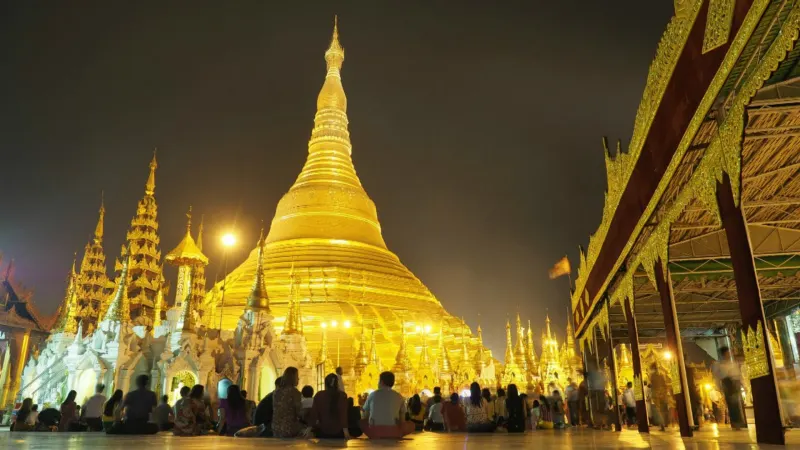
Its skyline is dominated by the Shwedagon Pagoda — a 99-metre golden stupa said to enshrine eight hairs of the Buddha and to be 2,600 years old (though archaeology suggests the current structure dates from the 6th-10th centuries). The stupa is covered with around 750 kg of gold leaf and crowned by a stupa-tip set with 5,448 diamonds and 2,317 rubies. It is one of Buddhism's holiest sites.
Yangon also holds South-East Asia's largest collection of colonial-era buildings — 189 listed heritage structures from the British period (1852-1948). Decades of economic isolation left them largely untouched. The Yangon Heritage Trust has documented every one, and several including the Strand Hotel and the former High Court have been beautifully restored. The city is the natural gateway for tours of Bagan, Mandalay and Inle Lake.
Things to do in Yangon
Standout experiences hand-picked by our local guides.
- 01Shwedagon PagodaMyanmar's holiest Buddhist site — a 99-metre gilt stupa visible across Yangon. Best visited at sunset and early evening.
- 02Colonial Heritage WalkThe downtown grid holds the best-preserved British colonial cityscape in Asia. The Strand Hotel, High Court and Customs House are highlights.
- 03Bogyoke Aung San MarketYangon's main bazaar — gems, longyi fabric, jade, and Burmese lacquerware in a 1926 colonial-era building.
- 04Sule PagodaA 2,500-year-old golden stupa marking downtown Yangon's central roundabout — pre-dating the city itself by 1,500 years.
- 05Kandawgyi Royal LakeAn artificial lake with a wooden boardwalk and the Karaweik royal barge restaurant — Yangon's most photographed sunset spot.
- 06Chaukhtatgyi Reclining BuddhaA 66-metre reclining Buddha statue in a sheltered pavilion — one of Asia's largest, with feet inlaid in mother-of-pearl.
- 07Circular TrainA 3-hour, 46 km loop train through Yangon's outer suburbs — wood-bench seats, rice paddies, market stops and unmissable people-watching.
- 08Inwa & Bagan DepartureYangon is the launch city for night trains and short flights to Bagan's 2,000+ temples and Mandalay's last royal palace.
Best time to visit Yangon
Yangon's tropical climate has a clear cool-dry window. The hot season is brutal; monsoon brings heavy daily rain.
- MONSOONSpringMarch – MayThe hot dry season. Daytime heat reaches 38°C+. The Thingyan water festival in mid-April (Burmese New Year) is a relief.25°C – 38°C
- MONSOONSummerJune – AugustMonsoon. Heavy daily rain (up to 600 mm/month in July). Some inland sites like Bagan are still visitable; coastal travel is limited.24°C – 32°C
- ★ BEST SEASONAutumnSeptember – NovemberThe light at the end of monsoon. Late October-November offers clean air, mild temperatures and the start of the dry tourist season.22°C – 32°C
- ★ BEST SEASONWinterDecember – FebruaryCool, dry and clear — the best window for Myanmar travel. Pagodas glow at sunset and the heritage walks are comfortable all day.18°C – 30°C