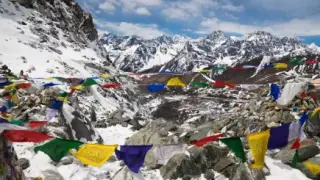
Mount Shishapangma Expedition is a 44-day high-altitude mountaineering objective on the 14th-highest mountain in the world at 8,027 m (26,335 ft), and the only one of the fourteen 8,000 m peaks that lies entirely within Tibet, China. The expedition approaches overland from Kathmandu through the Zhangmu border crossing into the Tibet Autonomous Region, driving to Nyalam and trekking to the North Base Camp and Advanced Base Camp at approximately 5,700 m, from which the technical climbing on the upper mountain begins.
Shishapangma has two summits: the Central Summit at approximately 8,008 m, reached by most parties, and the true Main Summit at 8,027 m, separated by an exposed, heavily corniced ridge that demands a higher level of technical commitment. The north-face route passes through a series of established camps, from Camp 1 at roughly 6,400 m through Camp 2 at around 7,000 m and Camp 3 at approximately 7,400 m, before the final push to the summit. Fixed ropes, supplemental oxygen and experienced Sherpa support are standard on this route.
Tibet was closed to western mountaineers until 1978, and Shishapangma was the last of the fourteen 8,000 m peaks to be first climbed, by a Chinese team in 1964. The expedition requires a Chinese Mountaineering Association (CMA) and Tibet Mountaineering Association (TMA) permit, organised through an authorised Kathmandu operator like Swotah. The sections below cover permits, acclimatisation, technical gear, the summit-day approach and how to prepare for the Tibet plateau environment.