

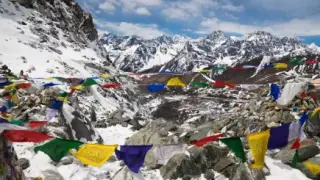

Situation update, 17 September 2026
The Rasuwa flood, and where it is safe to travel
A flash flood swept down the Bhotekoshi from the Tibet border on the morning of 26 August and destroyed much of northern Rasuwa. 1,403 bodies have been recovered and 6,150 people are listed as unaccounted for, a figure NDRRMA revised sharply upward on 16 September after reconciling district records rather than a new event. Search and clearance work is continuing as far south as Chitwan, and the only road linking Kathmandu to the Tibet border remains gone with no reopening date. The Prithvi Highway, cut at Krishnabhir since 30 August, reopened to two-way traffic on 17 September on a temporary gravel bypass.
What happened
Part of an unnamed glacier north of Langtang Lirung broke away and fell several hundred metres. The impact was violent enough to register as a magnitude 5.2 tremor on seismometers as far off as Germany and the United States, and it put a huge volume of meltwater and debris into the river in a matter of minutes.
The surge reached Nepal at about 08:37 and ran 72 kilometres down the Bhotekoshi into the Trishuli, through Rasuwa and Nuwakot. It took the customs post at Rasuwagadhi with it. Around 41 bridges are damaged or gone, along with 42 kilometres of road, including the only overland link between Kathmandu and Tibet. The Kathmandu Post put the generating capacity knocked out at around 430 MW across 14 or 15 projects on the Trishuli corridor, and more than 300 vehicles were swept away at the border.
As of NDRRMA's count for 16 September, 1,403 bodies had been recovered and 6,150 people were listed as unaccounted for. The dead toll has climbed steadily since Wednesday 26 August: it stood at 389 on the 27th, 469 on the 28th, 626 on the 29th, 903 on the 31st, 987 on 1 September and past 1,400 by mid-September. The missing count moved the other way for most of that time as reconciliation between district, police and family records took names off the list, then jumped sharply on 16 September, from 5,179 to 6,150, after NDRRMA said it had gone back through district-office lists and verified a much larger set of names than it had previously been able to confirm. Both police and NDRRMA have published figures through the weeks since the flood, and the earlier entries in the log below are marked with whichever agency's number they were reporting at the time. People were also killed across the border in Gyirong county in Tibet, where several hundred more are unaccounted for. The river carried people a very long way. Most of the bodies recovered early on were found not in Rasuwa but downstream in Chitwan and Nawalparasi, more than a hundred kilometres from where the water came down.
Officials have not finished investigating what set the collapse off, and the confirmed death toll is still moving. For current numbers, go to Nepal's National Disaster Risk Reduction and Management Authority or a national news desk rather than this page. The dated log below is the most recent picture we have.
Latest developments
Newest first. Each entry says when it is from, because the figures have moved a long way in a week and the older ones are already wrong.
Last updated 17 September 2026, with NDRRMA's revised count as of 16 September
- 17 September
The Prithvi Highway reopens at Krishnabhir, 18 days after it collapsed
Two-way traffic resumed from 6am on the new 270-metre gravel track cut into the hillside above the old road, ending the blockage that started on 30 August. The Department of Roads is treating it as a temporary fix: it will watch the track for about two weeks to see how it holds up under load before deciding whether to blacktop it, and it is separately studying a permanent bypass, either an 18km Benighat to Fisling detour or a tunnel or bridge past the unstable slope itself. Sections between Nagdhunga and Mugling still run one lane in places because of ongoing erosion, so the drive is not back to its old three hours yet, but Kathmandu to Pokhara and Chitwan no longer need a flight in place of the road.
- 16 September
Nepal revises the missing count up sharply to 6,150, and confirmed deaths reach 1,403
NDRRMA raised the number of people unaccounted for from 5,179 the day before to 6,150, after what its spokesperson Shanti Mahat described as further verification of lists collected from district offices, not a change in what happened on the ground. Confirmed deaths stood at 1,403 and the injured count at 9,287, both up from the figures in this page's earlier log entries as identification and district reporting continue to catch up with the scale of the disaster.
- 8 September
Engineers tell the government the Krishnabhir track is a stopgap, not a fix
With cracks appearing 50 metres above the new track being cut into the hillside, geologists and road engineers told the Kathmandu Post that the bypass will not hold as a permanent solution and pressed the Department of Roads to commit to a proper fix now rather than patch the slope again next monsoon. The options on the table are a 400 to 500 metre tunnel through the mountain, or a pair of roughly 150 metre bridges spanning the Trishuli to bypass the unstable ground entirely. No decision has been announced; work on the temporary track continues in the meantime.
- 7 September
1,403 bodies recovered, 6,150 still unaccounted for, and the Nepal Army says around 121 people remain trapped in hydropower tunnels
Nepal Police's count for the evening of 6 September, released in the early hours of 7 September, put bodies recovered at 1,403 and people unaccounted for at 6,150 - 2,827 Nepali men, 567 Nepali women, 267 foreign men and 239 foreign women. That is down from 4,044 unaccounted for in the previous day's count, as reconciliation continues to move names off the missing list rather than a fall in the number of dead. The Nepal Army separately estimated that around 121 people remain trapped in flooded hydropower tunnels along the Trishuli corridor, most at Upper Trishuli-1 and Upper Trishuli 3A, where clearing debris and pumping water out is going slowly. NDRRMA has not been issuing a comparably clean daily dead/missing bulletin of its own this week, which is why this page now reads its headline tally from the Police series (see the note on the numbers above).
- 6 September
Two more survivors pulled from a flooded tunnel, and China opens the rescue zone to foreign press
Rescue teams extracted two more survivors, including a Chinese national, from a flooded section of the Upper Trishuli 3A tunnel, four and five days after the flood hit. A day earlier a person was freed from a buried house in Betrawati. On the Tibetan side, Chinese authorities brought a group of foreign journalists to the Gyirong rescue and reconstruction site, the first time outside press have been given organised access to that side of the crossing. Nepal's Ministry of Foreign Affairs published its regular daily situation update on the Bhotekoshi flood the same day.
- 4 September
Two survivors found alive in a tunnel eight days after the flood
Army rescue teams pulled two people out alive from a flooded section of the Upper Trishuli-1 tunnel complex in Rasuwa, more than a week after the flood hit, showing there were still pockets of trapped survivors reachable once the water and debris were cleared far enough. Work restarted on the Krishnabhir bypass the same morning, with 18 workers and machinery cutting a new track roughly seven metres above the collapsed stretch of the Prithvi Highway; the Department of Roads put the new track at 350 metres long and seven metres wide, targeting seven to ten days to completion.
- 3 September
Work starts at Krishnabhir, and the Prime Minister promises the road back within September
The Ministry of Physical Infrastructure put 18 workers on the Krishnabhir slip on 3 September to clear trees from both sides, with machinery to follow. The damage is now put at 70 metres of highway gone into the Trishuli and a further 120 metres cracked. On 2 September Prime Minister Balendra Shah said the section would be open to traffic within the month. The Department of Roads is more careful: its director general, Bijay Jaisi, said on 1 September that a geotechnical team still had to decide between cutting a new track above the river and other options, and gave no date. Until then, the detours are the Tribhuvan Highway through Hetauda for anything up to ten wheels, the Kanti Lokpath for buses, the Bhimphedi and Kulekhani road to Dakshinkali for light vehicles, and the long loop through Dhading Besi, Arughat and Gorkha for traffic from the Muglin side. A journey that took three hours is taking about five. Around 12,000 vehicles a day normally use this road, so Kathmandu is short of some supplies. Fly Kathmandu to Pokhara or Bharatpur.
- 2 September, 09:00
1,403 confirmed dead, 6,150 still missing
The National Disaster Risk Reduction and Management Authority put the confirmed toll at 1,403, with 6,150 people unaccounted for, 9,287 injured, 13,728 brought out alive and 3,453 people in holding centres. The recovered are spread down the whole length of the corridor: 348 in Chitwan, 217 in Nawalparasi East, 190 in Nawalparasi West, 155 in Nuwakot, 66 in Gorkha, 59 in Dhading, 45 in Rasuwa and 38 in Tanahun, and nine bodies have been recovered across the border in India. Nepal Police count differently and their series runs higher: 1,508 sets of remains recovered and 4,606 people unaccounted for as of 1 September, 14:00, of whom 583 are foreign nationals from 38 countries. The NDRRMA's spokesperson, Shanti Mahat, said on 31 August that the authority cannot yet fix the exact number of missing because the lists from local governments, district offices and other agencies are still being reconciled. Of the bodies recovered, 911 remain unidentified and are listed on the Nepal Police website. Across the border in Tibet, Chinese state media reported 21 dead and 541 missing on 2 September.
- 2 September
Airlines add flights and freeze fares; China finishes a temporary road to Gyirong
Buddha Air said it would hold Kathmandu to Pokhara fares between NPR 5,799 and NPR 8,583 while the road is out, extended its last departures to 23:00 and added frequencies. Its executive chairman, Birendra Bahadur Basnet, said he expected road transport to take about six months to return to normal. On the Tibetan side, Chinese authorities completed a makeshift road to the Gyirong port on 2 September. Nothing on the Nepali side of the crossing has been rebuilt, and the border remains shut.
- 1 September
Relief fund passes NPR 5.87 billion; second Chinese shipment arrives
The Prime Minister's Disaster Relief Fund had received more than NPR 5.87 billion by 1 September. China delivered a second relief consignment the same day, including drones, DNA testing equipment and forensic experts to help identify the dead. A second, much smaller lake of around 14,000 square metres has been identified upstream of the collapse site and is being monitored; officials assess its chance of overflowing as low. The alert along the Bhotekoshi and Trishuli has not been lifted.
- 1 September, 09:00
987 confirmed dead, 3,916 still missing
The National Disaster Risk Reduction and Management Authority put the confirmed toll at 987, with 3,916 people unaccounted for, 279 injured and 11,814 brought out alive. The recovered are spread down the whole length of the corridor: 321 in Chitwan, 216 in Nawalparasi East, 170 in Nawalparasi West, 95 in Nuwakot, 65 in Gorkha, 55 in Dhading, 38 in Tanahun and 27 in Rasuwa. Only a fraction of the bodies found have been identified. Across the border in Gyirong county, Tibet, Chinese authorities have reported 16 dead and several hundred more missing.
- 31 August
China closes Tatopani, leaving Korala as the only way through
China shut the Tatopani crossing to imports and exports until further notice, citing landslide risk on the Nepali side. With Rasuwagadhi destroyed on 26 August, that leaves Korala in Mustang as the only functioning overland crossing between Nepal and China. Anyone holding a Tibet itinerary that crosses by road should assume it is flying instead.
- 30 and 31 August
Burials begin for the unidentified, with DNA taken first
With bodies decomposing faster than they could be identified, authorities began burying the unidentified dead after taking DNA samples and marking the graves so families can retrieve remains later. India sent a forensic team to help with the analysis and China is sending identification experts. Nepal's Ministry of Foreign Affairs is still running its emergency control room for the families of missing foreign nationals.
- 30 August
The Prithvi Highway collapses at Krishnabhir
A section of the Prithvi Highway fell into the Trishuli at Krishnabhir in Benighat Rorang, Dhading, after the swollen river ate away the base of the road. First reports put the loss at more than half of a twenty metre stretch; by 2 September the Department of Roads was describing 70 metres gone and a further 120 metres cracked. The Muglin to Kathmandu stretch is completely blocked. District police put reopening at a month or more, and the Department of Roads has an expert team on site but no published timeline. Fly Kathmandu to Pokhara or Bharatpur instead.
- 30 August
The barrier lake empties, and a second warning goes out
The lake dammed up behind the debris on the Tibetan side was reported to be largely empty. A second flood warning was issued along the corridor even so, and people are still being told to stay off the banks while the channel is unstable.
- 29 August
Hundreds unaccounted for at the hydropower projects
The Independent Power Producers' Association of Nepal said 934 people linked to 11 hydropower projects, including those under construction, were unaccounted for. The Ministry of Energy put more than 1,000 power-project employees out of contact. Around 430 MW came off the national grid from 14 or 15 projects along the Trishuli corridor. Army rescue teams are working the tunnels at the 216 MW Upper Trishuli-1 in Rasuwa, where access is the main obstacle: bridges are gone and tunnel mouths are buried.
- 29 August
The search has moved a long way downstream
As of 31 August, 20,819 army, police and armed police were working the corridor. Most recoveries are happening far below Rasuwa rather than in the gorge itself, so teams are searching the banks in Chitwan and Nawalparasi alongside the crews still upstream. Families in settlements judged unsafe have been moved to higher ground, and road crews are clearing debris and landslides to get access back.
- 28 August
The barrier lake in Tibet is reported to have breached
The Rasuwa Chief District Officer said the Nepali Army had passed on a report that the lake dammed up near the Chhochen Khola and Purepu Tsangpo confluence had given way. It did not produce a second surge on Wednesday's scale, but the alert along the river has not been lifted and people are still being told to stay off the banks.
- 28 August
644 of the missing were foreign nationals, on the 28 August count
Police said 644 of the people unaccounted for were foreign citizens, from more than thirty countries. The police count has since come down as people were located: 592 on 31 August and 583 from 38 countries on 1 September. The by-country table below is left as it was given on 28 August because no later breakdown by nationality has been published cleanly. Nepal's Ministry of Foreign Affairs is running an emergency control room for their families and their embassies.
- 27 August
China warns of a second flood, and 679,000 alerts go out
The Flood Forecasting Division issued a special alert after China informed Nepal, through the Ministry of Foreign Affairs, that two rivers near the head of the Bhotekoshi had been blocked and a lake was filling behind the debris. Around two million cubic metres had built up by Thursday morning, with a further three million forecast to run in. More than 679,000 warning messages were sent to people along the Trishuli in Rasuwa, Nuwakot, Dhading and Chitwan, and riverbank settlements were told to move.
- 27 August
Helicopters are flying, but there is nowhere to land
Four army helicopters and eight aircraft from private operators were working over Rasuwa. A flight sent to Timure had to turn back: the helipad had been washed away and the pilot could find nowhere safe to put down. Police posts at Timure, Syabrubesi, Rasuwagadhi and Mailung were all damaged, and staff at the Timure border post were out of contact.
- 26 August, 08:37
The surge reaches Nepal
Ice and rock came off a glacier north of Langtang Lirung, dammed the Lhende Khola on the border, and then let go. The water ran down the Bhotekoshi through Rasuwagadhi and Timure and into the Trishuli. The Rasuwagadhi customs post and the Gyirong crossing were destroyed. The first counts that morning stood at seven dead, then twenty-two.
If you are looking for someone
These are the official channels. Please use them rather than calling the district offices, which are running the search. We are a tour operator, not a rescue agency, and we have no access to the missing-persons record.
Emergency Control Room, Ministry of Foreign Affairs, Nepal. Phone or WhatsApp +977 9744441227 and +977 9744441228, 07:00 to 22:00 Nepal time. Email emergency@mofa.gov.np. Read the ministry notice.
Police 100, ambulance 102. District and national figures are published by the NDRRMA BIPAD portal.
Missions in Kathmandu are working through the same control room. US citizens should email KathmanduACS@state.gov; relatives in the US or Canada can call 1-888-407-4747. Other nationals, contact your own embassy first.
This page is written and updated by hand, so it is a record of what we knew at the time stamped above, not a live feed. For numbers that are current to the hour, use NDRRMA, Nepal Police, or the Kathmandu Post live coverage.
If you want to help, send it to one place
We are pointing everybody at the same account, and only this one.
Prime Minister's Disaster Relief Fund
Run by the Office of the Prime Minister. Gateway operated by Nepal Clearing House.
By law this money can only go to rescue, treatment, relief and rebuilding. It cannot be spent on running costs, and the accounts are audited every year. That is the reason we are sending people here instead of collecting anything ourselves.
Nepal Clearing House opened the gateway to donors abroad this week, so it now takes international cards as well as Nepali mobile banking, connectIPS and wallets.
Appeals collecting for this flood are already going round social media and messaging groups. We have no way of telling you which of them are genuine, so we are not linking to any of them. Before you type in a card number, check the address bar reads pmdrf.nchl.com.np and nothing else. Swotah does not collect, hold or pass on any of this money.
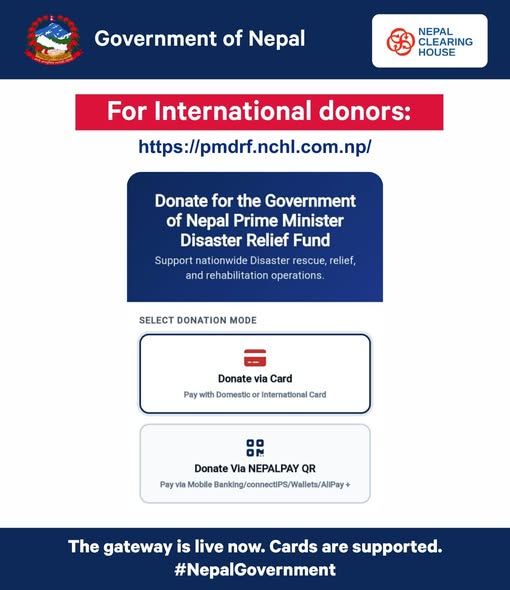

Prime Minister's Disaster Relief Fund
Terminal 2222010021637134
Singhadurbar counter
Where things stand
The damage is severe but it sits along one river system. Most of the country was not touched. Here is the split, as clearly as we can put it.
Stay away for now
8 areas- Rasuwagadhi and the Kerung borderThe crossing is shut. The border post and the bridges serving it were washed away.
- TimureOne of the worst hit villages on the river. Recovery work is still going on there.
- SyabrubesiHeavy damage to buildings and services, and the village is still hard to reach.
- Betrawati to Rasuwagadhi roadTens of kilometres of road and a long list of bridges are gone. There is no reliable way north.
- Tamang Heritage TrailThe trail follows the corridor the flood came down. Treat it as shut until surveyors have been through.
- Langtang valley and GosainkundaBoth sit inside the affected catchment. We are not sending anyone up until they have been checked properly.
- Trishuli rafting and the riverside campsThe Kathmandu to Pokhara river sections and the camps along them are off. The corridor is still under a flood warning and teams are searching the banks.
- Tatopani crossingChina suspended cargo through Tatopani on 31 August over landslide risk and has not lifted it; personal crossings are still allowed. With Rasuwagadhi gone, Korala in Mustang is the only crossing still carrying overland trade into Tibet.
Running normally
8 areas- Prithvi Highway at KrishnabhirReopened to two-way traffic from 6am on 17 September, 18 days after it collapsed, on a new 270-metre gravel track cut into the hillside above the old road. The Department of Roads calls it temporary: it is monitoring the track for about two weeks to check it can bear the load before deciding whether to blacktop it. Nagdhunga to Mugling still runs one lane in places from ongoing erosion, so build in extra time, but the drive from Kathmandu to Pokhara and Chitwan no longer needs a flight workaround.
- KathmanduHotels, restaurants, flights and city services are all running as normal.
- PokharaUntouched. Lakeside and the usual day trips are operating.
- LumbiniNo impact. Visits are going ahead.
- Bhaktapur and LalitpurBoth cities are fine and open to visitors.
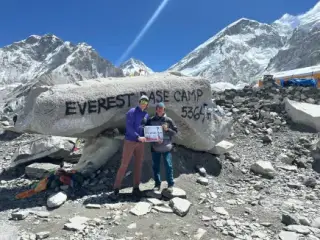
- Everest regionLukla, Namche and the main trail to Base Camp saw no flood damage.
- Annapurna regionThe circuit and the Base Camp trail are clear of this.
- Manaslu regionThe flood did not reach the circuit. Check the Dharapani to Larke section with your operator before you go: a separate spell of rain in early August damaged trail there and took out a suspension bridge over the Surkhi Khola.
For the state of a specific trip, our travel update page lists every trek and tour we run with its current status, the live departure board for Nepal, Bhutan and Tibet, and what the closed Kerung border means for a Tibet booking. If your trip goes through Rasuwa or up the Trishuli, write to us and we will check the state of the road before you commit to anything. Rescue teams are still working in the areas on the left, so please keep them clear.
A note from us
Written on 28 August, updated 17 September 2026.
We are a Kathmandu company and we have spent years walking the trails in the north of this country. Watching what happened to Rasuwa this week has been hard.
To everyone who has lost someone, we are very sorry. To the families still waiting for news, we are thinking of you. And to the crews who have been searching the river since Wednesday morning, thank you.
We will keep this page up to date as the picture gets clearer, and we will say so plainly when routes reopen rather than before. Everything we learn goes in the log above with the date attached, so you can see how old it is.
Swotah Travel and AdventureKathmandu, Nepal
Sources for the figures on this page: Nepal Police daily bulletins as reported by The Kathmandu Post, the National Disaster Risk Reduction and Management Authority, the Nepal Army, the Department of Hydrology and Meteorology Flood Forecasting Division, Nepal's Ministry of Foreign Affairs, the Government of Nepal Prime Minister's Disaster Relief Fund, the Department of Roads, The Himalayan Times, OnlineKhabar, Nepalnews and the Kathmandu Post. The casualty figures in the hero and at the top of the log are NDRRMA's revised count of 16 September 2026; rescued is the last clean figure available, from 12 September, and is labelled as such. Status of the areas listed above, including the Prithvi Highway reopening at Krishnabhir, is current as of 17 September 2026 and is being revised by Nepali authorities as surveys come in.