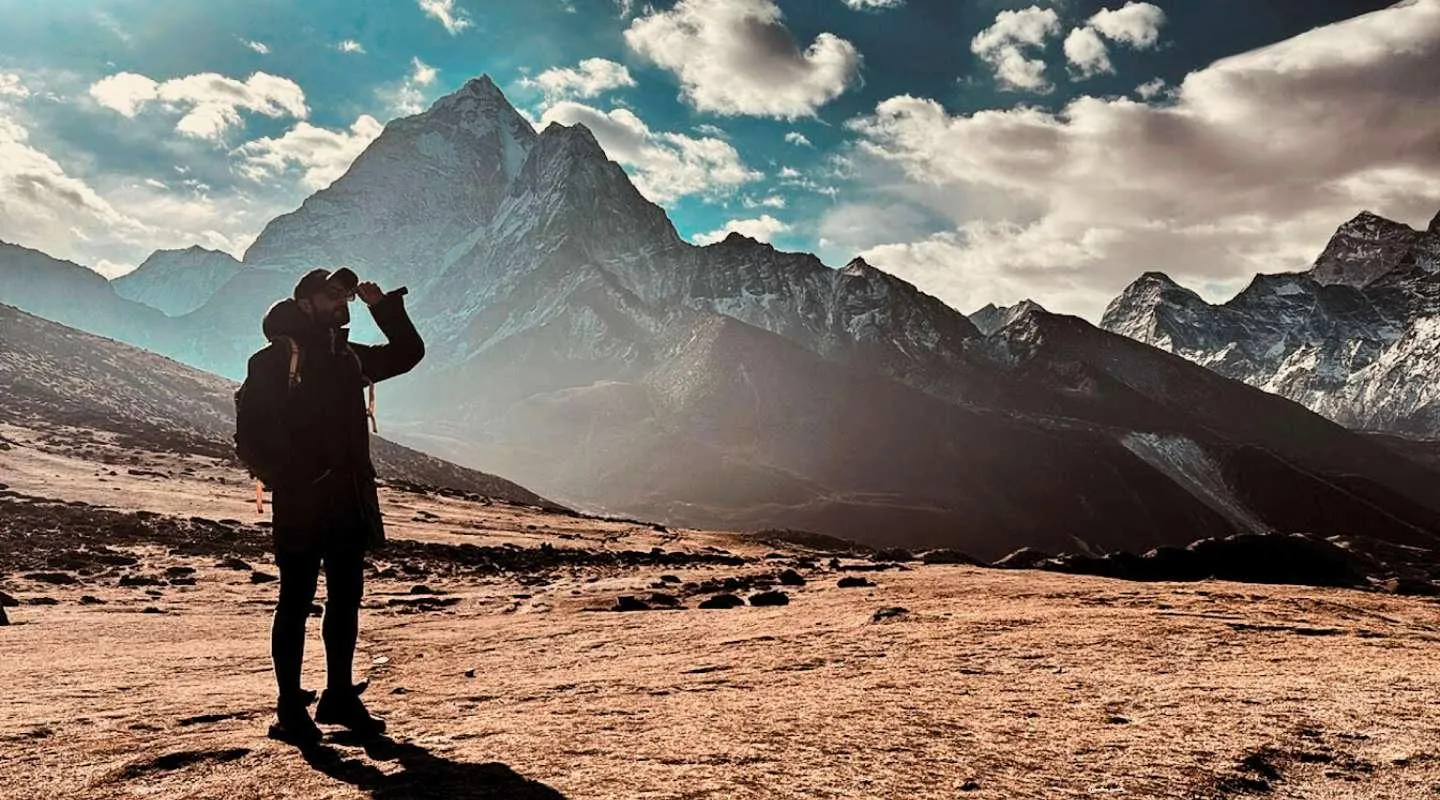
A 12-day Nepal and Bhutan combination tour: Kathmandu heritage, the 4-day Druk Path Trek to 3,880 m, Thimphu, Punakha Dzong and Bhaktapur.
Duration
12 Days
Max Altitude
3,880 m / 12,730 ft
Difficulty
Easy
Group Size
Max 14 trekkers
Region
Thimpu, Nepal
Best Season
Spring · Autumn
Accommodation
3-star hotels & tented trek camps
Meals
Breakfast at hotels; full board on trek
Transport
Private vehicle; domestic flights
Dates & Prices
Choose your date
All dates are guaranteed departures — we never cancel for low numbers. Book online or send a quick enquiry.
YearMonth
3 departures · 2026
Oct
20
Oct 20, 2026 — Oct 31, 2026
Guaranteed departure — from 2 trekkers
Available
USD2,775
per person
Nov
5
Nov 5, 2026 — Nov 16, 2026
Guaranteed departure — from 2 trekkers
Available
USD2,850
per person
Nov
20
Nov 20, 2026 — Dec 1, 2026
Guaranteed departure — from 2 trekkers
Available
USD2,775
per person
Can’t find a suitable date? We run private departures on any date with as few as 2 trekkers.
Trip Overview
About the Treasures of Bhutan
Treasures of Bhutan is a 12-day Nepal and Bhutan combination tour that covers Kathmandu Valley heritage, the four-day Druk Path Trek through Bhutan's alpine interior, Thimphu's capital landmarks, Punakha Dzong at 1,310 m, and Bhaktapur's medieval architecture before departure. It is built for travellers who want one trip to cover two distinct Himalayan cultures without reducing either to a brief stopover.
The Nepal segment runs three days in the Kathmandu Valley, visiting Pashupatinath, Boudhanath, Swayambhunath and Durbar Square, then closes with a half-day in Bhaktapur. The Bhutan segment opens with a flight into Paro, one of the world's most technically demanding airport approaches, then moves to Thimphu before the Druk Path Trek begins. The four-stage trek crosses terrain between 3,780 m and 3,880 m, passing yak pastures, alpine lakes and panoramic ridge lines with views toward Jomolhari (7,326 m) and the main Himalayan chain.
The trek's highest point is Simkota camp at 3,880 m on day 5, which sets the profile peak for the tour. After the trek finishes in Thimphu, a drive over Dochula Pass (108 chortens at 3,100 m) leads to Punakha and the dzong at the confluence of the Pho Chhu and Mo Chhu rivers, before the return flight to Kathmandu. All travellers entering Bhutan pay the Sustainable Development Fee (SDF) of approximately USD 100 per night as of 2024, which funds free healthcare, free education and the policies that keep Bhutan carbon-negative. The sections below cover entry requirements, best season, permits, accommodation and what to pack.
Last updated June 2026
Trip Highlights
Highlights
1
Druk Path Trek: 4 days on Bhutan's alpine ridge, reaching 3,880 m
2
Kathmandu Valley UNESCO heritage: Pashupatinath, Boudhanath and Durbar Squares
3
Thimphu landmarks: Buddha Dordenma, Tashichho Dzong and Memorial Chorten
4
Punakha Dzong at 1,310 m, at the confluence of two rivers
5
Paro approach: one of the world's most technically challenging commercial landings
6
Nepal + Bhutan in 12 days with a licensed Bhutanese guide and full trek crew
Day by Day
Treasures of Bhutan Itinerary: 12 Days
Tap any day to expand — altitudes, walking times, meals, and overnight details for every stage of the journey.
A Swotah representative meets you at Tribhuvan International Airport and transfers you to your hotel in Kathmandu. After settling in, your guide runs a short orientation briefing on the 12-day itinerary over a welcome dinner of Nepali cuisine. Overnight in Kathmandu.
Sleep at 1,400 m
Tonight’s stay
Hotel
A full guided day through the Kathmandu Valley's UNESCO World Heritage Sites: Pashupatinath Temple on the Bagmati River, the great stupa of Boudhanath, the hilltop Swayambhunath stupa and Kathmandu Durbar Square with its ancient palaces and carved architecture. Overnight in Kathmandu.
Sleep at 1,400 mBreakfast
Tonight’s stay
Hotel
A morning flight from Kathmandu to Paro International Airport at 2,235 m, with the approach route passing close to peaks above 5,000 m. From Paro airport, a 1.5-hour drive east reaches Thimphu, Bhutan's capital at 2,330 m. The afternoon is free for the National Textile Museum or a walk through the city. Your licensed Bhutanese guide joins the group here. Overnight in Thimphu.
Sleep at 2,330 mDinner
Tonight’s stay
Hotel
A drive from Thimphu back to Paro (50 km, about 1.5 hours) delivers you to the trek trailhead near Paro's National Museum at about 2,480 m. The trail climbs steeply through blue pine and conifer forest for about 7 hours, gaining roughly 1,330 m to reach the camp below Jelela Dzong at 3,810 m. Jelela Dzong is a small stone fortress with views west toward the Paro Valley. Camp dinner and overnight at 3,810 m.
Sleep at 3,810 mBreakfastLunchDinner
Tonight’s stay
Camping
The trail from Jelela (3,810 m) traverses the high ridge with views of Jomolhari (7,326 m) on clear mornings, crossing open alpine meadow and past the lake at Jimilangtsho. Today's route is rolling rather than steep, covering about 6 hours of walking to reach the Tshokam camp at 3,780 m. Camp at Tshokam includes a view north toward the main Himalayan chain. Overnight at 3,780 m.
Sleep at 3,780 mBreakfastLunchDinner
Tonight’s stay
Camping
Today's stage is the highest of the trek, finishing at Simkota camp at 3,880 m, the tour's altitude peak. The route from Tshokam (3,780 m) passes through yak herder pastures near Jangchulakha and climbs to the final high ridge before the descent to Thimphu. Walking time is about 5 to 6 hours. Views from the ridge include Jichu Drake (6,989 m) and a broad panorama south over Bhutan's Thimphu Valley. Camp at 3,880 m.
Sleep at 3,880 mBreakfastLunchDinner
Tonight’s stay
Camping
The final trek day descends from Simkota (3,880 m) into Thimphu through forest and farmland, a long descent of about 1,550 m over 5 to 6 hours. The trail passes the Phajoding Monastery cluster at around 3,600 m before dropping into the Motithang suburb north of Thimphu. Trek crew handles equipment and horses; you arrive in Thimphu for a shower and a hotel bed. Overnight in Thimphu.
Sleep at 2,330 mBreakfastLunchDinner
Tonight’s stay
Hotel
A morning in Thimphu visits the Buddha Dordenma Statue (169 ft / 51.5 m), Tashichho Dzong (Bhutan's seat of government and religion), the Memorial Chorten and the Folk Heritage Museum. After lunch, a 2.5-hour drive over Dochula Pass (3,100 m) with 108 memorial chortens and mountain views descends to Punakha at 1,310 m. Overnight in Punakha.
Sleep at 1,310 mBreakfastLunchDinner
Tonight’s stay
Hotel
A morning visit to Punakha Dzong, the second-most important dzong in Bhutan, built at the confluence of the Pho Chhu and Mo Chhu rivers in 1637. The dzong's whitewashed walls and painted timber interiors house the regional monastic body and significant Buddhist relics. A short walk across the Punakha suspension bridge (160 m) follows. After lunch, the drive returns over Dochula Pass to Paro (2,280 m). Overnight in Paro.
Sleep at 2,280 mBreakfastLunchDinner
Tonight’s stay
Hotel
A morning flight from Paro back to Kathmandu, with views of the Himalayan chain on the northward approach. On arrival a Swotah representative transfers you to your hotel. The afternoon is free for shopping in Thamel or rest before tomorrow's Bhaktapur excursion. Overnight in Kathmandu.
Sleep at 1,400 mBreakfastDinner
Tonight’s stay
Hotel
A 45-minute drive east from Kathmandu reaches Bhaktapur (1,401 m), a medieval Newar city and UNESCO World Heritage Site. The day covers Bhaktapur Durbar Square with its 55-Window Palace and carved stone temples, Taumadhi Tole and the Nyatapola Temple (five-tiered, 30 m), and Pottery Square where artisans still work in traditional kilns. Entry carries a municipal conservation fee included by Swotah. Overnight in Kathmandu.
Sleep at 1,400 mBreakfast
Tonight’s stay
Hotel
A Swotah representative transfers you to Tribhuvan International Airport for your onward flight. If you have time before your flight, the Thamel area in Kathmandu has cafes and bookshops for a final morning. Swotah can arrange extensions to Pokhara, the Annapurna region or a longer Nepal trek if you would like more time.
Breakfast
What’s included
What's included
Every cost on the trail is broken out below — no hidden fees, no surprises at the trailhead.
Included
12 items
Visa arrangement for the stay in Bhutan.
Accommodations are in the above hotels or in similar hotels on a twin-sharing basis.
A Shape sleeping tent for the trekkers, including a dining tent, kitchen tent, toilet tent, table, chair, all meals, horses, horseman, cook, waiter, trek guide, tea/coffee, sleeping bag, and sleeping mat.
Breakfast in the above hotels, whereas lunch & dinner in tourist standard restaurants.
English-speaking guide.
Transportation and sightseeing, as per the itinerary, are based on group size.
Museum and park fees are indicated in the itinerary only.
A bottle of drinking water per day.
Complimentary: wearing Gho/Kira and playing Archery in Paro.
One day farmhouse visit with lunch.
3 Nights' accommodation and sightseeing in Kathmandu.
SDF (Bhutan).
Not included
5 items
International flights; Nepalese visa fee.
Lunch and evening meals in Kathmandu.
Travel and rescue insurance.
Personal expenses (phone calls, laundry, bar bills, bottled or boiled water, shower, etc.).
Tips for guide(s), porter(s) and driver(s).
How Hard Is the Treasures of Bhutan?
Treasures of Bhutan is a moderate trek-based tour. The four-stage Druk Path Trek crosses terrain between 3,780 m and 3,880 m with 5 to 7 hours of walking per day on alpine trails. The Nepal days are low-altitude sightseeing with no significant physical demand.
Everything you need to plan the trek, topic by topic. Tap any one to open it.
The Druk Path Trek is rated moderate. Each of the four days covers 5 to 7 hours…
The Druk Path Trek is rated moderate. Each of the four days covers 5 to 7 hours of walking on mountain trails, crossing ridges between 3,780 m and 3,880 m. The total trek gain from the Paro trailhead (about 2,480 m, near the National Museum) to the first camp at Jelela Dzong (3,810 m) is roughly 1,330 m of ascent on day 3, which is the hardest single day. Subsequent days involve rolling ridge terrain rather than long climbs.
Travellers need reasonable fitness and should be comfortable walking 15 to 20 km a day on uneven ground at altitude. No technical climbing or prior trekking experience is required, but altitude acclimatisation matters: a day in Thimphu (2,330 m) before the trek starts helps the body adjust before the camps above 3,800 m. The Nepal sightseeing days at 1,400 m carry no physical demand.
Spring (March to May) and autumn (October to November) are the two peak seasons…
Spring (March to May) and autumn (October to November) are the two peak seasons for Treasures of Bhutan. Both give clear skies for the Druk Path ridge views toward Jomolhari and dry, firm trails at altitude.
Spring brings rhododendron in bloom along the lower Druk Path trail from about 2,500 m to 3,400 m, and temperatures at camp range from about 5 C at night to 15 C by day. Autumn follows the monsoon with the sharpest mountain views and stable weather. Winter (December to February) is feasible but cold at camp; snow can close the upper trails. The monsoon (June to September) brings wet, slippery trails and poor views and is not recommended for the trek. The season cards above show the month-by-month picture for the combined Nepal and Bhutan leg.
Bhutan requires a visa and a Sustainable Development Fee (SDF). As of 2024, the…
Bhutan requires a visa and a Sustainable Development Fee (SDF). As of 2024, the SDF is approximately USD 100 per night per person; Swotah includes this in the tour cost and handles the Bhutan visa application in advance. Regional country nationals (India, Bangladesh, Maldives) pay a lower SDF rate. Your passport must be valid for at least six months from entry.
Within Bhutan, the Druk Path Trek requires a trekking permit issued through your licensed tour operator, which Swotah arranges. Nepal entry is on a standard tourist visa on arrival at Kathmandu airport, available for 15, 30 or 90 days; bring a passport photo and the visa fee in cash or card. Bhaktapur town entry carries a small municipal fee. Swotah provides a pre-departure permit briefing so nothing is left to the last minute.
In Nepal you stay in 3-star hotels in Kathmandu with private bathrooms, hot wate…
In Nepal you stay in 3-star hotels in Kathmandu with private bathrooms, hot water and Wi-Fi. In Bhutan, Thimphu, Punakha and Paro nights are in 3-star or mid-range hotels. On the four nights of the Druk Path Trek you sleep in tented camps: basic but sound, with sleeping bags and pads provided.
Tented camps on the Druk Path are set at established sites: below Jelela Dzong (3,810 m), at Tshokam (3,780 m), Simkota (3,880 m) and back in Thimphu after the final descent. Camp meals are cooked by the trek crew. Upgrades to higher-category hotels in Thimphu or Paro are available on request. Rooms and camp pitches are booked ahead to secure peak-season availability.
Food in Nepal ranges from Nepali dal bhat to international hotel menus, with bre…
Food in Nepal ranges from Nepali dal bhat to international hotel menus, with breakfast included each morning. In Bhutan, hotel meals feature national dishes: ema datshi (chilli and cheese), red rice, suja (butter tea) and momo dumplings alongside international options. On trek days the crew cooks full meals at camp: breakfast, packed lunch and a hot dinner.
Drinking water on the Druk Path is purified by the crew from stream sources; do not drink untreated alpine water. In Thimphu and Paro, bottled water is widely available. Dietary requirements including vegetarian and gluten-free can be accommodated if notified in advance. Alcohol is available at Bhutanese hotels but not carried on the trek.
Private vehicles with drivers operate throughout Nepal and Bhutan: airport trans…
Private vehicles with drivers operate throughout Nepal and Bhutan: airport transfers, city sightseeing and the drive from Paro to Thimphu, from Thimphu to Punakha via Dochula Pass (3,100 m), and back to Paro. The Dochula Pass drive is about two hours from Thimphu and passes 108 memorial chortens with mountain views on clear days.
The international flights between Kathmandu and Paro are included in the tour. Drukair and Bhutan Airlines operate this route, and the Paro approach over the Himalayas is among the most technically demanding commercial landings in the world; only a small number of certified pilots fly it. Within Kathmandu and Bhaktapur, sightseeing is on foot with a guide, covering short distances. A domestic upgrade from Kathmandu to Bhaktapur by private car is standard.
The tour divides into three distinct phases. Nepal sightseeing (days 1-2 and 10)…
The tour divides into three distinct phases. Nepal sightseeing (days 1-2 and 10) covers Kathmandu's five main UNESCO sites: Pashupatinath, Boudhanath, Swayambhunath, Kathmandu Durbar Square and Bhaktapur Durbar Square. A licensed guide explains the religious functions of each site and its architectural history.
The Bhutan trekking phase (days 3-6) is the tour's core. The Druk Path starts near Paro at around 2,280 m and climbs to Jelela Dzong (3,810 m) on day one, then follows a high ridge through Tshokam (3,780 m) and Simkota (3,880 m), with views of Jomolhari, Jichu Drake and alpine lakes including Jimilangtsho. The route ends in Thimphu on day 6. The Bhutan culture phase (days 7-8) visits the Buddha Dordenma Statue (169 ft, 51.5 m), Tashichho Dzong, Memorial Chorten, the Folk Heritage Museum, Punakha Dzong and the Punakha suspension bridge.
Treasures of Bhutan is led by two guides: a licensed Bhutanese guide (mandatory…
Treasures of Bhutan is led by two guides: a licensed Bhutanese guide (mandatory by law for all foreign visitors in Bhutan) and an English-speaking Nepali guide for the Kathmandu and Bhaktapur days. All Bhutanese guides hold a Tourism Council of Bhutan certification and are required to accompany foreign travellers at all times outside designated free zones.
On the Druk Path Trek a cook, assistant cook and pack-horse handlers carry camp equipment and food; you carry only your daypack. This is standard practice for Bhutanese trekking permits, which require full crew support. The Nepal side uses licensed Ministry of Tourism guides for the heritage site visits. Swotah handles crew coordination, permits and crew insurance so you do not need to manage logistics.
Connectivity in Nepal is straightforward: Nepal Telecom (NTC) and Ncell give 4G…
Connectivity in Nepal is straightforward: Nepal Telecom (NTC) and Ncell give 4G across Kathmandu and Bhaktapur, and Swotah can provide a tourist SIM. All Kathmandu hotels have Wi-Fi. In Bhutan, B-Mobile and TashiCell provide 4G in Thimphu, Punakha town and Paro town, and hotels there have Wi-Fi.
On the Druk Path Trek there is no reliable phone signal above about 3,000 m and no electricity at camp. Bring a power bank (at least 20,000 mAh) charged before the trek starts and a lightweight solar charging panel if you use a lot of devices. A head torch and spare batteries are essential for camp use after dark. Charging is possible at the Paro and Thimphu hotels before and after the trek.
Bhutan's entry policy is built around responsible tourism: the Sustainable Devel…
Bhutan's entry policy is built around responsible tourism: the Sustainable Development Fee (approximately USD 100 per night as of 2024) funds free public services and conservation. As a traveller you extend this ethic by following guide instructions in monasteries, removing shoes at religious sites, not touching religious objects, keeping trails clear of waste, and carrying all non-biodegradable rubbish out of the trek camps.
Tipping is customary across both countries. A common guideline is 10 to 15% of the tour cost, distributed among the Bhutanese guide, Nepali guide, drivers, cook and trek crew; Swotah provides a tipping breakdown before departure so you can plan. In Nepal, direct tipping to hotel porters and site guides is also appreciated. Booking through a registered operator like Swotah ensures permits, staff insurance and compliance with both countries' tourism regulations.
What to pack
What to pack
The full kit list. Anything we loan (sleeping bag, down jacket) is called out — bring everything else.
✓Duffel bag (for porter carry on trek)
✓Daypack (25-30L for personal items on trail)
✓Packing cubes
✓Small padlock
Frequently Asked
Questions & Answers
Everything trekkers ask before booking. Don't see yours? Tap Enquire — we usually reply within a few hours.
Yes. All foreign nationals except Indian, Bangladeshi and Maldivian citizens require a Bhutan visa. The visa is processed online before travel through the Tourism Council of Bhutan and is handled by your licensed tour operator. You cannot obtain a Bhutan visa independently on arrival. Swotah applies for your visa as part of the booking process, and the visa fee is included in the tour cost. Your passport must be valid for at least six months beyond your entry date.
Bhutan charges all visitors a Sustainable Development Fee (SDF). As of 2024, the SDF is approximately USD 100 per night per person. For Indian, Bangladeshi and Maldivian nationals the rate is lower. The SDF funds free public healthcare, free education and Bhutan's broader conservation policies, which keep the country carbon-negative. Swotah includes the SDF in the tour package price so there are no surprise charges at the border. The rate can change between booking and travel; Swotah will confirm the current applicable rate at time of booking.
Spring (March to May) and autumn (October to November) are the two best windows. Both give clear, dry skies for the Druk Path Trek ridge views toward Jomolhari and firm alpine trails above 3,800 m. Spring adds rhododendron in bloom along the lower trail; autumn adds the Thimphu Tshechu festival (usually late September or October, date varies by lunar calendar). Winter (December to February) is feasible but cold at camp (down to about -10 C). The monsoon (June to September) is not recommended for this trek due to slippery trails and poor mountain views.
Paro International Airport (IATA: PBH) sits at 2,235 m in a narrow valley surrounded by peaks above 5,000 m. Pilots must execute a steep, curved approach between the mountains using visual flight rules, and the airport operates only in daylight. Only a small number of licensed pilots globally are certified to fly the Paro approach. Drukair and Bhutan Airlines operate the Kathmandu to Paro route, and the approach itself is a memorable part of the Bhutan experience. Delays or diversions due to weather are more common here than at major international airports; build flexibility into your schedule before and after the Bhutan segment.
Tiger's Nest Monastery (Paro Taktsang) is at 3,120 m and reached by a 2 to 3 hour hike from the base car park at about 2,600 m. It is not included in the standard Treasures of Bhutan itinerary, which uses the Paro and Bhutan days for the Druk Path Trek and Thimphu-Punakha sightseeing. A Tiger's Nest extension adds one night in Paro and approximately half a day of hiking. Swotah can arrange this extension; mention it at booking and we will build it into your custom itinerary. Note that the hike to Tiger's Nest is a separate and shorter half-day excursion, distinct from the four-day Druk Path Trek this tour already includes.
Book at least 8 to 10 weeks in advance. Bhutan visa processing through the Tourism Council of Bhutan typically takes 5 to 10 business days once your tour operator submits the application, and processing cannot start until full payment or a confirmed deposit is received. For travel in peak season (March to May and October to November), book 3 to 4 months ahead to secure preferred hotel dates in Thimphu and Paro. Swotah will begin the Bhutan visa application immediately on receipt of your booking deposit and passport details.
Treasures of Bhutan runs with a minimum of 2 and a maximum of 12 travellers per departure. Smaller groups (2 to 6) give more flexibility on the trek and at sightseeing sites. Private departures for solo or couple travel are available at a supplement; contact Swotah for pricing. The Bhutan trekking permit and mandatory licensed guide apply regardless of group size.
The tour includes: airport transfers in Nepal and Bhutan, 3-star or mid-range hotel accommodation in Kathmandu, Thimphu, Punakha and Paro, full tented camp setup and crew on the Druk Path Trek, the Bhutan visa fee and Sustainable Development Fee, Kathmandu to Paro and return flights, private vehicle transfers, a licensed Bhutanese guide for all Bhutan days, a licensed Nepali guide for Kathmandu and Bhaktapur, all trekking permits, breakfast at hotels and full board on trek days. International flights to and from Kathmandu, travel insurance and personal spending money are not included.
Yes. Bhutan requires all tourists to book through a licensed tour operator regardless of group size, so solo travel in Bhutan is always operator-arranged. Swotah offers solo traveller pricing on this itinerary; a small single supplement applies for private room use in Nepal and Bhutan. Solo travellers are sometimes matched with other solo bookings travelling on the same dates to share group costs, subject to availability. Contact Swotah to discuss solo options.
The Druk Path Trek is rated moderate. Each of the four days involves 5 to 7 hours of walking at altitudes between 3,780 m and 3,880 m. Day one (trailhead at about 2,480 m to Jelela Dzong at 3,810 m) is the hardest with roughly 1,330 m of ascent. Subsequent days follow rolling ridge terrain. You carry only a daypack; all camp equipment, food and personal duffel bags are carried by pack horses and crew. Good cardiovascular fitness, the ability to walk 15 to 20 km a day, and comfortable footwear are sufficient. No technical climbing skill is required.
In Nepal, the currency is the Nepalese Rupee (NPR). Indian Rupees (INR) are also accepted. USD and major currencies can be exchanged at Kathmandu airport and in Thamel. In Bhutan, the currency is the Ngultrum (BTN), pegged 1:1 to the Indian Rupee. USD cash is the most useful foreign currency for tips and incidentals in Bhutan. Cards are accepted at mid-range and upmarket hotels in Thimphu and Paro but are not reliable at smaller establishments or on the trek. Carry USD 200 to USD 300 in small bills for tips, souvenirs and incidentals across both countries.
Bhutan has strong Buddhist customs that guide visitor behaviour. Remove shoes before entering dzongs, lhakhangs (temples) and monastery interiors. Dress modestly with covered shoulders and knees at all religious sites; Bhutanese authorities enforce this at dzong entrances. Do not touch religious statues, prayer wheels (beyond spinning them clockwise) or butter lamp altars without permission. Always walk clockwise around stupas and mani walls. Photography inside temple interiors and during certain religious ceremonies is restricted; follow your guide's instructions. Accept food or drink with both hands as a sign of respect.
The Druk Path passes through blue pine and fir forest below 3,200 m, then transitions to open alpine meadow above 3,400 m. Wildlife sightings include Himalayan marmot, blue sheep (bharal), blood pheasant (Bhutan's national bird) and, at the higher camps, yak herds. The alpine lakes Jimilangtsho and Jangchulakha sit on or near the trail. Views on clear days include Jomolhari (7,326 m) and Jichu Drake (6,989 m) to the north. Bhutan has the highest forest cover of any Himalayan nation at about 72%, and the Druk Path corridor sits within a protected watershed.
The Druk Path Trek camps sit between 3,780 m and 3,880 m, which is a range where acute mountain sickness (AMS) can develop if ascent is too fast. The itinerary includes a night in Thimphu at 2,330 m before the trek starts, providing a partial acclimatisation day. Symptoms of AMS include headache, nausea, poor sleep and loss of appetite. Consult your doctor before departure about acetazolamide (Diamox) as a prophylactic option. Drink 3 to 4 litres of water per day on trek, avoid alcohol on the first two trek days, and ascend slowly. If symptoms worsen, descent is the definitive treatment; the guide is trained to recognise AMS and will initiate descent if needed.
Swotah requires that all travellers carry comprehensive travel insurance before departure. For this itinerary the policy must cover: trekking at altitudes up to 4,000 m, emergency medical evacuation by helicopter (minimum USD 100,000 coverage), trip cancellation and curtailment, and personal baggage. Standard city-travel policies often exclude trekking above 3,000 m; read the policy terms carefully or use a specialist adventure travel insurer. Proof of insurance is checked at the time of final booking confirmation. Bhutan has good basic medical facilities in Thimphu but limited resources at altitude; helicopter evacuation is the primary emergency option from the Druk Path camps.
Why Travel with Swotah
Why Book the Treasures of Bhutan with Swotah
Most Nepal operators look the same from the outside. Here's what actually makes the difference.
Born in Nepal
100% locally owned since 2016. Trek profits stay with the mountain families and village schools along your route.
Guaranteed Departures
Every date on our calendar runs — no minimum group size. You never pay to be cancelled.
Certified Guides
Government-licensed, WFR-certified, English-speaking. Most were born within two valleys of the trail.
Small Groups
Small groups, never more than 8 trekkers. You get a real experience, not a convoy.
Gear Included
Sleeping bag and down jacket loaned at no extra charge — both rated to –20°C.
Flexible Payment
Deposit from 10% to confirm, balance before departure or in cash on arrival. Reschedule up to 30 days prior.
24/7 Support
Kathmandu office and dedicated WhatsApp emergency line. We answer at 2am if needed.
Hall of Fame
TripAdvisor Travelers' Choice 2023, 2024 and 2025. Hundreds of verified five-star reviews.
Get a free personalised travel brief for the Treasures of Bhutan.
Tell us your travel dates and group size. Our team in Kathmandu will put together a tailored itinerary, honest costs, and practical tips — completely free, no commitment.


.webp)