



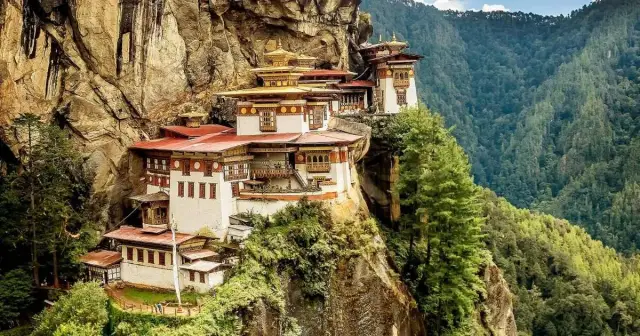

Tiger's Nest (Paro Taktsang) is a Buddhist monastery built in 1692 on a cliff about 900 metres above the Paro valley, at roughly 3,120 metres. You reach it on foot: about 4 km each way with 700 to 900 m of climbing, two to three hours up and four to six hours for the round trip with time inside. Entry costs Nu 1,000 for foreign adults (Department of Tourism, since March 2023), cameras and phones stay in lockers at the gate, and a licensed guide has to come with you. Go early on a clear morning in spring or autumn.
- AltitudeAbout 3,120 m, some 900 m above the Paro valley floor
- HikeAbout 4 km each way, 700 to 900 m of ascent
- Time2 to 3 hours up, 4 to 6 hours return with the visit
- Entry feeNu 1,000 per foreign adult, half price for ages 6 to 18, free for 5 and under
- HorsesCan be hired as far as the cafeteria, about 2,950 m
- InsideNo photos, cameras and phones go in lockers, shoulders and knees covered
- Best timeMarch to May and late September to November, starting by 7 or 8 am
When most people think of the word "monastery," they probably imagine a group of solemn men clad in robes, sequestered away in some remote corner of the world, living a life of quiet contemplation. But the Tiger's Nest monastery in Bhutan is nothing like that. This Buddhist temple, perched high on a cliff overlooking the Paro Valley, is one of Asia's most striking sights.
Perched at about 3,120 metres, roughly 900 metres above the floor of the Paro valley, Tiger’s Nest is one of Bhutan's most important religious sites. The Tiger's Nest monastery was built in 1692 under Gyalse Tenzin Rabgye, the fourth temporal ruler of Bhutan, around the cave where the Buddhist saint Guru Rinpoche (also known as the "Precious Master") is said to have meditated in the eighth century. Legend has it that Guru Rinpoche flew to this spot on the back of a tigress, and that's how the monastery got its name.
The temple's surrounding area is also home to several caves used as meditation retreats by Guru Rinpoche and other important Buddhist masters.
Today, Bhutanese pilgrims and thousands of foreign visitors make the climb to Tiger’s Nest each year, many of them hoping to receive some of Guru Rinpoche's blessing.

A Short History of Tiger's Nest
The legend is old, but the buildings you see are younger than they look. A fire in 1998 gutted most of the complex, and what stands today is a careful reconstruction.
| When | What happened |
|---|---|
| 8th century | Guru Rinpoche is said to arrive on a flying tigress and meditate in the cave |
| 1692 | Gyalse Tenzin Rabgye builds the monastery around the meditation cave |
| 19 April 1998 | Fire destroys most of the main buildings and their contents |
| 2005 | Restoration, led by the Royal Government of Bhutan, is completed |
| July 2022 | Entry fee for foreign visitors raised to Nu 2,000 |
| 15 March 2023 | Fee cut back to Nu 1,000 (Department of Tourism), the rate still charged in 2026 |
Myths and Legends of the Tiger's Nest
According to one legend, the great Buddhist saint Guru Rinpoche flew to the site on the back of a tigress, leaving his imprint on a rock at the entrance to the cave where he meditated.
Another legend says that Guru Rinpoche meditated in a cave for three years, three months, three days, and three hours to subdue a demon terrorizing the valley's people. These are stories told by the faithful, and versions differ from one telling to the next.
When Is Tiger's Nest Open, and When Should You Go?
Tiger's Nest monastery is open to visitors throughout the year. However, the best time to visit is between October and November, when the weather is cool and dry and the skies are usually at their clearest. March to May is the other good window. Mist is far more common in the monsoon, June to August, when cloud can hide the cliff for hours and the trail turns muddy.
The monastery usually admits visitors from about 8 am to 5 pm, with a break around lunchtime when the monks eat, and it closes earlier in winter. Times change for ceremonies, so check with your guide the day before. Starting by 7 or 8 am gets you to the top before the midday crowd and the afternoon cloud.
How Much Does Entry Cost?
The entrance fee for foreign visitors to Taktsang (Tiger's Nest Monastery) is Nu 1,000, roughly USD 11 to 12. Bhutan's Department of Tourism cut it from Nu 2,000 to Nu 1,000 with effect from 15 March 2023, when it also reduced the number of fee-charging monuments to seven, and Bhutan Broadcasting Service still reported the Nu 1,000 rate in 2026. Fees can be paid at the site or booked online through the Department of Tourism's services portal, and most tour packages already include them.
Children aged 6 to 18 pay half, and children aged 5 and below go free. This monument fee is separate from the Sustainable Development Fee and the visa, which our complete Bhutan travel guide explains.
How to Get to the Tiger's Nest Monastery
The Tiger's Nest monastery, also known as Paro Taktsang, is a large Buddhist temple complex that is perched on a cliff in the Himalayan mountains. The views from the monastery are wide, and the site's history is fascinating.
The only way to reach the monastery is on foot, up a steep trail from the car park on the Paro valley floor, about a 20-minute drive from Paro town. The trail is about 4 km each way, around 8 km return, and climbs 700 to 900 metres. Most people take two to three hours to get up and four to six hours for the whole outing, including time inside. Horses can be hired for the climb as far as the cafeteria, but not for the descent or the last stretch.
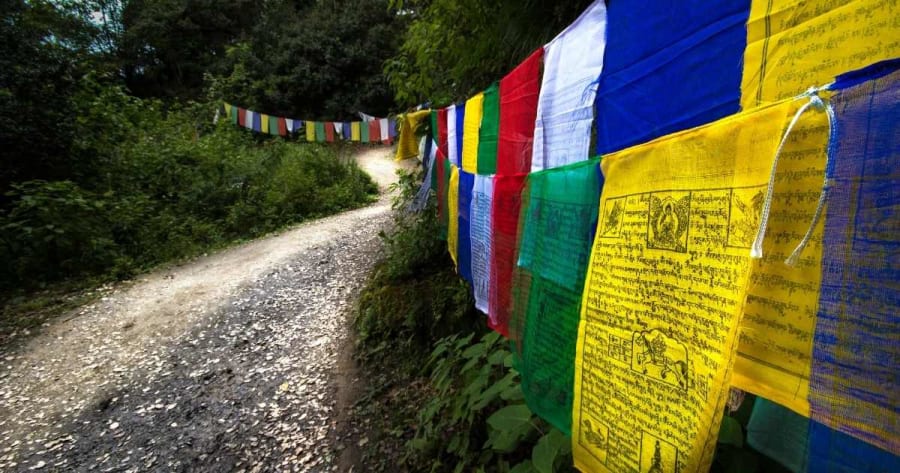
The hike to the Tiger's Nest monastery is challenging, but it is well worth the effort. The views from the temple are wide, and the sense of history and spirituality surrounding the site is easy to feel. If you are planning a trip to Bhutan, be sure to add a visit to Taktsang Monastery.
The Hike, Stage by Stage
Times are typical for a reasonably fit walker with stops. Altitudes are approximate and vary a little between sources.
| Stage | Altitude | Time from the previous point | What to expect |
|---|---|---|---|
| Car park and trailhead | About 2,300 to 2,600 m | Start | Prayer wheels, souvenir stalls, horse hire, walking sticks |
| Taktsang cafeteria | About 2,950 m | 1 to 1.5 hours | Tea, snacks and the first full view of the monastery. Horses stop here |
| Viewpoint opposite the monastery | About 3,100 m | 45 minutes to 1 hour | The classic photo spot, the highest point of the walk |
| Steps down to the waterfall and up to the gate | About 3,120 m at the gate | 15 to 25 minutes | Roughly 700 steps down into the gorge past a waterfall, then a shorter climb to the entrance |
| Inside the monastery | About 3,120 m | 30 to 60 minutes | Lockers for bags and phones, shoes off in the temples |
What Are the Highlights of the Tiger's Nest Monastery?
The Tiger's Nest Monastery is a remarkable piece of architecture set on the side of a cliff.
The complex is usually described as four main temples and eight caves, known for its architecture, paintings and sculptures.
The monastery's main hall is the Dukhang, or "Assembly Hall." The Dukhang has a statue of the Buddha and murals on the walls, and smaller shrines are built into the rock around it, including the cave linked to Guru Rinpoche's meditation.

Tips for visiting the Tiger's Nest Monastery
The hike to the monastery is strenuous, but the views are more than worth the effort. Here are a few tips for making the most of your visit:
Start early: The Tiger's Nest hike usually takes four to six hours there and back, depending on your fitness level and how long you spend inside. It's best to start early in the morning to avoid the day's heat and the late-morning cloud.
Wear comfortable shoes: The trail is rocky and steep in places, so it's important to wear comfortable shoes with good grip.
Bring plenty of water: The cafeteria sells tea, snacks and drinks, but there is nothing else on the trail, so carry enough water for the climb.
Take your time: There's no need to hurry on the way up or down. Enjoy the views and take your time taking photos. If you're tired, there are benches along the trail where you can take a break. You are at over 3,000 metres, so a slower pace also keeps headaches away.
Dress for the temples: Cover your shoulders and knees, and expect to take off your hat and shoes inside. Bags, cameras and phones go into lockers at the entrance.
Bring your guide: A licensed Bhutanese guide has to accompany tourists on monument visits, and your guide also arranges the ticket.
Finally, the monastery is an active religious site, so please be respectful of the monks. Photography is not allowed anywhere inside the complex, and drones are banned. If you follow these guidelines, you will have a memorable experience at the Tiger's Nest Monastery.
Is the Tiger's Nest Hike Worth It?
Yes. The Tiger's Nest Monastery is one of Bhutan's most beautiful and spiritual sites. The hike to the monastery is challenging, but it is well worth the effort, and the walk itself, through pine forest strung with prayer flags, is half the experience.
Just remember to start early, wear comfortable shoes, bring plenty of water, and take your time. And if you're visiting the monastery, please be respectful of the monks and refrain from taking photos inside the temple. Follow these guidelines and your visit to Taktsang will stay with you.
Tiger's Nest is the headline act of any Bhutan itinerary. Our 10 best things to do in Bhutan places it in a full trip, and the complete Bhutan travel guide covers the SDF, visa, and flights that get you to Paro in the first place. In short, the Sustainable Development Fee is USD 100 per adult per night until 31 August 2027, on top of your tour.
Tiger's Nest FAQ
How hard is the Tiger's Nest hike?
It is a steady uphill walk, not a technical one. You climb 700 to 900 metres over about 4 km and finish above 3,000 metres, so anyone who walks regularly can do it at their own pace. The 700-odd steps near the end are the part most people feel the next day.
How much does it cost to visit Tiger's Nest?
The monument fee is Nu 1,000 per foreign adult, half for ages 6 to 18 and free for children 5 and under, set by the Department of Tourism from 15 March 2023. Your tour's Sustainable Development Fee and visa are separate and covered in our Bhutan cost guide.
Can I take a horse to Tiger's Nest?
Yes, for the climb as far as the cafeteria at about 2,950 metres. From there everyone walks, and horses are not used for the descent because the trail is steep and loose.
Can I take photos inside Tiger's Nest?
No. Cameras, phones and bags stay in lockers at the entrance, and photography is banned throughout the complex. The best photos are from the viewpoint opposite the monastery, before the steps.
What is the best time of year to visit Tiger's Nest?
March to May and late September to November bring the clearest skies and the driest trail. Winter mornings are often crisp and clear but cold, and the monsoon months bring cloud and mud. Our guide to the best time to visit Bhutan has the month-by-month detail.