








Is It Safe to Fly in Nepal? Domestic Flight Safety Explained
Mostly yes, with clear caveats. Nepal's main routes between Kathmandu, Pokhara, and the Terai cities use modern ATR and jet aircraft and have a good recent record. The last fatal crash of a scheduled passenger flight was the Yeti Airlines accident at Pokhara in January 2023, and we found no fatal plane or helicopter crash in Nepal since August 2024. The higher risk is on short mountain airstrips such as Lukla and Jomsom and on helicopter flights in bad weather. Every Nepali airline has been on the EU Air Safety List since December 2013. Fly in the morning, keep a spare day, and avoid mountain flights in the monsoon if you can.
- Last fatal scheduled flightYeti Airlines, Pokhara, 15 Jan 2023 (72 killed)
- Last fatal crash of any kindAir Dynasty helicopter, Nuwakot, 7 Aug 2024
- Latest serious accidentBuddha Air overrun, Bhadrapur, 2 Jan 2026, no deaths
- Last fatal accident at LuklaApril 2019
- EU Air Safety ListAll Nepali airlines banned since Dec 2013
- CAAN splitBills in Parliament, target mid-January 2027
Nepal's skies carry a reputation that precedes them. Two fatal airline accidents in eighteen months, the Yeti Airlines crash at Pokhara in January 2023 and the Saurya Airlines crash at Kathmandu in July 2024, put that reputation back in world headlines, and every Nepali carrier has sat on the EU Air Safety List since 2013.
Yet hundreds of thousands of travellers fly safely within Nepal every year, and the jet and ATR trunk routes between major cities have a strong recent record. So what is the real story?
This guide covers what actually happened in the recent crashes and what the official investigations found, the longer history of aviation accidents in Nepal, how crashes are classified and caused, and, most practically, what you can do as a traveller to keep your own risk as low as possible.
The January 2023 Yeti Airlines Crash | What Happened?
The Civil Aviation Authority of Nepal mentioned that the twin-engine ATR 72 aircraft operated by Yeti Airlines crashed while landing in Pokhara. As per the report of CAAN, the plane took off at 10:32 am from Kathmandu's Tribhuvan International Airport and was close to landing at Pokhara Airport.
The crew made their last call to Pokhara Tower at 10:50 am over the Seti River gorge, about 18 minutes after take-off on a flight scheduled to last 27 minutes. Moments later the aircraft went down on the bank of the gorge, on its final turn to land.
Local witnesses saw the plane catch fire as it came down. The fire and the steep gorge made the rescue slow and dangerous.
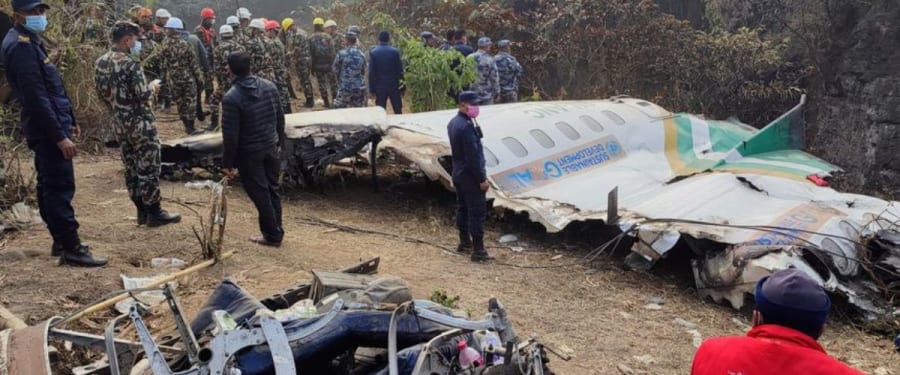
Local witnesses mentioned that half of the plane was on the hillside while the other half went into the Seti River gorge. They also stated that the aircraft tried not to hit the residential areas while crashing. It came down in a narrow space beside the Seti River, and videos taken that morning showed heavy smoke rising from the wreck.
Hundreds of soldiers, police, and local people joined the search. None of the 72 people on board survived.
Prime Minister Pushpa Kamal Dahal called an emergency cabinet meeting the same day. He said he was 'deeply saddened by the sad and tragic accident.'
'I sincerely appeal to the security personnel, all agencies of the Nepal government, and the general public to start an effective rescue,' he wrote on his Twitter.
What Caused Yeti Aircraft's Crash?
The Aircraft Accident Investigation Commission released its final report in December 2023, and the cause was as stark as aviation findings get: the crew inadvertently moved both condition levers to the feathered position while configuring the aircraft for landing, an action meant for the flaps, which cut thrust from both engines at once. With no propeller thrust on the visual circuit to Pokhara's newly opened international airport, the ATR 72 stalled and crashed seconds from the runway.
The report cited high workload, inadequate adherence to standard operating procedures, and gaps in training for the new airport's visual approach as contributing factors. None of it involved weather, which was clear that morning, and none of it involved the aircraft, which was functioning normally until the levers were moved.
Who Was on Board Yeti Airlines Flight 691?
Seventy-two people were on board when the Yeti Airlines aircraft crashed near Pokhara Airport on January 15, 2023. Sixty-eight were passengers, while four others were crew members. Officials later confirmed the nationalities of everyone on board.
Of the 68 passengers, 53 were Nepali. The rest were 5 Indians, 4 Russians, 2 South Koreans, and one each from Argentina, Australia, France, and Ireland. All four crew members were Nepali.
The July 2024 Saurya Airlines Crash
Eighteen months later, on July 24, 2024, a Saurya Airlines Bombardier CRJ-200 crashed moments after take-off from Kathmandu's Tribhuvan International Airport, killing 18 of the 19 people on board. The captain was the sole survivor. The aircraft was on a ferry flight to Pokhara for maintenance, carrying mostly airline staff.
The final investigation report, released in July 2025, found that the aircraft entered a deep stall after an abnormally rapid rotation at a lower-than-required speed, traced to an erroneous take-off speed card, with improperly secured cargo and a weak company safety culture cited as contributing factors. The case added to calls for an independent accident-investigation authority and the long-debated split of Nepal's civil aviation regulator from its airport-operator role.
History of Plane Crashes In Nepal | How Many Have Died To Date?
Nepal has recorded dozens of fatal air accidents since 1962. The first mishap in Nepal (Royal Nepal Airlines DC-3 crash) happened on August 1, 1962, near Tulachan Dhuri and all ten passengers lost their lives.
A series of plane crashes have followed since then. The Royal Nepal Airlines DC-3 crash was another plane crash that happened on July 12, 1969. It crashed in Hetauda in Makwanpur District, killing all 31 passengers and four crew members.
On 31 July 1992 an Airbus A310 operated by Thai Airways crashed while approaching Kathmandu, killing 99 passengers and 14 crew. It hit a mountain about 37 km north of the city in cloud, after a confused approach that investigators linked to navigation errors and poor communication with air traffic control. On 28 September of the same year, 167 people lost their lives in a Pakistan International Airlines plane crash. Reports cited that the aircraft collided with a mountain as it descended to Tribhuvan International Airport in Kathmandu.
On 31 July 1993 an Everest Air Dornier flying from Kathmandu to Bharatpur crashed, killing 16 passengers and three crew. On 27 July 2000 a Royal Nepal Airlines Twin Otter hit a hillside in Dadeldhura District while descending towards Dhangadhi in low cloud, killing 22 passengers and three crew.
Princess Prekshya Shah of Nepal and five others died in a chartered helicopter crash in November 2001.
In June 2006 a Yeti Airlines Twin Otter crashed at Jumla, killing six passengers and three crew. That September a Shree Air helicopter chartered for a conservation event crashed near Ghunsa in the Kanchenjunga region, killing all 24 on board.
In September 2011 a Buddha Air Beechcraft 1900D on a mountain sightseeing flight crashed near Kathmandu, killing all 19 on board, ten of them Indian. In May 2012 an Agni Air Dornier crashed near Jomsom, killing 15 people, 13 of them Indian pilgrims. In September 2012 a Sita Air Dornier bound for Lukla crashed just after take-off from Kathmandu, killing all 19, including seven British trekkers. A Nepal Airlines Twin Otter went down in Arghakhanchi in February 2014 (18 killed), and a Tara Air Twin Otter hit a hillside in Myagdi in February 2016 (23 killed). In May 2015 a US Marine Corps UH-1Y Huey flying earthquake relief crashed near Charikot, killing six Marines and two Nepali soldiers.
Also in February 2016, an Air Kasthamandap aircraft crashed in Kalikot district, killing two of the 11 people on board. In March 2018 a US-Bangla Airlines Dash 8 with 71 people on board crashed onto a football ground next to the runway at Kathmandu, killing 51.

An Air Dynasty helicopter crashed in bad weather in Taplejung in February 2019, killing all seven on board, including Tourism Minister Rabindra Adhikari. In April 2019 a Summit Air Let L-410 veered off the runway on take-off at Lukla, hit parked helicopters, and killed three people. In May 2022 a Tara Air Twin Otter flying from Pokhara to Jomsom crashed in Mustang District, killing all 22 on board. Investigators found the crew had flown into cloud with the terrain warning system switched off.
Helicopters have their own record. A Manang Air helicopter flying from Surke to Kathmandu crashed at Lamjura in Solukhumbu in July 2023, killing five Mexican visitors and the pilot. In August 2024 an Air Dynasty helicopter crashed in Nuwakot soon after take-off from Kathmandu, killing all five on board.
Selected Air Accidents in Nepal, 1992 to 2026
The table lists the accidents covered above plus the most recent events, newest first. Bars show deaths on the same scale. It is a selection, and smaller cargo and charter accidents are left out.
| Date | Aircraft | Where | Type | Deaths | |
|---|---|---|---|---|---|
| 2 Jan 2026 | Buddha Air ATR 72, runway overrun | Bhadrapur | No deaths | 0 | |
| 7 Aug 2024 | Air Dynasty helicopter | Nuwakot | Helicopter | 5 | |
| 24 Jul 2024 | Saurya Airlines CRJ-200, ferry flight | Kathmandu | Airline | 18 | |
| 11 Jul 2023 | Manang Air helicopter | Lamjura, Solukhumbu | Helicopter | 6 | |
| 15 Jan 2023 | Yeti Airlines ATR 72 | Pokhara | Airline | 72 | |
| 29 May 2022 | Tara Air Twin Otter | Mustang | Airline | 22 | |
| 14 Apr 2019 | Summit Air Let L-410 | Lukla | Airline | 3 | |
| 27 Feb 2019 | Air Dynasty helicopter | Taplejung | Helicopter | 7 | |
| 12 Mar 2018 | US-Bangla Airlines Dash 8 | Kathmandu | Foreign airline | 51 | |
| 26 Feb 2016 | Air Kasthamandap PAC 750XL | Kalikot | Airline | 2 | |
| 24 Feb 2016 | Tara Air Twin Otter | Myagdi | Airline | 23 | |
| 16 Feb 2014 | Nepal Airlines Twin Otter | Arghakhanchi | Airline | 18 | |
| 28 Sep 2012 | Sita Air Dornier | Kathmandu | Airline | 19 | |
| 14 May 2012 | Agni Air Dornier | Jomsom | Airline | 15 | |
| 25 Sep 2011 | Buddha Air Beechcraft 1900D | near Kathmandu | Airline | 19 | |
| 8 Oct 2008 | Yeti Airlines Twin Otter | Lukla | Airline | 18 | |
| 23 Sep 2006 | Shree Air helicopter | Ghunsa, Taplejung | Helicopter | 24 | |
| 21 Jun 2006 | Yeti Airlines Twin Otter | Jumla | Airline | 9 | |
| 27 Jul 2000 | Royal Nepal Airlines Twin Otter | Dadeldhura | Airline | 25 | |
| 31 Jul 1993 | Everest Air Dornier | near Bharatpur | Airline | 19 | |
| 28 Sep 1992 | PIA Airbus A300 | near Kathmandu | Foreign airline | 167 | |
| 31 Jul 1992 | Thai Airways Airbus A310 | north of Kathmandu | Foreign airline | 113 |
Sources: Nepal Aircraft Accident Investigation Commission reports, Aviation Safety Network, Wikipedia, The Himalayan Times, Reuters.
How Many People Have Died In Airplane Crash In The World?
The sad reality of aircraft accidents has resulted in the loss of countless individuals globally, dating back to the beginning of powered flight.
The first fatality of a powered flight occurred in 1908 when Lieutenant Thomas Selfridge died in a crash while flying with Orville Wright on a demonstration flight. Since then, the number of deaths resulting from airplane accidents has risen in proportion to the size and capacity of airplanes. 2014 was a grim year for aviation, with 537 lives lost in two Malaysia Airlines accidents.
The first was the disappearance of flight MH370 with 239 people on board in March 2014, which left families without answers.
Unfortunately, four months later, flight MH17 was shot down over eastern Ukraine, killing all 298 on board.
The deadliest accident in aviation history is still the 1977 runway collision at Tenerife, which killed 583 people.
In 1996, the Charkhi Dadri midair collision tragically resulted in the loss of 349 lives, the highest recorded number of fatalities from a midair collision. The September 11 attacks in 2001 killed 2,977 victims, though as deliberate attacks they are not counted as accidents.
If we were to count the commercial jet accidents, according to Boeing, there were 1,798 accidents, 603 of which were disastrous, resulting in 29,025 onboard fatalities and an additional 1,173 ground or noncommercial aircraft collision deaths, spanning the period of 1959 to 2011. However, their recent study suggests a drop in commercial aviation accident fatality rates in recent years.
Nepal has eight of the world's 14 highest peaks, including Mount Everest, and that terrain makes flying hard.
Reuters counted nearly 360 deaths in 19 air crashes in Nepal from 2000 until just before the Saurya accident of July 2024. Fast-changing mountain weather is part of the reason. Short airstrips, old aircraft types, and weak oversight are the rest.
The major Nepali accidents in that grim ledger, from the 1962 Royal Nepal DC-3 to the twin 1992 Thai Airways and PIA disasters and the 2018 US-Bangla crash, are covered in the history section above.
Plenty of visitors still fly within Nepal, and the vast majority of those flights are uneventful.
What Did the 2023 Crash Mean for Nepal's Tourism?
The 2023 Yeti crash sent shockwaves through the entire world. The tragedy has left the people of Nepal with a deep sense of grief and sorrow. The accident has also cast a shadow of doubt over the safety of air travel in Nepal.
The crash raised hard questions about the safety of air travel in Nepal, and bookings dipped in the immediate aftermath. The effect proved temporary: arrivals recovered strongly through 2023 and 2024, passing one million visitors a year again, as travellers weighed the tragedy against the millions of safe journeys completed by Nepali airlines.
The government set up an accident investigation commission the day of the crash. Its final report, published in December 2023, recommended changes to crew training and to procedures for the new Pokhara airport.
Is It Safe to Fly in Nepal Now?
Here is the honest, current picture as of October 2026. The last fatal crash of a scheduled passenger flight in Nepal was the Yeti Airlines accident of January 2023. The Saurya aircraft in July 2024 was on a ferry flight carrying mostly airline staff. We found no reports of any fatal plane or helicopter crash in Nepal since the Air Dynasty helicopter accident of August 2024. The closest call since was on 2 January 2026, when a Buddha Air ATR 72 overran the runway at Bhadrapur after dark. The aircraft was badly damaged, several people were hurt, and nobody died. The busy trunk routes between Kathmandu, Pokhara, Bharatpur, and the Terai cities, flown by modern ATR turboprops and regional jets, have an excellent recent record.
The structural caveats remain real. Every Nepali airline stays on the EU Air Safety List, a blanket judgment about regulatory oversight in place since December 2013. In August 2026 Tourism Minister Khadkaraj Paudel told Parliament that getting off the list is a top priority. The fix the EU wants most is splitting the Civil Aviation Authority of Nepal into a separate regulator and airport operator. Two bills to do that reached the lower house in October 2026, only hours before the session was prorogued, so they now wait for the winter session. The budget had promised the split by mid-January 2027. Most of the residual risk is concentrated where it always was: short, high-altitude STOL strips such as Lukla and Jomsom, and helicopter operations in mountain weather.
Where the Risk Sits
Not every Nepal flight carries the same risk. This is our reading of the accident record above.
| Type of flight | Relative risk | Why |
|---|---|---|
| Trunk routes: Kathmandu to Pokhara, Bharatpur, Biratnagar, Bhairahawa, Nepalgunj | Lower | ATR 72s and jets, long paved runways, airports with instrument approaches |
| Mountain airstrips: Lukla, Jomsom, Simikot, Dolpa | Higher | Short sloping runways, visual flying only, fast-changing cloud |
| Helicopter flights in the mountains | Higher | Single-engine aircraft flying low between valleys in variable weather |
| Mountain sightseeing flights from Kathmandu | Moderate | Larger aircraft at safe altitude, but the 2011 Buddha Air loss was on one |
What does that mean for your trip? A few practical rules tilt the odds firmly in your favour:
- Fly in the morning, when mountain weather is calmest and completion rates are highest. Our guide to Lukla flight delays shows the risk month by month.
- Build a buffer day around any Lukla or Jomsom flight rather than chaining it directly to your international departure. Our Lukla airport guide explains why delays happen there.
- Prefer trunk routes and established carriers. See our up-to-date guide to the best domestic airlines in Nepal.
- Buy travel insurance that covers helicopter evacuation at trekking altitudes.
- Remember the road alternative: in peak seasons Lukla flights leave from Manthali/Ramechhap anyway, and the jeep road to Surke lets you skip the Lukla flight entirely.
Beyond aviation, Nepal remains one of the safest countries in Asia for travellers in everyday terms, with low violent crime and a deeply hospitable culture.
What Has the Nepal Government Done For Aircraft And Passengers' Safety?
The Civil Aviation Authority of Nepal (CAAN) handles the airline guidelines aligning them to Global Aviation Safety Plan (GASP). CAAN is the government body that develops, carries out, and monitors that plan in Nepal.
CAAN has worked on creating the manifesto of the National Aviation Safety Plan (NASP 2018-2022). It works on Safety Enhancement Initiatives (SEI) after successfully identifying the safety deficiencies in the national aviation system.
According to the NASP, there are several goals which include the following points:
-
Achieve a continuous reduction of operational safety risks
-
Strengthen the safety oversight capabilities of Nepal
-
Implement Effective State Programmes (SSP)
Similarly, there have been developments in Safety Enhancement Initiatives. Some of them are listed below:
-
Development of a full regulatory oversight framework (GASP and SEI)
-
Establishment of an independent accident and incident investigation authority
-
Qualified technical personnel to support effective safety oversight
-
Strategic collaboration with crucial aviation stakeholders to enhance safety in a coordinated manner
-
Continued implementation of and compliance with ICAO SARPs at the national level.
Two of those items, an independent accident investigation authority and the split of CAAN's regulator and airport roles, were still unfinished in October 2026.
Types of Airplane Crashes And Accidents
An accident, as defined by the International Civil Aviation Organisation (ICAO), is a tragic event linked with the operation of an airplane that takes place from the moment any individual boards the plane with the intention of flight until all passengers have left.
This includes instances where a person sustains fatal or severe injuries, the aircraft sustains damage or structural failure or becomes missing or completely inaccessible. However, experimental test flights, sabotage, hijacking, terrorism, or direct military action are not considered accidents.
Depending on the severity of the incident, an accident can be categorized in various ways. One classification method is to identify the level of damage sustained, which can range from minor to catastrophic. Another approach is to evaluate the injuries imposed on individuals involved, ranging from minor to fatal. Additionally, the cost of repair or replacement of the aircraft can also be used as a metric for classification. These different classifications are commonly utilized in various taxonomies of accident categorization.
Damage: A thorough examination has determined that the damages sustained are beyond repair, or, if feasible, the expenses incurred for repairs would surpass half of the original cost of the aircraft at the time of purchase.
Substantial damage is any harm that negatively impacts an aircraft's structural integrity, functionality, or aerodynamic properties.
Minor Damage, considered minor, is characterized by its lack of significant impact on an aircraft's overall functionality and structural integrity.
Fatal Injury: A fatal injury is a tragic occurrence resulting in the loss of life immediately or within 30 days following an accident.
Serious Injury: Under ICAO Annex 13, a serious injury is one that needs more than 48 hours in hospital, starting within seven days of the accident.
This type of injury may include a fracture of any bone (except for simple fractures of the toes, fingers, or nose), damage to internal organs, muscle or tendon damage, burns of the second or third degree, or burns that cover more than 5 percent of the body.
Accident Classifications
Hull Loss Accident: A Hull Loss Accident is a catastrophic occurrence in which the aircraft sustains irreparable damage or is destroyed. This classification encompasses incidents where the plane is lost or missing, and the wreckage or waste is not recoverable.
Major Accident: In this category, the result bears severe consequences for those involved. It is defined as a situation where one of the following criteria is met:
· The aircraft was destroyed.
· Multiple individuals lose their lives.
· There is a single fatality accompanied by significant damage to the aircraft.
Fatal Event: A tragic event that results in the loss of life for one or more people on board the aircraft.
Damage Incident: An incident in which the aircraft sustained significant damage.
Serious Accident: A severe accident that meets one of the following criteria:
1. A single fatality without substantial damage to the aircraft.
2. There is at least one severe injury and substantial damage to the plane.
Minor Accident: An accident where the aircraft has sustained minor damage.
Common Causes of Airline Crashes
Airline crashes rarely have a single cause. Pilot error, mechanical failure, weather, and bird strikes are the usual factors, often in combination.
Let's see them detail by detail:
Pilot Error:
Pilot error is the most common factor in airline crashes. Studies put it behind roughly half of fatal accidents, and wider human-factor estimates run higher. In Nepal, the final reports on the Tara Air (2022), Yeti (2023), and Saurya (2024) crashes all traced the cause mainly to crew actions and company procedures, with the aircraft working normally. The reasons for the pilot error are many and varied. Sometimes it's simply a matter of inexperience or poor training. Other times, it may be a question of judgment or decision-making in a difficult situation. Fatigue can also play a role, as can distractions in the cockpit (including cell phones).
Mechanical Failure:
Mechanical failure is another common cause of airplane accidents. Although modern airplanes are incredibly reliable, they are still complex machines with many moving parts. Sometimes those parts fail, with potentially disastrous results. And even when an outright mechanical failure doesn't cause an accident, mechanical problems can still contribute to it (for example, if a plane loses power due to engine trouble and then crashes while the pilots are trying to land it).
Weather:
Weather is also a leading cause of airplane accidents. Turbulence, high winds, lightning strikes, and other severe weather conditions can make flying very dangerous (sometimes even impossible). The icing on an airplane's wings can also be problematic, as it can reduce lift and increase drag.
Bird Strike:
Lastly, bird strikes are a surprisingly common cause of airplane accidents (particularly during take-off and landing). A collision with even a small bird can damage an airplane.
Technologies That Could Help Prevent Airplane Crashes
Many different technologies could help prevent airplane crashes. Some of these include:
The Installation of Automatic Dependent Surveillance-Broadcast (ADS-B) Systems:
The ADS-B system allows air traffic controllers to track aircraft more accurately, which could help prevent collisions.
The Use of Terrain Awareness and Warning Systems (TAWS):
TAWS is a technology that can warn pilots about potential dangers on the ground, such as mountains, trees, or other obstacles. This could help prevent crashes due to pilot errors. Investigators found it had been switched off on the Tara Air Twin Otter that crashed in Mustang in 2022.
The Implementation of Runway Incursion Prevention Systems:
These systems use radar and other sensors to detect potential runway incursions (when an aircraft or vehicle enters a runway without clearance). This information is then displayed to air traffic controllers, who can take action to prevent a collision.
The Use of Collision Avoidance System (CAS):
CAS is a technology that uses sensors to detect potential collisions with other aircraft or objects. If a collision is imminent, the CAS will provide visual and auditory warnings to the pilots so they can take evasive action.
The Bottom Line
The accidents of 2023 and 2024 caught attention worldwide. Flying in Nepal carries more risk than flying in Europe or North America, and most of it sits on small mountain airstrips and on helicopter flights in poor weather. Choosing the season, flying early, and keeping a spare day bring that risk down a long way.
We share our heartfelt condolences with the families of everyone lost in the Pokhara and Kathmandu accidents. Their legacy should be, and slowly is becoming, a safer sky over Nepal.
Nepal Flight Safety: FAQs
Is it safe to fly to Lukla?
Lukla is one of the harder airports in the world, with a short sloping runway and no instrument landing system. Flights only operate in clear morning weather, and the last fatal accident there was in April 2019. Expect delays more than danger, and keep a spare day. Our Lukla airport guide covers the full record.
Which airlines are safest in Nepal?
The EU ban covers every Nepali carrier, whatever its own record, so it doesn't help you choose. Look at fleet age, recent incidents, and whether the airline flies the route daily. Our guide to the best domestic airlines in Nepal compares them.
Why are all Nepali airlines on the EU Air Safety List?
The EU judged Nepal's aviation oversight too weak in December 2013, after a run of fatal crashes. One big concern is that the Civil Aviation Authority of Nepal both regulates airlines and runs airports. Nepal is trying to split those roles, and the bills were waiting in Parliament in October 2026.
When is the safest time to fly in Nepal?
Early mornings in autumn (October and November) and spring (March to May) bring the most stable weather. The monsoon from June to September brings low cloud that grounds mountain flights for days at a time.
Can I avoid the Lukla flight?
Yes. A jeep road now reaches Surke, below Lukla, and the drive from Kathmandu takes 10 to 14 hours. You can also walk in from Jiri or Phaplu. Our guide on getting to Lukla without flying covers each option.