


Top Buddhist Destinations in Nepal: Lumbini, Boudhanath, Swayambhunath and Himalayan Monasteries
The top Buddhist destinations in Nepal are Lumbini, where the Buddha was born, and the two great stupas of Kathmandu, Boudhanath and Swayambhunath. Add Namo Buddha and Pharping on day trips from the city. If you trek, you can also visit Tengboche Monastery on the Everest Base Camp route, the walled city of Lo Manthang and its sky caves in Upper Mustang, and Shey Gompa deep in Upper Dolpo. Lumbini and the Kathmandu stupas are UNESCO World Heritage Sites and need no trekking at all.
- Birthplace of the BuddhaLumbini, UNESCO site since 1997
- Oldest written proofAshoka’s pillar, about 249 BCE
- Buddhists in Nepal8.21% of people (census 2021)
- Kathmandu stupasBoudhanath and Swayambhunath, UNESCO 1979
- Trekking monasteriesTengboche, Lo Manthang, Shey Gompa
- Buddha Jayanti 2027Thursday 20 May 2027
- Swotah tourBuddhism Circuit Nepal, 10 days, from USD 1,205 (group departure)
There are literally hundreds of Buddhist gompas (monasteries), shrines, stupas and sacred caves in Nepal, even though most Nepalis are Hindu. In the 2021 census, 81.19% of people gave their religion as Hindu and 8.21% as Buddhist, and Nepal has been an officially secular state since 2008. In addition, there is a unique and very interesting blend of Buddhism and Hinduism not found elsewhere. You may argue about Angkor Wat in Cambodia, but that temple was built for Vishnu in the 12th century and only later became a Buddhist site.
You may wonder why there are so many Buddhist sites here in Nepal. The answer is quite simple and something you may see written on various items throughout the country – Siddhartha Gautama, who went on to become the Buddha, was ‘born in Nepal’. Frankly, he was not born in Nepal as we know it, because Nepal as a country was not yet established. He was born into his father’s kingdom near modern day Lumbini on the Nepali side of the border between Nepal and India. Born, by tradition, around 563 BCE (many historians now place it closer to 480 BCE), there are various myths and truths about his life and of course his subsequent travels and becoming the enlightened Buddha. Nothing was written down in his lifetime. The earliest written record of the place comes from Ashoka, the Mauryan emperor of India (ruled about 268 to 232 BCE), who came to Lumbini on pilgrimage in about 249 BCE and had the visit carved in stone. Today you can see Ashoka’s pillar still standing there in memory of Buddha's birthplace.
With so many artifacts and sites dedicated to Buddha, as Siddhartha became, which should you visit while in Nepal? You can either dedicate your trip to some of these sites or visit them between / on your cultural or trekking tours. Here are a few of the best places to visit.
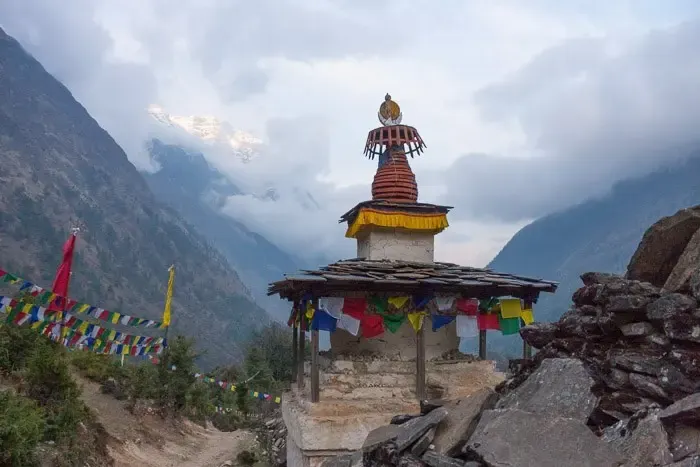
Nepal’s Buddhist Sites at a Glance
| Site | Where | Why go | Getting there | Foreigner fee (approx.) |
|---|---|---|---|---|
| Lumbini | Rupandehi, Lumbini Province | Birthplace of the Buddha, UNESCO 1997 | Flight to Bhairahawa, or 7 to 9 hours by road | NPR 1,000 (raised May 2026) |
| Boudhanath | East Kathmandu | Largest stupa in Nepal, centre of Tibetan Buddhist life | About 30 minutes from Thamel | NPR 400 |
| Swayambhunath | West Kathmandu | Hilltop stupa shared by Newar Buddhists and Hindus | 10 minutes’ drive from Thamel | NPR 200 |
| Namo Buddha | Kavre, about 40 km east | Tigress story, Thrangu Tashi Yangtse Monastery | 1.5 to 2 hours by road, or a hike from Dhulikhel | Free |
| Pharping | About 20 km south of Kathmandu | Guru Rinpoche’s meditation caves | 1 to 2 hours by road | Free |
| Tengboche | Khumbu, 3,867 m | Largest gompa in the Everest region, Mani Rimdu | Day 4 or 5 of the Everest Base Camp trek | Free (donation) |
| Lo Manthang | Upper Mustang, about 3,800 m | 15th-century gompas, sky caves, Tiji festival | Upper Mustang trek, restricted area permit | Small gompa fees |
| Shey Gompa | Upper Dolpo | Crystal Mountain, the spiritual heart of Dolpo | Three weeks or more of trekking | Restricted area permit |
Fees change often and listings disagree, so carry cash and check the board at the gate.
Buddhists in Nepal, Census by Census
The share of Nepalis who call themselves Buddhist has slipped over the last three censuses, though Buddhism is still the country’s second-largest religion by a wide margin.
| Census | Buddhist share | Share of population (0 to 10.74%) |
|---|---|---|
| 2001 | 10.74% | |
| 2011 | 9.04% | |
| 2021 | 8.21% |
Source: National Population and Housing Census 2001, 2011 and 2021, Central Bureau of Statistics / National Statistics Office, Nepal.
Lumbini, Birthplace of the Buddha (UNESCO World Heritage Site)
Here at Lumbini, you will see the birthplace of Buddha, the Mayadevi Temple within the Lumbini Garden. It was here archaeologists have stated that Buddha was born. The nearby Ashoka Pillar also has reference to Buddha’s birth at this spot, as is carved into the pillar’s inscription. The pillar was rediscovered in 1896, and its Brahmi inscription records that the emperor came to worship because “here the Buddha was born”. Excavations in the 1990s found a marker stone in the brick ruins under the old temple, and the present Maya Devi Temple, finished in 2003, was built over them. Visitors walk through on a raised path and can see the nativity sculpture and the marker stone. UNESCO listed Lumbini as a World Heritage Site in 1997.
Also over the past two or three decades, more than 25 international monasteries have come up in the monastic zone, built by Buddhist communities from countries such as Thailand, Myanmar, Japan, Germany, China and Vietnam. The site covers a large area, and as vehicles are not allowed into this sacred place, the best way to get around and see some of the monasteries and the Lumbini Garden is by rickshaw.
Nearby, there are a few hotels of international standard.
Practicalities
- Lumbini is situated in the south-west of the country and can be reached by a 35 to 40-minute flight to Gautam Buddha International Airport at Bhairahawa and a drive of about 22 km to the heritage site. Alternatively, you can go by road from Kathmandu – approximately 7 to 9 hours.
- There are a number of international standard hotels in the area.
- Entry to the Sacred Garden costs NPR 1,000 for visitors from outside South Asia and NPR 700 for SAARC visitors, after a rise in May 2026 that local groups protested. Check the current rate at the ticket office or on the Lumbini Development Trust website.
- Go at dawn or late afternoon. The Terai is very hot from April to June, and Buddha Jayanti (20 May in 2027) brings big crowds of pilgrims.
- You can combine your visit with a trip to Bardia National Park (approx. 7 to 8 hours’ drive further west by private transport, longer by bus) or a trip to Chitwan National Park (approx. 4 to 5 hours’ drive east).
Shey Gompa and the Crystal Mountain, Upper Dolpo
If you are trekking to Upper Dolpo, do not forget to visit the Shey Gompa Monastery and Crystal Mountain.
Shey Gompa is considered the spiritual heart of Upper Dolpo. Its holy status goes back centuries: Wikipedia and many guides date the monastery to the 11th century, while architectural surveys date the present Kagyu buildings to the late 17th century. Mythology says that the monastery was built on the site of a battle between a follower of Buddha, the Tibetan teacher Drubthob Senge Yeshe, who arrived on the back of a flying snow lion, and an evil local mountain spirit. Inside the monastery are wonderful Buddhist paintings and statues of Guru Rinpoche, Milarepa, and Sakyamuni. There are ancient texts in this monastery which give the history of the Crystal Mountain (known for natural quartz crystals) and the monastery.
You pass Phoksundo Lake on the way. Shey lies a few days beyond it, over the Kang La pass, inside the restricted Upper Dolpo zone.
Practicalities
- You can only reach Shey Gompa by trekking through Dolpo for approximately three weeks! So this site is only recommended if you are planning a trek and looking for somewhere interesting and remote.
- To reach the starting point of this trek, Juphal, you fly from Nepalganj airport in the west of the country.
- You can combine your trek with a trip to Bardia National Park, about 2.5 to 3 hours’ drive from Nepalganj.
- Upper Dolpo needs a restricted area permit, a licensed guide and at least two trekkers.
Tengboche Monastery
If you are trekking through the Everest Region, to Everest Base Camp for example, you will pass Tengboche Monastery (3,867 m), and most groups spend a night at Tengboche or nearby Deboche. This is the largest, and most impressive monastery in the Everest Region.
This monastery also has a long history. Lama Gulu founded it in 1916, and it was rebuilt after the 1934 earthquake and again after a fire in 1989. Sacred and special to the Sherpa community of the region, this monastery is loved by visiting tourists due to its location. Set within Sagarmatha National Park, one day’s walk from Namche Bazaar, it has the most outstanding views of several mountains. Panoramic views of Everest, Nuptse, Thamserku, Ama Dablam and more with the sounds of chanting monks is a very spiritual feeling.
Should you wish to visit this monastery but don’t want to make the long trek to Everest Base Camp and beyond, it is possible to fly into Lukla, walk two days to Namche Bazaar, acclimatize and visit the town and surroundings, then walk for another day to Tengboche, overnighting in the nearby village. Then returning to Namche. This makes the visit shorter and less arduous.
Practicalities
- You can visit Tengboche Monastery on any trek within the Everest Region.
- Visitors may sit in on the afternoon prayers, usually around 3 pm. Take off your shoes, sit at the back and ask before taking photos.
- Mani Rimdu, the monastery’s masked-dance festival, falls in October or November, at the full moon of the tenth Tibetan month. Swotah runs a Mani Rimdu Festival Trek.
- For a shorter trek, fly into Lukla, and follow the EBC Trek as far as Tengboche and return.
Lo Manthang and the Sky Caves of Upper Mustang
If you are trekking to Upper Mustang, perhaps to Lo Manthang, you will also visit the sky caves nearby. An often-quoted figure puts the man-made caves in Mustang’s cliffs at around 10,000. Archaeologists have found burials in some of them that go back roughly 2,500 to 3,000 years. From about the 10th century, many caves became homes, perhaps for safety during local wars, and by the 1400s most families had moved down into villages and the caves were used for meditation and storage. Buddhist manuscripts and wall paintings from roughly the 12th to 15th centuries have been found in several of them. Nobody knows for sure how the first diggers reached caves that sit several stories up a sheer cliff.
You can visit some of these caves today and wonder at their purpose. As Mustang, and Upper Mustang in particular, is a Buddhist area, the locals assign Buddhist practices to the formation of the caves.
Practicalities
- You can visit the best-known sky caves, around Chhoser and Garphu north of Lo Manthang, only on a trek to Upper Mustang. Other caves can be seen from the trail at Chhusang and Tetang.
- They lie a few hours walk from the main town – the ancient walled-city of Lomanthang.
- Do not go alone in the caves because they are very steep and can be dangerous.
- Upper Mustang is a restricted area. Since November 2025 the permit costs USD 50 per person per day, counted from Kagbeni, and you need a licensed guide.
The Monasteries of Lo Manthang
Lo Manthang itself is a Buddhist town. Ame Pal founded the walled capital of the Lo kingdom in 1380, and its four main gompas still stand inside the wall. Jampa Lhakhang and Thubchen, both from the 15th century, hold some of the finest Buddhist wall paintings in the Himalaya, restored over many years after the 1990s. In spring the town holds Tiji, a three-day masked-dance festival that tells how the deity Dorje Jono drove a demon out of Lo.
Kathmandu Valley
For those only visiting the Kathmandu Valley or who are trekking / sightseeing in other areas, there are several interesting Buddhist destinations nearby.
Boudhanath Stupa (UNESCO World Heritage Site)
Perhaps the most famous Buddhist site in Kathmandu is Boudhanath Stupa. Here is home to many Tibetans in exile as well as local Buddhists and people who come down from the mountains in the harsh winters.
Boudha is situated on an ancient Tibet-Kathmandu trade route. Nepali chronicles credit its building to a Licchavi king, either Manadeva in the 5th century or Shivadeva around 600 CE, and Tibetan tradition links it with King Songtsen Gampo, who converted to Buddhism in the 7th century. It is one of the largest stupas in the world and the most important Tibetan Buddhist site outside of Tibet. The 2015 earthquake cracked its spire, and the stupa reopened after repairs in November 2016. Boudhanath is one of the seven monument zones of the Kathmandu Valley World Heritage Site, listed in 1979. You will notice the all-seeing eyes of Buddha painted onto the high stupa and the whitewashed walls glimmering in the sun. You will also see these eyes in many other places, including tourist souvenirs!
If you visit in the early morning and evenings you will see hundreds of Tibetan Buddhists circumambulating around the stupa. Quite a sight to see and you are most welcome to join in. Walk clockwise, with the stupa on your right, as the pilgrims do. You can also light butter lamps in the nearby monasteries or outside around the stupa itself. Visiting on a full moon, it will be busier, but even more spiritual.
Practicalities
- Boudha is located around 30 minutes’ drive from the centre of Kathmandu. Foreign visitors pay an entry fee of about NPR 400 at the gates.
- Kopan Monastery, founded in 1969 by Lama Thubten Yeshe and Lama Zopa Rinpoche, is on a hill about 3 km north. It has run a month-long meditation course for foreigners every November since 1971, plus shorter courses through the year.
- You can easily go there yourself, join the locals for ‘kora’ and eat in one of the many cafes and restaurants with views over the stupa. After the pilgrims have gone (around say 7 or 8 pm) you will have an almost ghostly feeling.
- Going on a full moon is very auspicious although it will be very crowded. Also going at Gyalpo Losar, the Tibetan New Year (February or early March, early March in 2027), is colourful and exciting.
Swayambhunath Stupa (UNESCO World Heritage Site)
Swayambhunath Stupa is that delicate and interesting blend of Buddhism and Hinduism which exists mainly in the Kathmandu Valley.
Legend has it that it is from the hill at Swayambhu that the bodhisattva Manjushri took a sword and cut into the lake below. When the water flowed out of the valley (at Chobar Gorge which you can visit today) it left very fertile land on which Kathmandu was built.
In ancient times it is said, many religious people, gods and others, including Ashoka came to this site. The oldest firm records date from the Licchavi period, around the 5th century. Muslim raiders from Bengal sacked the stupa in 1349, and in the 15th century the Indian monk Shariputra, an abbot from Bodhgaya, led its reconstruction along with a king of the Malla dynasty. The 365-step eastern stairway was added under King Pratap Malla in the 17th century. That long royal patronage may help explain the combined Buddhist and Hindu connection.
Today the Newari people of the valley come to worship at Swayambhunath daily as it is among their most holy sites. For Tibetan Buddhists, it is only second to Boudhanath. The other group who occupy this stupa are monkeys! With so many monkeys at Swayambhunath, it also has the name ‘Monkey Temple’!
Practicalities
- It is a 10-minute drive or a 30 to 40-minute walk from the tourist hub of Thamel. Foreign visitors pay about NPR 200, and entry has been free on Buddha Jayanti in past years.
- There are 365 steps to climb on the eastern stairway to reach the summit of the hill on which the stupa stands.
- Do be aware of the monkeys and carry no food.
Namo Buddha and Pharping
There are many more Buddhist shrines throughout the Kathmandu Valley. We can recommend a visit to Namo Buddha, about 40 km east of Kathmandu and about 8 km / 5 miles from the ancient town of Panauti. It is said Namo Buddha is important due to the tale which involved an early incarnation of Shakyamuni Buddha who sacrificed his own body to a starving tigress who was unable to feed her cubs. The Thrangu Tashi Yangtse Monastery on the ridge, at about 1,750 m, is a place of worship and a centre for meditation and spiritual practices, visitors can visit for the day, or stay longer in their guest rooms.
We can also recommend a visit to Pharping, situated about 20 km / 12 miles south of Kathmandu. There are many Buddhist and Hindu sites to be seen here including the Asura Cave, where Guru Rinpoche (Padmasambhava) is believed to have meditated and reached the realisation of Mahamudra, and the Dakshinkali temple just down the road.
And naturally, there are many Buddhist stupas, shrines, mani walls, prayer wheels and gompas in many of the areas you can visit through trekking in Nepal.
So much for you to discover!
Visiting Nepal’s Buddhist Sites with Swotah
The easiest way to see most of this list in one go is the Buddhism Circuit Nepal. It runs 10 days, from USD 1,205 on a group departure. You see Boudhanath and Swayambhunath, walk the ridge from Namo Buddha down to Balthali, spend time in Lumbini at the Maya Devi Temple and the monastic zone, and finish at the World Peace Pagoda above Pokhara. The highest point is Namo Buddha at about 1,750 m, so no trekking experience is needed. Swotah can arrange it as a private trip on your own dates.
For the monasteries of the mountains, Tengboche sits on the Everest Base Camp Trek (14 days, from USD 1,620 on a group departure). Lo Manthang and the sky caves are on the Upper Mustang trek (16 days, from USD 2,399). Shey Gompa is on the Upper Dolpo Trek (26 days, from USD 3,650). Prices change with the departure, so check the trip page for the current one. If you ask, we try to match your guide to what you want, such as experience, language, gender or age.
Buddhist Destinations in Nepal: FAQs
Was the Buddha born in Nepal?
Yes. Siddhartha Gautama was born in Lumbini, in what is now Rupandehi district in southern Nepal, about 22 km from the Indian border. Ashoka’s pillar, put up around 249 BCE, marks the spot, and UNESCO listed Lumbini as a World Heritage Site in 1997.
How much does it cost to enter Lumbini?
After a rise in May 2026, foreign visitors from outside South Asia pay NPR 1,000 and SAARC visitors NPR 700 to enter the Sacred Garden with the Maya Devi Temple. Local groups protested the increase, so check the board at the ticket office before you go.
Which Buddhist sites in Nepal are UNESCO World Heritage Sites?
Lumbini is a World Heritage Site in its own right. Boudhanath and Swayambhunath are two of the seven monument zones that make up the Kathmandu Valley World Heritage Site, listed in 1979.
When is Buddha Jayanti in 2027?
Buddha Jayanti, the Buddha’s birthday, falls on Thursday 20 May 2027. Lumbini, Boudhanath and Swayambhunath fill with pilgrims, butter lamps and processions, so book rooms early.
Can I see Buddhist sites in Nepal without trekking?
Easily. Boudhanath, Swayambhunath, Kopan, Pharping and Namo Buddha are all day trips from Kathmandu, and Lumbini is a short flight away. Only Tengboche, Lo Manthang and Shey Gompa need a trek.