


Top 5 Cycling Routes in and around Kathmandu Valley
Kathmandu Valley is one of the most rewarding urban cycling destinations in Asia. Ringed by forested hills, threaded with ancient trade routes, and dotted with temples and traditional villages, the valley rewards riders willing to climb. Whether you have a half-day or a full day to spare, there is a route here that will show you a side of Nepal you simply cannot reach by taxi.
5 Best Cycling Routes Around Kathmandu Valley
- Kathmandu – Nagarkot
- Balaju – Kakani
- Chobar – Champadevi
- Patan – Lakuri Bhanjyang
- Satdobato – Lamatar – Lakuri Bhanjyang – Panauti – Banepa – Kathmandu
1. Kathmandu – Nagarkot
Distance: 28 km one way | Elevation gain: ~1,400 m | Difficulty: Intermediate to Challenging | Best time: October–November, February–April
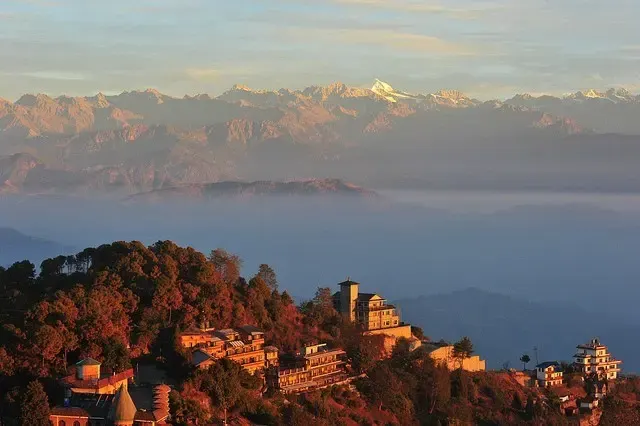
At 2,175 m above sea level, Nagarkot sits on the eastern rim of Kathmandu Valley and offers one of the most spectacular sunrise panoramas of the Himalayas accessible by road. The ride begins in Kathmandu and follows the Bhaktapur highway before climbing steadily through Newari villages and terraced rice paddies. The final push to the view tower is steep, expect some walking if you are on a heavier mountain bike.
The reward is worth every metre of effort. On a clear morning you can see a 200-kilometre arc of peaks from Dhaulagiri in the west to Kanchenjunga in the east, with Everest, Lhotse, and Makalu clearly visible in between. Consider staying overnight and timing your morning for sunrise, then enjoy a long, flowing descent back through pine forests above Bhaktapur. The Nagarkot route is also a great introduction to Newari culture, passing through villages where traditional architecture, stone courtyards, and roadside shrines have changed little in centuries.
2. Balaju – Kakani
Distance: 23 km one way | Elevation gain: ~900 m | Difficulty: Intermediate | Best time: October–April
Starting from Balaju, about 5 km north of Thamel, this route climbs through the Nagarjuna Forest Reserve, a protected area that begins almost immediately as you leave the city behind. The forest keeps the air noticeably cooler than the valley floor, and the road, while sealed, is quiet enough that you will often have it to yourself.
At the top of the initial ridge, a clearly marked T-junction gives you a choice: drop down toward Trishuli Bazar, or continue right toward Kakani (2,030 m). Take the right. After another 4 km of steady climbing, you reach a wide open ridge with sweeping views of the Ganesh Himal and Langtang ranges. Several tea houses line the ridge, making it a perfect spot to rest and eat dal bhat before the descent. On a clear day the view from Kakani is as good as Nagarkot with far fewer crowds.
3. Chobar – Champadevi
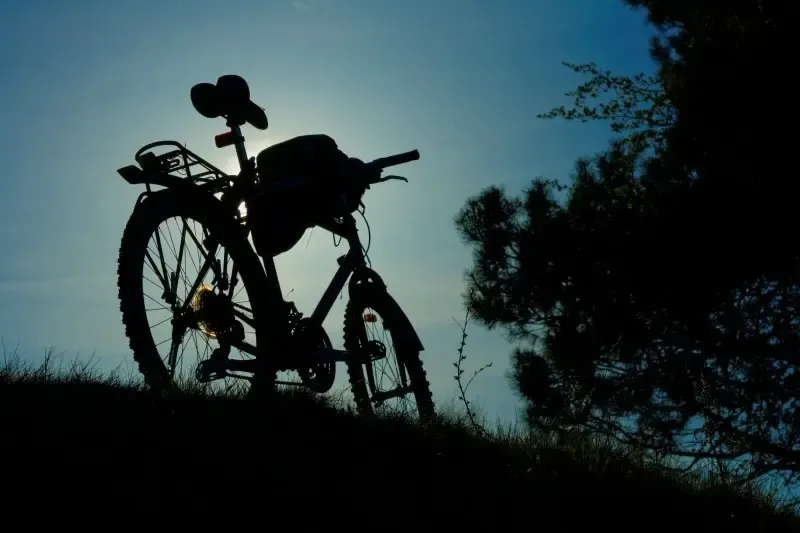
Distance: ~18 km round trip | Elevation gain: ~650 m | Difficulty: Intermediate | Best time: Year-round (avoid after heavy rain)
Chobhar Hill, just 10 km south of Kathmandu, makes for a satisfying half-day ride with a strong cultural component. The route passes Chobhar Gorge, where the Bagmati River cuts through a dramatic limestone cliff, and the ancient Jal Vinayak Temple, one of the four most important Ganesh shrines in the valley and an active pilgrimage site for local Hindus. From the gorge, a rugged 8 km trail through Chobar village climbs to the ridge at Champadevi (2,278 m).
From the summit ridge you can see the entire Kathmandu Valley spread below, with the white peaks of the Himalaya rising in the distance, including, on a clear day, the tip of Everest. The return can follow the same route or loop through Pharping, a monastery town with ancient cave temples carved directly into the cliff face. The Pharping descent is steep and rocky, enjoyable on a good mountain bike but demanding on a rental. Pharping's cave monasteries and the nearby Dakshinkali temple make this a rich cultural ride as well as a physical one. Allow 4–5 hours for the round trip.
4. Patan – Lakuri Bhanjyang
Distance: ~18 km one way | Elevation gain: ~900 m | Difficulty: Intermediate | Best time: October–April
This route starts in Patan, the City of Fine Arts, and works its way south-east through the historic Lubhu neighbourhood before hitting the open hills above the valley. After a few kilometres of urban roads, the trail narrows to a rugged jeep track that climbs steadily through Tamang and Chhetri villages with terraced fields on either side and wide views opening up behind you.
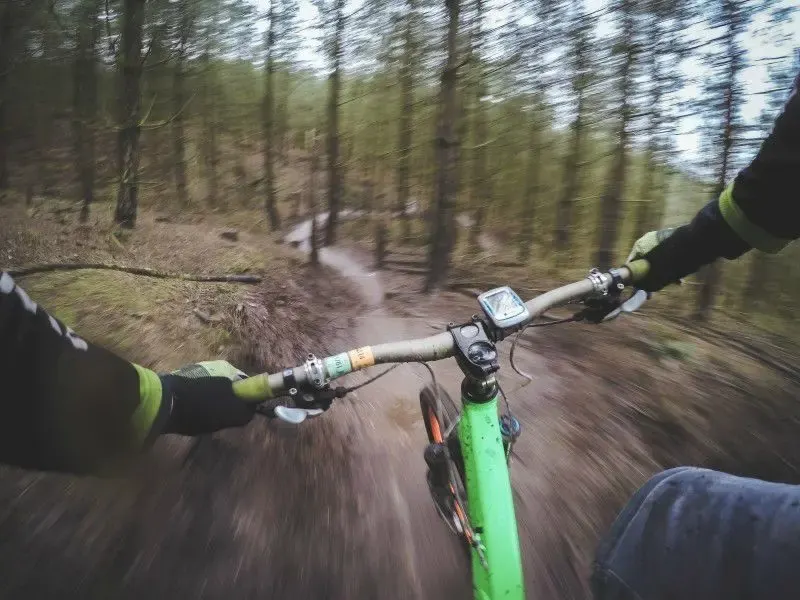
The final 500 m of switchbacks to Lakuri Bhanjyang (1,982 m) is the hardest stretch, narrow, steep, and exposed. At the top, the views reward the effort: the valley on one side and the forested Bebar Khola valley, home to ancient Newari, Tamang, and Chhetri settlements, on the other. From the pass you can descend to Godawari on a fast sealed road, or press on to Panauti, a wonderfully preserved medieval Newari town with 14th-century temples that very few tourists ever reach. Both options are excellent.
5. Satdobato – Lamatar – Lakuri Bhanjyang – Panauti – Banepa – Kathmandu
Total distance: ~65 km | Elevation gain: ~1,500 m | Difficulty: Advanced | Best time: October–May (avoid in monsoon)
This is the valley's classic full-day epic, a circuit that takes you out of Kathmandu to the south, over the Lakuri Bhanjyang ridge, down through the old Newari landscape to Panauti, and back to the city via the Araniko Highway. Start at Gwarko (Satdobato) on the southern Ring Road and follow the road to Lamatar, climbing steadily through small settlements and rhododendron forest all the way to Lakuri Bhanjyang.
The descent to Panauti is the highlight of the route: a long, mostly smooth downhill through a quiet rural valley where you are unlikely to meet another tourist. Panauti itself is well worth an hour of exploration, its 14th-century Indreshwar Mahadev temple and the sacred confluence of the Roshi and Punyamati rivers are genuinely impressive, and the town moves at a pace that feels centuries removed from Kathmandu's chaos.
From Panauti, a flat 8 km road leads to Banepa on the Araniko Highway, and from there it is a straightforward 25 km ride back to Kathmandu. Start early, carry at least 3 litres of water, and avoid this route after heavy rain, the Lakuri trail becomes slippery and the final highway section can be wet and busy. Allow a full 7–8 hours including stops.
Practical Tips for Cycling Kathmandu Valley
A few essentials before you set out:
- Best season: October to April. The monsoon (June–September) makes steep dirt tracks slippery and reduces Himalayan visibility significantly, stick to sealed roads only if you ride during this period.
- Bike hire: Thamel has dozens of rental shops. Basic mountain bikes cost $5–8 per day; decent hardtails with better components run $15–20. For Nagarkot, Lakuri Bhanjyang, or the full Panauti circuit, invest in a quality bike, your knees on the descent will thank you.
- Start early: Leave by 7am before Kathmandu traffic builds. The Ring Road and main arteries become frustrating to navigate on a bike after 8am.
- Water: Carry at least 2 litres. Altitude and sustained climbing dehydrate you faster than expected. Fill at teahouses along the ridge sections.
- Helmets: Bring or rent one. Traffic on the Ring Road and the Araniko Highway is dense and fast, this is non-negotiable on routes that use them.
- Route conditions: Main arteries are sealed but potholed. Jeep tracks and single-track sections become hazardous after heavy rain, check locally before committing to off-road descents.
Before you ride, it is worth spending a day exploring the city's sites on foot, the top attractions of Kathmandu give you context for the villages, temples, and courtyards you will pass through on two wheels. And if the valley routes have whetted your appetite for more serious mountain cycling, our Mountain Biking in Mustang is one of the great high-altitude cycling adventures in the world.