


Tengboche Monastery: The Spiritual Heart of the Khumbu
Tengboche Monastery (3,867 m) is the largest Buddhist monastery in the Khumbu and the fourth night's stop on the Everest Base Camp trek, a five to six hour walk from Namche Bazaar. Founded in 1916 and rebuilt after a fire in 1989, it belongs to the Nyingma school and is home to several dozen monks. Visitors can watch the afternoon prayers, usually around 3 pm. Each autumn it hosts Mani Rimdu, a festival of masked dances. From the meadow outside you see Everest, Lhotse, Nuptse and Ama Dablam.
- Altitude3,867 m / 12,687 ft
- Founded1916, rebuilt 1989 to 1993
- SchoolNyingma, Tibetan Buddhism
- From NamcheAbout 10 km, 5 to 6 hours
- Prayers open to visitorsAfternoon, usually around 3 pm
- FestivalMani Rimdu, October or November
Tengboche Monastery, also known as Dawa Choling Gompa or Thyangboche Monastery, is the spiritual and cultural heart of the Sherpa community. It is located in the village of Tengboche in the Khumbu region of eastern Nepal. The monastery sits at an altitude of 3,867 meters (12,687 ft) above sea level and is considered the largest Gompa in the Khumbu region.
As a significant stop on the Everest Base Camp trek, the monastery offers trekkers a unique blend of spiritual serenity and breathtaking views of the surrounding Himalayas, including Mount Everest.
Tengboche Monastery was founded in 1916 by Lama Gulu. It is linked to the Rongbuk Monastery in Tibet, which is also regarded as its mother monastery. Lama Gulu built the monastery on the site of an ancient hermitage that Tibetan saints had used for centuries.
The Gompa has been destroyed twice. In 1934, a massive earthquake struck and brought down the building, and it was rebuilt. Then in 1989, a fire caused by an electrical fault gutted the rebuilt monastery. Sherpa families, volunteers and international donors came together to rebuild it, and the new monastery was consecrated in 1993.
Today, Tengboche Monastery is home to several dozen monks living and working in the monastery's many temples and shrines.
It is located in the middle of a UNESCO World Heritage Site, Sagarmatha National Park. It sits in a perfect landscape with a view of majestic mountains, including famous peaks like Ama Dablam, Taboche, Everest, Nuptse, Lhotse, and Thamserku.
Tengboche is a central point of the 'Sacred Sites Trail Project' and links about ten monasteries and holy sites in the region, from Tengboche to Pangboche and Khumjung.
How To Reach Tengboche Monastery?
If you are to take a journey to Tengboche Monastery, you will have to leave for Lukla by flight or without it. From Lukla, your next stop will be at Namche Bazaar, which is at 3,440 meters/11,286 feet. You can make your stop there and cherish the beauty of the town before heading to Tengboche Monastery.
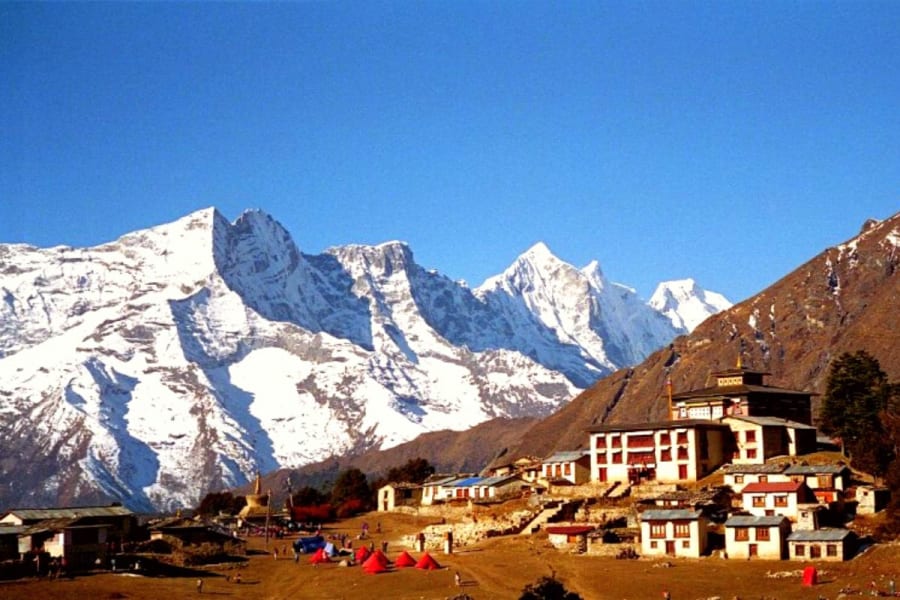
From Namche the trail contours along the hillside past Kyangjuma and Sanasa, with Everest and Ama Dablam (6,812 meters/22,349 feet) in view most of the way. In April and May the forests below Tengboche are full of flowering rhododendrons.
The routes are rugged and might be challenging for passive travelers. But the reflection of nature in your eyes will be satisfying. After hours of hiking, you will reach Dudh Koshi River at Phungi Tenga, at 3,250 meters/10,662 feet. Phunki Tenga is a small cluster of teahouses with water-driven prayer wheels, a good place for lunch. The river here is grey with glacial melt.
After the bridge comes the hardest part of the day, a steady climb of about 600 m through pine and rhododendron forest. It takes most trekkers two to three hours. The whole day from Namche is about 10 km and five to six hours.
At 3,867 meters/12,687 feet, there stands a large rock gate of the Tengboche Monastery, and as you pass through it, you are now in the broad arms of the Gompa. You can find a green grassy area directly ahead of you, and to the left is your destination, Tengboche Monastery: one of the finest Tibetan Buddhist monasteries in Nepal.
Namche to Tengboche on the altitude profile
The day drops about 190 m to the river before climbing about 600 m to the monastery, so you finish roughly 430 m above where you started.
| Point | What happens | Altitude |
|---|---|---|
| Namche Bazaar | Start | 3,440 m |
| Phunki Tenga (river) | Lunch, then the climb | 3,250 m |
| Tengboche Monastery | Overnight | 3,867 m |
| Deboche | Extra lodges, 15 to 20 min on | 3,820 m |
What To Know Before Entering The Monastery?
Tengboche is a working monastery, so visitors are welcome as long as they follow a few simple customs. How you dress and behave matters here.

The main point is you make sure that you pay a warm homage to Lord Buddha. Also, keep in mind that you are dressed modestly and correctly because the Gompa does not allow travelers with more revealing outfits. Similarly, no one is allowed to make physical contact with the monks, which is considered taboo. In addition, you are not supposed to step or stand on the door's threshold since the Buddhists believe it is Lord Buddha's shoulder.
Here are some of the lists of conducts we have prepared for you to know before heading to Tengboche Monastery:
-
Make sure you enclose disciplined activities around the Gompa.
-
Your gesture of praying in Gompa is a crucial factor in your manner.
-
You are not allowed to take photos/videos in restricted areas of the monastery. Follow the instructions provided by your guide or local.
-
Learn to greet Buddhist monks. Please show them some respect.
-
You are supposed to walk in Kora in A Clockwise Manner.
-
Bring offerings to Lord Buddha. Most people bring sang (juniper incense) or a small donation for the butter lamps.
What Can You Learn From Visiting Tengboche Monastery?
If you are interested in Tibetan culture and history, visiting the Tengboche Monastery is a must. The monastery is located in the Tengboche village in Khumjung and was founded in 1916. It is one of the largest and most important monasteries of the Nyingma school of Tibetan Buddhism.
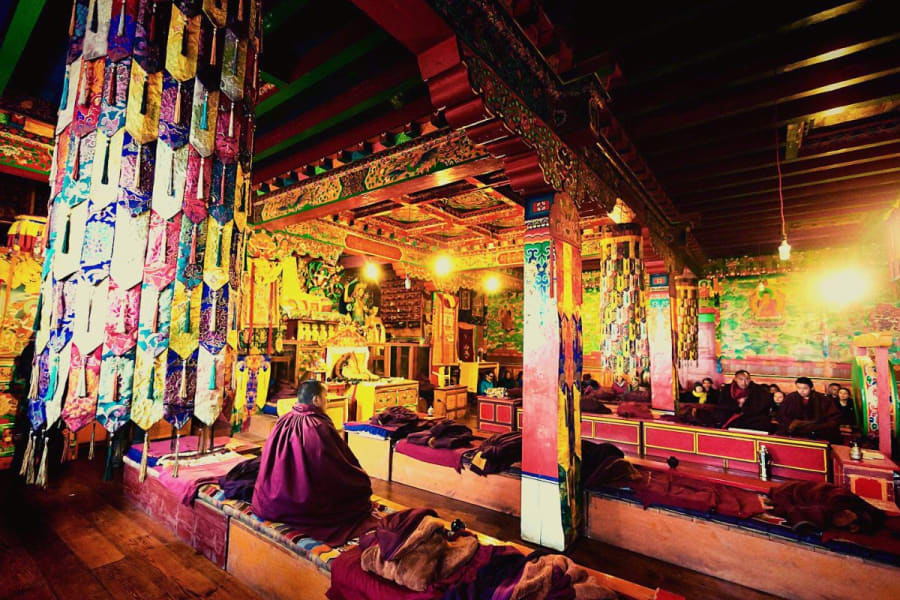
The monastery is home to several dozen monks and is an important learning centre. The monastery has an extensive library with thousands of manuscripts and books, many of which are rare and valuable. The sanctuary also has a museum with a collection of artifacts from Tibetan history and culture.
A visit to the Tengboche Monastery is an opportunity to learn about Tibetan culture, religion, and the region's history. You can also see beautiful artwork and architecture and meet some friendly monks!
Traditional Tibetan Buddhist Rituals at Tengboche Monastery
Tengboche Monastery follows the Nyingma tradition of Tibetan Buddhism. Its most famous celebration is the Mani Rimdu festival, held each October or November at the full moon of the tenth Tibetan month: nineteen days of rituals culminating in three days of public masked dances that draw trekkers and Sherpa families from across the Khumbu.
The monastery has several traditional Tibetan Buddhist rituals that are performed on a daily basis. These include the recitation of prayers, the performance of puja (worship) ceremonies, and the practice of meditation.
The monastery also trains young monks, who study scripture, ritual music and the masked dances performed at Mani Rimdu.

Accommodation Facilities Around Tengboche Monastery
Tengboche has only a handful of teahouses around the meadow, and they fill up fast in October and November, especially during Mani Rimdu. Many groups sleep at Deboche, 15 to 20 minutes further on and slightly lower, where there are more lodges.
Rooms are basic, twin beds with blankets, and there's a bakery on the meadow for cake and coffee with the mountains.
The Gompa is about 430 meters (1,400 feet) higher than Namche Bazaar.
An Overview of Tibetan Buddhism
Tibetan Buddhism is the form of Buddhism practiced in Tibet, which combines elements of Indian Vajrayana Buddhism with the indigenous Tibetan religion. Chinese Buddhism and Mongolian Buddhism also influence it. Tibetan Buddhism has a unique character among the various forms of Buddhism due to its geographical isolation and development in a cultural and religious milieu quite different from other Buddhist traditions.
A distinctive feature of Tibetan Buddhism is its system of recognised reincarnate lamas (tulkus), such as the Dalai Lama, alongside its Vajrayana tantric practices. Tibetan Buddhists also strongly emphasize meditation and developing a personal relationship with their chosen deity or deities.
One of the most important aspects of Tibetan Buddhist practice is a pilgrimage. Pilgrims travel to holy sites associated with the Buddha or with specific saints and bodhisattvas (enlightened beings). These pilgrimages can be very long and arduous, sometimes taking months or even years to complete.
Tibetan Buddhist monasteries are often located in remote, mountainous regions. The best-known Tibetan Buddhist landmark is probably the Potala Palace in Lhasa, home of the Dalai Lamas for centuries, while famous monasteries include Tashilhunpo, Samye, and Ganden.
Tengboche Monastery: FAQs
Can tourists go inside Tengboche Monastery?
Yes. The prayer hall is open to visitors outside private ceremonies, and you can sit quietly at the back during the afternoon puja. Take off your shoes and hat, and don't photograph inside without permission.
How high is Tengboche Monastery?
3,867 m (12,687 ft), about 430 m higher than Namche Bazaar.
When is the Mani Rimdu festival at Tengboche?
At the full moon of the tenth month of the Tibetan calendar, which falls in October or November. The dates change each year, so check them before you book if you want to see the masked dances.
Can you see Everest from Tengboche?
Yes. From the meadow in front of the monastery, Everest's summit shows above the Nuptse-Lhotse ridge, with Ama Dablam to the right. The light is best early in the morning.