


Best Time for the Everest Base Camp Trek and Helicopter Tour
The best time for both the Everest Base Camp trek and the helicopter tour is October and November, when the air after the monsoon is the clearest of the year. April and May are a close second, with warmer days, rhododendrons and expedition tents at base camp, though cloud builds most afternoons. December to February is clear but cold. June to August is the monsoon, the worst time for views and for Lukla and helicopter flights.
The highest mountain in the world, Mt. Everest, is situated in the Northeast part of Nepal (Khumbu region). Even though it is possibly everybody’s dream to see Everest in person, there are different factors that might make it quite a process. Whether you plan to trek to Everest Base Camp on foot or see it on a helicopter tour, this is just the guide you need!
The classic Everest Base Camp trek takes 12 to 14 days from Lukla, while a helicopter tour covers the same ground in just 3 to 4 hours from Kathmandu. Flying above the small valleys, colorful villages, Chortens, prayer flags, and enjoying the sights of lakes and glaciers are other exciting experiences of this tour. Along with Everest, other majestic mountains like Mt. Lhotse (8516 m / 27940 ft), Mt.Nuptse (7861 m / 25791), Mt. Ama Dablam (6812 m/ 22349 ft), Mt. Pumori (7161 m / 23494 ft), etc. will be visible during Everest base camp helicopter tour.
There is not necessarily any time restriction to fly to Everest Base Camp. However, choosing the right season and month is important to avoid bad weather and make the most out of your tour. It is best to avoid the Summer/ Rainy season ( June, July, and August), for flying in the rain, dark clouds, and thunder is dangerous. The view of Everest won’t be very clear either.
Winter (December, January, and February) is cold, with short days. The skies are often very clear, but snow and high winds up high cancel flights more often than in Spring (March, April, May) and Autumn (September, October, and November), so check the weather before the Everest base camp helicopter tour and keep a spare day.
Hence, the apt time for the helicopter tour for the best view, perfect weather, and experience is during the Spring and Autumn. In case you make up your mind to take the Everest base camp helicopter tour during any of the four seasons, here is what to expect:
Best Time for the Everest Base Camp Trek
For trekkers, the same two windows rule. Late September to November is the prime season: post-monsoon skies are at their clearest, trails are dry, and every teahouse is open, though Lukla flights and lodges in Namche and Dingboche book out fast. March to May is a close second, with warmer days, rhododendron forests in bloom below Namche, and the buzz of expedition teams gathering at Base Camp itself. Winter trekking (December to February) is entirely possible for well-equipped walkers who want empty trails, but expect nights around -20°C at Gorak Shep and occasional snow over the high sections. The monsoon months are the hardest sell: the mountain views hide behind cloud for days, and Lukla flight delays multiply. Whichever season you choose, build in acclimatization days and a buffer day or two for weather. Our guides to Everest Base Camp elevation, trekking EBC in July and the Everest Base Camp trek in winter cover the details.
Everest Base Camp Month by Month
Each month is rated for the trek and for the helicopter tour, on a scale of Best, Good, Possible and Avoid.
| Month | Trek | Helicopter tour | What to expect |
|---|---|---|---|
| January | Possible | Good | Clear and very cold, nights near -20 C at Gorak Shep |
| February | Possible | Good | Cold, quiet trails, some high lodges still closed |
| March | Good | Good | Warming up, snow possible early in the month |
| April | Best | Best | Rhododendrons, expedition tents at base camp |
| May | Good | Good | Warm, haze and afternoon cloud build late in the month |
| June | Avoid | Avoid | Monsoon arrives mid-month, flight delays begin |
| July | Possible | Avoid | Wettest month, clear spells early in the morning |
| August | Possible | Avoid | Rain eases late in the month, leeches lower down |
| September | Good | Good | Monsoon clears in the second half |
| October | Best | Best | Clearest skies of the year, busiest trail |
| November | Best | Best | Clear and dry, colder nights |
| December | Good | Good | Clear, cold and quiet |
Helicopter tours in 2026. In December 2024 the Khumbu Pasang Lhamu Rural Municipality announced a ban on commercial sightseeing flights above Lukla from 1 January 2025, which Nepal's aviation authority disputed. Swotah's Everest helicopter tours, with landings at Kala Patthar and the Everest View Hotel, are operating normally in autumn 2026. Our article on the Everest helicopter flight ban has the background.
And for the helicopter tour itself, season by season:
Spring season
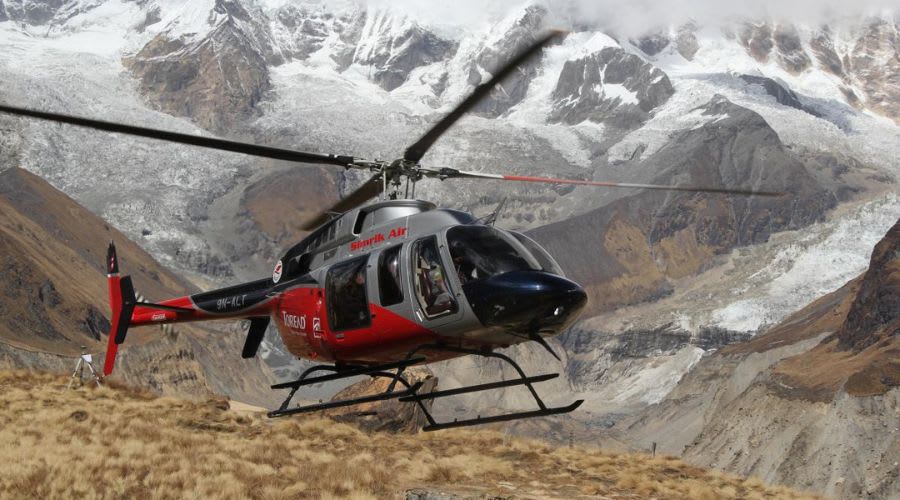
Spring season is the perfect time for the Everest Base Camp helicopter tour. In Nepal, the month of March marks the start, and May marks the end of Spring. Days reach about 20 to 25 degrees Celsius in Kathmandu, while nights at base camp can still fall to around -10 degrees Celsius.
Mornings are usually clear, with blue skies and rhododendrons in flower lower down. Cloud builds most afternoons and haze increases through May, so book an early departure. Spring is one of the two best windows for the Everest base camp helicopter tour.
Summer/ Rainy season/ Monsoon
Monsoon in Nepal lasts for three months, namely June, July, and August. These months experience heavy and continuous rainfall. The highest temperature of this period is around 15/16 degrees Celsius during the day, and the lowest temperature is around -1/-2 degrees Celsius during the night.
Planning the Everest Base Camp helicopter tour during this time is not the wisest decision. Pilots won't fly in poor visibility, so tours are cancelled or postponed often throughout the summer. When a flight does go, cloud usually hides Everest.
A monsoon tour can be arranged if your dates are fixed, but keep two or three spare days and expect the view to be a gamble.
Autumn season
Like spring, the Autumn season is also pleasant and ideal for the tour. This season begins in September and ends in November. The temperature is neither too hot nor freezing cold. During the day, it ranges from 12 degrees Celsius to 18 degrees celsius, and during the night, it can drop down from 7 degrees Celsius to -5 degrees Celsius.
The surroundings are clear and have a cool, relaxing temperature in Autumn. Since clouds are generally cleared by this time, navigating the way gets easier. The visibility is also really good. There are fewer chances of any mishaps. October and November have the clearest air of the year, which makes autumn the best season for photos from the helicopter.
Winter season
Winter season is right for the Everest Base Camp helicopter tour. It begins in the month of December and ends in February. January month has the coldest temperature of the entire year, which can drop to around -20 to -25 degrees Celsius at Base Camp altitude at night.
The Himalayas look their whitest in winter, with fresh snow down to the valleys. The navigating way should not be much of an issue, either. But one has to be aware of the snowfall cause it may hamper the helicopter ride.
Also, a severe cold can make one sick easily. There are possibilities of the flight being canceled because of the weather occasionally. Check the weather forecast beforehand, and you should be good to go. Overall, winter is a good season for the helicopter tour if you can be flexible by a day.

Photo: Everest and Nuptse View from Kala Patthar
Safety Tips for the Everest Helicopter Tour
All the helicopter rides to the Everest base camp are planned and executed by people with years of experience. Still, there are a few things that you can do from your side to make the experience even smoother. Here are a few safety guides to follow to prevent any sort of accidents and enjoy the Everest Base Camp helicopter tour to the fullest:
Know that you are going high fast. The tour climbs from Kathmandu at 1,400 m to Kala Patthar at about 5,545 m in roughly an hour, with no time to acclimatise. Stops up high last 5 to 10 minutes. Move slowly, don't run, and tell the pilot at once if you feel dizzy or short of breath.
Check with your doctor first if you have a heart or lung condition, high blood pressure, or are pregnant. These are the conditions altitude affects most.
Dress for minus 10 degrees Celsius at the landing site: a down jacket, hat, gloves, sunglasses and sunscreen, even if Kathmandu is warm.
Expect to be weighed. Helicopters can lift less in thin air, so the pilot may carry fewer passengers up to Kala Patthar and shuttle the group in turns.
Keep your seatbelt on, keep loose items secure, and follow the pilot's and ground crew's instructions, especially around the rotor when you get in and out.
Book the earliest slot you can. Mountain weather is clearest in the morning, and flights are often called off once afternoon cloud and wind build.
Why Everest Base Camp Helicopter Tour?
You might want to know why so many people gush about the helicopter ride to the Himalayas. To start one does not need to walk there and can be comfortably seated while looking at Everest and the peaks around it. This might sound boring to people who want adventure and are in good shape. For those who are physically unable to get there, this Everest base camp helicopter tour is a life savior.
Not to forget we can not just spend two weeks traveling around. They still want to see Everest. These people generally find the Everest base camp helicopter tour the best alternative to save time yet indulge in sightseeing of the glorious mountains.
A helicopter ride to Everest is hard to forget. Some people dream of being part of this, for it is adventurous and gets close to the highest landmark on the earth. How exciting and thrilling is that? Flying above the beautiful landmarks, mountains, glaciers, lakes, small valleys, Kathmandu city, and vivid temples, monasteries, and /or gompas, what can compare to this? These points just prove the Everest base camp helicopter tour hype is absolutely worth it.
Best Time for Everest Base Camp: FAQs
What is the best month to trek to Everest Base Camp?
October. It has the clearest, driest weather of the year and every lodge is open. November is almost as good and a little quieter, and April is the best month in spring.
What is the best month for an Everest helicopter tour?
October and November, followed by April. Book a morning flight in any season, because cloud usually builds by early afternoon.
Can you trek to Everest Base Camp in the monsoon?
Yes, but expect rain most afternoons, leeches below Namche, cloud over the peaks and delayed Lukla flights. Mornings are often clear. Our guide to the EBC trek in July explains how to make it work.
Can you trek to Everest Base Camp in winter?
Yes, with a four-season sleeping bag and proper down clothing. Nights at Gorak Shep drop to around -20 degrees Celsius and some high lodges close. See the Everest Base Camp trek in winter.
When are the climbing expeditions at Everest Base Camp?
From about early April to early June. Outside those weeks base camp is a quiet stretch of moraine and prayer flags.