





In brief we recommend the best time to visit Mount Kailash is in spring and autumn. Indeed the main season for pilgrims to this area is mid-April to mid-October.
Since Mount Kailash sits high in the Himalayan mountains, and to do the Yatra (or Kora) round the mountain means being at around 5,000 m / 16,404 ft for several days, we suggest you do not go in the winter due the cold, many guest houses being closed, and no guaranteed the route around Mt Kailash will be open. With temperatures in the day being around -1o C / 30 °F and falling to as low as -34°C / -29°F, at night, you really don’t want to be there!
If you are thinking of the summer – which is monsoon in much of Asia, including Nepal – from June to September then know that the temperatures in Tibet can be very pleasant in the day time, even reaching to 18°C / 64°F. This is a very popular time to visit Kailash despite it being cold in the night and having some snow on the high passes. But bear in mind you have to drive from Kathmandu to the Chinese border and onto the Tibetan Plateau. And while the plateau itself may be dry the road from Kathmandu may be subject to landslides and floods which will delay progress. Interestingly, in 2025 there was a rare occurrence. The monsoon winds enabled the rains to cross over the Himalayas onto the Tibetan Plateau. Normally the mountains act as a barrier to the rains. Experts say this could be because of climate changes, potentially bringing about environmental changes.
So yes, we still stand by our ‘recommended best time’ of mid-April to mid-October.
Auspicious Times
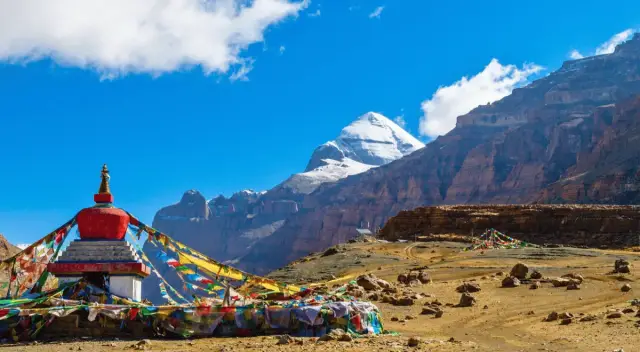
For people of four different religions, Tibetan Buddhists, Hindus, Jains and Bon people, Kailash stands at the centre of the world. Revered and sacred they all have different, yet oddly similar reasons why this mountain is so important. Straddling (more or less) the countries of Nepal, China and India, it is, even to the non-religious eye, amazing that this mountain is shaped as a rough triangle and sits in a triangle position between these three countries.
You might want to do some research yourself if you are interested in the history and mystery of this area. In brief, Hindus believe Lord Shiva, the creator of the universe, sits atop the mountain along with his wife, Paravati. For the Jains, whose core belief is in non-violence, they believe this is where Rishabhanatha, a figure central to their spiritual practices, obtained enlightenment. Those who follow the Bon religion, which pre-dated Buddhism, believe the founder of their religion descended from Mt Kailash. And as for the Buddhists, they believe the deity Chakrasamvara, of Vajrayana Buddhism, who is a wrathful male, with four faces and twelve areas, his consort is Vajravarahi live here. Buddhists also believe Mt Kailash is connected with the spiritual journey of Milarepa, yogi and poet.
The most auspicious time to visit Kailash is during the Saga Dawa festival which celebrates the birth, enlightenment and death of Buddha. Saga Dawa is celebrated in Nepal too, but it is on the Kora of Mt Kailash that most Buddhists would like to celebrate this festival at least once in their lives. Saga Dawa takes place in May and is celebrated for a whole month. This month is a time to do acts of merit, with the main day falling on the 15th of the month at full moon. This day is celebrated as the birth, enlightenment (nirvana) and ‘parinirvana’ – the final state of nirvana reached after death if one has achieved enlightenment during their life. It means the end of suffering, the end of rebirth (samsara) and freedom from karma.
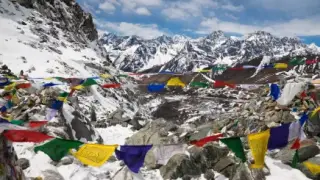
There are lots of ceremonies and festivals being held during Saga Dawa but the most important is the raising of a flagpole, around which people will walk in prayer. When the flagpole is taken down then the old prayer flags which have been hung around during the previous year are taken down and new flags erected onto the flagpole which is again raised.
This is an exciting time to visit Mt Kailash when the Kora (Yatra) will be filled with pilgrims, noise, colour and sounds of chanting and prayers. It will also be extremely busy and hard to find ponies (should you wish to hire one) or accommodation. Booking well in advance if recommended!
What is the best time for you to visit Kailash?
Definitely the answer is still spring and autumn. The autumn is a great time for photography as the skies are clear. And with the weather a little warm, it’s a good time for trekking.
The month of May with the Saga Dawa festival is also a very good time if you are interested in photography of people as well as landscapes. It’s a time when those interested in culture and learning how different peoples worship and travel will be in their element. On the other hand, if you do not like crowds, perhaps it’s best to go before or after Saga Dawa!
Also, if you are planning to hire a pony for the first 1.5 days (the ponies do not cross the high Dolma La Pass at 5,600 m / 18,373 ft) it’s probably best to avoid the times when the Kora will be at its busiest. Having said that, many Tibetan pilgrims can do the whole Kora in one day! That is because they are used to the high altitude and the strenuous hiking that living in Tibet can entail. You may see some pilgrims doing prostrations every few feet, and for them, it can take the whole month to complete the Kora.
For visitors from elsewhere, it takes three days to do the Kora because of the altitude. We assume you are not prostrating yourself on the ground every five feet so will not take a month! For you, the second day is the longest and toughest (even if you hire a pony).
Trekking round Mount Kailash is not to be taken lightly. But if you have a good level of fitness and are interested in the culture, devotion and practices of the area, this trek is unlike any other.