



Green Boots Recovery 2026: India's Plan to Bring the Everest Body Home
India has launched a mission to bring home one of Mount Everest's most recognisable casualties. In June 2026 the Indo-Tibetan Border Police (ITBP) floated a tender to hire a high-altitude recovery agency to retrieve "Green Boots," the body of a climber that has lain in a limestone alcove at around 8,500 m (about 27,700 ft) on Everest's north side since 1996. Green Boots is the unofficial name for that body, a grim landmark passed by north-side summit climbers for almost 30 years. The ITBP wants the recovery completed in the 2026 climbing window between June and September, carried out in line with religious and cultural protocols. This is what the plan involves, who Green Boots is, and why bringing him down is so hard.
What India has announced
The ITBP issued a formal tender in June 2026 to hire an experienced agency for the recovery, the clearest move yet on a body that has been discussed for years. The brief is demanding: the winning bidder must field at least six highly experienced Sherpas skilled in technical retrieval above 8,000 m, secure permission from the Chinese authorities in Tibet who control the north side, arrange cross-border transport through Nepal, and complete the legal repatriation of the remains to India. The whole operation is to follow religious and cultural protocols, and the ITBP wants it finished within the 2026 season, which on the north side runs roughly June to September. The tender names the climber as Lance Naik Dorje Morup, though, as below, the identity has never been settled.
Who is Green Boots?
Green Boots was a member of a six-man Indo-Tibetan Border Police team attempting the first Indian ascent of Everest from the Tibetan north side in May 1996. On 10 May 1996, three of them, Subedar Tsewang Smanla, Head Constable Tsewang Paljor and Lance Naik Dorje Morup, pushed for the summit late in the day and were caught in the same ferocious blizzard that killed climbers on the Nepalese south side, the storm made famous by the 1996 Everest disaster. None of the three came down. The body that became "Green Boots," named for the climber's bright green mountaineering boots, came to rest in a small limestone cave at about 8,500 m on the north-east ridge. For years it was widely identified as Tsewang Paljor, who died at 28; the ITBP tender instead names Dorje Morup, and the true identity is one of mountaineering's unresolved questions. Whether the team actually reached the summit before they died is also disputed.
Why the body stayed for 30 years
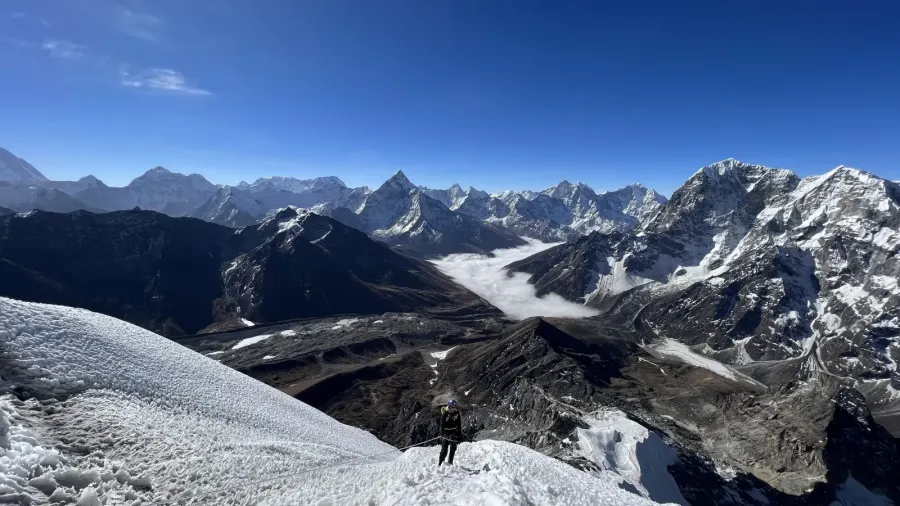
The body sits in the "death zone" above 8,000 m, where there is barely a third of the oxygen available at sea level and the human body steadily deteriorates. At that altitude a frozen body can weigh well over 100 kg once ice-locked, and moving it across exposed, technical ground is slow and extremely hazardous. The cold also preserves remains for decades, which is why Green Boots stayed visible and intact for so long. Around 2014, Chinese mountaineers are reported to have moved the remains under a boulder to reduce their visibility on the route, and the body was seen less often afterwards. For most of three decades, the practical answer to "why not recover it" was simply that the risk and cost to living climbers were judged too high.
Why recovering it is so difficult
A recovery above 8,000 m is among the hardest operations in mountaineering, which is why the ITBP tender reads the way it does. The team needs at least six elite Sherpas working in a zone where every task takes far longer and rescue of the rescuers is almost impossible. The north side is controlled by China, so the operation needs Tibetan-side permission, while the logistics and repatriation route run through Nepal, adding a cross-border layer. The work can only happen in a narrow weather window, and even then a sudden storm, like the one that killed the team in 1996, can shut the mountain down. Bringing a body of that weight down technical terrain, then across an international border and through legal repatriation, is a major undertaking, not a single climb.
The bigger picture on Everest
Green Boots is one of more than 200 bodies thought to remain on Everest, most of them above the death zone where recovery has long been impractical. That is starting to change. Nepal's army has run an annual high-altitude cleanup since 2019, bringing down tonnes of rubbish and several bodies, and in late 2025 Nepal announced a five-year Everest Cleaning Action Plan for 2025 to 2029, with trials of heavy-lift drones that can ferry loads from the high camps. India's move on Green Boots fits this shift toward recovering the mountain's dead and treating them with dignity rather than leaving them as landmarks. For the wider story, see our guides to the Green Boots of Mount Everest, the bodies that remain on Everest, and the 1996 Everest disaster.
What to watch next
The next milestone is whether the ITBP awards the tender and a recovery team reaches the body inside the June-to-September 2026 window. If it succeeds, it would be one of the highest body recoveries ever attempted on Everest and would finally return a climber who has marked the route for almost 30 years. We will update this story as the mission progresses. If Everest's history draws you to the mountain itself, our Everest Base Camp Trek walks the Nepalese approach to the foot of the world's highest peak.