


Everest Base Camp Trek Training: Fitness, 12-Week Plan & Altitude Prep
You do not need to be an athlete to trek to Everest Base Camp, but you do need trained endurance: the ability to walk 5 to 7 hours a day, on uneven uphill trails, with a light daypack, for roughly 12 days in a row, with the air thinning to half its sea-level oxygen near the 5,545 m high point at Kala Patthar. Training for the Everest Base Camp Trek is a structured fitness build-up, mostly cardio and leg endurance, over the two to three months before you fly to Lukla. This guide answers how fit you actually need to be, how long to train, a week-by-week plan, and what training can and cannot do about altitude.
How fit do you need to be for Everest Base Camp?
Everest Base Camp is a non-technical trek, so the fitness you need is aerobic endurance, not climbing skill. There are no ropes, crampons or exposed scrambling on the standard route; the challenge is repetition and altitude. A useful benchmark: if you can hike 6 to 7 hours over hilly terrain carrying a 5 to 6 kg daypack and feel tired but fine the next morning, you have the base fitness to start the trek. You do not need to run marathons. What stops people is rarely the legs on day one; it is the cumulative load of consecutive long days combined with reduced oxygen above 4,000 m. Building cardiovascular endurance is the single most useful thing you can do.
How long should you train before the trek?
Most trekkers should train for 8 to 12 weeks before departure. If you already exercise three or more times a week, 8 weeks of focused preparation is usually enough. If you are starting from a sedentary base, give yourself 12 weeks or more so the build-up is gradual and injury-free. Starting earlier is never wasted, and the goal is to arrive in Kathmandu able to repeat long days, not to peak for a single hard effort. Consistency over two months beats a frantic two weeks.
The 12-week Everest Base Camp training plan
This plan builds in four phases. Adjust the starting point to your current fitness, and train four to five days a week.
- Weeks 1 to 4, base: three cardio sessions a week (brisk walking, jogging, cycling or swimming) of 30 to 45 minutes, plus two strength sessions focused on legs and core. Add one longer weekend walk of 2 to 3 hours.
- Weeks 5 to 8, build: raise cardio to 45 to 60 minutes and add hills or stair climbing. Make the weekend hike 4 to 5 hours and start carrying a 5 to 6 kg pack. Keep two strength sessions.
- Weeks 9 to 11, peak: the key block. Do back-to-back long hikes on consecutive days (for example a 5 to 6 hour hike on Saturday and a 3 to 4 hour hike on Sunday) with your loaded pack and the boots you will trek in. This teaches your body to recover overnight and walk again, which is exactly what the trek demands.
- Week 12, taper: cut the volume by half, keep movement easy, rest the last two or three days, and let your body arrive fresh.
Cardio is the most important part
Cardiovascular endurance carries the whole trek, so it should be the backbone of your training. Running, cycling, swimming, fast hill walking and stair machines all work; the best choice is the one you will do consistently. Aim to build to a continuous 60-minute effort at a conversational pace, then add hills. Stair climbing is the closest gym substitute for the Everest trail, which gains and loses height all day, so a stair machine or a tall building staircase with a daypack is excellent specific training.
Strength and core
Leg strength protects your knees on the long descents and powers the climbs, while a stable core keeps your posture under a pack. Two sessions a week covering squats, lunges, step-ups, calf raises, and planks are enough; you are training endurance and resilience, not maximum lift. Step-ups onto a bench while holding light weights mimic the trail closely. Strong quads and a strong core are what keep day 10 feeling like day 2.
Train on hills with a loaded pack
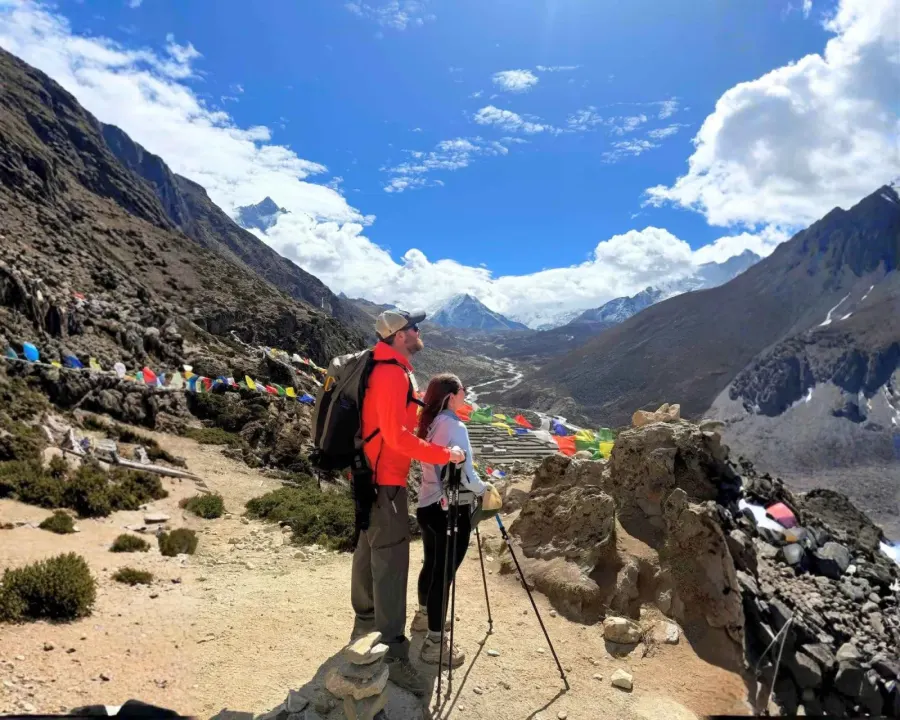
The principle that matters most is specificity: train the way you will trek. Walk on real hills, in your trekking boots, carrying the daypack you will use, ideally on back-to-back days. Treadmills and gyms build the engine, but hill walking with a load conditions the exact muscles, joints and feet that the Everest trail works. Breaking in your boots during training also prevents the blisters that end more trekking days than fitness ever does.
Altitude and acclimatisation: what training can and cannot do
Fitness does not make you immune to altitude. Acute mountain sickness (AMS) can affect fit and unfit people alike above roughly 2,500 m, because it is driven by how your body adapts to low oxygen, not by your VO2 max. Good fitness helps you walk efficiently and recover, but it cannot be trained at sea level, and being very fit can even tempt people to ascend too fast. The real altitude protection is the itinerary: the built-in acclimatisation days at Namche and Dingboche, a slow ascent profile, and sleeping lower than the day's high point. Read our guide on how to avoid altitude sickness on the Everest Base Camp trek alongside your training.
Older trekkers and those short on time
Plenty of trekkers in their 60s and 70s reach Everest Base Camp, and limited training time does not rule you out, it just changes the plan. If you cannot train much, build whatever cardio base you can, walk hills at every chance, and choose a slightly longer itinerary with extra acclimatisation so the daily effort is lower. A steady, well-paced trekker who trained moderately almost always does better than a fit trekker who rushed the ascent.
Everest Base Camp training at a glance
| Phase | Weeks | Focus |
|---|---|---|
| Base | 1-4 | 3x cardio + 2x strength + one 2-3 hr walk |
| Build | 5-8 | Hills/stairs, 4-5 hr weekend hike, add 5-6 kg pack |
| Peak | 9-11 | Back-to-back long hikes with loaded pack and trek boots |
| Taper | 12 | Halve volume, rest, arrive fresh |
Ready for the trail?
Train your cardio for two to three months, walk hills with a loaded pack, break in your boots, and let the acclimatisation schedule handle the altitude, and Everest Base Camp is within reach for most reasonably active people. For the route, season and day-by-day detail, see our complete Everest Base Camp trek guide and the Everest Base Camp Trek itinerary, or contact our team to plan a departure with the right number of acclimatisation days for you.