






Yes, Nepal now has a working e-visa. You apply on the Department of Immigration's official portal, NepaliPort, upload a passport scan and a photo, pay USD 30, 50 or 125 by card, and receive the approved visa by email. VisasNews tested it in September 2026 and got approval about three days after paying, so apply at least a week before you fly. The visa must be used within six months of issue. Visa on arrival at Kathmandu airport and the land borders has not been withdrawn, so the e-visa is optional for most nationalities.
- Where to applyNepaliPort, the official Department of Immigration portal
- Tourist visa feesUSD 30 / 50 / 125 for 15 / 30 / 90 days
- PaymentCard or Nepali wallets online, 3.5% convenience fee
- DocumentsPassport scan (6+ months valid), photo on a white background
- ProcessingAbout 72 hours quoted, one test took three days
- Use it within6 months of the issue date
- Visa on arrivalStill available for most nationalities
- AvoidThird-party visa websites, which the department warns against
This guide covers how the e-visa works in late 2026, how it compares with the older pre-arrival form and the visa on arrival, and where the system came from. For visa types, free visas and the nationalities that must apply at an embassy, see our Nepal tourist visa guide. For the airport steps and extensions, see visa on arrival and visa extension.
Nepal e-Visa in 2026: What Changed
The department told VisasNews on 3 August 2026, through its spokesperson Tikaram Dhakal, that the full e-visa would roll out on 17 August 2026. The date passed without a big official announcement, but the system was running by early September. VisasNews applied through it and published the steps on 7 September 2026, and the department's own ETA and eVisa page, updated on 25 October 2026, now walks applicants through the same process. The department calls the online visa an Electronic Travel Authorization (ETA) in some places and an eVisa in others. For a tourist they lead to the same visa.
Card payment was the missing piece for years. On 21 September 2025, the Financial Comptroller General Office, the immigration department and Nepal Clearing House switched on international card payments for visa fees, which is what made a fully online visa possible.
e-Visa, Pre-Arrival Form or Visa on Arrival?
| Option | What you do online | What happens at the airport | Best for |
|---|---|---|---|
| e-visa (ETA) | Apply, upload documents, pay by card, receive approval by email | Show the printed e-visa at the immigration desk. Biometrics are taken on arrival | Plan ahead Travellers who want approval before they leave |
| Pre-arrival form, paid online | Fill the visa form within 15 days of arrival and pay by card | Skip the bank counter, go to the immigration desk with the form and payment receipt | Quick Avoiding the payment queue |
| Visa on arrival | Nothing, or fill the form in advance | Use a kiosk, pay at the bank counter, then the immigration desk | Simple Last-minute trips, cash payers |
All three cost the same: USD 30 for 15 days, USD 50 for 30 days and USD 125 for 90 days. The online routes add a 3.5% card convenience fee (at least the rupee equivalent of USD 1). Citizens of the nationalities on the department's restricted list cannot use the visa on arrival and must apply in advance.
How to Apply for the Nepal e-Visa, Step by Step
- Open the official portal. Go to NepaliPort through immigration.gov.np and choose the Electronic Travel Authorization or eVisa application.
- Fill in your details. Personal details, passport data, travel dates, purpose of visit and your address in Nepal (your hotel is fine).
- Upload documents. A scan of your passport photo page, valid for at least six months, and a recent passport photo with a white background.
- Wait for verification. The status moves from Applied to Verified. In the VisasNews test this took about an hour.
- Pay. A payment voucher is generated. Pay by Visa, Mastercard, American Express or UnionPay, or with connectIPS or NepalPay QR. Download the receipt.
- Get the approval. A Visa Approved email arrives with your reference numbers. In the VisasNews test the document was not attached, so it had to be downloaded from the tracking page with Print ETA. Check your spam folder too, as the department warns.
- Print it and fly. Carry the printed e-visa and show it at the immigration desk on arrival.
Immigration officials quoted about 72 hours for processing, according to VisasNews. That likely means working days, and Nepal's government offices close on Saturday and Sunday, so give yourself a week. A visa cannot be withdrawn once issued and the fee is not refundable, so check the dates before you pay.
Where the e-Visa Came From: the 2024 Launch
In a significant leap towards modernising its immigration services, the Nepal Immigration Department unveiled, in February 2024, the first stage of its e-visa platform, automated systems, and online payment facilities. This initiative, inaugurated by Deputy Prime Minister and Home Minister Narayan Kaji Shrestha, was meant to streamline the visa application process and change how travellers enter Nepal.
The introduction of these services was celebrated at a program held at the Immigration Department Office in Kalikasthan, with prominent figures such as Deputy Prime Minister and Home Minister Narayan Kaji Shrestha and Director General Rudra Singh Tamang leading the ceremony. The launch event underscored the government's commitment to embracing digital solutions to enhance the efficiency and transparency of its immigration services.

Beginning 13 February 2024, the online services were announced to run from 8:00 am to 8:00 pm, allowing applicants to submit their visa applications and payments with greater flexibility and convenience. A notable feature was the 'Electronic Travel Authorization' (ETA), a preparatory step towards the full implementation of the e-visa system. This let foreigners apply for a Nepali visa online and submit their fees accordingly.
Moreover, the department has facilitated the submission of all sorts of service fees and fines through mobile banking and digital wallet service providers, simplifying the process further. Applicants can now easily track the status of their applications and payments online, with the department providing updates via email and SMS. This feature is especially beneficial for those with limited digital literacy, as the department's employees are set to facilitate communication and assist customers through the process.
Services Launched in 2024
E-Visa and Automated System: From February 2024, applicants could apply for a Nepali visa online. This system introduced the Electronic Travel Authorization phase, preparing for the full e-visa that followed in 2026.
Online Payment Mechanism: The department has also introduced a system for paying service fees and fines through mobile banking and wallet services. This addition is not just about convenience but also about promoting financial inclusiveness and easing the process for travelers.
Application and Payment Tracking: Applicants can now monitor the status of their applications and payments online. The department promises to keep applicants informed via email and SMS, ensuring transparency and reliability in the process.
All of these services run on the department's official portal, NepaliPort. Use only this portal and immigration.gov.np. The department warns that third-party visa websites are not official and charge extra.
Enhancements in Immigration Administration
Director General Rudra Singh Tamang highlighted that introducing automated and online services aims to ensure transparency, accountability, and frugality within the immigration administration. The move towards digitalization, including the upcoming launch of digital signatures, reflects a broader effort to modernize the department’s operations and make them more accessible to the public.
The department also unveiled its new website, providing a user-friendly platform for accessing the online e-visa application and related information.
What the Launch Promised
The shift towards an e-visa system and online services was expected to revolutionize the visa application process, making it more streamlined, efficient, and user-friendly for foreigners wishing to visit Nepal. This transition not only benefits travellers by reducing paperwork and wait times but also enhances the operational efficiency of the immigration department.
Two and a half years later most of that has arrived. Fees can be paid by card, the e-visa is approved before you fly, and the visa on arrival queue has a fast lane for anyone who has paid online.
Previous Situation vs. New System
Prior to the introduction of these digital services, visa applicants often faced lengthy processes involving multiple visits to the immigration office, extensive paperwork, and long waiting periods. The new system addresses these challenges head-on, offering an online application process that can be completed from anywhere.
What Came Next
The 2024 launch was the beginning. With plans to integrate digital signatures and expand e-visa services, the department set the stage for a more digital system, and the next steps followed over two years.
| Date | Step |
|---|---|
| 13 Feb 2024 | Online visa application, ETA trial phase and online fee payment by mobile banking and wallets launched |
| 21 Sep 2025 | International card payments enabled for visa fees (ShareSansar) |
| 3 Aug 2026 | Department spokesperson announces the full e-visa for 17 August 2026 (VisasNews) |
| 7 Sep 2026 | VisasNews completes a full test application: approval three days after payment |
| 25 Oct 2026 | The department's ETA and eVisa page sets out the procedure, fees and the six-month rule |
How Do Tourists Actually Get a Nepal Visa Now?
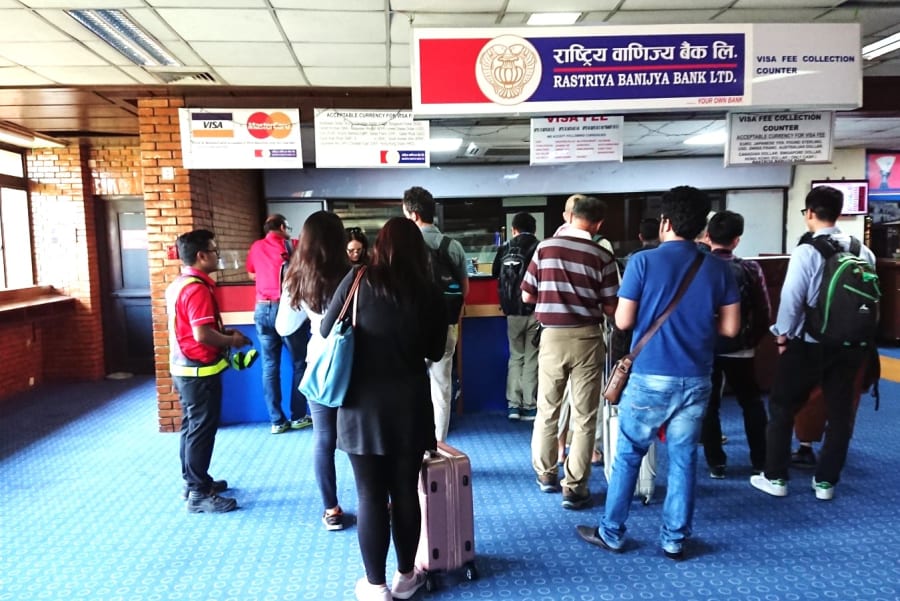
For most travellers, the practical picture is reassuringly simple. Nepal still issues tourist visas on arrival at Tribhuvan and Gautam Buddha international airports and at the designated land border crossings, and that remains the route most visitors use. Rasuwagadhi on the Tibet border has been closed since the 26 August 2026 flood, and Pokhara's immigration desk only began handling a daily international route in September 2026, so check before relying on either. What the digital system changes is the queue: you can complete the online visa application form up to 15 days before you travel, bring the printed submission receipt, and head straight to the payment counter and immigration desk on landing. Self-service kiosks at the airport handle the same form for those who have not pre-filled it.
Tourist Visa Fees
| Visa | Fee | Cost per day |
|---|---|---|
| 15 days | USD 30 | USD 2.00 |
| 30 days | USD 50 | USD 1.67 |
| 90 days | USD 125 | USD 1.39 |
| Keeping multiple re-entry on an extension | USD 25 | Extensions only |
The fees are the same online and on arrival. The tourist visa itself is multiple entry. The USD 25 multiple re-entry fee in the department's table applies only when you extend the visa and want to keep re-entry for a side trip to India, Tibet or Bhutan. On arrival, pay in cash to keep things quick: US dollars, and usually euros and pounds, as card terminals at the counters can be unreliable. Children under 10 receive a free visa, except US citizens. SAARC nationals other than Afghans get their first 30-day visa of the year free, Chinese nationals get a free visa, and Indian citizens do not need a visa at all. Tourist visas can be extended at immigration offices in Kathmandu and Pokhara at USD 3 per day (minimum 15 days, so USD 45), up to a maximum stay of 150 days per calendar year. Pokhara extends only up to 120 days in a visa year. Our visa extension guide has the fee calculator and overstay fines.
Tips for a Smooth Arrival
If you use the e-visa, apply at least a week ahead, print the approval and keep the payment receipt. If you use the pre-arrival form instead, fill it in within the 15-day window (an early submission expires), carry a passport valid for at least six months, keep a passport photo handy in case a kiosk is down, and screenshot or print your form receipt, as airport Wi-Fi can be patchy. If your plans include restricted-area treks such as Upper Mustang or Manaslu, remember those permits are arranged separately through a registered agency (see our trekking permits guide). Full requirements live on our visa information page, and the official portal is at nepaliport.immigration.gov.np.
Common e-Visa Problems and Fixes
- No email after approval. Check spam and junk, then log in to the tracking page and download the ETA yourself.
- Photo rejected. Use a recent photo with a plain white background and no glasses glare.
- Passport too close to expiry. It must be valid for at least six months from arrival.
- Paid on a lookalike site. Only NepaliPort and immigration.gov.np are official. Other sites add their own fees.
- Restricted nationality. If your country is on the department's list, the e-visa and visa on arrival do not apply, and you must go through a Nepali embassy.
Does Nepal have an e-visa in 2026?
Yes. The full e-visa was announced for 17 August 2026 and was working by September. You apply on NepaliPort, pay by card and receive the approved visa by email.
How long does the Nepal e-visa take?
Officials quote about 72 hours. In a September 2026 test the approval came three days after payment, so allow a week to be safe.
Do I still need the pre-arrival form if I have an e-visa?
No. The e-visa replaces the form. The pre-arrival form is for travellers who will get their visa on arrival.
Is the e-visa cheaper than the visa on arrival?
No. The fees are the same, USD 30, 50 or 125, and paying online adds a 3.5% card convenience fee.
How long is the e-visa valid before I travel?
Six months from the date of issue. The 15, 30 or 90 days of stay start on the day you enter Nepal.