






Nepal's five best wildlife safaris are Chitwan National Park, Bardia National Park, Koshi Tappu Wildlife Reserve, Shivapuri Nagarjun National Park and Parsa National Park. Chitwan is the easiest and most rewarding first safari, with about 694 one-horned rhinos and 145 tigers. Bardia in the far west is quieter and better for serious tiger tracking. Koshi Tappu is the place for birds and Nepal's last wild water buffalo, Parsa is the quiet forest where gaur roam, and Shivapuri is a walking park on the edge of Kathmandu. Go between October and April, and February to April gives the best sightings. Swotah's 7-day Chitwan Jungle Safari starts from USD 800 per person on group departures.
- Best first safariChitwan National Park
- Best for tigersChitwan (145) and Bardia (112), 2026 census
- Tigers in Nepal429 (July 2026), up from 355 in 2022
- One-horned rhinos752 (2021 count)
- Best monthsOctober to April, peak sightings February to April
- Chitwan entryNPR 2,000 a day for foreigners
- Swotah tripsChitwan from USD 800, Bardia from USD 1,100
Nepal is one of the most biodiverse countries in the world and home to some of the most spectacular wildlife species. If you're looking for an adventure that will let you experience the wonders of nature, then a wildlife safari in Nepal is the perfect way to do it. From the wild elephants of Chitwan National Park to the rare Gaurs of Parsa National Park, Nepal's top wildlife safaris offer an incredible opportunity to see the country's majestic animals in their natural habitats.
Nepal's Five Safari Parks at a Glance
All five parks sit in the lowlands or on the hills just north of Kathmandu, so none of them needs any altitude acclimatisation. They differ in size, in how far they are from Kathmandu and in what you are most likely to see.
| Park | Area | Protected since | Star animals | Getting there | Swotah trip (group departure) |
|---|---|---|---|---|---|
| Chitwan NP | 952.63 km² | 1973 (UNESCO 1984) | Rhino, tiger, gharial, sloth bear | 5 to 7 h drive or 25-min flight to Bharatpur | 7 days, from USD 800 |
| Bardia NP | 968 km² | 1976 reserve, national park 1988 | Tiger, wild elephant, Gangetic dolphin | 1 h flight to Nepalgunj + 2 to 3 h drive | 7 days, from USD 1,100 |
| Koshi Tappu WR | 176 km² | 1976 (Ramsar site 1987) | Wild water buffalo (arna), wetland birds | Flight to Biratnagar + about 1.5 h drive | 6 days, from USD 1,469 |
| Shivapuri Nagarjun NP | 159 km² | 2002 (Nagarjun added 2009) | Forest birds, langur, leopard (rarely seen) | 30 to 60 min from central Kathmandu | 4 days, from USD 446 |
| Parsa NP | 627.39 km² | 1984 reserve, national park 2017 | Gaur, wild elephant, tiger | About 1 h east of Sauraha by road | No fixed trip |
Tiger Numbers by Park, 2022 and 2026
Nepal's July 2026 national tiger survey counted 429 wild tigers, up from 355 in 2022 and about 121 in 2009. Four of the five tiger parks grew. Bardia was the only one to fall. The bars run from 0 to 150 tigers.
| Park | 2022 | 2026 | 2026 count (0 to 150) |
|---|---|---|---|
| Chitwan | 128 | 145 | |
| Bardia | 125 | 112 | |
| Parsa | 41 | 71 | |
| Banke | 25 | 51 | |
| Shuklaphanta | 36 | 50 |
Source: Department of National Parks and Wildlife Conservation tiger survey, released on Global Tiger Day, 29 July 2026. Banke and Shuklaphanta are not in this top five but are worth adding on a longer western trip.
1. Chitwan National Park: Rhinos, Tigers and River Safaris
Tucked away in the heart of Nepal, Chitwan National Park is a great destination for wildlife lovers. It is the oldest and most renowned national park of Nepal, set up in 1973 and listed as a UNESCO World Heritage Site in 1984. It covers 952.63 square kilometers and is home to more than 700 species of wildlife, including tigers, rhinoceros, sloth bears, deer, and monkeys. The 2021 rhino count found 694 of Nepal's 752 one-horned rhinos here, and the 2026 tiger survey counted 145 tigers, the most of any park in the country.
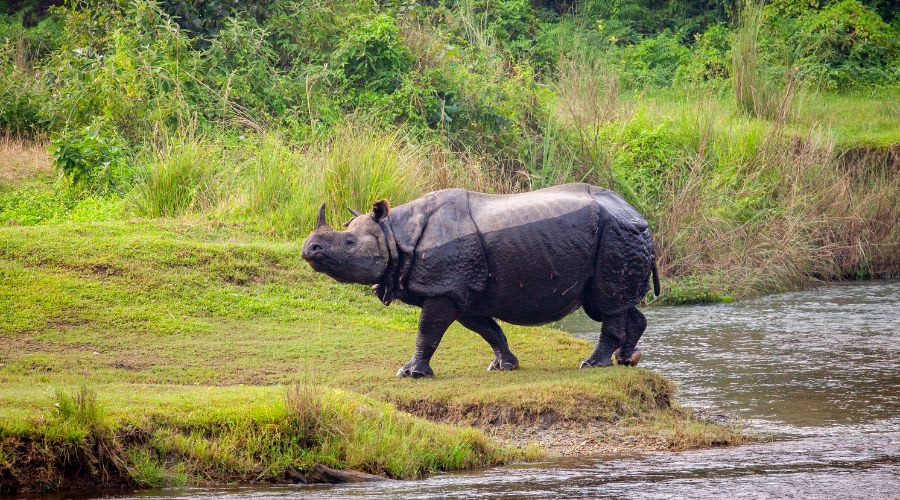
Photo: A one-horned rhino in Chitwan National Park.
The main attraction of this park is its variety of activities, such as jeep safaris, jungle walks, dugout canoe rides, river cruises, and bird watching. Visitors can also watch traditional Tharu cultural dances in the evening and stay overnight in a Tharu homestay. Walking safaris are done only with a licensed nature guide. In April 2024 a guide was killed by a rhino, so keep to your guide's instructions and never approach rhinos on foot. Entry is NPR 2,000 a day for foreigners and NPR 1,000 for SAARC nationals.
You can witness the great Bengal tigers and one-horned rhinoceros on a Chitwan National Park Safari. There are also sloth bears and a wide variety of deer species, such as hog deer, spotted deer, and barking deer. Reptiles and amphibians such as gharials, turtles, and snakes can also be seen in the park. Bird watchers can observe more than 540 species of birds, including parakeets, pheasants, jungle fowls, cuckoos, and hornbills. The Rapti River and its oxbow lakes are ideal for spotting water birds.
Apart from wildlife sightings, visitors can also explore several villages in the buffer zones surrounding the park. Here, they can glimpse local customs and traditional culture through homestays and cultural shows.
Overall, Chitwan National Park Safari is an experience like no other. It offers visitors a chance to face some of the rarest wildlife on the planet and experience Nepalese culture in its full glory. Swotah's 7-day Chitwan Jungle Safari runs from USD 800 per person on group departures, with jeep safari, jungle walk and a Rapti River canoe ride included, and Swotah can arrange it as a private trip.
2. Bardia National Park: Nepal's Wildest Tiger Country
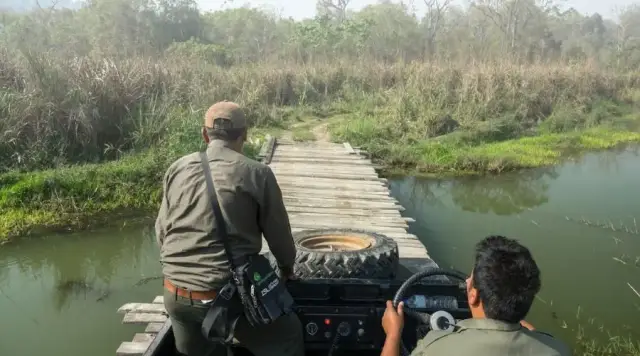
Visitors can discover some of the most diverse species and breathtaking natural beauty in Nepal at Bardia National Park, which is situated in the far western part of the country. It is the largest national park in Nepal's Terai lowlands. It began as the Royal Karnali Wildlife Reserve in 1976 and became a national park in 1988. Bardia lies inside one of the Terai's priority Tiger Conservation Units (TCUs), and its tiger numbers climbed fast after 2010. The 2026 survey counted 112 tigers, down from 125 in 2022, but Bardia is still the second-best tiger park in Nepal and far quieter than Chitwan.
Sprawling across 968 square kilometers, this protected area is home to over 30 mammals, including royal Bengal tigers, leopards, Gangetic dolphins, one-horned rhinoceros, and Indian wild elephants. Visitors can also spot a variety of bird species, such as Bengal florican, white-rumped vulture, peafowl, bar-headed geese, Lesser florican, sarus crane, aberrant bush warbler, striated grassbird, golden-headed cisticola, and chestnut-capped babbler. A total of 839 species of flora, 642 species of fauna, and about 407 bird species have been recorded in Bardia National Park.

Photo: Bardia National Park
There are various choices for anyone who wants to go on a safari to Bardia National Park.
A jeep safari is an option that gives you a thorough view of the park from the comfort of your seat. Alternatively, you can take a guided walking trip, which will allow you to go closer to nature and see the species up close. A riverboat trip down the Karnali can offer a distinctive perspective of the park if you want to continue exploring, and the Karnali is one of the few places in Nepal where Gangetic dolphins still surface. Most visitors fly from Kathmandu to Nepalgunj in about an hour, then drive 2 to 3 hours to the park gate at Thakurdwara.
During your safari, you may have the opportunity to visit local Tharu villages to experience the culture and lifestyle of the indigenous people. You will also be able to learn more about the conservation efforts being implemented in the park and gain insight into how communities can be involved in protecting the environment.
No matter what kind of safari experience you choose to embark on in Bardia National Park, it will surely be a truly memorable one. With incredible wildlife sightings, opportunities to learn more about local cultures, and breathtaking landscapes, this park has something for everyone. Swotah's 7-day Bardiya National Park Safari starts from USD 1,100 per person on group departures, and Swotah can arrange it as a private trip.
3. Koshi Tappu Wildlife Reserve: Birds and Wild Water Buffalo
For those who enjoy nature, a trip to Koshi Tappu Wildlife Reserve is a must.
Situated in the eastern Terai, it is one of the most diverse and biologically significant ecosystems in the country. It was set up in 1976, became Nepal's first Ramsar wetland in 1987, and has an area of 176 square kilometers and has two sizable wetlands that are the only remaining fragments of the vast and immaculate Koshi River floodplain that formerly covered this area.
The wildlife reserve and the nearby Koshi Barrage have about 490 to 530 recorded bird species, depending on the survey (BirdLife lists 486), making it an ideal place for birdwatching. It also boasts a diverse range of more than 30 species of mammals, including wild water buffalo (arna), Asian elephant, spotted deer, hog deer, wild boar, smooth-coated otter and golden jackal. Furthermore, 524 species of flora and more than 200 species of fauna can be witnessed in the serene environment of Koshi Tappu. Diverse ecosystem of fishes topped by Gangetic dolphins is one of the major attractions of this wildlife reserve.

A guided safari is the best way to explore this amazing wildlife reserve. Typically, safari tours start at Biratnagar, the nearest airport, and drive west for about an hour and a half to the reserve. You will have many opportunities along the journey to see some of the distinctive wildlife found in the area.
In the meadows, watch herds of arna, the wild water buffalo that is the reserve's flagship species and found nowhere else in Nepal, or scan for wild elephants wandering through. Only 63 arna were left when the reserve was created in 1976, and the 2021 count found 498. A 2017 plan to start a second herd in Chitwan failed, and the last of those animals died in 2022, so Koshi Tappu remains their only home. In the wetlands, you might also come across the incredible and endangered Gangetic dolphin.
Koshi Tappu is considered as a paradise for bird watchers and ornithologists. Many bird lovers explore the park on foot along its flat embankment and grassland trails. Be sure to keep your eyes peeled for both native and migratory birds that can be found in great numbers at the Koshi Wildlife Reserve. Winter, from November to March, brings the biggest flocks of migratory ducks and waders. Moreover, locals love to picnic in Koshi Tappu Picnic Spot on vacations.
Overall, a trip to the Koshi Tappu Wildlife Reserve is memorable. There is something wonderful about this environment that will leave you with long-lasting memories, whether you see exotic elephants or flocks of beautiful birds. So don't miss this wonderful chance to experience one of Nepal's most breathtaking natural reserves. Swotah's 6-day Koshi Tappu Wildlife Tour starts from USD 1,469 per person on group departures, and Swotah can arrange it as a private trip.
4. Shivapuri Nagarjun National Park: A Walking Safari Near Kathmandu
Located on the northern rim of the Kathmandu Valley, Shivapuri Nagarjun National Park is a beautiful and diverse protected area. It became a national park in 2002, the Nagarjun forest was added in 2009, and it now covers 159 square kilometers, topping out at Shivapuri Peak (2,732 m). The park is home to over 2122 species of plants, including orchids, as well as an array of wildlife such as Indian leopard, jungle cat, large Indian civet, golden jackal, Himalayan black bear, yellow-throated marten, small Indian mongoose, wild boar, rhesus monkey, Hanuman langur, Chinese pangolin, Indian crested porcupine, Royle's pika, Himalayan goral, Indian muntjac, Indian hare and orange-bellied Himalayan squirrel.
Over 318 species of birds, including Eurasian eagle-owl, slender-billed scimitar-babbler, white-gorged flycatcher, and barred cuckoo-dove, make this place a heaven for bird-watchers. Shivapuri Nagarjun National Park is also popular for its scenic beauty, which includes views of the Langtang, Ganesh and Jugal Himal on clear mornings.
A safari in Shivapuri Nagarjun National Park means walking, not driving, and it is the ideal way to discover this amazing location.
You can take a guided hike or drive to one of the park gates, such as Budhanilkantha or Sundarijal, and explore on foot from there. You'll have the chance to see wildlife, stroll through meadows blossoming with wildflowers, and take in distant views of the spectacular Himalayan peaks as you move.
Guests can participate in a wide range of activities at the park, including birdwatching, hiking, camping with park permission, and even yoga and meditation programs at Nagi Gompa and the retreat centres nearby. Entry for foreigners is about NPR 1,000. You can experience the local customs and cultures by booking a stay at one of the resorts or guest houses in the area. The resort employees can arrange jeep tours, bike excursions, and brief walks.
You will undoubtedly have a wonderful experience in Shivapuri Nagarjun National Park, regardless of how you spend your time there. Therefore, pack your gear and prepare to discover Nepal's natural beauties by touring Shivapuri National Park. Swotah's 4-day Shivapuri Day Hike package starts from USD 446 per person on group departures, and Swotah can arrange it as a private trip.
Also read: Inland Seas of Nepal
5. Parsa National Park: Gaur and Quiet Forest
Joined to Chitwan National Park on its west side and part of the same forest block as India's Valmiki Tiger Reserve, Parsa National Park (upgraded from a wildlife reserve in 2017) is an incredible destination for a wildlife safari. Spanning 627.39 square kilometers, with a 285 square kilometer buffer zone, it is one of the largest protected areas in the Terai and is home to a wide variety of flora and fauna, including Bengal tigers, leopards, sloth bears, chital deer, sambar deer, and rhinoceroses.
Parsa was first protected in 1984 as a wildlife reserve for wild elephants, long before it was declared a National Park. Gaurs, also called Indian bison, are the main attractions of Parsa, and a 2016 park survey counted about 105 of them. Its tiger numbers have grown faster than anywhere else in Nepal, from 41 in 2022 to 71 in 2026. Over 500 species of birds, including White-breasted kingfisher, Paradise flycatcher, Large racquet-tailed drongo, and Golden-backed woodpecker, are found in this region.

Photo: Parsa National Park
A safari is unquestionably the perfect way to appreciate the beauty and diversity of this wildlife reserve. You can take a jeep safari or even hike through the jungle with a guide. Some of the most amazing wildlife species, including gorgeous birds, reptiles, and amphibians, are found in abundance for you to observe. As you travel through the forest, you may spot some iconic wildlife, such as Bengal tigers and leopards. Keep your eyes peeled for more elusive snake species like python, cobra, and krait.
You will undoubtedly come up close to some of nature's most stunning wildlife, regardless of the sort of safari you pick. There are numerous opportunities to see some spectacular birdlife.
Numerous animal species, including the Blue bull, Sambar, Chital, Hog deer, barking deer, Langur, Rhesus macaques, and striped hyena, safely reside in the reserve's deep woodlands.
If you’re looking for a unique way to experience the beauty of Nepal’s wilderness and wildlife, consider a safari through Parsa National Park. You can admire some of the country’s most impressive creatures in their natural habitat and create memories that will last a lifetime. Swotah has no fixed Parsa departure, but a Parsa day is easy to add to a Chitwan safari.
Best Time for a Safari in Nepal
The safari season runs from October to April. October and November are green and clear after the monsoon. December and January are cool, with misty mornings. From February to April the tall grass is cut and burned, waterholes shrink, and that is when rhinos and tigers are easiest to see, though April days in Chitwan and Bardia go above 35°C.
| Months | What to expect | Good for |
|---|---|---|
| October to November | Clear, warm days, grass still tall | Birds, canoe rides, comfortable walks |
| December to January | Cool, foggy mornings, mild afternoons | Migratory birds, Koshi Tappu wetlands |
| February to April | Grass cut, dry and hot by April | Best rhino and tiger sightings |
| May to September | Hot, then monsoon rain and leeches | Few visitors. Some lodges close and jungle walks are limited |
Park Entry Fees for Foreigners
Fees are charged per person per day at the park gate, in cash. Chitwan's rate comes from the park's own regulations. The others are the most recent published figures and can change, so treat them as a guide.
| Park | Foreigners | SAARC nationals |
|---|---|---|
| Chitwan NP | NPR 2,000 (about USD 13) | NPR 1,000 |
| Bardia NP | About NPR 1,000 + 13% VAT | Lower rate, check at gate |
| Koshi Tappu WR | About NPR 1,000 + 13% VAT | Lower rate, check at gate |
| Parsa NP | About NPR 1,000 + 13% VAT | Lower rate, check at gate |
| Shivapuri Nagarjun NP | About NPR 1,000 | Lower rate, check at gate |
On a Swotah safari the park fees are paid for you. If you want more than one park in a single trip, the 18-day Jungle Safari in Nepal links Chitwan, Bardia, Khaptad and Shuklaphanta, from USD 2,150 per person on group departures, and Swotah can arrange it as a private trip.
Conclusion
In summary, a wildlife safari in Nepal is undoubtedly one of the best ways to experience nature and its drama up close. Unlike zoos, visitors can witness the wild beasts and diverse flora topped by the soothing sound of birds in their natural habitat. There are plenty of wildlife Safaris in Nepal, and each of them has something unique to offer. From jeep safaris to guided walking safaris to dugout canoe trips, Nepal has it all.
Hence, don’t think twice before finalizing a decision, as the wildlife safari in Nepal will be an awe-inspiring trip that will be something to remember for the rest of your life.
Frequently Asked Questions
Which is the best national park in Nepal for a safari?
Chitwan is the best all-round choice. It is the easiest to reach from Kathmandu, has the most rhinos and tigers, and offers jeep, walking and canoe safaris. Bardia is better if you want fewer crowds and a real chance of tracking tigers on foot.
How many tigers are there in Nepal?
The July 2026 national survey counted 429 wild tigers, up from 355 in 2022. Chitwan has 145 and Bardia 112, followed by Parsa, Banke and Shuklaphanta.
Can you see tigers on a safari in Nepal?
Yes, but sightings are never guaranteed. Your best odds are a few days of jeep safaris in Chitwan or Bardia between February and April. Rhinos, deer, crocodiles and birds are seen on almost every trip.
How many days do you need for a safari in Nepal?
Plan two to three nights inside or next to the park. Chitwan works as a 3-day trip from Kathmandu or Pokhara, while Bardia and Koshi Tappu need extra travel days because of the flights and long drives.
Is elephant-back safari still offered?
Some private operators around Chitwan still offer it, but many lodges have stopped on animal-welfare grounds. Jeep safaris, guided walks and canoe rides are the main ways to explore today.