



All You Need to Know About Nepal Tourist Visa 2026
A Nepal tourist visa costs USD 30 for 15 days, USD 50 for 30 days, or USD 125 for 90 days, and almost every nationality can get one on arrival at Kathmandu's Tribhuvan International Airport or at the major land borders. Indian citizens need no visa at all, most SAARC nationals and Chinese citizens get theirs free, and around a dozen nationalities must apply in advance at an embassy. The visa is multiple entry, can be extended inside Nepal for up to 150 days per calendar year, and the queues move faster if you complete the official online form before you fly. This guide covers every way to get the visa, the current fees, and the special cases.
What Is a Nepal Tourist Visa?
A Nepal tourist visa is a multiple-entry entry permit issued by Nepal's Department of Immigration for tourism, trekking, and other non-working visits. Every visa issued on arrival is a tourist visa; other categories (business, study, work) must be arranged through different channels. The clock starts on the day you enter Nepal, and the 15, 30, or 90 days count your total permitted stay, not the validity of the sticker.
How Can You Get a Nepal Tourist Visa?
Three routes lead to the same visa: on arrival at an airport, on arrival at a land border, or in advance at a Nepali embassy or consulate. A fourth option, the official online pre-arrival form, speeds up the first two.
Visa on Arrival at the Airports
Tribhuvan International Airport (TIA) in Kathmandu issues the large majority of tourist visas, and Nepal's two newer international airports, Gautam Buddha International in Bhairahawa and Pokhara International, offer the same service. The process takes three steps: fill the form at a self-service kiosk (or online beforehand), pay the fee at the bank counter, and present your passport, receipt, and form at the immigration desk. During the peak months of October, November, March, and April, the whole process can take 45 to 90 minutes. Our guide to visa on arrival and visa extension in Nepal walks through each step in detail.
Visa on Arrival at the Land Borders
Six major land crossings issue visas on arrival through their immigration offices: Kakarbhitta in the east, Birgunj, Belahiya (Bhairahawa), Nepalgunj, Dhangadhi, and Gaddachauki in the far west, plus Rasuwagadhi on the Chinese border. Land border counters take cash only, so carry crisp US dollar notes. If you are coming overland from the south, our guide to travelling to Nepal from India covers each crossing and its onward connections.
Applying in Advance at an Embassy
Nepali embassies and consulates abroad issue the same tourist visa before you travel, which removes all airport queue time. Advance application is optional for most travellers but mandatory for the nationalities listed below.
The Official Online Form (Pre-Arrival)
The Department of Immigration runs an online tourist visa form at nepaliport.immigration.gov.np, and filling it within 15 days of your arrival lets you skip the kiosks entirely. Note what this form is and is not: Nepal does not issue a fully approved e-visa, so the online submission produces a barcode receipt that you print or save, and the actual visa is still approved and paid for when you land. The receipt expires after 15 days, in which case you simply fill the form again.
Nepal Tourist Visa Fees in 2026
| Duration | Fee | Entry |
|---|---|---|
| 15 days | USD 30 | Multiple entry |
| 30 days | USD 50 | Multiple entry |
| 90 days | USD 125 | Multiple entry |
| Extension (first 15 days) | USD 45 | + USD 3 per additional day, in Nepal |
Children under 10 years of age need a visa but pay no fee. The counters accept US dollars, euros, pounds, and several other major currencies; airport counters also take cards, though the machines are unreliable, so cash in US dollars remains the safe choice. Multiple entry is included in all three durations, which is useful for side trips to Tibet, Bhutan, or India.
Extensions cost USD 45 for the first 15 days and USD 3 per additional day, payable in Nepali rupees at the immigration offices in Kathmandu or Pokhara, up to the 150-day annual ceiling. Full extension rules are in our visa extension guide.
Who Does Not Need a Visa, and Who Cannot Get One on Arrival?
Indian nationals need no visa for Nepal under the 1950 India-Nepal Treaty of Peace and Friendship; they only need a passport or an Election Commission voter ID to prove nationality when flying.
Citizens of the other SAARC countries (Bangladesh, Bhutan, Maldives, Pakistan, and Sri Lanka) receive a free 30-day gratis visa on their first visit in a calendar year; Afghan citizens can receive the same only with a prior recommendation arranged through the Department of Immigration. Chinese citizens have received a free tourist visa on arrival since 2016.
Twelve nationalities cannot get a visa on arrival and must apply in advance at a Nepali diplomatic mission: Nigeria, Ghana, Zimbabwe, Eswatini (formerly Swaziland), Cameroon, Somalia, Liberia, Ethiopia, Iraq, Palestine, Afghanistan, and Syria, along with holders of refugee travel documents.
What Do You Need for a Visa on Arrival?
- A passport valid for at least six months beyond your arrival date
- One passport-size photo with a light background (kiosks photograph you, but a spare photo helps at land borders)
- The visa fee in cash, ideally exact change in US dollars
- The completed visa form, from the kiosk or the online portal
A practical tip from every frequent visitor: fill out your arrival card on the plane, and carry several passport photos and photocopies of your passport. You will need them again for trekking permits and SIM cards. Our guide to surviving your first arrival at Tribhuvan Airport covers what happens after the visa desk.
Other Visa Rules Worth Knowing
A transit visa costs USD 5 and covers up to 24 hours for passengers connecting through Kathmandu with an onward ticket; ask for it at the same immigration counters. The tourist visa is the only category issued on arrival, and it does not permit paid work, journalism assignments, or formal volunteering, all of which need different visas arranged through the Department of Immigration before those activities begin.
The 150-day limit runs per visa year, which follows the calendar year from January to December. The counter resets on January 1, so a traveller who exhausts 150 days by November can legally re-enter in the new year. If you renew your passport mid-stay, the Department of Immigration in Kathmandu transfers the visa to the new passport; if you lose your passport, file a police report first, obtain an emergency travel document from your embassy, and then visit the Department of Immigration for the transfer.
Nepal Tourist Visa FAQ
How long does the visa on arrival take?
Between 20 and 90 minutes at Tribhuvan, depending on season and time of day. The October-November and March-April peaks produce the longest queues; completing the online form in advance typically saves 20 to 30 minutes.
Can I pay the visa fee by card?
The airport counters accept cards in principle, but the machines fail often. Treat US dollar cash with exact change as the only dependable method, and the only method at land borders.
Do children need a visa?
Yes. Every traveller needs a visa regardless of age, but children under 10 pay no fee.
Can I extend a 15-day visa?
Yes. Any tourist visa extends in increments of your choosing, at USD 45 for the first 15 days and USD 3 per day after, up to the 150-day annual ceiling.
What if my passport has less than six months' validity?
Nepal requires six months' validity beyond arrival, and airlines enforce it at check-in. Renew the passport before travelling rather than testing the rule at the counter.
Can I get two 90-day visas in one year?
You can enter twice, but total stay is capped at 150 days per calendar year, so a second 90-day visa would be cut short by the ceiling.
Planning Your Trip to Nepal?
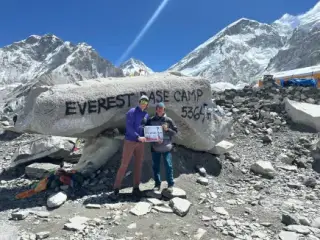
Our team at Swotah Travel plans treks and tours that fit neatly inside your visa window, from a one-week Poon Hill trek to a full Everest Base Camp expedition. Contact us to get started.