


Annapurna Base Camp or Everest Base Camp: Which Should You Trek First?
For most first-time trekkers, Annapurna Base Camp is the easier first choice. It tops out at 4,130 m, takes about 9 days on the trail, starts from Pokhara by road, and costs from USD 1,000 with Swotah for a 14-day trip. Everest Base Camp goes much higher, to 5,545 m at Kala Patthar, needs 12 trail days, depends on Lukla flights, and costs from USD 1,620 for 14 days. Choose Everest if seeing Everest and sleeping at 5,170 m is the point of the trip. One rule differs too: a licensed guide is compulsory for Annapurna, but the Everest region doesn't enforce it.
When thinking about Nepal, most people think about the majestic mountains and trekking. Although there are dozens of different trekking areas and routes, the most well-known are in the Annapurna Region and, of course, the Everest Region, home to the highest mountain in the world.
Within these two regions are several trekking routes. For example, the Everest Three Passes Trek and the Annapurna Circuit Trek. But the treks that attract the highest number of visitors are Everest Base Camp and Annapurna Base Camp. But, as a first-time trekker in Nepal, which should you pick?
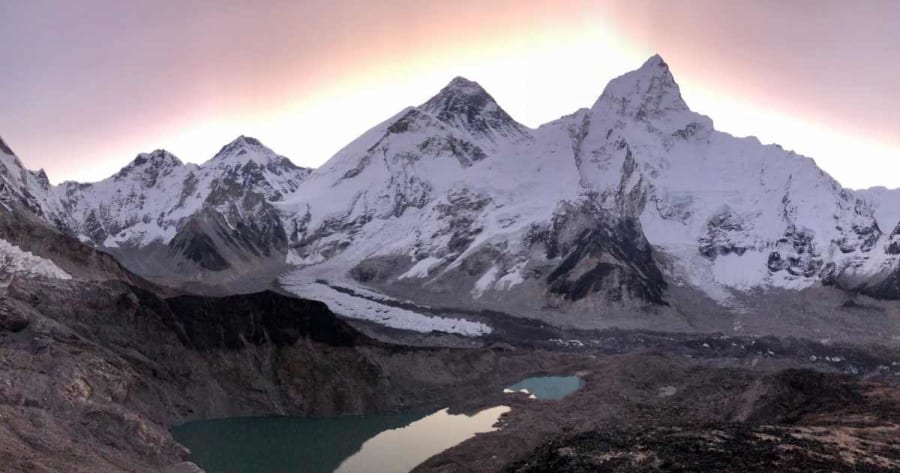
Photo: Everest View From Kala Pathar
Main Differences
It really is an individual choice whether to head to Everest or to the Annapurna. Both trekking areas offer very different experiences. In brief, the main differences are:
Scenery
The Annapurna Region is more lush at lower altitudes, and the mountains are magnificent against the blue sky.
The Everest Region is starker and rockier, with snow and ice on the trail at some points. The mountains are also fabulous but to get a good view of Mount Everest, you need to hike up Kalapattar. Base Camp itself is too close to the mountain to get great views.
Access
The main way into the Everest Region is to fly to Lukla. In spring and autumn most flights leave from Manthali (Ramechhap), a 4 to 5 hour drive from Kathmandu. The alternative is a jeep from Kathmandu to Surke, just below Lukla, in 10 to 14 hours, which our guide to the Everest Base Camp trek on a budget covers. Most people fly. That can be problematic as the weather can cause flight delays either way. And if your flight is delayed on your return trip, Lukla gets very crowded with waiting passengers, and there can be a shortage of accommodation. Something to consider if you have a tight international flight deadline.
The main access to the Annapurna Region is a 25-minute flight or a 6 to 8 hour bus ride to Pokhara, then a short drive to the start of the trek. This gives you more flexibility in case of delays, and on your return, you get to visit the lakeside town of Pokhara. Added bonus! It is also possible to take a flight from Pokhara to Jomsom, but this is not the best access to the Annapurna Base Camp Trek.
Trekking Difficulty
Neither trek is ‘easy.’ Both have their own challenges. For Everest, it is mainly the high altitude that guides the pace (the highest point is at Kala Patthar, 5,545m, and the highest sleeping point is at Gorak Shep, 5,170m). In the Annapurnas, the altitude is lower, with the highest point being 4,130m at Base Camp. Those with a lot of trekking experience will have an easier time deciding which trek to start with. We need to consider our fitness level for the rest of us as it is harder to trek at high altitudes and for longer hours.
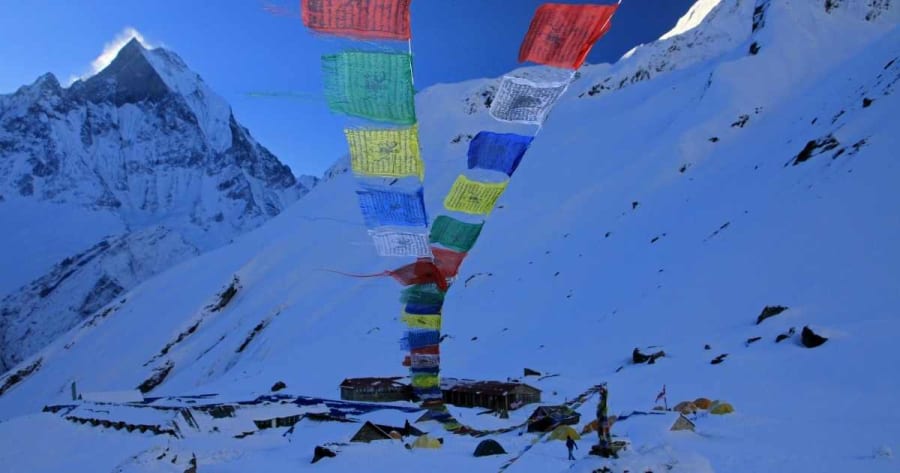
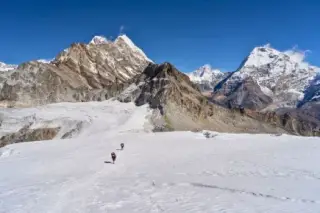
Photo: Annapurna Base Camp
Safety
Both treks take place at altitudes which are high enough to cause problems if you are not careful. Always go slowly and take the recommended acclimatization days, and ALWAYS listen to your guide if you feel unwell. Your guide will be able to give you all the Nepal travel advice and safety details you need to stay safe. Both regions are now fairly accessible if there are any accidents (such as a sprained ankle or broken bone).
The Annapurna Base Camp trail has one specific hazard. Between Deurali and Machhapuchhre Base Camp it runs along a narrow gorge under steep slopes, and avalanches come down there after heavy snow, mostly from January to March. In January 2020 an avalanche near Deurali buried four South Korean trekkers and three Nepali guides. Guides watch the conditions and hold groups at Deurali or Himalaya when the risk is high, which is one more reason to trek with one.
Culture
Everyone is familiar with the name Sherpa. These are the people who are native to the Everest Region. In fact, they are closely related to the peoples of Tibet, having made the journey over the mountains to Nepal many centuries ago. They are very well adapted to the altitude and climate of the region and make wonderful trekking and climbing guides for this very reason. You might have heard of Tenzing Norgay Sherpa who, together with Edmund Hillary, made the first ascent of Everest in 1953. So, if you have a particular interest in the Sherpas this is the trek for you. You can even visit the health post and school set up by Hillary as a thank you to the Sherpa community.

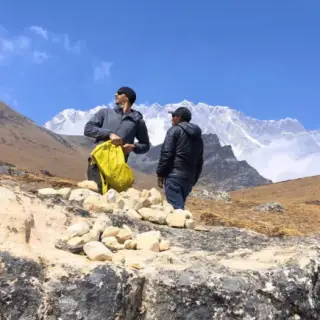
Photo: Annapurna Base Camp Trek
Over in the Annapurna Region, there is a diverse population of Magars, Thakalis, Tamangs, Brahmins, and Chhetris, among others. The predominant ethnic group are the Gurungs, who have their own language and a long tradition of service in the British and Indian Gurkha regiments. And like the Everest Region, as you go further north into Upper Mustang, you are very close to the Tibetan border so obviously there has been trading routes and intermingling of people in the past.
In the Everest Region, the religion is Buddhist, so you will see many prayer flags, chortens (Buddhist shrines), mani walls (stone walls with Buddhist prayers carved into them) and monasteries. Over in the Annapurna, there are both Buddhist sites and Hindu sites.
Both areas carry out farming, although both areas, particularly in the Everest Region, now see much of their income through trekkers and tourists. As both areas are old trekking areas, the lodges are all pretty well-established with good facilities (except those in more remote locations). Great places to relax and chat with fellow trekkers in the evening.
Annapurna Base Camp vs Everest Base Camp at a Glance
| Everest Base Camp | Annapurna Base Camp | |
|---|---|---|
| Highest point | Kala Patthar, 5,545 m | Annapurna Base Camp, 4,130 m |
| Highest night | Gorak Shep, 5,170 m | Annapurna Base Camp, 4,130 m |
| Days on the trail | 12 | About 9 |
| Start and finish | Lukla, by plane | Pokhara, by road |
| Licensed guide | Optional (Khumbu doesn't enforce the rule) | Mandatory since 1 April 2023 |
| Permits | Khumbu card NPR 3,000 + Sagarmatha National Park NPR 3,000 | ACAP NPR 3,000 + TIMS card NPR 2,000 |
| Main hazards | Altitude, Lukla flight delays | Avalanche zone above Deurali in late winter |
| Best months | October to November, March to May | October to November, March to May |
| Swotah 14-day price from | USD 1,620 | USD 1,000 |
The numbers that decide how hard each trek feels. Each row is scaled on its own, so compare the two bars in a row.
| Measure | Everest Base Camp | Annapurna Base Camp |
|---|---|---|
| Highest point (m) | 5,545 | 4,130 |
| Days on the trail | 12 | 9 |
| Nights above 4,000 m | 5 | 1 |
On the Everest trek you sleep above 4,000 m at Dingboche (two nights), Lobuche, Gorak Shep and Pheriche. On the Annapurna trek the only night that high is at base camp itself.
Before and After the Trek
While it is possible to stay in Pokhara before and after the Annapurna Base Camp Trek, the only choice after the Everest Base Camp Trek is to return to Kathmandu. There are so many things to do in Pokhara it would be foolish to miss out on a few days of relaxation there. There is the possibility of expanding your trek into something longer on both treks. But in the case of the Everest Region, you need to organize that beforehand to allow for the booking of your flight out. In the Annapurnas, you are more flexible. You can even change the route to allow staying longer at some of the lower altitude lodges (Ulleri, Tadapani, Birethanti) outside of any organized trek. But do discuss this first with your Nepal travel agency.
So, Which Should I Choose to do First?
It really does depend on what you want to see. Many people want to be able to say they have been to Everest Base Camp as most folks at home know the name Everest. But if you are not influenced by the region's fame, for my money, Annapurna Base Camp offers more variety and better mountain views. And it is less expensive, takes fewer days on the trail (about 9 against 12 for Everest), carries less risk of flight delays, and starts and ends at Pokhara!
But let me give you a few more details, and you can make up your own mind.
Everest Base Camp Trek
Day 1. Fly from Kathmandu to Lukla, the entry point into the region, then trek for around 3 hours to Phakding, the first overnight stop.
Day 2. Trek from Phakding to Namche Bazaar.
Day 3. Because you are now at an altitude of 3,440m, there is an acclimatization day at Namche. It's time to explore this busy market town or visit the Hillary school.
Day 4. Trek to Tengboche, the most famous monastery in the region and one with stunning 360-degree views of the mountains!
Day 5. Trek to Dingboche (4,410m), about 5 to 6 hours, where we take another acclimatization day.
Day 6. Acclimatize in Dingboche at 4,410m.
Day 7. Hike Dingboche to Lobuche
Day 8. It is getting really exciting now as we trek from Lobuche to Gorakshep with a side trip to Kala Patthar.
It takes about three hours of hiking over boulders and rough terrain to Gorakshep. Then onwards to Kala Patthar, known as the viewpoint of Everest, and you will find out why! The views here are amazing and it is the closest you can get to Everest without actually scaling it! After taking in the once-in-a-lifetime view, head back to Gorakshep for the night.
Day 9. Gorakshep to Pheriche with a hike to Everest Base Camp. Another epic experience as you hike to Base Camp and get a glimpse of mountaineering groups preparing for their ascent of this towering giant.
Day 10. Pheriche to Namche.
Day 11. Namche to Lukla. Overnight in Lukla to await the early morning flight back to Kathmandu.
Day 12. Fly back to Kathmandu
Annapurna Base Camp Trek
Day 1. Drive from Kathmandu to Birethanti. Alternatively drive/fly to Pokhara and overnight in Pokhara and set off to Birethanti the next morning.
Day 2. Trek Birethanti to Ulleri. Be prepared for hundreds of stone steps!
Day 3. Trek Ulleri to Ghorepani
Day 4. Trek Ghorepani to Poon Hill, with an early morning start to watch the sunrise from Poon Hill, then back to Ghorepani for breakfast before heading on to Tadapani
Day 5. Trek Tadapani to Chhomrong
Day 6. Trek Chhomrong to Dovan
Day 7. Trek Dovan to Deurali
Day 8. Trek Deurali to Base Camp
At Annapurna Base Camp, there is a 360-degree view of some of the highest mountains anywhere in the world! At 4,130m, this is the highest point of this trek. Stay overnight at Base Camp.
Day 9. Trek Annapurna Base Camp to Sinuwa
Day 10. Trek Sinuwa to Jhinu Danda
Day 11. Trek from Jhinu Danda to Syauli Bazaar and drive back to Pokhara. Jeep roads now reach several points on the lower trail, so the walk out is shorter than it used to be.
Bottom Line
In the end, it is a personal choice once you take your budget, time, and fitness level into account. If you have two weeks and have never trekked at altitude, start with Annapurna. If Everest is the reason you're coming to Nepal, go to Everest and give yourself the full 14 days.
BUT - the actual solution might be to do one trek now and come back again soon to do the other!
Happy trekking!
Annapurna Base Camp or Everest Base Camp: FAQs
Which is harder, Annapurna Base Camp or Everest Base Camp?
Everest Base Camp, mainly because of altitude. It goes 1,400 m higher than Annapurna Base Camp and you sleep five nights above 4,000 m. Annapurna has more stone steps and steeper ups and downs in the first days, but the altitude is far gentler.
Do I need a guide for Annapurna Base Camp?
Yes. Since 1 April 2023 foreign trekkers in the Annapurna Conservation Area need a licensed guide and a TIMS card issued through a registered agency. In the Everest region the local municipality doesn't enforce the rule.
Which has better mountain views?
They're different. Annapurna Base Camp sits in a ring of peaks, with Annapurna I, Machhapuchhre and Hiunchuli all around you. Everest gives you Everest itself, Lhotse, Nuptse and Ama Dablam, with the best view from Kala Patthar.
Can I do both treks in one trip?
Yes, with about four weeks. Do Everest Base Camp first, fly back to Kathmandu, then go to Pokhara for Annapurna. You'll be well acclimatised for the second trek.
Which trek is cheaper?
Annapurna Base Camp. There are no Lukla flights to pay for, and lodges are cheaper at lower altitude. With Swotah, the 14-day Annapurna trip starts at USD 1,000 and the 14-day Everest trek at USD 1,620.