



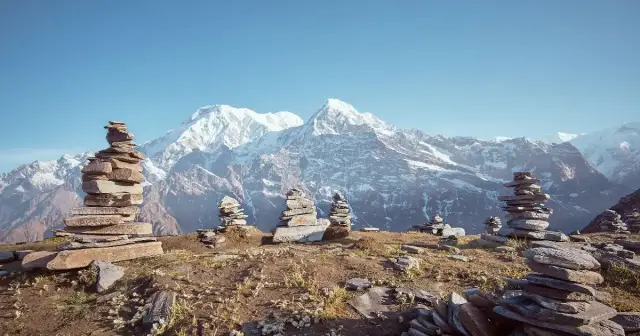

The best time for the Mardi Himal trek is October and November, followed by late March and April. October and November bring the clearest views of Machhapuchhre and the Annapurnas, and March and April add rhododendrons in bloom, with more afternoon haze. December to February is possible if you are equipped for snow, since nights at High Camp (3,580 m) drop well below freezing. June to early September is the season to avoid. Pokhara averages about 940 mm of rain in July, the ridge sits in cloud, and the forest trail turns muddy and full of leeches.
- Best monthsOctober, November, then late March and April
- Months to avoidJune to early September (monsoon)
- Highest pointMardi Himal Base Camp, about 4,500 m
- Highest overnightHigh Camp, 3,580 m
- Wettest monthJuly, about 940 mm in Pokhara
- RulesACAP and TIMS permits, licensed guide required
The Mardi Himal trek is an underrated gem of the Annapurna region and an ideal option for anyone who prefers to be away from the hustle and bustle. It is suitable even for beginners, being classified as an easy-to-moderate trek. While the paths may be slippery and rocky at times, most reasonably fit walkers can complete it in 5 to 7 days from Pokhara.
The highest point of the Mardi Himal trek is Mardi Himal Base Camp at about 4,500 m (14,764 ft), reached on a day hike from High Camp (3,580 m), where most groups sleep. Anyone can feel mild altitude effects such as headaches or shortness of breath at these heights, so take the ascent steadily. Chasing Mardi, one traverses through beautiful rhododendron forests ( in spring ), Pun and Gurung villages, exotic flora and fauna, and endless panoramic views. Trek to Mardi Himal Base camp is known for one of the best views of the Machhapuchhre Himal / Mt. Fishtail (6993 m / 22943 ft) and other snow-capped mountains like Mt.Annapurna 8091m / 26545 ft, Mt. Gangapurna 7455 m / 24459 ft, Mardi Himal 5,587 m / 18,330 ft, Hiunchuli peak, etc.
The trail is open all year, but the weather changes the trek a lot from one month to the next. Spring, Summer, Winter, and Autumn are the 4 seasons Nepal experiences. Autumn and Spring are the best seasons to visit the Mardi Himal Base camp, but the other two seasons are not bad either. Let us explain what Mardi welcomes you with according to the season.
Spring season
Nepal experiences the Spring season from March to May. This is the peak season of trekking for nature lovers because the flowers start blooming, making the environment magical. The temperature is suitable for trekking. It ranges from 18 degrees Celsius / 64.4 degrees Fahrenheit to 21 degrees Celsius / 69.8 degrees Fahrenheit during the day. Similarly, it drops down to 5 degrees Celsius / 41 degrees Fahrenheit to 0 degrees Celsius / 32 degrees Fahrenheit at night on the lower trail, and well below freezing at High Camp in March. Mornings are usually clear. Afternoon cloud and showers become common in April and May, when Pokhara averages about 140 mm and 355 mm of rain.

Photo: Clear View of Mardi Himal during Spring Season
Therefore, the Spring season has the best scenic bliss for you to witness with flowers of all the colors you can imagine! Oh, what a dream it would be to trek amidst wildflowers with their fragrance accompanied by birds chirping. The days are longer than nights which gives ample amount of time to finish the trek on time.
Not to forget, with a great view comes great traffic on the trail. Meaning there will be a lot more people, unlike in any other season. So, if you want to enjoy trekking peacefully then this season might not be for you. One might not have many options regarding accommodation either, as almost all the lodges and tea houses are pretty full.
Summer / Monsoon season
The monsoon (June to early September) season is not the best time to trek to Mardi Himal. The temperature ranges from 17 degrees celsius / 62.6 to 23 degrees celsius / 73.4 during the day. During the night, it drops down from 5 degrees Celsius / 41 degrees Fahrenheit to 10 degrees Celsius/ 50 degrees Fahrenheit. It experiences heavy rainfall, with Pokhara averaging about 940 mm in July alone. Yes, the green forests and other vegetation will be a sight worth beholding. The trail, on the other hand, gets muddy and slippery. This makes trekking a bit hard and risky. You may slip and hurt yourself. In case of sudden rainfall, you might get wet for a prolonged time and eventually fall sick.
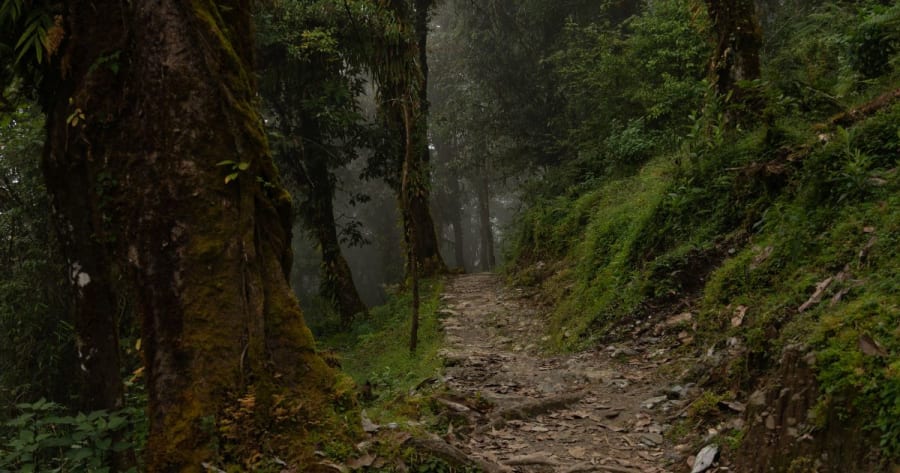
Photo: Mardi Himal Trekking Path during Monsoon
Likewise, the dark clouds and rainfall also obstruct the clear view of the panoramic sights. The only reason one should opt for this season for the Mardi Himal trek is seclusion. During this time, there is not much movement of trekkers. Thus, less crowded trails are perfect for people who cherish “me time”. You will not struggle to find a teahouse at that very instance if needed.
If you plan the Mardi Himal trek around Monsoon / Spring season, make sure to be prepared to stay safe from the rain with proper clothes and other supplies like raincoats, umbrellas, waterproof jackets, and boots.
Autumn/fall season
Autumn season is the best time for the Mardi Himal trek. Be it weather-wise, temperature-wise, or view-wise. The Autumn season has the best of it all. Nepal experiences the season of harvest (Autumn ) from September to November. In late September or October, Nepalese celebrate their biggest festival, Dashain. In 2026 it runs from 11 to 25 October, with the main Tika day on 21 October, and Tihar follows in early November. Traveling around this time lets you enjoy the greatest Nepalese festival with them. The festivity’s warmth in the air is a plus point in the trek to Mardi Himal during the fall season.
Since the monsoon bids farewell and the environment gets clear, nature is on another level in Autumn. The sky is crystal clear, and the temperature is not too hot and not too cold either. It is around 20 degrees celsius/ 68 degrees Fahrenheit in the daytime and falls down to around 5 degrees celsius/ 41 degrees Fahrenheit at night. The trails are perfectly intact this time around, making it easier for you to walk long hours continuously.
September still belongs partly to the monsoon (Pokhara averages about 635 mm), so the reliable dry spell starts in October. By November the rain is almost gone.
The only downside of this season’s trek is the traffic, like in that of the Spring season or even more. Since Autumn is a peak season and perfect from all aspects many people travel during this timeline. You can not expect to trek without encountering a crowd. It can get hard to get a teahouse that is at the top of your list and changing the teahouse seems nearly impossible. If you make the bookings prior and have no issues with crowds at trails, then go for it.
Winter season
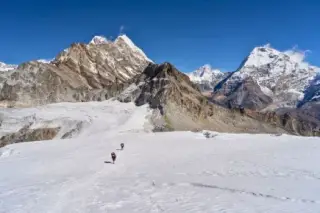
Don’t we all prefer to see mountains being piled up with snow? If your answer was yes, then winter is the season to visit Mardi Himal for you. Winter starts in December and ends in the month of February. The surrounding gets cold, and the snow starts to cover everything, making it a winter wonderland.
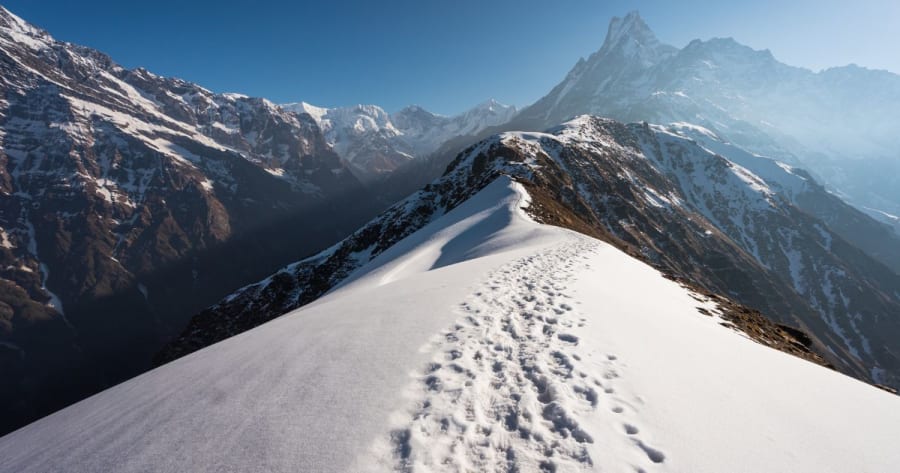
Photo: The snow-covered path of the Mardi Himal trail during the winter season
The temperature gets really low. During the day time, the approximate range of the temperature is 9 degrees Celsius to 12 degrees Celsius/ 53.6 degrees Fahrenheit, and at night it really gets freezing as it gets below 0 degrees Celsius / 32 degrees Fahrenheit to -5 degrees Celsius/ 23 degrees Fahrenheit. Even though the view looks really pretty with the snow all around, the surrounding gets really dry. It can be hard to navigate the correct trail due to snow. There is also a risk of snowstorms, and some lodges above Low Camp close for part of the winter, so check before you go.
Other than these issues, everything else is fine. The trails are not overly crowded, you can trek peacefully. Many people do not prefer trekking during this time, so teahouses are easily available. Some offer lower room rates. For the Mardi Himal trek during the Winter, wear warm clothes like down jackets, gloves, hats, etc. Do not forget to carry trekking boots that are specially made to be walked on snow.
Mardi Himal Weather Month by Month
The table below rates each month for the trek. It matches the way we grade seasons for our other trekking guides, and the notes describe what you will find on the trail.
| Month | Rating | What to expect |
|---|---|---|
| January | Possible | Coldest month, snow on the ridge above High Camp, some lodges shut |
| February | Possible | Still cold, snow lingers above Badal Danda, days get longer |
| March | Good | Warming up, rhododendrons start to flower in the forest |
| April | Best | Rhododendrons in full bloom, clear mornings, afternoon showers |
| May | Good | Warm, hazy, pre-monsoon storms build late in the month |
| June | Avoid | Monsoon arrives, cloud on the ridge, leeches in the forest |
| July | Avoid | Wettest month, views rarely open |
| August | Avoid | Heavy rain, slippery and muddy trail |
| September | Possible | Rain eases in the second half, trails still wet |
| October | Best | Clearest skies, Dashain festival, busiest lodges |
| November | Best | Dry and clear, colder nights, Tihar festival |
| December | Good | Clear and quiet, nights well below freezing at High Camp |
How Much It Rains Each Month
No weather station sits on the Mardi ridge, so the best long-term record is Pokhara Airport (827 m), the start of the trek. These are the 1991 to 2020 averages from the World Meteorological Organization and Nepal's Department of Hydrology and Meteorology. The ridge gets cloud on most of the same days.
| Month | Average rainfall in Pokhara | mm |
|---|---|---|
| Jan | 22 mm | |
| Feb | 35 mm | |
| Mar | 64 mm | |
| Apr | 142 mm | |
| May | 355 mm | |
| Jun | 648 mm | |
| Jul | 941 mm | |
| Aug | 839 mm | |
| Sep | 635 mm | |
| Oct | 159 mm | |
| Nov | 17 mm | |
| Dec | 12 mm |
Temperatures at Each Camp
These are estimates, worked out from Pokhara's average highs and lows with the usual drop of about 6.5 degrees Celsius for every 1,000 m of height. Wind on the open ridge above High Camp makes it feel colder.
| Place | Altitude | April (day / night) | October (day / night) | January (day / night) |
|---|---|---|---|---|
| Pokhara (measured) | 827 m | 30 / 16 °C | 28 / 17 °C | 20 / 7 °C |
| Forest Camp | about 2,520 m | 19 / 5 °C | 17 / 6 °C | 9 / -4 °C |
| Low Camp | about 2,970 m | 16 / 2 °C | 14 / 3 °C | 6 / -7 °C |
| High Camp | 3,580 m | 12 / -2 °C | 10 / -1 °C | 2 / -11 °C |
| Base Camp (day hike) | about 4,500 m | 6 / -8 °C | 4 / -7 °C | -4 / -17 °C |
Festivals in the Best Season (2026)
Dashain, Nepal's biggest festival, runs from 11 to 25 October 2026, with the main Tika day on 21 October. Tihar follows, with Laxmi Puja on 8 November. Both are good times to see village life around Pokhara. Buses and flights fill up in the days before Tika, and some lodge owners head home, so book transport early if your trek falls in that window.
Final Say on the Right Season
The Mardi Himal trek is easy to moderate and possible in most months. We suggest you avoid the monsoon months and go in winter only if you are well equipped for snow. The ideal option to go for is Spring and Autumn/ Fall seasons. The most important thing is to stay safe and go prepared if you decide to trek during Summer or Winter. Carry proper clothes and trekking gear, and always keep up with the weather forecast. Eat healthy food and stay warm. Since 1 April 2023 a licensed guide is required for trekking in the Annapurna Conservation Area, so you will not be walking alone in any season.
Why Mardi Himal trek?
Suppose your confusion about choosing the right time to plan your trek is out of the picture now. Let us give you some reasons that answer “Why choose the Mardi Himal trek?”
-
Manageable for fit beginners, with short days and no technical sections.
-
Flaunts the best rhododendron forest during spring
-
Doesn’t elevate up to a very high altitude (the highest point is Base Camp at about 4,500 m / 14,764 ft)
-
Close views of Machhapuchhre / Fishtail (6,993 m / 22,943 ft), Annapurna South (7,219 m / 23,684 ft), Hiunchuli (6,441 m) and Mardi Himal (5,587 m / 18,330 ft), with Annapurna I (8,091 m / 26,545 ft) and Gangapurna (7,455 m) further off. On clear days many trekkers also pick out Dhaulagiri (8,167 m) far to the west.
-
The Mardi Himal trek can be completed in a short period of time.
-
Get to trek away from the crowded classic routes.
-
Observe the Gurung and Magar lifestyles of remote places closely and be a part of them.
Why Swotah Travel for Mardi Trek?
Swotah Travel is your ideal choice for the Mardi Himal trek. We are a socially responsible travel company that is passionate about sustainable tourism. We take pride in providing personalized service and tailor-made packages to our clients. We believe in creating meaningful experiences that are both enlightening and enjoyable. Our goal is to help our clients explore Nepal in the most responsible way possible.
When you travel with Swotah Travel, you can be assured that your journey will be eco-friendly and hassle-free. We plan every trek to be well organized, safe and comfortable. We plan our treks considering tourism's impact on the environment, local communities, and cultures. We take special care to minimize the wastage of resources and to promote responsible tourism practices.
If you're looking for an unforgettable adventure in the Annapurna region, book your trek with Swotah Travel today! We provide a wide range of packages to meet your needs, so you can have the best experience possible. Let us help you explore Mardi Himal and its surrounding areas in a responsible way.
Mardi Himal Best Time: FAQs
What is the best month for the Mardi Himal trek?
October gives the clearest views of Machhapuchhre and the Annapurnas, with November a close second and quieter. April is the pick if you want rhododendrons in flower.
Can I do the Mardi Himal trek in winter?
Yes, with warm gear and microspikes. Expect snow above Badal Danda, nights around -10 degrees Celsius at High Camp in January, and a few lodges closed. The views on a clear winter morning are excellent.
Is Mardi Himal possible in the monsoon?
It is possible but rarely worth it. The ridge sits in cloud most days, the forest trail is muddy and full of leeches, and roads to the trailhead can be blocked by landslides. For summer treks, the rain-shadow routes in our monsoon trekking guide are a better choice.
How cold is Mardi Himal High Camp?
High Camp (3,580 m) drops a little below freezing on autumn nights and to around -10 degrees Celsius or lower in mid-winter. Daytime in October is mild, roughly 10 degrees Celsius.
Do I need a guide for Mardi Himal?
Yes. Since 1 April 2023 a licensed guide is required in the Annapurna Conservation Area, and you need ACAP and a TIMS card, which your agency arranges. Our permits guide lists the fees.