


For trekking in Nepal you need a travel policy that lists trekking as a covered activity, covers the highest point you will reach and pays for emergency helicopter evacuation and hospital care. For Everest Base Camp, Gokyo, the Annapurna Circuit and Manaslu, that means cover to 6,000 m. A helicopter rescue from the Khumbu costs roughly USD 3,000 to 6,000. Nepali law doesn't make insurance a condition of a trekking permit, but Swotah and most agencies ask for proof before you start. Trekking peaks such as Island Peak and Mera Peak need mountaineering cover, because standard trekking policies stop where ropes and crampons begin.
- Altitude to cover6,000 m for most high treks
- Helicopter rescue (Khumbu)About USD 3,000 to 6,000
- Policy costAbout USD 100 to 250 for a three-week trek
- When to buyBefore you leave home, soon after booking
- Peak climbingMountaineering cover to the summit height
- Before any helicopterCall the insurer's 24-hour assistance line
The last thing you want to worry about when preparing for a trekking excursion to Nepal is the possibility of getting sick or injured. Having the appropriate travel insurance is crucial for this reason. This post covers what a trekking policy for Nepal needs to include up to 6,000 meters, what it usually leaves out, what a rescue costs, and which insurers trekkers from different countries tend to compare.
We'll also discuss some frequently asked questions and considerations to think about while purchasing travel insurance for a trekking trip in Nepal. So, if you're planning a trekking trip to Nepal, read on to learn more about getting the right insurance coverage.
Do you require any special travel insurance for trekking in Nepal?
Yes, having specialized travel insurance is necessary for trekking in Nepal. Trekking in Nepal is a difficult and occasionally risky endeavor. Having the appropriate travel insurance is crucial when trekking in Nepal in consideration of all these risks. With the right policy, you can protect yourself against any potential risks while enjoying your trek in Nepal.
No Nepali law makes insurance a condition of a trekking permit. Agencies are a different matter. Swotah asks every trekker for a policy covering trekking to at least 6,000 m and helicopter evacuation, along with the policy number and the insurer's 24-hour assistance number, before departure. Any insurance your agency holds for its guides and porters covers the crew, not you.
Below are some of the reasons why you should consider trustworthy travel insurance before trekking in Nepal:
- Medical reasons: Trekking requires physical effort, which puts you at risk for accidents or unexpected medical needs. Insurance can cover those expenses and even continue your journey if it's not risky.
- Medical care during the evacuation: If you didn’t know earlier, helicopter evacuation doesn’t inherently include the cost of medical bills during the evacuation. Hence, you need to ensure that those costs are included in the insurance.
- Medical care in hospitals: You can be protected by insurance against the price of medical care and other expenses brought on by illness or injury after your evacuation.
- Unpredictable weather: Unexpected weather changes can result in mishaps and delays.
- Lost or stolen possessions: While walking in remote locations, your possessions could be misplaced or stolen.
- Emergency evacuation: You might require evacuation in a medical emergency, such as altitude sickness. Evacuation can be by ambulance or helicopter in remote areas. A rescue flight from the Everest region costs roughly USD 3,000 to 6,000, and without insurance you pay it yourself, often before the helicopter takes off.
- Blockage due to natural disaster: Unexpected events, such as a natural disaster, could cause your trip to be canceled.
- Trek cancellation or postponement: If your vacation is postponed or canceled, insurance can also help with making travel plans.

What does travel insurance not cover?
Despite travel insurance being a safe way to minimize the chances of unfortunate events and medical bills making a big hole in your pocket, there are certain things that are not covered. Below are the list of things that are marked as an exclusion in most of the travel insurance policies :
Pre-existing medical conditions: People with all kinds of health conditions trek in Nepal, and that is brave. Many policies, though, exclude conditions such as asthma or diabetes unless you declare them and the insurer accepts them, sometimes for an extra premium. Declare everything when you buy, because an undeclared condition can void a claim, and check with your doctor that the trek is safe for you.
Pregnancy: Routine pregnancy care isn't treated as an illness, and many policies limit cover in the later months. If you find out you are pregnant after buying the policy and booking the trek, check whether your cancellation cover includes it, because many policies do. Keep your medical reports, since the insurer will ask for them.
Injuries because of intoxication or drug abuse: It really hits differently when you have a couple of beers relaxing at the lap of the Himalayas. However, any accidents or injuries caused when being high on drugs or drunk are not covered in travel insurance. Ensure you are safe and sound and drink moderately while trekking because you will be in serious trouble if you need evacuation.
Risky activities: You get an adrenaline rush when trekking Nepal because, understandably, the views of towering peaks are amazing. Nonetheless, an activity your policy doesn't list, such as swimming in rivers or leaving the marked trail, may not be covered if you get hurt doing it. Climbing with ropes, ice axes or crampons, including trekking peaks like Island Peak and Mera Peak, needs a mountaineering policy, because standard trekking cover won't pay out. Hence, keep your head low and be aware of any possible risks from your actions.
Going above your declared altitude: You state your highest point when you buy the policy. Walk higher, for example up Kala Patthar on a policy capped at 5,000 m, and anything that happens up there may not be covered.
Rescues nobody approved: Most insurers want a call to their 24-hour assistance line before a helicopter is sent, unless a life is at immediate risk. A flight that a guide or lodge books without that approval can be refused. The rule grew out of Nepal's helicopter rescue fraud, covered below.
Ignoring local rules: A licensed guide has been required on most trekking routes since 1 April 2023, although the Khumbu doesn't enforce it (see our guide to the guide rule). Some policies exclude claims that arise while you break local law, so read that clause if you plan to trek without a guide.

What is the cost of travel insurance for trekking in Nepal?
Note: Prices vary a lot by country, age and insurer, so treat these as rough ranges.
Depending on the length of your trip, the elevation you intend to reach and the coverage you choose, travel insurance for trekking in Nepal can cost anywhere from about USD 30 to 250. As the trek's height and length increase, prices do as well. For a short trek to about 3,000 meters, basic travel insurance costs about USD 30 to 50, and for a two- to three-week trek with cover to 6,000 meters and helicopter evacuation, expect roughly USD 100 to 250. Remember that this is only an estimate, and costs could change based on the insurance.
It's crucial to know precisely what coverage you're receiving for your money when choosing travel insurance for hiking in Nepal. Carefully examine the policy to ascertain whether the coverage satisfies your needs and expectations. Additionally, bear in mind that certain insurers provide special rates for multiple insurance purchases or for longer plans.
How high can I trek in Nepal with travel insurance?
Many standard travel policies don't cover trekking at all, or stop at about 2,000 to 3,000 m. Trekking or adventure cover usually comes in bands of 4,000, 5,000 or 6,000 m, and many policies stop at about 4,000 m unless you add more. Anything that needs ropes, ice axes or crampons calls for specialist mountaineering cover, and expedition climbers going higher need it too. Fortunately, most of the trekking routes in Nepal stay below 6,000 m.
The table shows the highest point on popular routes and the altitude band to buy. Pick the band above your highest point, and take 6,000 m if you might add a side trip.
| Trek or climb | Highest point | Height | Cover to buy |
|---|---|---|---|
| Everest Base Camp Trek | Kala Patthar 5,545 m (base camp 5,364 m) | 6,000 m | |
| Everest Three Passes Trek | Kala Patthar 5,545 m, Kongma La 5,535 m | 6,000 m | |
| Gokyo Ri Trek | Gokyo Ri 5,357 m | 6,000 m | |
| Annapurna Circuit Trek | Thorong La 5,416 m | 6,000 m | |
| Manaslu Circuit Trek | Larke La 5,106 m | 6,000 m | |
| Langtang Valley Trek (with Tserko Ri) | Tserko Ri 4,984 m | 5,000 m | |
| Mardi Himal Trek | Base camp about 4,500 m | 5,000 m | |
| Annapurna Base Camp Trek | Base camp 4,130 m | 5,000 m | |
| Ghorepani Poon Hill Trek | Poon Hill 3,210 m | 4,000 m | |
| Island Peak climb | Summit 6,189 m | Mountaineering, 6,500 m | |
| Mera Peak climb | Summit 6,476 m | Mountaineering, 6,500 m |
How often do people get sick trekking?
Trekking could be a physically exhausting endeavor, and being away from the comforts of home elevates your risk of becoming ill. It is crucial to be aware of the risks and take the necessary precautions, even though there is no single figure for how often trekkers in Nepal get sick.
As long as they take the necessary precautions, people generally do not get terribly sick while trekking in Nepal. This entails watching your diet, drinking enough water, and not pushing yourself too hard.
Nevertheless, some conditions have the potential to cause illness. One of the most common illnesses that might impact trekkers in Nepal is altitude sickness. Symptoms can include tiredness, headaches, nausea and vomiting. Be alert to these symptoms, and if they get worse, rest or descend. Our guide to avoiding altitude sickness covers the warning signs and when to turn round. The Himalayan Rescue Association runs seasonal aid posts at Pheriche on the Everest trail and at Manang on the Annapurna Circuit.
Overall, it can be very challenging to determine the precise number of trekkers who fall ill while trekking in Nepal. Therefore, taking the best precautions to stay healthy throughout your entire journey will considerably lower your risk of becoming sick.
What a Helicopter Rescue Costs in Nepal
Helicopter evacuation is the line on a policy that matters most in Nepal, because a flight of an hour or two replaces several days of carrying someone down. Prices depend on distance, altitude and how many people share the aircraft.
| Flight | Typical cost | Source |
|---|---|---|
| Rescue from the Khumbu (Everest region) | USD 3,000 to 6,000 | Our Everest insurance guide |
| Charter, Kathmandu to Everest Base Camp or Kala Patthar | USD 4,500 to 7,000 | Operator listings, 2026 |
| Charter, Kathmandu to Lukla | USD 2,000 to 2,800 | Operator listings, 2026 |
| Charter, Kathmandu to Muktinath | USD 3,300 to 5,500 | Operator listings, 2026 |
| Charter, Kathmandu to Langtang or Gosaikunda | USD 1,250 to 2,000 | Operator listings, 2026 |
| Cap insurers demanded per rescue flight in 2018 | USD 4,000 | Insurers' ultimatum, August 2018 |
The charter rows are for sightseeing or transfer flights and show what a dedicated aircraft costs. A rescue adds medical staff and hospital fees, and 13% VAT and a 10% service charge may apply. See our helicopter cost guide for the full price list and our note on the Everest helicopter rules.
Why Insurers Check Every Rescue
In 2018 insurers found they had been billed more than USD 6.5 million for about 1,300 helicopter rescues in the first five months of the year. Nepal's government opened an inquiry that named 15 helicopter firms, trekking agencies and hospitals. In August 2018 insurers demanded that every rescue be pre-approved and capped at USD 4,000 per flight, and they renewed the threat in January 2019. A government committee recommended reforms that year, but they were not carried through.
The problem came back. In early 2026 Nepal Police's Central Investigation Bureau arrested executives from three rescue companies, and in March 2026 a case was filed against 32 people, including staff of helicopter firms, hospitals and trekking companies. Police allege that trekkers with minor complaints were pushed into flights, that several people on one charter were billed as separate rescues, and that in some cases food was laced to make trekkers ill. Police put the claims made by the three helicopter companies at about USD 19.7 million.
What this means for you is simple. Call the assistance number on your policy before any helicopter is booked, unless a life is at immediate risk, and make sure your guide has that number too. Keep copies of every medical note. A genuine rescue that the insurer has approved goes through without trouble.
Travel Insurance Companies Trekkers Compare, by Country
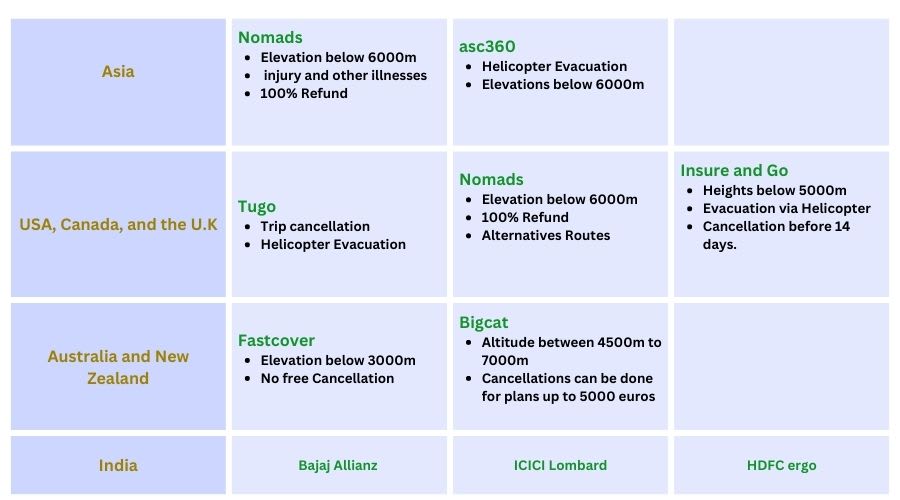
Plenty of travel insurance options are available for people who intend to trek in Nepal. It’s hard to list one travel insurance package because they all have their own policies and pricing. However, based on where you live, a list of insurers that trekkers often compare is below. It is sorted by country, not ranked, and we haven't tested each policy. Plans and altitude limits change every year, so for any name on the list check three things in the policy wording for your country: the altitude limit for trekking, whether helicopter evacuation is included and up to what amount, and whether you must call the insurer before a rescue.
| Where you live | Insurers often compared | What to check |
|---|---|---|
| Worldwide | World Nomads | On its US site the Standard plan covers hiking to 6,000 m and Explorer to 6,500 m. Its Nepal page states 6,000 m. You declare your highest altitude when you buy. |
| Asia | World Nomads, ASC360 | Check the trekking altitude band and helicopter limit for your country of residence. |
| USA and Canada | TuGo (Canada), World Nomads, IMG Global, HCCMIS, Travel Guard, Travel Lite | Adventure or sports add-ons usually decide whether trekking is covered. |
| UK | BMC Travel Insurance, Dogtag, JS Insurance, Snowcard, InsureandGo, World Nomads | BMC policies are arranged for the British Mountaineering Council and underwritten by Endurance Worldwide for 2025/26. |
| Europe | Europ Assistance, RACC and FEDME (Spain), HanseMerkur (Germany) | Check the altitude band and the medical and rescue limits. |
| Australia and New Zealand | Fast Cover, Cover-More, World Nomads | Check whether trekking needs an add-on and which altitude it covers. |
| India | Bajaj Allianz, ICICI Lombard, HDFC ERGO, TATA AIG, Reliance General | Policybazaar compares these plans. ICICI Lombard agreed to take over Bharti AXA General in 2020. |
| Evacuation only | Global Rescue | A rescue membership, not full travel insurance, so pair it with a medical policy. |
What to Check Before You Buy
| Check | What to look for | Why it matters |
|---|---|---|
| Trekking named as an activity | Trekking or hiking listed, with no surprise conditions | Some policies leave trekking out entirely |
| Altitude limit | Your highest point plus a margin (see the table above) | Claims above the limit can be refused |
| Helicopter evacuation | Included, with a limit well above a Khumbu rescue (USD 3,000 to 6,000) | This is the cost most likely to hit you |
| Medical care and repatriation | Hospital treatment in Kathmandu and the flight home | Rescue alone doesn't pay the hospital |
| 24-hour assistance line | Saved in your phone and given to your guide | Insurers want a call before a rescue |
| Pre-existing conditions | Declared and accepted in writing | Undeclared conditions can void a claim |
| Cancellation and delay | Covers trip cancellation and flight delays such as Lukla | Mountain flights are often delayed |
| Where you buy it | Bought before you leave home | Most insurers won't sell to someone already abroad |
| Peak climbing | Ropes, crampons and the summit height covered | Needed for Island Peak, Mera Peak and Lobuche |
Lukla flights in particular get held by weather, and in peak season they run from Manthali rather than Kathmandu, so read our note on Lukla flight disruption before you pick a delay limit.
Choosing Your Policy
To conclude, there are many insurance options for trekkers heading to Nepal from all around the globe. However, all these plans have their own set of features and pricing. Additionally, some travel plans only cover up to a certain height like 3000m or 4000m. You need to do your research thoroughly before finalizing a plan because there are fewer insurance plans that cover up to 6000m or even above.
Make sure that you read the policy thoroughly and ask questions in case of any confusion. Moreover, buy the policy soon after you book the trek, because cancellation cover only protects you from the day you buy it. Check what the insurer deducts if you later cancel the policy itself.
Travel Insurance for Trekking in Nepal: FAQs
Is travel insurance mandatory for trekking in Nepal?
No Nepali law makes it a condition of a trekking permit. Most agencies require it anyway. Swotah asks for a policy covering trekking to at least 6,000 m and helicopter evacuation, with the policy number and the insurer's 24-hour assistance number.
How much does a helicopter rescue cost in Nepal?
A rescue from the Everest region costs roughly USD 3,000 to 6,000. Without insurance you pay it yourself, and operators often want payment or a guarantee before they fly.
What altitude cover do I need for Everest Base Camp?
Buy cover to 6,000 m. Base camp is at 5,364 m and most trekkers climb Kala Patthar at 5,545 m, which is above a 5,000 m band.
Does travel insurance cover Island Peak or Mera Peak?
Only a policy that includes mountaineering does. Both climbs use ropes and crampons and go above 6,000 m (Island Peak 6,189 m, Mera Peak 6,476 m), so standard trekking cover won't pay out.
Can I buy travel insurance after I arrive in Nepal?
Usually not. Most insurers only sell to people still in their home country, and local Nepali policies rarely cover foreign trekkers for helicopter evacuation. Buy before you fly.