


Choose the Everest Base Camp trek if this is your first high-altitude trek or you have about two weeks. It takes 14 days from Kathmandu, tops out at Kala Patthar (5,545 m) and costs from USD 1,620 with Swotah. Choose the Everest Three Passes trek if you've trekked at altitude before and want the full Khumbu. It takes 21 days, crosses Kongma La (5,535 m), Cho La (5,420 m) and Renjo La (5,360 m), includes Everest Base Camp and Gokyo, and costs from USD 1,955. Three Passes is clearly harder: longer days, a short glacier crossing on Cho La, and seven nights at 4,700 m or higher.
- Everest Base Camp trek14 days, from USD 1,620
- Three Passes trek21 days, from USD 1,955
- EBC high pointKala Patthar, 5,545 m
- Highest passKongma La, 5,535 m
- Other passesCho La 5,420 m, Renjo La 5,360 m
- Nights at 4,700 m+About 3 on EBC, 7 on Three Passes
- Shared sectionLukla, Namche and EBC in week one
If you're choosing between the Everest Three Passes trek and the Everest Base Camp trek, you're choosing between two very different trips that share the same first week. Both start in Lukla, climb through Namche Bazaar and reach Everest Base Camp. The Three Passes route then keeps going, over three passes above 5,300 m and across to the Gokyo Lakes.
Nepal is the home of the world’s tallest mountain, Mount Everest. Everest sits in the highland of this country, which circulates the Everest Base Camp and Sagarmatha National Park. If you are looking for a long trek, then you can extend your hike to the Three Passes in Everest.

Difference between the Everest three pass and the Base camp trek
Many of you might get confused about the destination since both trekking routes start from Lukla and have familiar names under Everest. But the distance and the places you go around during the trip make the destinations different.
No matter what, you will experience the thrilling beauties of Nepal, known for its mountain ranges and extreme climate. The majestic view of Everest, Lhotse, Nuptse, Cho Oyu, and other famous peaks are the best attractions of the Three Passes and Everest base camp trek. Similarly, the high-altitude temperature, steep landscapes, and heart-blowing scenes of white rhododendron forest will keep you alive throughout your hike.

Photo: Suspension Bridge En Route to Namche Bazaar
The local villages with Sherpa culture, monasteries, and warm and hospitable vibes that you will receive here will be the reason for you to come back to Nepal for another trek. The Everest region, including Three Passes and the Base Camp, is a bit tougher than you might have expected.
However, visiting these places won’t go in vain since you are about to grab a once-in-a-lifetime experience with all the adventures, risks, and natural beauties. So if you are an avid trekker and risk-taker, Three Passes and Base Camp are your cup of tea.
Overview of Everest Three Pass Trek
Everest Three Pass Trek is one of the most challenging treks in Nepal. Also, it is longer than any other hike in the Everest region. Visitors have rated this trip ‘Challenging’ since it’s a platform for high-risk adventure, unlike Everest Base Camp.
First, let’s start with the Three Pass trail – a route situated in a high-altitude Everest region and passes across three high valleys of the Khumbu. The track sits at an altitude of above 5000 meters from sea level, which is a challenging walk to go. During the hike, you will pass through the EBC intersection, and you see four of the world's 8,000 m peaks: Everest, Lhotse, Makalu and Cho Oyu.
Everest Three Passes consist of Renjo La Pass (5,360 meters), Cho La Pass (5,420 meters), and Kongma La Pass (5,535 meters). If you are a passive hiker, you will have to think twice before taking this route since your daily activities will be walking over the moving glaciers, steep landscapes, and low temperatures. Fresh snow can close the passes, Cho La most often, and in winter they are frequently impassable. Plan the trek for spring or autumn and keep a spare day.
Renjo La Pass
Trekkers will pass through Renjo La Pass, which is at 5,360 meters, in the shadow of the tallest mountain, Everest. It is one of the naturally abundant regions of the Khumbu region, with snowflakes and glaciers around it. It links the Gokyo Lakes with the Bhote Koshi valley, and below the pass the trail drops through juniper and rhododendron scrub toward Thame. You are likely to get a pristine view of mountains like Everest (8,848.86 m), Makalu (8,485 m), Cho Oyu (8,188 m), Ama Dablam, and Lhotse (8,516 m) during the clear sky.

Photo: A view of Everest from Renjo la Pass
Cho-La Pass
Cho La Pass is one of the passes situated in Sagarmatha National Park in the Khumbu Region. This pass connects Gokyo Lake with the Everest Base Camp route.
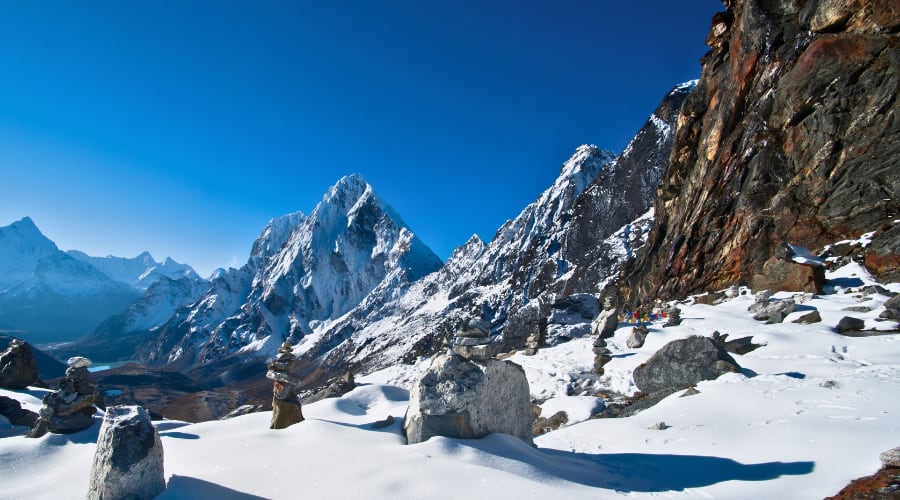
Photo: Incredible Vista of the Snow-Covered Everest Peaks from Chola Pass
The crossing starts at Dzongla (4,830 m) and ends at Thagnak (4,700 m), usually 7 to 8 hours. The next morning you cross the Ngozumpa Glacier to Gokyo. The east side of Cho La has a short stretch over a small glacier, often icy, where microspikes help.
Kongma-La Pass
The trip to Kongma-La Pass starts from Chukhung, 4,730 meters above sea level. The endpoint of this pass is at Lobuche at 4,940 meters.
Traveling the route through this pass takes around 7 to 9 hours, and the total distance of Kongma-La Pass is 6 miles or 9.6 km.
Overview of Everest Base Camp
Everest Base Camp is at an altitude of 5,364 meters above sea level.
Unlike the Everest Three Pass trek, the Everest Base Camp Trek is much more accessible and easy to conquer. Since it is a single trek that trails to the base of Mount Everest, you will not be exploring the highlands above Base Camp.

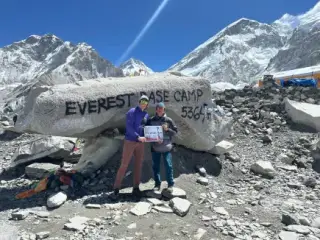
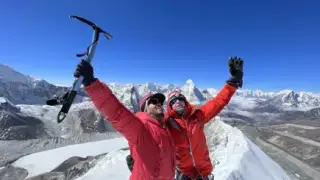
Photo: Joyful Celebration of Trekkers Upon Reaching Everest Base Camp
The Base Camp trek goes up to Kala Patthar and comes back the same way. If you want more, it can be extended with the Gokyo Lakes or Cho La on a longer itinerary. Above Lobuche the trail follows the moraine of the Khumbu Glacier, but you never cross glacier ice, and avalanche risk on the main route is low.
Distance, Duration & Difficulty Levels
The Everest Three Pass trek is much longer than the Base Camp trek. The total distance of Three Passes is about 165 kilometers, which takes around 17 trekking days, or 21 days from Kathmandu on our itinerary.
All passes are above 5000 meters, and the trail features rugged, sloppy, slippery glaciers and a narrow pathway. So the difficulty level is higher than at Everest Base Camp. The air is thin at high altitudes, and you will likely get altitude sickness and other illnesses. Throughout your trek, you will travel across several eye-pleasing sites like Lukla, Renjo La Pass, Cho La Pass, Kongma-La Pass, and Gokyo. The best time to visit this region is from March to May and September to November.

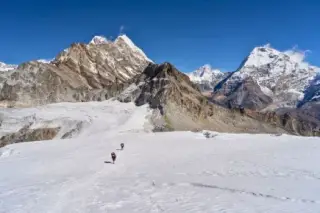
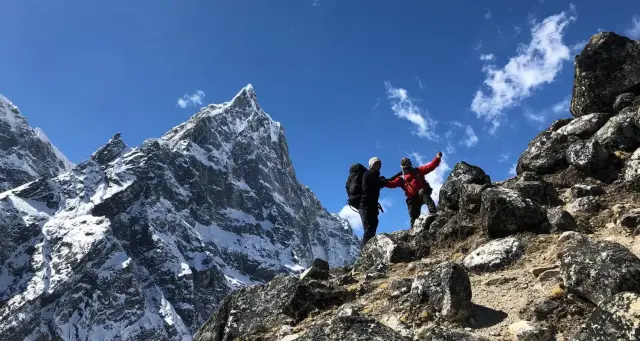
Photo: Trekker Navigating the Rugged Terrain of the Everest Region
When it comes to Everest Base Camp, the distance you cover in your trek is less than the Three Pass trek. The total distance you need to walk during the hike is about 130 km, which takes 12 trekking days, or 14 days from Kathmandu.
You will start your trek from Lukla and end your tour at Kala Patthar, 5,545 meters. You see less of the Khumbu than on the Three Passes route. Still, you will be satisfied with the majestic views of Mt. Everest and its range with the grooming environment of local Sherpa culture. As for the difficulty level, Everest Base Camp is a challenging hike to take but not as arduous as a three-pass trek. You skip the glacier crossing and the steep, loose descents off the passes.
Cost Comparison for Both Treks
For any trek in the world, the cost differs based on the total number of days you will be on the hike and the activities you will be doing throughout it. The same goes for the Everest Three Pass Trek and Base Camp Trek. Until and unless you are involved in more activities than planned and have additional days to stay, your designated budget will likely cover all the costs.
With Swotah, the 21-day Everest Three High Passes trek costs from USD 1,955 per person and the 14-day Everest Base Camp trek from USD 1,620. Both prices include the Lukla flights, permits, a licensed guide, porters, teahouse lodging and all meals on the trek. Groups get a further discount.
The Three Passes trek costs only a few hundred dollars more for a week of extra trekking, but you also spend more on the trail. Seven extra days of showers, Wi-Fi, charging, snacks and tips add roughly USD 100 to 200. Your visa, insurance and international flights come on top for both. Our Everest Base Camp trek cost guide breaks down the spending money.
Everest Three Passes vs Everest Base Camp at a Glance
| Everest Base Camp trek | Everest Three Passes trek | |
|---|---|---|
| Days from Kathmandu | 14 | 21 |
| Trekking days | 12 | 17 |
| Distance | About 130 km | About 165 km |
| Highest point | Kala Patthar, 5,545 m | Kala Patthar, 5,545 m |
| High passes | None | Kongma La, Cho La, Renjo La |
| Gokyo Lakes | No | Yes, with Gokyo Ri |
| Glacier crossing | No | Short sections on Cho La and the Ngozumpa |
| Longest day | About 8 hours (Lobuche to base camp and back to Gorak Shep) | 8 to 9 hours (Kongma La) |
| Difficulty | Moderate to strenuous | Strenuous |
| Swotah price from | USD 1,620 | USD 1,955 |
| Best for | First high-altitude trek | Experienced trekkers |
The three passes in order
We cross the passes anticlockwise, Kongma La first, after you've already acclimatised at Namche and Dingboche. The bars show how much height you gain from that morning's lodge to the top of the pass.
| Pass | Height | Crossed on | Start | Climb to the pass | What makes it hard |
|---|---|---|---|---|---|
| Kongma La | 5,535 m | Day 10 | Chukhung, 4,730 m | 805 m | Steep boulder climb, longest day |
| Cho La | 5,420 m | Day 13 | Dzongla, 4,830 m | 590 m | Small glacier, often icy |
| Renjo La | 5,360 m | Day 16 | Gokyo, 4,790 m | 570 m | Stone stairs, best Everest view of the three |
For comparison, the hardest climb on the Base Camp trek is Gorak Shep to Kala Patthar, about 375 m.
Which Trek Should You Choose?
Pick the Base Camp trek if you've never slept above 4,000 m, if you have two weeks, or if base camp and the sunrise from Kala Patthar are what you came for. Most people come home completely satisfied. Pick Three Passes if you've done a high trek before, such as the Annapurna Circuit or Manaslu, and you're comfortable on loose rock and the odd icy patch. You get everything the Base Camp trek offers plus Gokyo, the Ngozumpa Glacier and far quieter trails between the passes. There's a middle option too. Our Gokyo Ri with Everest Base Camp trek crosses only Cho La and takes 18 days.
Things to Consider Before You Book
Several factors can make a difference in choosing the Everest Three Pass and Base Camp Trek. If you are a risk taker and an active trekker, you can go for Three pass trek. If you are just an adventure lover who is afraid of extreme landscapes and climates, then Everest Base Camp is the better idea for you.
Before trekking to the Everest Region, you should consider a few things. These include tough and rugged routes, extreme climate, cold temperatures, the possibility of natural calamities, high altitude, and long distances.
Whichever you choose, train for at least 12 weeks, book for spring or autumn, and keep a spare day for Lukla flight delays. Our Everest Base Camp training plan works for both treks. Add more hill days with a loaded pack if you're doing the passes.
Three Passes vs Everest Base Camp: FAQs
Is the Everest Three Passes trek harder than Everest Base Camp?
Yes, clearly. It's a week longer, it crosses three passes above 5,300 m, and the pass days run 7 to 9 hours on steep, rocky ground. Everest Base Camp has no day like Kongma La.
Does the Three Passes trek include Everest Base Camp?
Yes. After Kongma La you reach Lobuche, then visit Everest Base Camp and climb Kala Patthar before heading west to Cho La. You don't miss anything the Base Camp trek offers.
Can a beginner do the Everest Three Passes trek?
We don't recommend it as a first trek. Do the Base Camp trek first, or another high route such as the Annapurna Circuit, so you know how your body handles 5,000 m before you add three passes.
Do I need crampons for Cho La?
Microspikes are usually enough. The glacier section on the east side of Cho La is short, but it can be icy in the morning, especially after fresh snow. Your guide will tell you before you leave Dzongla.
What is the best time for the Three Passes trek?
October and November, then April and May. The passes are often blocked by snow from December to February, and monsoon cloud hides the views from June to September.