


Very few people climb Mount Everest for free. A south-side expedition in 2026 costs about USD 35,000 to 50,000 with a Nepali operator and USD 70,000 or more with a Western one, and the USD 15,000 government royalty is fixed. Climbers cover it through corporate sponsorship, crowdfunding, grants or agency deals, and only climbing staff, mostly Nepali Sherpas, reach the top without paying because it is their job.
- Royalty (spring)USD 15,000 per foreign climber
- Royalty (autumn / winter)USD 7,500 / USD 3,750
- Nepali climbers (spring)NPR 150,000
- Typical expeditionUSD 35,000 to 76,000+
- Permit valid55 days
- Climbs paid in fullSponsored athletes and climbing staff
Do you want to experience the thrill and challenge of climbing the world’s highest mountain, Mount Everest, but don’t have the budget? A handful of climbers each year reach the top with most of the bill paid by someone else. This post covers the ways they climb Mount Everest on other people's money, and what each route really takes.
Start with the bill itself. The cost table below shows what a sponsor, a crowd or an employer would have to cover.
Get sponsored
Securing sponsorship is probably one of your best options if you wish to summit Mount Everest for free. Sponsors can provide you with the necessary gear along with the money you need for your ascent. In the best case a sponsor covers all of it.
You must first develop a strong case for sponsorship. Describe your motivation for climbing Mount Everest as well as your goals. After that, be sure to include a budget outlining the costs related to the adventure. Getting a sponsorship means that you will have to be the face of the company during the expedition. The sponsor anticipates some financial gain, such as increased sales, brand awareness or some measurable outcome.
After the pitch is finished, it's time to start exploring for sponsors. Start by looking into businesses that engage in financing climbing adventures online. Make contact with these businesses and present your sponsorship request. Provide details about who you are along with your mountaineering background and experience.
Don't be hesitant to contact other sources if you're having problems attracting possible sponsors online. Try asking your relatives and friends if they know any influential people or possible sponsors who would be interested in helping you with your expedition.
Additionally, a university, an outdoor club or even your local government might be willing to fund you. Some of them run grants for outdoor projects. Be realistic here: most mountaineering grants fund new routes, science or exploration, and very few pay for a guided climb on the normal route.
Last but not least, if you are having a hard time finding a sponsor from the above-mentioned options, you can consider starting a crowdfunding campaign. Crowdfunding allows you to raise money from individuals who support your cause. With crowdfunding, you can easily reach many people and potentially get the sponsorship you need.
Climbing Mount Everest is an amazing achievement and a once-in-a-lifetime experience. Getting sponsored is one of the few ways to do it with little of your own money. With some effort and determination, you can find a sponsor or collect money from crowdfunding and make your dream of summiting Mount Everest come true.
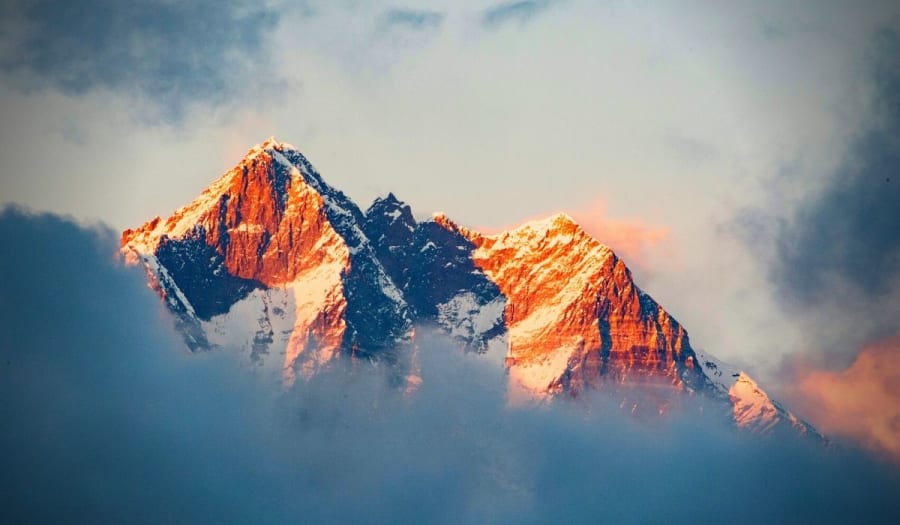
Photo: Mount Everest sunset view
Fundraise
If you want other people to carry most of the cost, fundraising is a strong option. The best way to go about it is to find a group of like-minded people who are also interested in doing the climb and have them help with your fundraising efforts.
After successfully building up a team, you can start by setting up a fundraising event. You might want to spread your team across different locations to collect more funds parallelly for higher success. There are several platforms available for this, such as Kickstarter and GoFundMe. You can create a page on these sites that outlines your story and your goal for the trip. You can then share the page on social media and other platforms to spread the word.
Fundraising and crowdfunding might sound similar but they are a bit different. While crowdfunding is used to establish individual initiatives or company ideas, fundraising is done by non-profit organizations with the goal of supporting charitable causes or local projects.
Fundraising means gathering donations, usually for a charitable cause. Donors can give as much as they wish to the organization or individual asking for help.
Keep the two pots apart. If you climb for a charity, most charities expect you to pay your own expedition costs so that every donation reaches the cause. Tell donors clearly which money pays for the climb and which goes to the charity.
You might also want to think about approaching sponsors to assist you in paying for a portion of your trek. Companies are frequently eager to provide financial support to people or organizations who are attempting an adventure or pursuing an ambitious goal. To achieve your objectives more quickly, you might create a hybrid model of fundraising and sponsorship. In an appealing letter, you can put your motivation for climbing Mount Everest and how their support would help you accomplish this objective.
Organizing events in your neighbourhood is yet another inventive approach to raising funds. This can be bake sales, movie nights or handicraft shops. You might even organize an auction and request donations from surrounding companies for goods you could sell.
Whatever method you select, make sure to record all donations and manage the funds effectively. Steady work and persistence can cover a large part of the cost.
Become a guide
If none of the above-mentioned tips works for you, working on the mountain is the other route. It takes years, and it suits Nepali nationals far better than foreigners. Start with a trekking guide licence, but know its limit: it lets you lead treks, and it does not qualify you to guide on Everest.
To become a trekking guide in Nepal, you’ve got two options :
1. Sign up for a training program organized by the Nepal Academy of Tourism and Hotel Management (NATHM).
2. Signing Up for the training program organized by Nepal Mountain Academy.
Time and qualifications :
1. Course duration: 5 weeks
2. Fee: around 7,000 NPR
3. Qualification: two years experience with a registered travel company / 12th standard or equivalent
OR
Three years experience with a registered travel agency / 10th standard or equivalent
Photo: PP size photo not older than six months
The trekking guide course alone takes about 2.5 years once you count the required work experience. The Everest route is longer.
From Trekking Guide to Everest Climbing Staff
Climbing Sherpas usually start as porters or kitchen staff, then carry loads to high camps on smaller peaks. Along the way they take the Nepal Mountaineering Association's basic and advanced mountaineering courses (the basic course runs about 40 days, with theory in Kathmandu and practice in the mountains). Most spend several seasons on 6,000 and 7,000 m peaks before an operator hires them for Everest.
Foreign climbers who want to guide usually qualify at home. Full IFMGA mountain guide certification takes years, and Western operators hire those guides to lead their own teams.
Climbing staff pay nothing to summit because they are working: fixing ropes, carrying oxygen and guiding clients. Kami Rita Sherpa has reached the top 32 times this way and Pasang Dawa Sherpa 31 times (May 2026). It is paid work with real risk, and a licensed guide with a few years of experience earns a decent living in Nepal.
Become an agent
Attracting more customers to the travel company you are working for might be a good option to climb Mount Everest for free. You can agree upon a deal that suits both the company and yourself. For every number of customers you convert, you can propose a free climb to Everest for yourself.
However, the climbing royalty alone is USD 15,000 per person for the spring season (Nepal raised it from USD 11,000 in September 2025), and your travel company might not be down to pay this amount. Nonetheless, other expenses, including guides, porters, oxygen, and gear, which typically add another USD 30,000 or more, may be waived off for you. That still cuts a large chunk off the bill.
Find a group
Finding a group that is already on the adventure is one of the better ways to bring the cost down. This group could be a climbing club or a scheduled tour of a company that intends to take on the challenge.
Many organizations around the world offer expeditions to Mt. Everest and other Himalayan peaks. These groups often provide a much-needed support system as well as discounted prices. While it's less likely to summit Everest for completely free by using this method, you will be amazed at the discounted cost you might be offered.
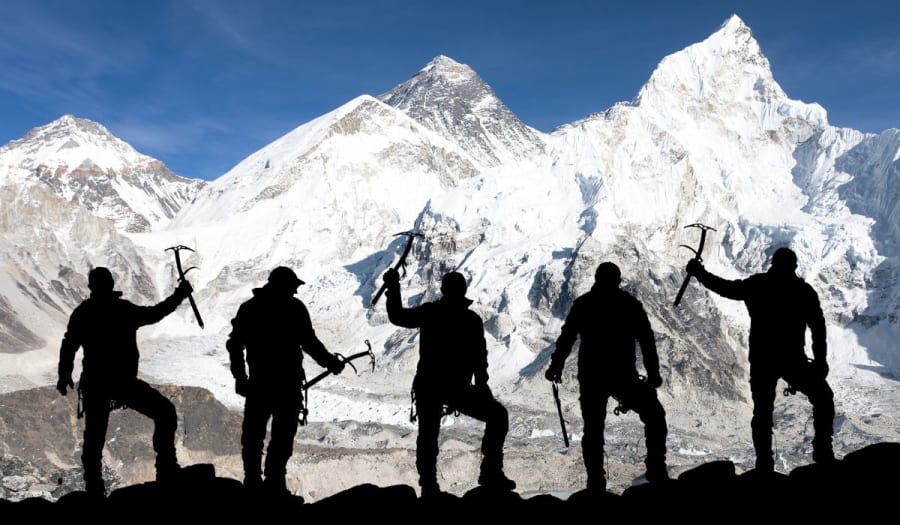
A group also gives you people with more experience to learn from, and friends for the long weeks at base camp.
Local climbing shops, online discussion boards, social media pages, and even newspaper classifieds are good places to look for such groups. Make sure to do your research on any organization you are thinking about joining so you can confirm that their safety procedures, experience, and credentials are up to code. Be careful to assess the group size, the availability of knowledgeable guides, and other aspects that may affect your experience when choosing a group.
To find out if there are any planned excursions to Mount Everest or surrounding peaks, you can also ask around at your local climbing store, mountaineering club, or sports shop. You might be surprised what turns up.
Also Read: Francys Arsentiev - The Sleeping Beauty of Mount Everest
How Much Does Climbing Everest Actually Cost in 2026?
To understand what "free" really means here, look at the bill you are trying to avoid. The Nepal government charges a USD 15,000 royalty per climber for the standard spring season (USD 7,500 in autumn and USD 3,750 in winter and summer). On top of that come the expedition operator’s logistics, climbing Sherpas, bottled oxygen, food, tents, and insurance. A Nepali-run expedition from the south side now costs about USD 35,000 to 50,000, and a Western-led one USD 70,000 or more. Alan Arnette's 2026 survey put the medians at USD 45,250 and USD 76,000, and luxury trips pass USD 100,000. Even a stripped-down, no-frills logistics package rarely dips under USD 35,000. That is the mountain of money that sponsorship, fundraising, guiding, or agency work has to climb before you ever set foot on the icefall.
Where the Money Goes
Typical 2026 figures on the Nepal side. The royalty is fixed by law, while the rest are ranges quoted by operators, so check them against your own offer before you build a budget or a sponsorship pitch.
| Cost item | Scale | Typical cost | Notes |
|---|---|---|---|
| Climbing royalty (spring, foreigners) | USD 15,000 | Fixed by the government since 1 Sep 2025, up from USD 11,000 | |
| Climbing Sherpa (one-to-one) | USD 5,000 to 9,000 | Wage plus summit bonus, set by the operator | |
| Climbing gear | USD 6,000 to 10,000 | Down suit, 8,000 m boots, sleeping bag, crampons | |
| Bottled oxygen | USD 3,000 to 6,000 | Usually 5 to 7 bottles, plus mask and regulator | |
| Flights, Kathmandu hotels, visa | USD 1,500 to 3,500 | Depends on where you fly from | |
| Insurance with rescue to 8,850 m | USD 1,000 to 2,000 | Many policies stop at 6,000 m, check the cover | |
| Tracking chip | USD 10 to 15 | Compulsory since February 2024 |
Expedition operators add their own logistics on top: base camp food and tents, Icefall Doctors' rope fees, liaison officer costs, waste rules and porters. That share is what separates a USD 40,000 trip from a USD 80,000 one.
Ways to Cover the Cost: How Realistic Is Each?
| Route | Chance of a free climb | What to expect |
|---|---|---|
| Corporate sponsorship | Rare | Covers the full bill only for climbers with a big audience or a strong story |
| Crowdfunding | Hard | Usually pays for part of the trip, gear or the permit |
| Charity climb | Hard | Donations go to the cause. You still pay your own way |
| Grants | Rare | Mostly fund new routes or research, rarely the normal route |
| Working as climbing staff | Realistic | Years of work, suited to Nepali nationals |
| Agency deal or group discount | Realistic | Cuts the bill, but the royalty is still yours |
Rules That Apply Whoever Pays
Nepal tightened its climbing rules in February 2025, and they apply to sponsored climbers too. Solo climbs on 8,000 m peaks are banned. Each team needs one guide for every two climbers, and the permit now lasts 55 days instead of 75. A proposal to make Everest climbers prove they have summited a 7,000 m peak first sat in the 2025 tourism bill. It was still a proposal at the end of the 2026 season.
Sponsors read those rules closely. A pitch that names a 6,000 or 7,000 m peak you have already climbed, such as Island Peak or Lobuche, carries far more weight than enthusiasm alone.
Conclusion
Climbing Everest for absolutely free is hard. You will need to invest significant time and resources to achieve the goal. However, people climbing Everest for free is not unheard of. There are multiple methods like sponsorships, fundraising and becoming an agent or a guide. Sponsorship and fundraising come much easier to influencers and to people with strong connections.
Famous people like celebrities and sportspeople can easily find donations for their mission. If you are a common individual, you might need to look for other options, such as crowdsourcing and becoming a guide/agent.
If scaling Mount Everest is your lifelong dream, but you’re struggling to make it happen for free, Swotah Travel can plan a Nepali-run expedition that keeps the cost as low as safety allows. Let us help make your dream come true, and join us to make the climb of a lifetime.
Climbing Everest for Free: FAQs
Can you climb Everest without paying the permit fee?
No. Every foreign climber on the Nepal side pays the USD 15,000 spring royalty, or USD 7,500 in autumn. Nepali citizens pay NPR 150,000 in spring. Working climbing staff go up under their employer's arrangements.
How much does it cost to climb Everest in 2026?
About USD 35,000 to 50,000 with a Nepali operator and USD 70,000 or more with a Western one. Luxury expeditions pass USD 100,000. Flights, gear and insurance can add USD 10,000 or more.
Do sponsors really pay for Everest climbs?
Sometimes, but mostly for climbers with an audience, a strong story or a record attempt. A first-timer with no high-altitude record rarely gets the full bill covered. Partial deals for gear or the permit are far more common.
Can a foreigner work as a guide on Everest to climb it free?
Only after years of guiding at home. Western operators hire certified mountain guides, usually IFMGA, to lead their teams. Nepal's trekking guide licence is aimed at Nepali nationals and covers treks, not Everest.
What is the cheapest way to see Everest up close?
Trek to Everest Base Camp. Our 14-day trek starts from USD 1,620 and reaches 5,364 m, with Kala Patthar (5,545 m) for the classic summit view.