



Yes, you can get online on the Everest Base Camp trek. Most teahouses sell Wi-Fi for about USD 3 to 10 a day, and above Namche most of them run on Everest Link, a prepaid data card that costs roughly NPR 2,000 to 3,000 (USD 13 to 20) for 10 GB. Mobile data from Ncell and Nepal Telecom works well in Lukla and Namche, then turns patchy past Tengboche. Gorak Shep (5,170 m) is the last place with dependable Wi-Fi. Speeds drop every evening when lodges fill up, so plan on messages and photos and leave video calls for Namche.
- Lodge Wi-FiAbout USD 3 to 10 a day
- Everest Link, 10 GBNPR 2,000 to 3,000 (USD 13 to 20), 30 days
- Best mobile dataNcell in Lukla and Namche
- Signal fadesPast Tengboche
- Last dependable Wi-FiGorak Shep, 5,170 m
- Charging above NamcheUSD 3 to 6 a device
- 5GNone in the Khumbu
If you’ve booked a trek to Everest Base Camp, you’ve probably sorted the big things already. But have you gone through the stuff you need daily while planning the trip? You might be okay with all the plans on a budget, physical preparation, gear and equipment – but you might be missing the Internet on the Everest Base Camp trek.
So, what are the things that you should know before landing at Everest Base Camp to have fine Internet Access? Just know this, there are several things that you should work on to get the services.
Internet access is sometimes difficult to find while trekking in the Himalayas. But don’t let that stop you from staying connected during your trip. While some hikers prefer to be alone and avoid technology and the Internet, others must keep in touch with loved ones while on their trek.
Though it’s hard to get reliable internet access there, you won’t miss cherishing it while hiking up arid mountain trails to Everest Base Camp. There are a number of ways for you to get you online at any point. Whether it’s fast or slow, you can still get connected.

What Are the Options for Internet Access on an Everest Base Camp Trek?
Many hikers in Everest Base Camp dream of having fast internet access since they are actively engaged in video streaming and vlogging. However, you might find some issues accessing it, but you will still have access.
You have a few different options for getting online while trekking to Everest Base Camp. Namche Bazaar, the hub of the trek, has reliable electricity and internet access, allowing you to be connected to several platforms 24/7. However, the quality of service can vary greatly, so be prepared for patchy connections, slow speeds, and sporadic service.
If you need to stay connected the whole way, carry a local SIM for the lower valley and buy an Everest Link card for the lodges higher up. Between them they cover the route from Lukla to Gorak Shep.
You can also choose Everest Link Card or Ncell Network for better connectivity. Everest Link Card is a prepaid wireless broadband service that has become the workhorse of Khumbu connectivity: a 10 GB card costs roughly NPR 2,000 to 3,000 (USD 13 to 20) and lasts 30 days, with prices varying by seller, and although speeds drop when lodges fill up in the evening, it works surprisingly far up the valley, all the way to Gorak Shep.
The NTC and Ncell mobile networks (3G/4G) are preferable for those who use the Internet briefly. At higher elevations the signal comes and goes. Ncell usually gives faster data in Lukla and Namche, while Nepal Telecom (NTC) tends to hold calls and texts higher up the valley, sometimes as far as Lobuche on a clear day. Above Dingboche, treat any mobile signal as a bonus.
There is no 5G in the Khumbu. Even where 4G shows on your phone, real-world speeds are often closer to 3G.
What type of internet access is available at lodges/teahouses during the trek?
Most importantly, WiFi is available at lodges and tea houses throughout the trek. You can expect to have at least some signal in most places, but the connection quality and data vary greatly. In general, you’ll be able to access essential functions like sending emails and checking Facebook. You might have issues with streaming videos or something related. The WiFi is usually adequate for basic browsing.
Nowadays, most teahouses feature WiFi and charging points, from Lukla all the way to Gorak Shep. Above Namche you pay extra to charge your devices, and both the price and the wait go up as you climb. Additionally, the internet connection could be better, so finish your online work before starting the trek. The Khumbu region’s tea houses, especially those in Namche Bazaar, have relatively decent connections compared to other trekking areas. Although the speed is impressive, it can sometimes lag due to a high number of connections.

Internet Access Through Data: How To Get a SIM Card in Nepal?
One of the best bets for getting online while on the Everest Base Camp trek is to buy a SIM card once arriving in Nepal. You can purchase one at the airport or in major towns and cities.
You’ll need to present your passport and fill out some paperwork to get a SIM card. The process is relatively straightforward, and you should have your SIM card and access to the Internet within minutes. Ncell also sells eSIMs, and international eSIM plans that roam on Nepali networks work too. Confirm with your service provider that your phone is unlocked before purchasing.
The SIM itself costs only a few dollars, and the airport counters bundle it with a tourist data pack. Buy a pack big enough for the whole trip in Kathmandu, because topping up in the mountains is harder.
Satellite Phones, Hotspots and Starlink in Nepal
Satellite communication is licensed in Nepal, and you can't simply rent a satellite phone or hotspot in Kathmandu and carry it up the trail. In May 2025 the Nepal Telecommunications Authority warned that unlicensed satellite internet terminals were running at Everest Base Camp and told operators to stop. Starlink has no licence in Nepal. As of mid-2026 talks were still stuck on Nepal's 80% cap on foreign ownership of telecom companies.
Many trekkers carry a two-way satellite messenger such as a Garmin inReach for emergencies. The rules for these small devices are unclear in Nepal, so ask your trekking agency before you pack one. If you fly through India, leave it at home, because India detains travellers who carry them. On a guided trek you rarely need one. Your guide carries a local phone, and Nepal Telecom calls connect from most villages on the route.

Phone Calls and Messaging Apps
You can use your phone with a local SIM or international roaming. WiFi can be found in various places along the trek, so keep your eyes peeled for restaurants and tea houses that offer it. Voice calls over WhatsApp, Viber or Messenger work on lodge Wi-Fi when the connection is quiet, usually early morning.
Namche Bazaar has cafes with stronger Wi-Fi than the lodges higher up, so it is the best place on the trek for a video call home.
Internet Village by Village on the Everest Base Camp Trek
Connectivity follows altitude. The higher you sleep, the slower and dearer the Wi-Fi gets, and mobile data fades after Tengboche. This is what to expect on the standard route in spring and autumn, when lodges are busiest.
| Village | Altitude | Wi-Fi | Mobile data | What you'll find |
|---|---|---|---|---|
| Lukla | 2,860 m | Good | Good | Lodge routers and cafes |
| Phakding | 2,610 m | Good | Good | Lodge Wi-Fi |
| Namche Bazaar | 3,440 m | Good | Good | Best on the trek, cafes with fast Wi-Fi |
| Tengboche | 3,867 m | Patchy | Patchy | Everest Link |
| Dingboche | 4,410 m | Patchy | Weak | Everest Link, slow in the evening |
| Lobuche | 4,940 m | Patchy | Weak | Everest Link, NTC calls on a clear day |
| Gorak Shep | 5,170 m | Patchy | None | Everest Link, the last dependable Wi-Fi |
| Everest Base Camp | 5,364 m | None | None | Nothing reliable for trekkers |
Good means you can upload photos and make a voice call. Patchy means messages go through, slowly, and photos may need a second try. Weak means texts and the odd call.
What Staying Connected Costs
| Item | Typical cost | Notes |
|---|---|---|
| Tourist SIM with data | A few dollars plus the data pack | Buy at Kathmandu airport with your passport |
| Everest Link card, 10 GB | NPR 2,000 to 3,000 (USD 13 to 20) | Valid 30 days, works in lodges from Lukla to Gorak Shep |
| Lodge Wi-Fi | USD 3 to 10 a day | Free in some lower lodges, dearest near Gorak Shep |
| Charging a device | USD 3 to 6 a time above Namche | Phones, batteries and power banks priced separately |
One Everest Link card usually works out cheaper than paying for lodge Wi-Fi every night. For the rest of your trail spending, see our breakdown of how much the Everest Base Camp trek costs.
Charging Phones and Cameras on the Trail
Lodges below Namche run on hydro power and charging is often free or cheap. Higher up, power comes from solar panels and small generators, so lodges charge per device and sockets fill fast in the evening. Bring a 20,000 mAh power bank, charge it whenever you get the chance, and carry a universal adapter (Nepal uses round two-pin and three-pin sockets). Cold kills batteries. Above Dingboche, sleep with your phone, camera batteries and power bank inside your sleeping bag and they'll last noticeably longer.
Bottom Line
Trekking to Everest Base Camp doesn’t mean you have to be completely disconnected from the outside world. While finding reliable internet access in this remote region can be challenging, there are ways to stay connected.
Many tea houses along the trail offer WiFi, but the connection is often not strong enough for sending large files or making video calls. Plan ahead and do your heavy uploads in Namche.
If you're planning to trek to EBC, keep in mind that finding internet and WiFi access can be difficult. There are a few ways to get online, but it may cost money, and the connection can be spotty.
Internet on the Everest Base Camp Trek: FAQs
Is there Wi-Fi at Everest Base Camp?
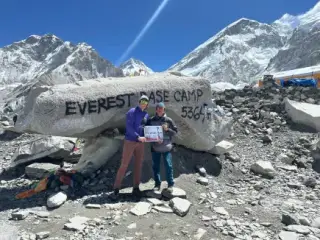
Not for trekkers in any dependable way. Gorak Shep, two to three hours below base camp, has Everest Link Wi-Fi in its lodges, and that's where you'll send your base camp photos.
Which SIM card is best for the Everest Base Camp trek?
Ncell gives faster data in Lukla and Namche, and Nepal Telecom (NTC) tends to keep a call signal higher up. Many trekkers carry both. Above Dingboche, Everest Link Wi-Fi is more useful than either.
Can I make video calls on the Everest Base Camp trek?
In Lukla and Namche, yes, usually. Higher up, video calls rarely hold, especially in the evening when every trekker in the lodge is online. Try early in the morning.
Where can I buy an Everest Link card?
In Lukla, in Namche Bazaar and at most lodges along the route. Namche has the most sellers. Cards work in any lodge on the Everest Link network until the data or the 30 days run out.
Can I use Starlink on the Everest Base Camp trek?
No. Starlink isn't licensed in Nepal, and the telecom regulator has warned against unlicensed satellite terminals in the Everest region.